FINAL PART — What I Had to Say Out Loud
On Wednesday morning, I heard Dana open the cabinet over the coffee maker.
“Which one do you want?” she asked.
I was already smiling when I came around the corner. For a second I thought she was talking to me.
She was holding two dog treats.
Our dog, Walter, looked from one hand to the other, then sat down so hard his back feet slid out from under him. Dana gave him the smaller one and put the other back.
“Coffee’s fresh,” she said.
She left for work with her mug in her hand. I stood in the kitchen listening to her car back out of the garage, wondering how many ordinary sentences I’d mistaken for good news since Saturday.
There was a time when I could tell from the way Dana shut a cabinet whether she’d had a good day. Or I thought I could. That morning, I would have given quite a bit to know what she meant by making enough coffee for two.
I poured a cup and drank it standing up.
Then I opened the message I’d sent Lacey.
I gave you the wrong impression. Our marriage isn’t open.
Underneath it was her reply.
You didn’t give me an impression.
I’d read that sentence enough times to know what came next without scrolling. Still, I read the entire exchange. This time I stopped at the part where she asked me to leave her alone except about work.
I put the phone down.
Then I put it in my pocket, took it out again, and opened my own messages with Dana.
The last thing I’d sent her before the festival was a picture of the barbecue menu. I’d circled the ribs with my finger and drawn a little arrow toward the price.
Split one?
She’d written back, If you let me have an actual half this time.
That was at 11:42 in the morning. At 2:15, I’d told her in front of Lacey that it had all been a joke.
I remembered setting my plate down after Dana walked away. Some sauce had run over the edge and onto my thumb. I’d licked it off because there was a man from purchasing standing next to me and I wanted something to do with my hands.
What I hadn’t remembered until that morning was the first thing Lacey said after Dana left.
“Why did you say I misunderstood?”
I told her I needed to go home.
I hadn’t answered the question.
At work, Lacey was already at her desk. I could see the top of her head from my chair if I leaned an inch to my left. I’d gotten in the habit of doing that around eleven thirty to see if she was ready for lunch.
I moved my monitor enough to block the view.
At ten, she sent me a note asking whether the delivery window for a damaged refrigerator had been confirmed. There was a ticket number in the subject line and a period after every sentence. I checked with the carrier and sent her the window.
She wrote, Thanks.
For months, I’d have found a reason to keep the conversation going. I’d have said the driver was taking the scenic route or sent her a picture of the dent and asked whether she thought it looked like a famous person.
I closed the email.
Near noon, a man named Glenn stopped by my desk and asked if I wanted to try the sandwich place across the street. Glenn worked in purchasing. He’d been standing just outside the booth on Saturday.
I said I had lunch.
“Suit yourself,” he said. Then he looked over his shoulder. “Everything okay at home?”
My first thought was that Dana had told someone. I felt annoyed with her for about half a second before I remembered I was the reason Glenn knew enough to ask.
“No,” I said. “I told people Dana and I had an open marriage. I made that up. She had no idea I was saying it.”
Glenn blinked at me.
“I was just asking how you were doing, man.”
“Right. Sorry.”
He stood there another second, holding his wallet. Then he said he’d be back in forty minutes if I needed him to look at the fridge claim.
After he left, I ate my lunch at my desk. I’d packed two pieces of bread, a slice of cheese, and nothing to put between them but mustard. I ate the whole sandwich without taking my eyes off the screen.
I’d spent three days thinking that saying I lied would make me look pathetic.
It did make me look bad. Glenn’s face had made that perfectly clear. The interesting thing was how quickly he’d found something else to do.
I’d imagined an audience because I knew what I’d done deserved one. Mostly, people had refrigerators to get off trucks.
That evening, Dana came home with a tote bag full of books. I reached for it out of habit.
“I’ve got it,” she said.
I stepped out of her way. She set the bag down herself and took off her shoes.
“I told Glenn today,” I said.
She looked up.
“He asked how I was doing. I told him I’d made up the thing about us being open and you didn’t know I was saying it.”
“Was Glenn one of the people you told?”
“I don’t know if I told him directly. He was around for some of it. He was at the booth.”
She leaned against the wall and rubbed the heel of one foot with the toes of the other.
“What are you hoping I’ll say?”
I’d pictured her saying that it was a start. In the version I’d rehearsed on the drive home, she even came into the kitchen and sat down with me.
“I was hoping you’d be glad I said it.”
“I’m glad Glenn knows.”
She picked up her bag and went down the hall.
I stood there long enough for Walter to come investigate my shoes. Then I went into the kitchen to make dinner.
I got down two plates. I stood there with the second one in my hand, trying to decide whether putting it back would look spiteful. Finally I called down the hall and asked whether she wanted spaghetti.
“Yes, please,” she called back.
I left her bowl on the counter when it was ready. She came out later and ate it at the table while I washed the pot. We talked about Walter’s vet appointment because one of us needed to take him. She had a staff meeting that morning, so I put the appointment on my calendar.
Before she left the kitchen, she said, “The woman whose husband heard it works in my book club.”
I turned off the water.
“Her name is Mel. You’ve met her.”
I had. She’d brought lemon bars over once when the power went out on our side of the street. She and Dana had eaten them on the front steps in the dark while I carried a flashlight around the basement pretending I knew how to fix a neighborhood outage.
“Did she say who told him?” I asked.
“I didn’t ask.”
“I can find out.”
“I heard what she said to me. I don’t need you to trace it like a missing washing machine.”
She took her bowl to the sink. There was a single strand of spaghetti curled around the bottom.
“When she first told me about the joke, I laughed,” Dana said. “I thought her husband meant I was easygoing because I let you buy that stupid grill.”
“I remember that.”
“You asked what we were laughing about. I told you I’d explain later.”
I remembered that, too. I’d been at the grill with a pair of tongs in my hand. Mel had looked uncomfortable, and I’d decided it had something to do with her and her husband.
“After Saturday, I asked Mel when he’d heard it,” Dana said. “It was before that cookout. I spent the entire night sitting beside her asking about her new kitchen. All that time, she knew something about my marriage that I didn’t.”
“She knew something I’d made up.”
Dana looked at me.
“To her, it was something you’d told people about me.”
She rinsed her bowl and set it in the dishwasher.
I’d intended my correction to make her feel better. I heard it afterward, the way I’d made her stop in the middle of telling me what had hurt so I could argue about the wording.
At about nine, she came out of the guest room with a sheet of paper folded in half.
“Can we sit down?”
I followed her to the table. She put the paper under her hand and flattened it. It was a list she’d written on the back of a library event flyer. I could see a cartoon squirrel in one corner.
She wanted to know when I first said it, when Lacey asked about the rules, and what I told her. She wanted to know whether I’d said it to anybody else myself.
I’d already answered some of those questions in pieces. Dana wanted to hear the whole thing in order.
I began with the brewery.
“The others had gone home. We were talking about somebody she’d been out with. She said she didn’t want to get involved with married men.”
“You said she didn’t have to worry about you.”
“Yes.”
“What did you mean by that?”
I looked at the cartoon squirrel.
“At first I meant she didn’t have to worry because I wasn’t going to do anything. Then I heard myself telling her we were relaxed about seeing other people. I wanted her to hear that she could keep looking at me the way she was looking at me.”
“How was she looking at you?”
“Like she was waiting to see what I’d say next.”
Dana picked up the pen she’d brought out with the paper. For a moment I thought she’d write something. She put it back down.
“Did she ask you right then if it was open?”
“Yes. I said yes.”
“And the rules?”
“That was later. We were eating lunch outside. She asked if you wanted to know about dates beforehand.”
Dana brought her hands into her lap.
“I told her we didn’t bring things home,” I said. “I said you and I trusted each other to be respectful.”
“What did you think she would do with that information?”
“I thought she’d keep flirting with me. There were a couple of times when I thought she might ask me out.”
“Did you want her to?”
I had a ready answer for that. My mouth was halfway around the word no when I stopped.
“I wanted to be asked,” I said. “I liked thinking she might.”
Dana waited.
“I’d always pictured turning her down if she asked,” I said. “I never spent much time picturing how I’d explain why.”
Dana looked toward the back door. Walter stood there waiting to go out. His nose was leaving a wet circle on the glass.
She let him into the yard and came back.
“Who else did you tell?”
I named one guy in our department who’d asked me at happy hour if it was true. I’d said yes. Another time, when someone joked that I should teach a class for married men, I told him he’d have to get his wife to sign up, too.
Dana shut her eyes.
I’d forgotten the second one until I started answering. I wished, for a moment, that it had stayed forgotten.
“What about the festival?” she asked.
“What about it?”
“You told me you wanted me there. You knew she’d be working the booth. Did you think about how that would go?”
“I thought you’d say hello. I knew you’d met before.”
“You knew she thought I’d agreed to let you date her.”
It was a horribly simple thing to hear.
I’d treated my marriage and the lie as two things I could keep apart by paying attention. Then I’d invited both women to stand at the same folding table. Somewhere in my head I’d expected Lacey, a grown woman who’d specifically said she wanted to stay out of somebody else’s marriage, to protect the lie simply because I’d found it convenient.
“I thought she’d assume it was private,” I said.
“Why?”
“Because that’s how I wanted her to handle it.”
Walter scratched at the back door. Dana got up, let him in, and gave him a towel because the grass was wet.
We’d bought that towel for our first apartment. It had been white. Now it came out of the wash looking like oatmeal.
He leaned against her knees while she rubbed his back. I sat at the table and kept my mouth shut.
After a while, she said, “I’m going to ask Lacey one more thing. I’ll do it myself. She can decide if she wants to answer.”
I had a sharp urge to ask what it was. I could feel it in my throat.
“All right,” I said.
Dana went back to the guest room. She took her list with her.
I washed our coffee mugs before I went to bed. There were twenty-six of them in the cabinet. I counted because, for the first time in days, there was a question in my house with an answer I could work out by myself.
On Friday, I had a delivery meeting in the small conference room off the warehouse. Lacey was there. We both reached for the stack of route sheets at the same time. She took her hand away, and I passed the stack down the table.
We discussed trucks for twenty-five minutes.
When we finished, our department manager asked me to hang back. I wondered if Lacey had spoken to her. Then I realized that, even if she had, I had no right to ask.
“I heard some talk this week,” my manager said. “I’m trying to understand whether there’s a problem here I need to address.”
“There was a problem I caused,” I said.
I told her what I’d said about my marriage and that Lacey had believed me. I told her I’d made jokes about it and that I’d confirmed it when asked. I told her Lacey wanted to limit our contact to work, and that I was following that request.
My manager asked whether anybody was still making comments to me.
“Glenn asked me how things were at home. That’s all this week.”
“Okay,” she said. “Keep the personal conversation out of the department. If somebody’s making remarks about Lacey or your wife here, tell me. I can deal with that.”
I picked up my notebook.
“One other thing,” she said. “Don’t make her the person who has to rearrange her workday around yours.”
I’d been considering asking to move our overlapping lunch breaks. I’d been telling myself it was a considerate idea.
“I won’t,” I said.
I went back to my desk. At eleven thirty I worked another ten minutes, then took my sandwich to the park across the road. There was a bench facing a baseball diamond, with a crooked aluminum sign telling people to keep dogs off the infield.
Lacey would have had something to say about the condition of that field. The bases were gone and somebody had left a grocery cart behind home plate.
I sat there and missed her.
I’d been afraid to admit that part even to myself. I missed having lunch with her. I missed knowing I could turn my chair five degrees and catch her eye when someone said something funny. We’d been coworkers who liked talking to each other, and I’d turned that into something she needed distance from.
I thought about whether I could tell Dana that honestly. At first I framed it in my head as proof I was finally capable of telling the truth. Then I imagined what it would sound like to come home that night and tell my wife that I missed the woman I’d lied to about her.
I finished my lunch. I walked back to work. I let the feeling be something I had to live with for an afternoon.
That night, Dana and I took Walter around the block.
A family at the corner had put a new porch light up. It was much brighter than it needed to be. Walter stopped under it to study a leaf stuck to the sidewalk.
Dana said, “I talked to Lacey.”
I loosened my hold on the leash so Walter could take another step.
“I asked what she would’ve done if I’d said yes to dinner.”
I waited.
“She said she would’ve asked you out. She told me she’d been waiting for a chance to meet me properly.”
I had an image of Lacey at the booth smoothing down the corner of a tablecloth while Dana stood with her lemonade. I’d seen them from a distance when I came back. Their conversation looked so ordinary that I’d taken my time walking over.
“She said she wanted to make sure you and I agreed about what open meant,” Dana continued. “She’d heard of people using the word when one person was having a much better time with it than the other.”
I swallowed.
“She gave me more consideration in two minutes than you gave me in months.”
Walter finally moved on from the leaf. I stepped forward with him because I didn’t know what else to do with my feet.
“Yeah,” I said.
“Also, she was worried I blamed her.”
“Do you?”
“No. I was startled at the festival. I know my first reaction made her feel stupid. I told her that.”
I’d spent a week thinking chiefly about how I’d looked at the food festival. Dana had gone back to make sure Lacey knew where she stood.
When we got to our driveway, she took Walter’s leash from me.
“I made an appointment to see an apartment on Tuesday,” she said.
I could hear a sprinkler running somewhere down the street.
“How far away?”
“Just past the library. The small building behind the pharmacy. They do leases by the month.”
My first impulse was to start adding up costs. We had a mortgage. We paid for two cars. It would be easy to make the money sound like an objection that came from both of us.
“How long are you thinking?” I asked.
“I’m thinking I need to see it.”
Walter nosed at the back of my hand. I scratched the spot above his eye where the fur was getting thin.
“Do you want me to stay somewhere else instead?” I asked.
“I thought about asking you to. I want to have a place where I can come home and figure out how I feel without wondering how quiet I have to be about it.”
I nodded, though there was enough darkness between us that I doubt she saw.
Inside, I took my shoes off and set them side by side. One of Dana’s shoes was lying on its side where she’d kicked it off in the morning. I started to straighten it and left it alone.
On Tuesday she saw the apartment. She came home with a sheet showing where to park.
The place had room for a table, a small bedroom, and windows that opened. Walter could visit under the building’s pet rules if she paid a fee. She’d decided she could do without the television for a while.
I asked whether she wanted help figuring out the money.
“Yes,” she said. “Tomorrow. I’d like to know what the arrangement actually is before I sign anything.”
She seemed to hear the word at the same time I did. She pressed her lips together hard. I couldn’t tell if she was going to cry or laugh.
Then she laughed. It was one quick burst and it startled both of us.
“God,” she said.
“Yeah.”
She sat on the edge of the sofa. I stayed by the door.
“I still think about stupid things,” she said. “I was in the apartment wondering if we had a spare can opener, and I remembered you buying that one with the yellow handle because I kept cutting myself on the lids.”
“It’s in the drawer under the oven,” I said. “You can take it.”
“I know where it is.”
She bent over to untie her shoe.
“I remembered how happy I was the day you bought it,” she said. “I’d made soup and I said it was like living with somebody who paid attention.”
She took the shoe off and set it down gently.
“Now I remember the same afternoon and have to think about two things at once.”
“The can opener and what I did.”
“The fact that you do pay attention,” she said. “That you knew exactly what I’d think about the open marriage business if you ever told me.”
When we’d watched the documentary, it had been late and we’d paused it toward the end because Walter wanted out. Dana had been sitting with a blanket around her shoulders. She said she understood why some people wanted that kind of relationship. Then she took a long drink of tea before she added that, for herself, she would find the uncertainty exhausting.
I said I would, too. I’d leaned over the dog to kiss her.
There wasn’t any version of that memory in which I had to guess how she felt. It had helped me lie. As long as I kept her away from the conversation, I could be sure she’d never say anything to support my story without some explaining from me first. I’d relied on how unlikely she was to ask the right question.
“I knew,” I said.
Dana finished taking off her shoes. She picked them up and carried them down the hall.
The next night, we spread our bills out on the table. I made coffee even though it was after dinner. Dana got out the calculator on her phone. The dog slept with his head on the power strip until I reached under the table and moved it.
We worked out what each of us would pay on the house. We each took our own car expenses. We talked about groceries. She’d pay the rent out of her account, and we’d divide Walter’s bills the way we always had. She wrote down when she wanted to stop by for him. I offered to cover a bigger share of the house costs while she was paying rent, and she looked at the figures for a while before accepting a smaller increase than I’d offered.
“You have to be able to keep paying it,” she said.
“I can afford what I wrote down.”
“Then keep the difference in case the water heater goes. It’s been making that noise again.”
I could see our tenth anniversary trip in the list of transactions. I’d paid the hotel deposit in June.
“We have until the end of the month to cancel for a full refund,” I said.
“I already checked.”
“Should I do it?”
She leaned toward the stove, where the clock had been wrong by seven minutes for about two years.
“Yes,” she said.
I took out my phone and did it while we sat there. In the confirmation email, the hotel told me how sorry they were that we wouldn’t be joining them. I started deleting the email and then remembered Dana would want the refund amount for our records.
I forwarded it to her.
She looked down when her phone buzzed.
“Thanks,” she said.
There was an empty place on the table between us after we gathered the bills. I laid my hands there.
“I’m sorry I told Lacey you agreed to something I knew you didn’t agree to,” I said. “I kept saying it because it helped me get what I wanted from her. And when she asked you to your face, I blamed her.”
Dana sat still.
“I’m sorry I tried to keep another part of the lie going when I told her I gave her the wrong impression,” I said. “I was trying to leave myself a way to tell it later where it all just got away from me.”
She looked at my hands. I realized I’d been pressing down on the table so hard the edges of my fingernails had gone pale.
“Why now?” she asked.
“I think I owe you the plain version.”
“Are you hoping it’ll change the apartment?”
“Yes. Part of me is.”
Her face tightened a little.
“I know it’s your decision,” I said. “If you want help moving, I’ll help. If you’d rather do it with somebody else, tell me when to be out of the house.”
She took a long time tightening the lid on her pen.
“Mel said she’d help me load,” she said. “Saturday morning.”
I got up to rinse our mugs. Over my shoulder, Dana asked if I meant to stay in the house Saturday night.
“Yes,” I said.
“That’s probably good. Walter will have a hard time if we both go at once.”
I turned the tap off. When I turned around, she was still at the table, with her face turned away. I could see the side of her jaw move.
I went and got the box of tissues from the living room. I set it beside her.
She took one and said, “Please give me a minute.”
So I did.
On Saturday morning I drove Walter to the park. I bought a cup of coffee on the way, which he made me spill across the cup holder when he tried to climb into my lap at a red light. We walked farther than he wanted and less far than I did.
When we got home, there were three fewer coats in the closet.
Dana had taken her desk lamp, her clothes, six or seven books, and the spare comforter that always caught in the dryer. She’d emptied half a shelf in the bathroom. I stood in front of the mirror looking at my own toothbrush beside the space where hers had been.
I opened the kitchen drawer and found a small pair of scissors, a packet of rubber bands, two takeout menus, and the empty spot where we’d kept the can opener.
Walter made his rounds. He checked the guest room, our bedroom, and the garage. Then he came back to the kitchen and sat with his nose pointed at the door.
At five Dana texted me.
I’m settled. I’ll get him tomorrow at ten if that still works.
I started to write, How are you?
I deleted it. Then I thought about whether asking was really so terrible. For nine years, if Dana went anywhere, I had wanted to know she got there safely. Sometimes I’d phoned when she was on her way home just to see whether she wanted me to put something in the oven.
I’d been behaving lately as if she owed me a temperature reading every time she answered a message.
Ten works, I wrote. He had a long walk and came home hungry. I sent him to check the garage twice because he was convinced I’d missed something.
Dana wrote back, He likes to supervise.
I smiled. I also cried, standing in the kitchen with my phone in my hand. When I could see properly again, I checked Walter’s bowl. I’d already fed him. He was still standing next to the cupboard where I kept the food, willing to give me another shot at remembering.
The first week, I kept coming home hungry and finding things that needed doing before I cooked. The trash had to go out. A button had come off my work shirt. The grass was getting high on the side of the driveway Dana usually parked on. I mowed it all at dusk on Wednesday and ate a bowl of cereal over the sink.
I had friends I could have called. I called my brother first.
He asked if Dana was okay. I said she’d moved out for a while.
“What happened?”
I got as far as “I flirted with a woman at work” before he interrupted.
“You? You can barely order a sandwich if the girl at the counter is pretty.”
Ordinarily I would’ve laughed and let him take the conversation wherever he wanted. I told him what I’d said to Lacey, and that I’d said it more than once. He stopped making jokes.
“Were you trying to sleep with her?” he asked.
“I thought I could get her to want to without having to decide what I’d do if she asked.”
There was a little silence. I could hear him fussing with something at his end.
“That sounds like a lot of trouble to go to,” he said.
“It was, by the end.”
“I would’ve been furious if I was Dana.”
“Yeah.”
“You got food in the house?”
“Some.”
“Go buy some eggs.”
I bought eggs. I bought bread, tomatoes, and a piece of salmon just big enough for one. The next morning I put the eggs in a frying pan and broke the first yolk trying to turn it. I ate it anyway.
On my way to work, I made an appointment with a counselor. Later, I almost texted Dana the appointment time. I’d pictured her reading it behind the desk at the library and feeling something had begun to change.
I put the appointment in my calendar. The phone reminded me on the day, and I went.
The counselor had a green chair with wooden arms. I rested my elbows on them and told the story in the same order I’d told it at home. About halfway through, I said, “I don’t know why I did it.”
She asked me which part I meant.
“The whole thing, I guess.”
“You can start with the night at the brewery. What did you want to happen in the next five minutes?”
I said I wanted Lacey to stay. The counselor asked whether Lacey had been getting up to leave. I said she was already seated, with about half a beer left.
I sat in the chair and tried to remember how that half beer had felt like something I could lose.
“I wanted to see what would happen if she thought I was available,” I said.
“What happened?”
“She smiled. She leaned a little closer because the music was loud. She asked if I’d ever been out with anybody else. I said I hadn’t met anybody I wanted to ask.”
I’d left that sentence out when I talked to Dana. I’d remembered the question. I’d filed my answer away as a quick way to get out of naming dates that never happened.
In the green chair I could hear how I’d actually said it. I’d looked at Lacey the whole time. I knew I’d made her wonder whether I meant I’d just met somebody.
I rubbed my thumb across a worn patch on the arm of the chair.
“I made a joke when we left about how she was going to get me in trouble,” I said. “I remember thinking I’d kept things just vague enough.”
“For her?”
“For me,” I said.
There was a clock on the wall behind the counselor. I’d been watching it whenever a question felt hard. That was the first time I forgot to look.
Two weeks into the separation, Dana came by for Walter’s winter coat. It had rained all morning, and he disliked getting wet enough to stand at the edge of the porch and tremble like a man being asked to cross a rope bridge.
I’d washed the coat. It was still in the laundry room, drying on a hanger.
Dana followed me halfway down the hall before saying she’d wait in the kitchen. I came back with the coat and found her reading the grocery list I’d stuck to the refrigerator.
“You’re out of mustard?” she asked.
“I’ve been making some pretty awful sandwiches.”
“That must be hard on Walter.”
“He’s managing.”
She smiled. I felt the old lift in my chest. I had to remind myself I could enjoy a smile without trying to turn it into a proposal.
She clipped Walter’s leash on.
“Do you mind if we walk together?” she asked. “There’s something I want to talk about.”
We took the shorter route, the one with the cracked sidewalk that forced us to go single file in a couple of spots. I let her lead. Walter wanted to go with whichever one of us had a little more leash to offer.
Dana said, “I keep trying to figure out whether there was a point when you would have told me yourself.”
I thought of all the chances I’d had. Lacey asking about our rules. Glenn coming over to the table at happy hour. The cookout with Mel. The drive to the festival.
“I don’t know,” I said. “Before Saturday, I hadn’t made any plans to tell you.”
“If Lacey had asked you out without talking to me, would you have turned her down?”
“I always thought I would.” I let Walter walk up to a mailbox to sniff. “The night at the brewery, I always thought I wouldn’t tell her we were open again. Then the next time she asked, I gave her rules. I don’t know how much credit I should get for what I picture myself doing.”
Dana stood on the curb.
“That’s a different answer than the one you gave me the night of the festival.”
“I was scared to tell you anything that made it sound worse.”
“And today?”
“I’m still scared.”
She waited until a car passed before stepping off the curb.
We walked another block before she said, “I’m scared, too. Some mornings I wake up and want to come home. Then I put my key in the apartment door after work and I’m grateful I can go inside by myself.”
“I miss you,” I said.
“I miss you, too.”
For a second I wanted to ask what we were doing out here in the cold if we both missed each other. Walter took a sharp turn after something in the gutter. I steadied the leash and waited for Dana to catch up.
At the end of the walk, she said, “If somebody asked you today whether you cheated, what would you tell them?”
I thought about how much I’d wanted a vote. I’d expected people to hear I never touched her and give me a verdict I could carry back to Dana.
“I’d tell them I lied to another woman about having my wife’s permission to date,” I said. “I kept flirting with her after she said being married mattered to her. I knew what you expected from me, and I went home every night and let you think you were getting it.”
Dana looked down at Walter’s coat. One corner had folded under itself.
“I would call that cheating,” I said.
Dana bent to fix the coat. When she stood up, she put both hands in her pockets.
“I do,” she said.
I’d thought hearing that would make me want to defend myself all over again. What I felt was sad. She’d been trying to tell me this in the kitchen the night it happened. I’d been so busy insisting on the importance of the things I hadn’t done that she’d spent weeks wondering whether I could say out loud what I had.
“I’m sorry,” I said.
“I know,” she said, after a moment.
She took Walter back to her apartment for the afternoon. She sent me a picture of him asleep on the one good pillow she’d brought from home. I could see a slant of light across the bare floor. I was glad she’d found a place with light like that.
Work settled down, mostly because a batch of stoves had come in with the wrong trim and everybody had something more pressing to talk about.
I still had to speak to two people who made jokes in front of me. One of them asked how the bachelor life was treating me. I told him the rumor he’d heard came from me, that Dana had never agreed to an open marriage, and that I’d put her in a bad position by saying she had. He said he hadn’t meant anything by it.
The other one wanted to know whether Lacey had been the reason.
I said I’d made the claim myself. He asked the question again with a grin, and I told him it was turning into a conversation about a coworker and he needed to drop it. He rolled his eyes. I went back to tracing a pallet that had gone to the wrong store.
The first time Dana’s friend Mel saw me after the separation, it was in a grocery store. I’d gone in for coffee filters. She had two cartons of yogurt in one hand and a shopping basket looped over her arm.
I said hello. She said hello back.
I was tempted to tell her how grateful I was that she’d helped Dana move, which was true. I also knew that if I started talking about the move, it would be difficult to stop myself from asking how Dana was doing.
So I told her the other thing I’d been meaning to say.
“I told people we had an open marriage. I made it up. Dana didn’t know I’d said it. I know your husband heard about it at work.”
“He did,” Mel said.
“I’m sorry I put you in a position where you had to figure out whether to bring it up again.”
She shifted the yogurt from one hand to the other.
“To tell you the truth, I thought there’d been a misunderstanding,” she said. “For a little while I thought Dana was pretending she didn’t get the joke because I’d embarrassed her.”
“She actually didn’t know what you meant.”
“I know that now,” she said. “I wish I’d asked her that night.”
“I wish I’d told you myself.”
Mel looked at me for a second. Then she said she needed to get home with the cold stuff.
I got my coffee filters and went home, too. I never found out if she told Dana we’d spoken. By then I could see how easy it would have been to turn every conversation into something I expected Dana to hear about and reward me for.
One Thursday in the second month, Lacey dropped a signed delivery form at my desk. We’d used to leave paperwork for each other under a ceramic baseball she kept by her keyboard. Now she just set it on the edge of my desk.
“The customer wants the old unit hauled off,” she said. “It’s in the notes.”
“I’ll make sure the driver sees it.”
She nodded. Then she hesitated.
“Are people still bothering Dana about it?”
“I don’t think so. There were a couple of comments around here. I corrected them.”
“Okay.”
She turned to go. I could have let that be our entire conversation. I also knew she’d chosen to raise the subject, and there was one thing I had never managed to say straight to her.
“I lied to you,” I said. “And when you checked with Dana, I acted like you’d invented it. I’m sorry.”
Lacey stayed where she was. There was a strip of printer paper on the floor between us.
“I remember sitting in my car after the festival,” she said. “I worried I’d said it wrong. I spent about twenty minutes trying to remember if you’d actually used the word open. Then I remembered I’d asked you exactly that.”
“I did. I said yes.”
“Right,” she said.
She bent and picked up the strip of paper. She dropped it in the recycling bin beside my desk.
“For a while I didn’t even want to ask anybody here to lunch,” she said. “I thought they’d wonder if that was what I was doing with them. I’m getting over that.”
She walked back to her desk. At noon I saw her go across the street with two coworkers and come back carrying a paper cup. She was laughing at something one of them had said. I turned away before she caught me looking.
That night I sat down to write Dana a letter. I’d tried a few times before and kept ending up with some version of our wedding vows surrounded by requests.
This time I wrote about the brewery. I gave her the line I’d left out, the one about having never met anybody I wanted to ask. I wrote about the time Lacey and I ate lunch outside and I described our supposed rules. I wrote that I’d liked people joking that I could have any woman I wanted, even though all I’d actually done was betray the one who trusted me. I put that last sentence back in plain terms after I’d read it. It had sounded like something I’d practiced in a mirror.
What I wrote instead was, I liked hearing people say I was lucky. I liked it even when they were laughing about you. I told myself they were admiring you, because that made it easy to laugh with them.
I told her I knew nine years was a long time to share a life. I hoped she would remember those years with some happiness, even if she decided she couldn’t stay married to me. By the time I got to that sentence, I had to take my hands off the keyboard.
Walter had taken up most of my side of the bed. I could hear him moving in his sleep from the next room.
I went in and sat next to him for a while. Then I finished the letter, printed it, folded it, and left it on my dresser.
The next time Dana came over, I told her I’d written down some things I hadn’t been able to say clearly and asked if she wanted it. She said she did. I brought it out and handed it to her with the dog leash looped around my wrist.
“I’ll read it at home,” she said.
“Okay.”
We were out of dog bags. I opened a new roll and wound the loose end back around it until it fit in the little plastic holder.
Dana put the letter in her coat pocket. She held Walter still while I clipped the holder onto his leash. Then the two of them left.
She didn’t mention the letter for nine days.
I know the number because I counted. There was a stretch when the first thing I did getting out of bed was see whether there was a text from her. On the fourth morning I left the phone on my nightstand and made my coffee first. On the fifth I had a perfectly normal morning at work and realized, while I was carrying my lunch across the road, that I hadn’t wondered about the letter all day.
Then I wondered about it all afternoon.
On the ninth day she called from the library parking lot. It was already dark outside.
“Do you have time for me to come over?” she asked.
I said yes. I put water on for tea, turned off the television, and cleared the mail off the table. Then I put two envelopes back where they’d been because I could see myself getting ready to look like a man who’d had the house under control the entire time she was gone.
She came in with rain on the shoulders of her coat. Walter greeted her by putting a paw on each of her shoes. She couldn’t get farther than the hallway until I called him away.
She had the letter in her hand. The top fold had gone soft.
“This part about the brewery,” she said once we sat down. “I’m glad you told me. I wish it had been in the first conversation.”
“So do I.”
“I had a few days when I felt angry all over again.”
I let that sit.
“Then I got to the last page,” she said. “You said you hoped I could remember the nine years with some happiness. That bothered me at first. I thought you were saying goodbye.”
“I was trying to work out how to tell you I love you without giving you a job to do because of it.”
Dana looked past me toward the kitchen.
“The kettle’s going,” she said.
I got up, filled our mugs, and put hers on the table. It was the one with a picture of a brown bear reading in a lawn chair. I’d wanted to get rid of it in one of my periodic campaigns to reduce the size of our mug collection. Dana had said she could always find it in a crowded break room.
She turned the bear toward herself.
“I needed to hear you understood I could leave,” she said. “I think I needed to hear it from you because for a long time I felt like you’d already decided how I’d feel once you explained it.”
“I expected you to forgive me,” I said. “I kept treating you like you were taking too long.”
“Part of me wants to tell you how long it’s going to take. I’d like to be able to put it on the calendar and get on with things.”
“What do you want right now?”
She wrapped both hands around her mug.
“I want to see if we can talk with somebody together. I have things to say that get away from me when we’re alone. I’d like to get them said.” She looked at me. “I also want another month in the apartment.”
“Okay,” I said.
“Think for a minute first, if you need to.”
“I already know I want to go with you,” I said. “And I know you need the apartment.”
She took a sip of tea. Walter stretched out underneath our chairs. His nails scraped against the floor as he settled.
We made the appointment the following week. I thought about asking my counselor to recommend somebody and decided Dana might prefer to choose. She had two names from her own counselor. We called the one who could see us after Dana’s Tuesday shift.
The office was in a brick house that had been divided into suites. The waiting room still had an old fireplace with the grate leaning to one side. Dana picked a chair near the window. I sat beside her, leaving one chair empty between us.
When we went in, she told the counselor why we were there. I heard her say, “I felt foolish,” and my first thought was to tell her she had no reason to feel foolish. I waited instead.
She said she’d felt foolish sitting in the festival parking lot because she’d left her lemonade behind and was thinking of going back for it. She’d felt foolish when she called Lacey, because a part of her hoped there was an explanation Lacey would give her that I’d been too embarrassed to give in public. She’d felt foolish when she saw the brewery picture and realized she knew exactly what shirt I’d been wearing and that she had taken it out of the dryer and put it over the back of a chair for me before I left.
She had spent a lot of time looking at that shirt in the picture.
“I liked that shirt on you,” she said to me.
It was blue with a white stitch along the collar. I knew the one.
She told the counselor that she’d been at work on Monday when a man whose daughter used to be in the library’s summer reading program stopped by to talk. He leaned on the counter to ask her something about a printer. Dana had looked at his wedding ring, then up at his face, and briefly wondered if he’d said something about his marriage to her that would turn out to mean something else to his wife.
“I used to like feeling that I knew what I was doing in an ordinary conversation,” she said.
The counselor asked me what it was like to hear that.
I said it hurt. The counselor waited, and I knew I could do better than letting the answer end there.
“I’d been thinking of the lie as something I did when Dana wasn’t there. I can hear how it followed her into parts of her life I’d never bothered to picture.”
Dana rubbed the corner of the cushion next to her. She kept rubbing it as she told me that some part of her still wanted to check my phone if I left it on the kitchen counter.
I offered to show it to her.
“I know I can ask,” she said. “I want to talk about what it feels like to want to ask. I never used to care where you left your phone.”
I put mine back in my pocket. I’d taken it out so quickly it hadn’t even occurred to me she might want to finish the thought.
There were sessions after that where I left feeling hopeful. There were others where we said good night beside our cars and I drove home to sit in my kitchen until Walter came to get me.
Once I told Dana I had an early truck coming in on a day she wanted me to pick up Walter. There really was an early truck. I said it would be easier for her to pick him up afterward.
“How early?” she asked. “I can probably come by before I open.”
I heard suspicion in the question. I told her I could send her my schedule if she wanted to look at my hours.
She grew very still.
“I’m trying to figure out when I can get the dog,” she said.
I took a breath. She had her keys in her hand and was standing in the doorway of a house she’d once walked into every day without having to announce herself.
“The truck gets in at six thirty,” I said. “I’ll be home by four thirty. I can bring him to you on my way if you’re up at six, or you can bring him back here before your shift.”
“I’ll get him before my shift,” she said.
I told her I’d been quick to hear the question as something else. She nodded. She told me she might ask about my schedule sometimes because she wanted to know where I was. She needed to be able to ask about a dog, too. I’d have to hear her out either way.
“Six works,” I said.
In the morning I put Walter’s food in a container and waited with him by the door. Dana came by just after six with two cups of coffee. She handed me one, took the container, and asked why I’d packed him enough food for a family of four. I checked it and realized I’d measured out four meals instead of two.
“He told me you’d been cutting back,” I said.
She laughed, and Walter tried to get his nose into her coffee.
A few days later we met at our old diner for breakfast. Dana picked the place. She said it was the one restaurant where she could get an egg cooked the way she wanted without having to explain it twice.
We sat in a booth near the window, wearing our coats until someone turned the heat up. She ordered eggs and toast. I ordered pancakes and bacon. We ate half our food before we talked about anything that had happened between us.
She told me about an eleven-year-old at the library who wanted to learn how to repair bicycles. He’d been turning up every Thursday, checking whether the repair book that showed actual photographs had come back. She finally found him another copy through a branch across town. He’d told her he only needed it for one afternoon because the brakes were the only part he couldn’t figure out.
“Did he bring it back?” I asked.
“He brought it back the next morning,” she said. “He rode the bike.”
We both laughed. I’d forgotten what it was like to be the person she’d tell something like that to over breakfast.
Then the server came by with coffee, and Dana turned her mug upright.
“I had a thought yesterday,” she said. “I was folding laundry at the apartment and I thought, ‘He’d know where I could get a bracket for the shelf in the bedroom.’ And I felt stupid again. About wanting to call you for something so small.”
“Did you find one?”
“At the hardware store. I took the old bracket in.”
“Good.”
“I still wanted to tell you about it, though.”
She put her fork down.
“I’ve been finding out which things I can do on my own. Most of them. I think I needed to know that before I could decide what I actually wanted from you.”
I kept my hands around my coffee cup.
“What do you want from me?”
“To eat breakfast today,” she said. “And maybe to do it again next week.”
The server came back and asked about the check. I looked at Dana. She said she had it. I said I’d get the next one.
We went back the next week. We ordered the same things. The week after that I tried the eggs, and Dana pointed out that I’d ordered them differently from hers. She was right. I liked mine a little firmer. All the years we’d been going there, I’d always ordered pancakes.
In the middle of the third month, the water heater finally gave out. I found two inches of water around it in the laundry room and called the plumber, then Dana.
She asked whether everybody was dry. I said Walter had put one paw in it and backed away like I was offering him a bath.
“Get those towels out of the bottom drawer,” she said.
“I did.”
“The oatmeal one, too?”
“It’s soaked.”
“That towel’s had a good life,” she said.
She came over that evening to meet me after the plumber had gone. We both wanted to see the invoice because it was coming out of the house account. Then we stood under the light in the laundry room discussing how to keep the new heater from rusting.
I leaned against the door frame, and Dana put her hand on my shoulder as she stepped around me. She left it there a little longer than she needed to. I looked at her and she leaned forward and kissed my cheek.
“See you Tuesday,” she said.
I stood in the laundry room listening to her put on her shoes. I wanted to run down the hall and ask if I could kiss her properly. I also wanted to have whatever she’d meant by that kiss without making her explain it before she got out the door.
“See you Tuesday,” I called.
By the time our anniversary came around, the refund from the hotel had been back in our account for months. I’d learned to walk past the calendar without staring at the date. It was on a Thursday, one of Dana’s long days at work.
That morning she texted me before I left for the warehouse.
Do you want to come over for dinner tonight? I have spaghetti. Bring the dog.
I stopped in the garage with my keys in my hand and read it twice. Then I said yes.
I’d never been inside her apartment. I’d seen the lower windows from the parking lot when I dropped off Walter and knew which one belonged to the living room because there was a little reading lamp with a shade she’d taken from our guest room.
When she opened the door, Walter made a beeline for the bedroom.
“He likes to check my pillow,” she said.
I handed her a small paper bag. Inside was a wedge of Parmesan from the good grocery store, the one that gave us both trouble when we tried to remember what aisle the rice was in. I’d stood in front of the flowers on my way to the cheese counter. I was glad I’d brought the Parmesan. She got the grater out as soon as she saw it.
There was room at her table for two plates and the pot if we moved the salt. I set out the silverware while she drained the spaghetti. On the windowsill was a little stack of pencils held together by a rubber band. A bowl by the door held her keys and half a roll of dog bags. The bracket on the bedroom shelf looked fine.
We ate. She told me about a leak over the picture-book section at work and how they’d discovered it when a little girl brought up a copy of Goodnight Moon and solemnly announced it was raining on the rabbit.
I told her the warehouse had hired a new driver who couldn’t back a trailer into the second bay but could do it beautifully into the third. We talked about whether he should spend a day practicing before we gave him a route. Dana said she’d like a day to practice any part of her job before somebody decided whether she was good at it.
After dinner, she did the dishes. I dried. There were four mugs in the cupboard. The bear was in front.
“Four?” I said.
“Five,” she said. “Look behind the blue one.”
I moved the blue mug. There was a small brown one with a handle so narrow I could only get one finger through it.
“That’s the one you hate,” I said.
“I needed something to put a spoon in while I cooked.”
I dried the last plate and handed it to her.
“I signed for a month through June,” she said.
It was like the first time she’d told me about the apartment, in that I had to wait a moment for my brain to catch up. This time I didn’t have a spreadsheet ready in my head.
“How are you feeling about that?” I asked.
“Good. I want to come back in July if we’re still feeling the way we do now.”
I set the dish towel down. I picked it up again.
“I’d like that,” I said.
“I want to be able to say when something is bothering me without spending the next hour proving I have a good reason.”
“I can see how often I made you do that.”
“And I want you to tell me things while they’re happening. Small things. I’d rather hear that you liked it when somebody flirted with you than have to find out you’ve been telling them my position on it for three months.”
“I can tell you that,” I said.
She looked at me for a while.
“Sometimes you’ll have to tell me you’re feeling something ugly,” she said. “Can you do that, too?”
“I did this morning,” I said. “Well, I admitted it to myself. I felt a little angry that you waited until today to ask me about dinner. I’d spent a week thinking about whether you’d want to see me tonight. I could have called you and asked. I wanted you to ask first so I could feel wanted.”
“Why didn’t you call?”
“I was afraid you already had plans. Or that you’d say you wanted the night to yourself. I didn’t want to hear either one.”
“What did you do about being angry?”
“I took the recycling out. It helped some.”
She laughed. Then she got quiet again.
“I thought about asking you on Sunday,” she said. “I wasn’t sure until this morning whether I could have a nice time on our anniversary without thinking it meant I’d decided something big.”
“Did you?”
“Have a nice time?”
“Yeah.”
“I did,” she said.
We went to the sofa. Walter installed himself between us and began to stretch until there was hardly room for either of us. Dana moved his back feet. I moved his front ones. He sighed at the injustice and put his head across both our laps.
At nine thirty I took him home. Dana kissed me at the door. This time I asked if I could kiss her back, and she said yes.
I drove home with the windows down an inch. The air smelled like somebody’s wet grass. For a few minutes Walter kept his head up in the back seat as though he expected me to turn around and go get her. At the stoplight by the pharmacy he lay down.
July came in hot. Dana backed her car into our driveway on the first Saturday of the month with two boxes on the back seat. Mel had offered her the use of a truck. Dana said she had a few weeks to clear everything out and wanted to bring the things she needed first.
I carried one box in. She carried the other.
Between us there were books, sheets, two pairs of shoes, four mugs, and the yellow can opener. The fifth mug had broken in her sink. She put the blue one beside my coffee cup and the can opener back in the drawer under the oven.
She slept in the guest room that night. We’d talked about it in advance. I put clean sheets on both beds before she arrived, and when we finished dinner I washed the dishes while she unpacked. Around ten, I heard her close the guest-room door. Walter stood in the hall for a minute, weighing his options. Then he came into my room, climbed onto the bed, and took up precisely as much space as he ever had.
At six the next morning, I heard two mugs knock together in the kitchen.
I came out and found Dana at the counter, still in her pajamas. The coffee maker had finished. She’d set down the bear mug and the blue one, with the handles turned toward us.
“Do you want some?” she asked.
I said yes. I put bread in the toaster and got out the butter. She talked about where to keep the books she’d brought over. I suggested the shelf by the sofa. She said that was probably best, because she planned to read them there.
We sat down together at the kitchen table. Walter came over expecting toast. Dana tore the dry corner off hers and gave it to him.
That summer, she moved the rest of her things over a few trips. Little by little, we got used to sharing a house again. There were nights we stayed up talking in the kitchen and one night she cried when she found the hotel brochure in a drawer, even though she’d been the one to ask if we might try the trip another year.
I sat beside her while she cried. When she was ready, we put the brochure back in the drawer. I think it’s still there.
Lacey and I work in the same department. We speak when we have something to take care of. Once, the local team blew a six-run lead and I heard her discussing it in the break room. I almost made a joke from the doorway. Then I realized I could get my coffee without trying to have a special place in her day. I went in, said good morning to everybody, and got my coffee.
There were people at work who only ever heard the first story. A man who’d been on leave came back late in the summer and told me he’d heard Dana was the most easygoing woman in town. I told him what I’d told Glenn. It was a lie I made up. Dana never agreed to it. I shouldn’t have said it.
He looked away from me and tied the strings on a trash bag. He said he hadn’t known.
“I know,” I said. “That’s why I’m telling you.”
The next time our company sponsored the food festival, Dana had to work in the morning again. I told her about the music and which trucks were coming. Then I asked if she’d like to go.
She thought about it while she took books out of her tote bag.
“I’d go for the barbecue,” she said. “Would you meet me there at two?”
I told her I would. We agreed to meet by the food truck instead of at the company booth. I took my shift helping set up, answered two questions about where to plug in an extension cord, and went to wait for her.
She arrived at five after two. She had her library badge in her hand and was trying to find the side pocket of her purse for it. I waved. She waved back.
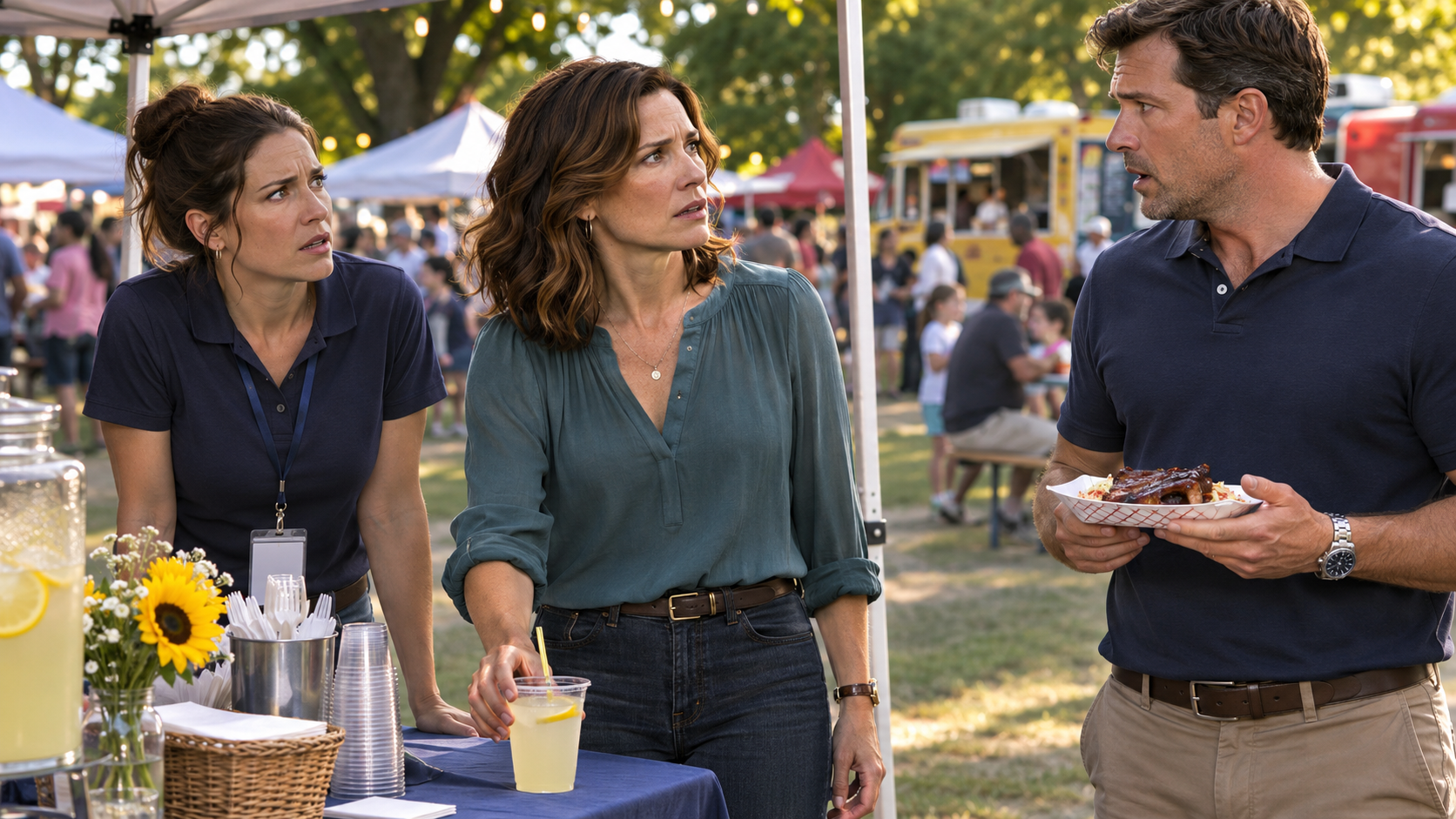
We bought lemonade first. The woman at the stand filled Dana’s cup so high that she had to stop and take a drink before we could walk. I held her purse while she got the lid on.
At the barbecue truck there was a photograph of the ribs on the board. Dana studied it while the line moved.
“Want to split one?” I asked.
She looked at me and smiled. There was a time when I would’ve looked at that smile and believed I knew all the things it meant. By then I knew I could ask her what she wanted and give her time to tell me.
“Whole rack?” she said.
“I think we can manage it.”
“Can we get two plates?”
“Of course.”
We found a place to sit where we could hear the band over the generators. I cut the rack down the middle, put half on each plate, and passed one to Dana. She looked down at her portion. Then she took a rib off her plate and set it on mine.
“I want more room for the potatoes,” she said.
I handed her the potatoes. We ate until the band took a break, then sat there in the afternoon sun and finished our lemonade. When her cup was empty, I asked if she wanted me to get her another one.
“Maybe in a little while,” she said. “Sit with me for a minute.”
I stayed where I was.