“Mom?”
I took my hands off the keyboard.
Kevin stood in the doorway in his socks. He had changed out of his work clothes, but there was still a faint line across his forehead from the cap he wore on the job. He looked at the blue folder before he looked at me.
“I thought you went to bed,” he said.
“I did. Then I got up.”
“Does that email have my name in it?”
“It could.”
He came as far as the chair opposite mine. I had found that chair at a yard sale the year he started kindergarten. One of the legs was shorter than the others. He knew where to put his heel to keep it from rocking, and he did it without looking down.
“Would you hear me out first?” he asked.
I closed the laptop halfway.
“How much did you pay for the apartment?”
He pulled the chair out and sat.
“Forty-two hundred.”
“Where did it come from?”
“Thirty-four from our savings. Eight from the money I had left in the account with you.”
I opened the folder and slid the leasing receipt across the table.
“Read the last line.”
His eyes went all the way down the page. Then they went back to the top.
“I’ve seen this.”
“Read it out loud.”
He put his finger on the line.
“Application and holding fee. Two hundred dollars.”
I waited.
He lifted the lease receipt and looked under it, as if the rest of the money might be on the next page.
“That’s just the first receipt,” he said.
“It’s the receipt the leasing office sent to you and copied to me because you asked me to be your guarantor. I called them this morning. They received two hundred dollars. The hold expired last Friday.”
He kept looking at the paper.
“Did they say why?”
“Because the balance never came.”
He sat back. The chair gave a little knock against the tile.
I had pictured this moment several times over the last three weeks. In the worst version, he already knew where every dollar had gone. In the version I wanted, he got angry at the right person and asked me the right questions.
What he actually did was take his phone out and open the message thread with his wife.
I watched his thumb move up the screen. He stopped and came back down a little.
“She sent me a screenshot. It showed four thousand going out.”
“Going out to whom?”
He enlarged it with two fingers.
I saw the answer reach him before he said it.
“Valeria.”
Tiffany’s sister had eaten at that table often enough to know where I kept the serving spoons. She usually brought ice. Most years she was the first one to ask if I needed anything and the first one Tiffany waved out of the kitchen.
“Valeria was helping us get the apartment,” he said. “She knows somebody who works there.”
“Did you ever meet that person?”
“No.”
“Did you speak to the leasing office yourself?”
He put his phone down.
“I kept telling her I wanted one thing I didn’t have to follow up on.”
I understood that better than I wanted to. There were years after his father died when I would have paid a good deal of money for one thing I didn’t have to follow up on. The plumber. The insurance woman. Whether my son had eaten supper. It had seemed to me that any task I left unattended would make another one behind my back.
“You can want that,” I said. “You still have to know where you live.”
He let out a breath through his nose.
“I thought we’d be gone by January.”
“So did I.”
That was the arrangement we’d made when they moved in. Six months, a little grace if the apartment they wanted took longer, and then I would have my upstairs rooms back. I had written January on a strip of masking tape and stuck it to the box of winter clothes I’d moved out of their closet. I had figured I wouldn’t need to open it until they were gone.
January was eleven days away.
I handed him the next page.
“The eight hundred from the joint account was yours. You’re entitled to spend it. There’s another transfer I need you to look at.”
He read the date first.
“November twenty-ninth.”
“Do you remember asking me to borrow the card that morning?”
He did. His face changed just enough.
“I got the hinges for the back door.”
“You brought me the hardware receipt. I put it in the drawer under the phone.”
He looked at the line again. The payee was Valeria. The amount was twenty-four hundred dollars.
“I didn’t send this.”
“It came out of the joint account. There was nothing of yours left in it by then.”
I had opened that account with him when he was seventeen and working at the grocery store. It had stayed open through direct deposits, lost debit cards, and the time his old truck needed a transmission. Most of what was in it now was money I used for yearly expenses. The property tax payment was due at the end of the month.
There’d been plenty of money. That was how I’d gone days without noticing.
“Does Tiffany have your login?” I asked.
He pressed the pad of his thumb into the tabletop.
“She does the bills sometimes.”
“Does she have it?”
“Yes.”
“Did you tell her she could use my money?”
“No.”
I believed him. He sounded like the boy who used to bring me the things he’d broken because he could never stand to have me find them later.
Then he said something in a much quieter voice.
“I told her you might help us if we needed more to move.”
“Might I?”
“You’ve helped before.”
“You’re right. And every single time I got to say yes.”
He looked over at the dishwasher. The little green light was on. I had run it before dinner because I thought the children might want clean mugs for hot chocolate.
“Where’s the money now?” he asked.
“That’s what I’m trying to find out.”
I opened the laptop again. He could see the subject line from where he sat.
“Who are you sending it to?”
“I’ve started with you and Tiffany. I may have separate questions for other people.”
“Can we talk to her before you send anything?”
“You can go get her.”
He glanced at the staircase. Then he stayed in his chair.
“Tell me the rest first.”
I took out the printout with Marco’s name on it.
My printer had put a pale stripe through the middle of that page. I had printed it twice, and the stripe was in the same place both times, so I’d gone over it with a pen where a few letters were hard to read.
Kevin recognized the chain.
“This was the roof question.”
“You sent it to me because you wanted to know how old the roof was.”
“I never read down that far.”
I knew. He had forwarded it from his work phone at six in the morning with one line at the top.
Mom, is it the same roof Dad put on?
Beneath his question there had been five messages between Tiffany and Marco. The first ones sounded normal enough. When was the roof replaced? Was the garage attached? Did the downstairs bathroom have a shower?
I had answered that his father and I replaced the roof together. I had paid as much of that bill as his father had, and for some reason it mattered to me to put that in the reply.
Then I had gone back and read the rest.
Kevin read it now.
“‘The owner is expected to vacate after the holidays,’” he said.
He paused.
“‘Family will be able to deliver the property without an outside listing.’”
He stopped again.
“Keep reading,” I said.
“‘Please confirm whether an owner signature can be made available during the gathering.’”
The heat came on. The vent by the back door ticked as the metal warmed. Neither of us moved.
“What did you tell her about where I’d be living?” I asked.
“Nothing.”
“What did she tell you?”
“That you might want something smaller eventually.”
“I might want to learn to play the trumpet eventually. I haven’t asked anybody to buy me one.”
He looked almost ready to smile. Then he put the page down and covered his face with both hands.
“I told her Dad wanted me to have the house someday.”
“Did he say that to you?”
“Yes. In the garage. It was the year we fixed the back steps.”
I remembered those steps. I remembered a pair of gloves left in the rain, stiff by morning. I remembered Kevin coming in to ask where the level was. His father had been down on one knee for hours and couldn’t get up without putting a hand on Kevin’s shoulder.
“He may have said exactly that,” I told him. “Someday is a word people use when they think they have time to explain what they mean.”
Kevin took his hands off his face.
“Did he put it in writing?”
“The deed went to me when he died. I pulled the county record, and it still says what it said the day he died. I know what’s in my will. I don’t discuss it at the kitchen table.”
He nodded once. He kept his eyes on the edge of the folder.
“Is she trying to sell it?”
“I have an email that says she led somebody to believe I was moving. I want to know what else she told him.”
A board creaked again.
This time it was farther up.
Tiffany came down in the sweater she’d worn at supper, with one sleeve pulled over her hand. She stopped on the bottom step.
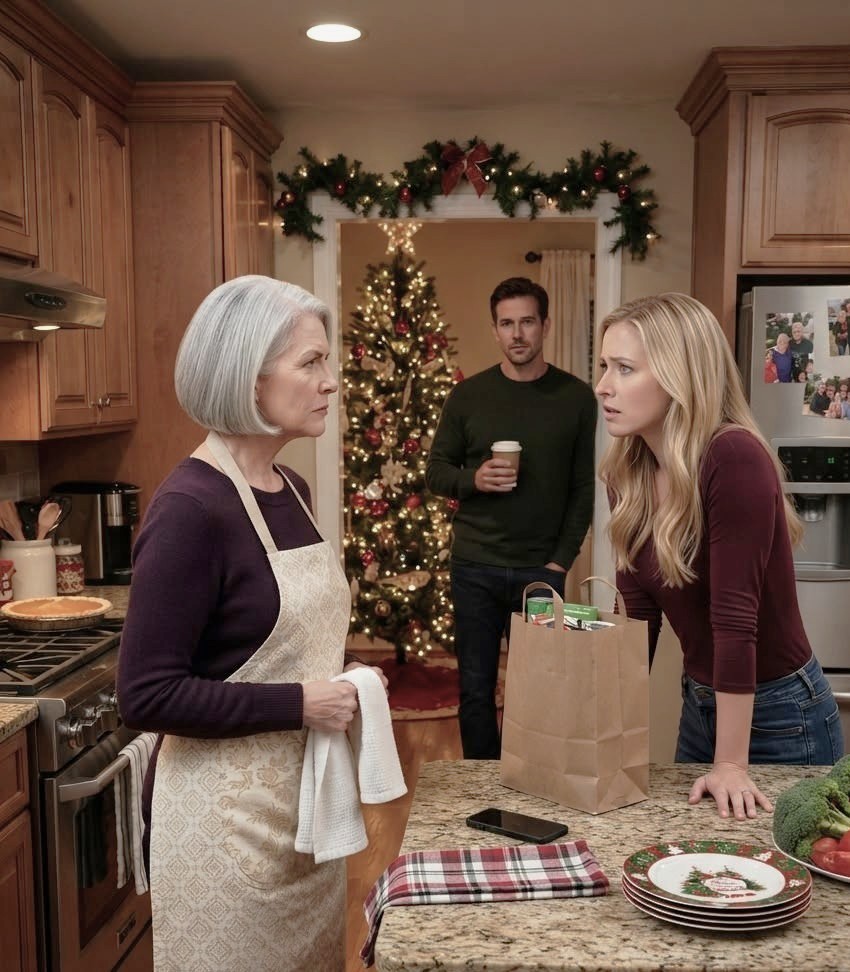
“Are you two seriously doing this at midnight?”
Kevin turned his chair.
“How much did you pay the leasing office?”
She looked at me.
“I’m asking you,” he said.
“Two hundred to hold it.”
He waited for her to say the rest. When it became clear she wouldn’t, he picked up his phone and laid it in front of her.
“You said this was the deposit.”
“I told you I had taken care of the deposit.”
“You showed me the money going to your sister.”
“Because she was holding it until we needed it.”
I watched his hand close over the edge of the chair.
“Call her,” he said.
“It’s late.”
“She has forty-two hundred dollars that I thought went to an apartment. Call her.”
Tiffany brushed her hair behind her ear. Her face had the appearance of someone doing arithmetic in front of people who could see her work.
“It isn’t all there anymore.”
“How much is there?”
“I don’t know down to the dollar.”
“Start with what you know,” I said.
She looked at my laptop.
“Who have you told?”
“The leasing office knows I asked about the receipt. The bank knows I’m looking at the account. So far the two people in this kitchen know what’s in my folder.”
She pulled out the chair beside Kevin’s. She didn’t sit.
“Valeria put down a deposit for food. And some things for Christmas.”
“What things?” Kevin asked.
“Tables. Dishes. I think linens.”
I looked around my kitchen. I had been counting chairs in my head since supper, even after I’d told her I was leaving. It was a habit I would have to break on purpose.
“You told me there was no catering,” I said.
“There isn’t. Alejandro was getting some of the food from the place that does the parties for his work. It wasn’t the whole meal.”
“The three turkeys were still mine.”
She swallowed.
“I thought you’d want to make those.”
“You told me I had to.”
A car went by slowly enough that its headlights were on my kitchen wall for three long seconds. I watched them go. It gave me something to do while I waited for her to speak.
“All right,” she said. “I told you.”
Kevin pulled the bank statement out from under the receipt.
“Where’s Mom’s twenty-four hundred?”
Tiffany sat down then.
“I used it to pay Valeria back.”
“For what?”
“She put the first charges on her own card. I was going to replace it when we had everything worked out.”
“Everything with the apartment?”
She looked at the email from Marco.
That little movement of her eyes cost my son more than anything she’d said that night. He had been sitting with his shoulders hunched forward. Suddenly he stood, as if he needed more room around him.
“What did you promise him?” he asked.
“I asked what houses were going for.”
I tapped the printout.
“He asked for my signature.”
“I didn’t promise him your signature.”
“You wrote that he’d have an opportunity to talk to me at Christmas.”
“It would have been a conversation.”
“With twenty-five people in my house.”
“Most of them wouldn’t even know what we were talking about.”
“Were you counting on that?” I asked.
She opened her mouth. No words came out.
I had been afraid she would cry. I was so accustomed to helping when somebody cried that I didn’t trust the first thing my hands might do. But she just looked down at the table and picked at a rough edge in the nail polish on her thumb.
Kevin sat again.
“How were we supposed to put the money back?” he asked.
“I thought if the house sold, your mother might help with a down payment. You said she could. You said there would be plenty after she bought something smaller.”
Kevin looked at me.
“I said it once,” he said. “In the car. We’d just been to another apartment showing, and I was mad about what they wanted for a place with carpet that smelled like a dog.”
I could picture that conversation. I could even picture him reaching across to turn the heater down, a man of his age still willing to have a wild, comforting thought out loud with his wife. That thought had traveled farther without him.
“Did you say I’d agreed?” I asked Tiffany.
“I said we’d talked about it as a family.”
“Had we?”
“No.”
“Did you tell Marco that I wanted to move?”
“I told him you were ready for a change.”
“I’ve been ready for a new dishwasher for about a year.”
She looked toward it. I did too.
A drop of water had been hanging from the bottom of that door for months. Only one drop. I put a folded rag under it before I ran a load, and when I bought a new rag it seemed foolish to replace the whole machine. I could still see a corner of the rag from my chair.
I looked back at her.
“Did you sign my name to anything?”
“No.”
“Did you send anyone a copy of anything from my desk?”
“No.”
“Have you taken money out of that account before?”
“No.”
I didn’t know yet which of those answers I could take to the bank. I wrote the three questions down with the date beside them.
Tiffany watched me write.
“You’re making this sound like we stole your house.”
“Right now, I’m trying to get twenty-four hundred dollars back.”
Kevin asked for Valeria’s number as if he didn’t already have it. Tiffany picked up her phone and called.
We heard it ring four times.
“Somebody better be hurt,” Valeria said.
Tiffany told her the three of us were sitting in my kitchen. After a pause, Valeria asked whether she was on speaker. Tiffany said she was.
“Then I want to say one thing before you say anything,” Valeria told her. “I asked you twice if she knew.”
“Knew what?” I said.
“That you were talking about selling, and that the Christmas money was coming out of what you were going to give them when you did.”
I touched the lid of the laptop with one finger. It was warm.
“Valeria, I’ve never agreed to sell my house. I’ve never agreed to give them money from a sale. The twenty-four hundred dollars you received last month came from my account.”
There was a little rustle on her end. I thought she might have gotten out of bed.
“Then I owe you some money,” she said.
I hadn’t expected her to say that as plainly as she did.
“How much do you have left?” I asked.
“I can tell you in the morning. The orders are all in my name. I’ll call as soon as they’re open and see what can still be canceled. The rest, I’ll show you receipts for. I’ve got them.”
“Thank you.”
“Tiff?” she said.
Tiffany leaned closer to the phone.
“Yeah.”
“When I asked if she knew, you said you’d sat down with her on a Sunday.”
“I remember what I said.”
“Good,” Valeria said. “I want you to remember tomorrow, too.”
She hung up.
For a minute the three of us listened to the refrigerator.
Then I raised the laptop lid the rest of the way and finished the email. I sent it to Kevin and Tiffany. I wrote down the amount the leasing office had received, the amount that had come out of my account, and the fact that I had given nobody permission to discuss a sale on my behalf. I wrote that I expected the money returned and wanted a written account of where it had gone.
At the bottom I put the date they had originally agreed to move out.
January fifteenth.
I had almost written if possible. I could feel the words ready in my fingers. I read the sentence again and left it the way it was.
“Christmas dinner here is canceled,” I told her when I had sent it. “My house is off the invitation. You can still host your family wherever you make arrangements.”
“Where are you even going?” Tiffany asked.
“I haven’t decided yet.”
She stared at me.
I’d said I was going away at supper, and I’d meant it the moment it came out of my mouth. As of that minute, I could have packed a bag and driven to the next town and sat in a motel eating crackers. The idea of doing exactly what I wanted with an entire day was so unfamiliar that it would have taken me a while to think of something better.
Kevin stood up.
“What do we tell the kids?”
“That Christmas is still happening. They get to open their presents. Nobody is going to ask them to take sides.”
He nodded.
I gathered my papers. Tiffany moved her glass so I could reach the page beneath it. I noticed she was careful to lift the glass straight up so it wouldn’t wet the ink.
It was nearly one when I went upstairs.
In the drawer beside my bed I found a birthday card from my sister, Ellen. Her number was on the back in handwriting I could read without my glasses. I already had it in my phone. I kept the card because she’d written the number so large it took up more room than her name.
I sent her a message.
Would you still have room for me Christmas Eve and Christmas Day?
I turned off the lamp.
Four minutes later my phone lit up.
Yes. Bring a warm coat. I keep the house at sixty-five.
Then another message came.
I have towels.
I had been to Ellen’s house at least thirty times. For thirty years she had been telling me she had towels, and I had been bringing my own.
I left them in the closet this time.
In the morning, my grandson was on a stool in front of the toaster, watching two slices of bread rise and fall as he pushed on the lever. My granddaughter sat on the floor in her pajamas, trying to fit an old doll’s shoe on a stuffed rabbit.
Kevin had made coffee. He’d put in too much water.
I drank it anyway.
“Dad says your house isn’t doing Christmas,” my grandson said.
“My house is taking a year off from the big dinner.”
“Can a house do that?”
“Apparently.”
He considered this. The bread popped up and startled him even though he’d been staring right at it.
“Can we still come here?”
“Of course you can come here.”
“What about today?”
“You’re here right now, sweetheart.”
He turned around and looked at me for a second. Then he went back to his toast.
My granddaughter got the shoe halfway onto the rabbit and brought it to me to finish. I helped her pull it off again, because it was starting to tear at the seam. She looked at the shoe, looked at the rabbit, and put the shoe on her own thumb.
I sat there with them until they finished eating. I didn’t ask whether their mother had slept. I didn’t tell them I’d heard Kevin walking around upstairs until nearly three.
When Tiffany came down, she had a piece of notebook paper in her hand. At the top she’d written the names of everyone she’d invited. Beside each name was a little dash.
“I need to tell them something,” she said.
“Yes.”
“What do you want me to say?”
I rinsed a knife and set it in the rack.
“Tell them the invitation came before you checked whether you could use the house. Tell them where you’re moving it when you know.”
“If I tell them I didn’t check, my aunt will call and ask why.”
“She probably will.”
She went to sit at the table, but after a moment she turned to Kevin.
“Will you help me find somewhere?”
“I’ll help look,” he said. “You have to make the calls.”
He poured a cup of weak coffee for her, too. She took it and sat down.
I’d sometimes imagined what I would do if my son ever stopped stepping between his wife and the results of her decisions. I suppose I thought I’d feel pleased. Standing at the sink, I mostly felt tired for him. His hand had shaken a little pouring her coffee. He still knew how she took it.
I left them the kitchen and went to the bank.
The woman who helped me had a tissue box on her desk with a picture of a lighthouse on it. She explained that a joint account came with complications. Kevin had the right to access it. What somebody else did with his login was a different question, and the bank needed to hear from him as well as from me.
I’d brought printed pages. She was grateful for the dates. I was grateful that she asked one question at a time and let me finish answering.
Kevin came by on his lunch break. He told the woman the truth about giving Tiffany the login. As he spoke, he looked down at his hands and turned his wedding ring once. It was the only time he touched it.
We set up separate accounts and made arrangements for the remaining balance. I moved my tax money into the new account and changed the information for the automatic payments. For the first time in years, I had to look up how much I paid for the garbage pickup. It was more than I thought.
On the way out, Kevin held the glass door for me.
“Can I ask you something?” he said.
“You can ask.”
“Would you have helped us with a deposit if we’d just asked?”
“I might have. I would have asked to see the lease and wanted to know how much you could afford every month.”
He looked out over the parking lot. Somebody had left a shopping cart beside his truck. Before we walked away he took it to the return.
“I wish we’d had that conversation,” he said when he came back.
“So do I.”
I went home and called Marco. I got his office number myself. A woman answered and put me through, and the first thing he asked was whether I was Kevin’s mother.
“Yes,” I said. “I own the property you’ve been discussing with Tiffany.”
He was silent for just long enough to make me wonder if he had me on speaker and was reaching to take me off.
“I understood that you were involved,” he said.
“I became involved when I read your email. What have you been given with my name on it?”
He said Tiffany had shown him the county property page. She’d sent him exterior pictures and a few rooms, and he’d drawn up an estimate from other sales in the area. He’d spoken to someone who might be interested if I chose to sell. He said he had no signed papers.
I let him finish.
“And what were you supposed to do at Christmas?”
“She said she’d introduce us after dinner. I was going to bring the estimate and talk you through what a private sale could look like.”
“You asked if a signature would be available.”
“I phrased that poorly.”
“What would you have asked me to sign?”
“If you wanted to go ahead, I had an authorization I could have brought. It would have given me permission to proceed with discussing the property on your behalf.”
“So you wanted to arrive at my house as a dinner guest and leave with my permission to find a buyer.”
He took a breath.
“Yes. With the understanding that you were expecting me.”
“Did you ask to speak to me before dinner?”
“No.”
“Did you have my number?”
“I did.”
I stopped waiting for him to explain the difference between those two answers.
“Please put in writing that you have no instructions from me, no signed documents, and no permission to share my photographs or discuss my property with anyone else. Send me the photographs and anything else you received.”
“I can do that.”
He did it before two. The attachment with the pictures took a while to download. I went to take the rag out from under the dishwasher and wash it in the sink while I waited.
There were nine pictures.
In one, my husband’s old radio was on the garage shelf, with a coil of orange extension cord hanging beside it. In another, I could see the edge of a pair of slippers under the armchair in my bedroom.
I hadn’t even known anybody had been in there.
The last picture was of the dining room. The table was stripped down to its plain top, and the leaves were out. I knew when it had been taken because there was a seam in the tablecloth I’d intended to fix, and I’d brought the cloth up to my room the previous Sunday while Tiffany had the downstairs to herself.
I remember threading the needle by the window. I remember hearing her move a chair.
I’d thought she was sweeping.
I called the attorney who had handled the paperwork after my husband died. She made room for me the following morning. She checked the property records, went over Marco’s written response, and explained what steps were available if anything turned up later. I asked her to check my will and the papers that named who could make decisions for me if I couldn’t. We made another appointment for January, when I could sit with her without watching the clock.
At home I put the papers from my desk in a locked drawer. It hadn’t been locked in so long that I tried three keys before I got the right one. There was a little brass key with a stripe of red nail polish on it. My husband had marked it. I remembered teasing him about using my good polish.
I held it in my palm a moment before I put it on my ring.
Valeria came to my house Thursday evening carrying a paper envelope and two grocery bags. One held an unopened table runner. The other had stacks of heavy paper plates with gold rims, the sort I used to think cost too much to throw away after one meal.
“I can return these myself,” she said. “I brought them so you could see what I’m talking about when I say it was stupid.”
I cleared a space for her at the counter.
She spread her receipts out, one after another. It was a strange feeling to see things I recognized as my money become a deposit on rented tables, a payment toward food, a delivery fee. There was enough cranberry-colored fabric on the linen order to cover my downstairs twice.
“Alejandro thought all this was a surprise for you,” she said.
I looked at the order form.
“Was I supposed to be surprised before or after I’d cooked the turkeys?”
Valeria looked up. Her mouth moved a little like she was thinking whether it was safe to smile.
“After, I guess.”
I did laugh then. Quietly, and only once. I could see myself standing in my kitchen with the oven door open while someone behind me said surprise.
Valeria showed me the places where she’d been able to get a refund. Some had come through right away. A few would take days. The money had been mixed in her account, so she and Tiffany had gone through the transfers side by side that afternoon. She could send me eighteen hundred dollars immediately, and there would be another payment after the refunds cleared.
She opened the banking app in front of me.
“Whose money is the eighteen hundred?” I asked.
“It’s what was still sitting there from what she sent and two refunds I got today. We agreed yours comes back first.”
She transferred it. I checked it had arrived, then took a pen from my apron and wrote the amount and date on one of the pages she’d brought. I made a copy for her.
She sorted the scraps of paper back into the envelope.
“I asked Tiffany if I ought to call and thank you when she said you’d offered the house,” she told me. “She said everybody was making enough of a fuss already, and to leave it alone. I liked that answer. It was Christmas. I was glad somebody else had the space.”
I could understand being glad of that. My own first invitation to Ellen had been little more than a hope that somebody else had a room.
“Next time,” Valeria said, “I’ll ask the person with the house.”
“Next time you can come for coffee,” I said. “Give me a call first.”
She took her bags off the counter and went to the door. Before she opened it, she turned.
“You know it’s more than twenty-five, right?”
“How many?”
“Twenty-seven with Marco and the woman he works with. I counted from the messages this morning.”
I could see why she’d told me. I could also see why Tiffany had left those two off while she stood in my kitchen naming cousins and nephews.
After Valeria drove away, I went upstairs and knocked on Kevin and Tiffany’s door.
Tiffany opened it. There were two suitcases on the floor behind her. One was the one she took on trips. The other had a purple ribbon tied to the handle, and I knew it had been in my spare closet because I’d carried it out of the way to reach my winter things.
“Did you get the money?” she asked.
“Eighteen hundred. I need to ask you about the pictures Marco sent me.”
She went still.
“Which pictures?”
“The ones you took in my bedroom.”
Kevin came to the door behind her. I saw a shirt folded over his forearm. He had always folded shirts that way, across his arm, ever since I’d shown him how to do it without a table.
Tiffany looked over her shoulder at him.
“He wanted to see the upstairs bedrooms,” she said.
“You could have shown him yours.”
“I did.”
“You went into mine.”
“Yes.”
“Did you move anything?”
“Just a bottle off your dresser. I put it back.”
I knew the bottle. It was hand lotion. My husband had bought one every year for Christmas, even when I had told him I liked the cheaper kind just as much. It had been empty for years, and I still kept it by the lamp. She wouldn’t have known what she was moving.
“Why didn’t you ask me?” I said.
Tiffany glanced down the hall toward the children’s room. Both doors were open, and I heard the little clack of wooden blocks.
“Because you would have said no,” she said.
I waited a moment, to see whether she would soften it. She didn’t.
It was the most honest answer she’d given me in two days.
“That’s right,” I said. “I would have.”
I went back downstairs.
A little later, she came into the kitchen and put two sheets of paper on the table. The first was the list of charges she’d checked with Valeria. The second had the amount still owed to me and her plan to pay it out of her next two checks if the refunds didn’t cover it.
She’d written remaining six hundred on the top. Beneath it she’d started to write we’ll pay, crossed out we, and written I above it.
I took the paper.
“Has anybody found a place for Christmas?” I asked.
“Alejandro can get the room at the back of his building. They’ve got stackable chairs. Everyone has to bring a dish, and my aunt says that’s what she thought we were doing in the first place.”
I didn’t fill the space after she said it. I could imagine how many of her relatives would have happily brought food if she’d just asked.
“Did you tell them about the house?” I said.
“I sent a message. I said I offered your house before I asked, and I was wrong to do it.”
“How did they take it?”
“My aunt wants to know if her green beans will have somewhere to plug in.”
“Will they?”
“We’re finding out.”
She stood there a little longer.
“If you want to come,” she said, “I’ll tell you where it is.”
“I’m going to Ellen’s.”
“All right.”
I put the repayment sheet in the blue folder. Tiffany went upstairs, and I opened the pantry to check whether Ellen had asked me to bring anything. I had written coffee on a list because she used instant and would insist I couldn’t tell the difference. Other than that, there was nothing.
I took the list off the fridge.
On the bottom, in Kevin’s handwriting, were the words find Grandma’s star.
That was a note to himself. The children had been asking for the star on top of the Christmas tree, and he’d been down to the basement twice looking for it. I knew where it was. I’d wrapped it in one of his father’s old flannel shirts after the cardboard box finally gave out.
I went downstairs and took him with me.
We found it at the back of the shelf, behind two boxes of ornaments and a bag of ice melt. The flannel came loose in my hands. One of the points of the star had bent and the seam was beginning to come apart.
“Could you fix that?” he asked.
I handed it to him.
“I bet you could.”
He brought it upstairs and worked at it with a pair of small pliers. The children stood close enough to touch him. He asked them to step back, and they took exactly one step in unison.
Once he’d wired it to the top, my grandson went around the tree to look at it from three directions.
“It’s tilted,” he said.
Kevin stepped down from the stool.
“It’s always tilted.”
My grandson studied it some more, and apparently this made sense to him. He reached up and put a paper candy cane back where his sister had moved it.
The next morning, I pulled out the old box of gift tags.
In other years I would have set a little pile for each of them around the tree and waited until Christmas morning. This year we opened the children’s gifts on Saturday. They wore pajamas and wrapped up my gifts in newspaper while I pretended I couldn’t see. I got a bookmark that said GRANDMA in marker, with the last A squeezed in above the rest of the word. I also got a package of peppermints from the pantry. I thanked my granddaughter as if she’d been to three stores to pick them.
The dress I gave her was a little big. She put it on over her pajamas anyway.
My grandson got the binoculars he’d been asking for since September. He ran to the front window and used them to look at a plastic reindeer nine feet away.
“Does it look real?” I asked.
“It looks dusty.”
He handed them to me so I could see for myself. He was right.
Kevin and Tiffany stayed on the couch with their coffee. When it came time to pick up the wrapping paper, I reached down out of habit. Kevin was already holding the bag open. I let go of the corner I had in my hand, and he caught it.
After lunch I found him on the garage steps, sitting with his elbows on his knees. The new hinges he’d bought were working well. The door closed quietly behind me.
He made room.
“Did you ever think about selling?” he asked.
“I did after your father died. For about a month.”
“You never told me.”
“I didn’t have very much to tell. I’d get up in the morning and open his side of the closet because I was looking for something on the top shelf. Then I’d have to sit down. I wondered whether I’d have an easier time in a place where I didn’t have a reason to do that every morning.”
“What made you stay?”
“I had a plumber coming Tuesday,” I said.
He looked at me.
“That was it?”
“For that week. Then I had somebody coming to see about the gutters. The daffodils came up. I went back to my Wednesday group. By June there were whole mornings when I could open that closet and just reach up for what I wanted.”
He listened. He was good at listening when he’d finished trying to think of the answer a person expected.
“Some years I might want to stay,” I said. “Some years I might want to move. I’d like to decide when I get to them.”
He picked up a leaf that had blown in under the garage door and turned it over.
“I think I talked about the house because whenever I looked at what we could afford, I felt like I’d messed up somewhere.”
“You were shopping on what you made. That’s hard enough.”
“I made it harder,” he said.
“Yes.”
He dropped the leaf beside his boot.
“I keep thinking that if I’d read all the way down in that email, I could have done something before you had to.”
“You could have. You can read all the way down next time.”
He laughed a little at that. Then he leaned his shoulder against mine, the way he used to when we sat on the low wall outside the dentist’s office and he was waiting to go in.
We stayed there until the cold came through our jeans.
I drove to Ellen’s on Christmas Eve.
On the passenger seat I had my overnight bag, the coffee she hadn’t asked for, and the bookmark. On the back seat I had the chocolate pie. It was the last one I’d made before Tiffany announced the dinner, and I had frozen it the next morning. I’d gone back and forth about taking it. Then I remembered how Ellen ate chocolate pie. She took a narrow slice and, ten minutes later, went back to straighten the edge.
I brought the whole thing.
The highway was clear. Near the turn for her town, a flock of birds lifted from a field all at once. I had no one beside me to point them out to, so I watched until they came down again.
Ellen was standing in her doorway when I arrived, wearing a coat over her sweater.
“It’s cold in there too,” she said.
“I’ve heard.”
She took my bag and left me the pie. When she saw the coffee, she put it on the counter and brought out a French press still in its box.
“Somebody gave me this three years ago,” she said. “I’ve been afraid it’ll explode.”
We figured it out together. The first pot was strong enough that both of us poured more hot water into our cups. We drank it at the little table by her kitchen window, where the ceiling sloped low on one side.
Ellen asked whether I wanted to tell her the whole thing.
I said I could tell her some of it.
So I told her about the money, the house, and the pictures. I told her how it had felt to see my slippers in a photograph taken for somebody who might buy the room where I slept.
She set her cup down.
“Did you say anything about the slippers to Tiffany?”
“No.”
“Would it help?”
“I think I said what I needed to. She knew I would say no. Those were her words.”
Ellen turned her cup around until the handle faced her.
“I would have had a hard time hearing her say that,” she said.
I was glad she left it there.
We’d lost our mother the same winter my grandson was born. When Ellen and I had cleaned out her kitchen, we found two dozen foil containers tucked behind the good serving bowls. Our mother had bought them every year so her grown children could take home Christmas leftovers and she wouldn’t have to ask for her plates back.
Ellen had taken the bowls. I had taken the foil containers. I used every one of them.
“Remember Mom’s turkey pan?” Ellen asked.
“The one that warped on the burner?”
“She brought it to my place the year I said I was going to cook. She was so sure I couldn’t get a turkey done that she cooked one at home and showed up with it in the trunk.”
“I remember that.”
“I told her to take it back out to the car. She did. And then mine really was raw in the middle.”
I could see our mother as clearly as if she were pulling a chair out beside me. Her good coat would have been buttoned wrong because she’d put it on in a hurry. She would have had a dishtowel wrapped around the handles of the pan.
“What did you do?” I asked.
“We ate the side dishes. The kids got into the rolls. Mom told everybody the potatoes were good. At the end of the night, I asked if she’d leave me enough of her turkey for one sandwich.”
“Did she?”
“She left me enough for three.”
We had soup that evening and cut into the pie a day early. Ellen took a narrow piece. Ten minutes later she stood up to straighten the edge.
I was in the guest room reading when my phone lit up with a picture from Kevin.
The children were sitting next to each other at a table in the shared room at Alejandro’s building. I could see a line of slow cookers along the wall and a stack of wet boots by the door. Somebody had used the fancy table runner, or one like it, to cover a folding table.
My granddaughter held up a bread roll as big as her palm.
Your sister could plug in the beans, Kevin wrote.
I looked again at the photograph and saw Tiffany in the background, reaching up to get something from a shelf. One child who wasn’t mine was holding the hem of her sweater. Two people were putting dishes on the table. The star-shaped cookies didn’t look homemade. There were plenty of them.
I wrote back.
Tell her I’m glad.
A few minutes later, Tiffany sent me her own message.
There were twenty-three. My cousin’s boys couldn’t come. We had too much food anyway.
Then another.
I paid for the room and I’m staying to clean it. Valeria says she’ll stay too.
I thought about how easy it would be to call and ask what they’d served and how it went and whether she’d remembered containers. She had given a party. Things had been done. There had been enough food.
I put the phone down and read another chapter.
On Christmas morning Ellen and I went for a walk.
There was frost on the rail by her back steps. We could see where a rabbit had crossed the lawn. I was wearing my warm coat and a pair of gloves I’d found in one of the pockets, and halfway down the street Ellen borrowed the left one because she’d dropped hers somewhere in the house.
We put our bare hands in our coat pockets and went the rest of the way like that.
I didn’t peel a potato all day.
When I got home on the twenty-sixth, there was a narrow ice ridge at the bottom of my driveway. Kevin was out there with the shovel, breaking it up before I turned in.
He leaned the shovel against the garage and came to take my bag. I handed it to him.
“Have you had lunch?” he asked.
“Ellen gave me two sandwiches for the road. I ate both before I got on the highway.”
He laughed.
Inside, the living room looked almost the way it had when I left. The tree lights were off. One of the children’s socks was on the arm of the couch. I picked it up and put it on the bottom step for its owner.
Tiffany was at the kitchen table with a list of apartments.
“Valeria got another refund,” she told me. “I sent you the three hundred this morning. I’ll cover the other three.”
“Did you get any of the apartment money back?”
“Some. Kevin and I both know exactly what’s left.”
There was a number beside each apartment on her list. She kept a sheet with the money they had, the application costs, and what they could pay monthly. She handed it to Kevin when he came in. He sat down and read it from top to bottom.
One of the entries was crossed out because there was no door between the second bedroom and the living room. Another was out of their price range. The one they both liked had a coin laundry and was far enough from the children’s school that mornings would have to start earlier.
They went to see it the next day.
The leasing office didn’t require a guarantor, but it did require the whole deposit before they got the keys. They had a shortfall. Kevin sold a set of tires he’d been keeping in the garage because he thought he might want to switch them back onto his truck someday. They canceled some furniture they’d ordered the previous month. Tiffany returned a coat.
I heard about the coat when she came downstairs with it in a shopping bag. It was the coat she’d bought to wear when people came for Christmas. She had tried it on in my hall mirror, and I remembered saying the blue looked good on her.
“Are you sure you can return it?” I asked.
“I kept the tags on.”
She was able to.
On January fourth, she paid me the final three hundred dollars. There was no note attached to the transfer. At supper she asked if I’d seen it.
“I have,” I said. “The twenty-four hundred is paid.”
She put her fork down.
“There’s something else I should say.”
Kevin looked at her, then got up and took the children’s plates to the sink. He asked them to come help him choose which leftovers to put away. My grandson asked why there was a choice.
“Because I don’t know what your grandma wants to eat tomorrow,” he said.
I heard the drawer of containers come open.
Across from me, Tiffany folded her napkin and unfolded it again.
“I’m sorry I took the money,” she said. “I knew the account had your money in it. I kept telling myself I was borrowing against what Kevin had said you’d probably give us. I didn’t ask because I couldn’t bear to hear what you would say about how I’d spent it.”
I waited. I was learning she could go on speaking if I gave her room.
“I’m sorry I took those pictures. I’d hate it if somebody walked around my room and made plans for it. I even waited until I heard you go upstairs with your sewing.”
“You went into my room later?”
“Yes. When you came down and went out to get the mail. I heard the front door close.”
I had wondered whether my recollection was wrong, whether I’d accidentally made it sound worse to myself because I was angry. Now I remembered standing at the mailbox in my slippers. The photograph had caught my spare pair by the chair.
“And Christmas?” I asked.
She looked straight at me.
“I wanted my family to think I could do something big for them. Then I wanted Marco to see all of us together, so he’d think I was telling the truth about having the family behind me. I knew you’d be busy. I thought if I introduced you after dinner, after you’d worked all day, you’d be too polite to ask him what he was doing there.”
I picked up my water glass.
It was hard hearing her say what she’d expected of my politeness. For a long time I had thought it was a virtue everybody in my family valued. I hadn’t asked myself whether some of them valued it most when it saved them an uncomfortable conversation.
“You may have been right about that,” I told her.
She looked surprised.
“If I hadn’t read the email, I might have sat through that talk,” I said. “Then I would have spent a week feeling rude because I wanted him to leave.”
“I’m sorry,” she said again.
“I hear you.”
Her chin creased a little. She flattened the napkin with her palm.
“Are we going to be all right?”
“I hope so. Some things will take longer than paying back the money.”
She nodded and looked down at her plate.
I got up to take my glass to the sink. My granddaughter had chosen the leftover chicken and written her name on the lid in washable marker. Kevin was writing for Grandma on the potatoes because she’d told him that was what I liked.
It was a little thing. I let it be a little thing.
They got their keys a week later.
The apartment was on the bottom floor. The window beside the parking lot had a deep sill, which my grandson immediately saw as a place to keep his binoculars. There was a white scratch across the kitchen floor where the refrigerator had been moved in. Tiffany put the trash can over it, saw that blocked a cabinet, and moved the trash can away again.
The children each got a drawer in the room they were sharing. My granddaughter put the rabbit in hers and then moved it to the pillow because the drawer was dark.
I took them a box of dishes. Kevin opened it on the counter and found four plates, four bowls, and some mismatched cups wrapped in newspaper.
“Mom. You use these bowls every morning.”
“I kept two.”
He looked in the box. The bowls were yellow, with a thin white line around the lip. He picked one up carefully.
“I thought you only had four.”
“I had six. I’ve been getting them down in stacks of four for so long, I forgot there were two on the bottom.”
He unwrapped the cups. At the bottom of the box there was an envelope with his name on it. He gave me a quick, uncomfortable look.
I understood why. Money in an envelope had always been my way of helping him when there was a problem neither of us wanted to make too much of.
“Open it,” I said.
It was a photograph. His father and Kevin were sitting on the back steps they’d fixed. One board was fresh and pale in the middle. In the picture Kevin had a blur where his hand should have been, because he’d lifted it just as I took the picture.
“I want that,” he said.
“I thought you might.”
He set it against the wall by the toaster while we finished unpacking.
We went back to my house for the last load. There were two boxes and a laundry basket still in the upstairs hall. Kevin went down with both boxes stacked under his chin. Tiffany came back to the bedroom doorway and ran her hand across the frame where the closet door stuck.
“Should I tell you about the hinge?” she asked.
“I know about the hinge.”
She smiled. I could see her wondering whether she was allowed to.
I went past her and pulled the closet door shut. It stuck at the same place it had stuck since Kevin was a boy. A nail in the top frame held a little piece of masking tape. I pulled it off, folded it over on my finger, and put it in my pocket.
Kevin brought the laundry basket down. At the door he reached into his coat and found his key. Tiffany had hers in the pocket of her jeans. They each put a key on the table by the phone.
“I’ll call before we come over,” Kevin said.
“Do.”
“Even if it’s just me?”
“Especially if it’s just you. Then I’ll know how much coffee to make.”
He zipped his coat up. His father used to hold the top of his zipper flat with one fist and pull the tab all the way up. Kevin did exactly that. I could see a thing like that after all these years and still feel it where a bruise fades.
When the car pulled away, I stood by the window until they passed the reindeer.
The wind had knocked it over. It was lying flat on its side with its feet aimed at the mailbox.
I left it until morning.
That first night alone, I cooked a piece of fish and ate it in the living room. I set the plate on the arm of the chair, the way I always told the children not to. The house made its regular noises. The heat came on. The refrigerator settled. Upstairs one of the boards snapped as the temperature dropped.
I knew every one of those sounds.
I slept through the night.
The next few months gave us ordinary things to get right.
Tiffany called before she brought the children over one Saturday. She asked if I could watch them from ten to noon because she and Kevin had an appointment.
I had arranged to go to the garden store with Ellen.
“I can do two to four,” I said.
There was a little pause. Then she said, “I’ll see what we can move.”
The appointment couldn’t be moved. They worked it out with Valeria, and after lunch Tiffany called again because the children wanted to come anyway.
They came at two. My grandson brought his binoculars. There was a bird in the maple that neither of us could name, so we sat on the steps and tried to draw it from what we remembered. His drawing had a beak in the right place. Mine looked like something that would live at the bottom of a pond.
At four Tiffany came to get them.
She rang the bell.
I opened the door and she held the children’s jackets while they put their arms in. Then she asked if she could have a cup of coffee. I said yes, and she stayed half an hour.
In February, Kevin came to repair the closet hinge. He’d offered when I mentioned it on the phone. He brought a little plastic package of screws and set them on the dresser in the spare room. When he was finished, he opened and closed the door twice.
“Better?” he asked.
I tried it myself. There was no need to lift the handle on the way through.
“Yes.”
He went to put the screwdriver away. I asked if he had time for supper. He looked at his phone first to make sure Tiffany wasn’t expecting him home.
“I have time,” he said.
I took two bowls out of the cupboard and heated the soup.
We ate at the same table where he’d read the leasing receipt. He told me about the day my grandson wore two different shoes to school and neither of them noticed. I told him Ellen and I were going to take a weekend trip when the weather warmed up. He asked where. I said we were still looking at a couple of places and wanted one where we could walk to dinner.
He stopped with his spoon halfway up.
“You know, when you said you’d be out of town, I thought you were trying to make her back down.”
“I wanted her to take me seriously.”
“Did you already plan to go to Ellen’s?”
“No.”
He ate his spoonful of soup.
“Did you have a good time?”
“I did.”
He smiled, and something in his face loosened.
We finished the soup. Kevin reached for his bowl and mine.
“Leave mine,” I told him. “There’s a little left.”
He took just his.
In the spring I had the attorney appointment I’d promised myself. I went over the house paperwork and the will and the names of the people I trusted to help me if I ever needed it. I signed the papers I’d chosen after she answered my questions, and I brought home a copy in an envelope.
It went in the drawer with the brass key.
I put the blue folder beside it. I had no desire to throw the folder out. I’d had trouble trusting the feeling that something was wrong until I saw the numbers and dates laid side by side. I wanted to keep the work I’d done to make sense of it.
Then I locked the drawer and went outside. The daffodils had come up along the garage again. A couple had pushed through the little lip of gravel I’d meant to pull back. I got down on one knee and moved the gravel with the palm of my hand.
It took me a minute to get up.
There was nobody in the yard to see. I put one hand on the step and stood when I was ready.
The next Christmas, Tiffany called me on a Sunday afternoon in November.
I was sewing a button on a coat. I put the needle down where I could find it, took my glasses off, and answered.
“Are you doing anything on the twenty-fourth?” she asked.
“I don’t know yet. What did you have in mind?”
“We’re having supper at our place. Valeria and Alejandro are coming. The kids want you and Ellen to come. I said I’d ask.”
“What are you serving?”
“Lasagna. Alejandro says he can bring salad as long as nobody expects him to make it.”
That sounded about right.
“You can say no,” she added.
“I know,” I said. “Let me ask Ellen.”
Ellen said she’d come if she could sit next to the children. She had bought them both the same puzzle and wanted to see which one figured it out first. I asked her if she agreed we’d leave whenever we felt ready. She said she’d been leaving places whenever she felt ready for forty years.
I thought about it. She had.
A few days before Christmas, Tiffany called again to tell me what time to come. While we talked, I opened my pantry and looked at the shelf where I kept the pie pans.
“Would you like me to bring a chocolate pie?” I asked.
There was a brief silence.
“You don’t have to,” she said.
“I know. Would you like one?”
“Yes,” she said. “I would.”
I made it that morning. I rolled the crust on the old board Kevin’s father had sanded for me. There was a shallow groove at one end where he’d put his initials with a pocketknife, and now flour settled in the letters every time I used it. I brushed most of it away before I hung the board up.
I carried the pie into the apartment with both hands. Kevin opened the door wide and stood back. He asked where I wanted to put it.
“The kitchen, wherever there’s room.”
“There’s room by the toaster,” he said.
There was. The photograph of him and his father was still there, in a cheap wooden frame. The paper at the back was buckled where it had gotten damp. The picture itself was fine.
We ate with one person at the end of the table and two more in chairs brought over from the living room. My granddaughter told us who got each of the cracked pieces along the edge of the lasagna. When the children went to get their puzzles, the adults moved the chairs back enough to give them a patch of floor.
Valeria put her plate in the sink and came back to sit beside me. She wanted to tell me about a soup she’d made. She’d gotten the proportions wrong and ended up with twice as much as she’d intended. I asked if I could have the recipe.
She showed me a picture of her handwritten notes on her phone.
I took out my own phone to copy them.
When Tiffany brought out the pie, she asked if I’d cut it.
I picked up the knife. The first piece came free a little crooked. I’d expected to straighten the edge and pass it to one of the children, the way I had for years.
My grandson was watching me, waiting to see how many slices there would be.
I put the first piece on my own plate.
“Five more good ones,” I told him. “Maybe six if you come hold the pan.”
He put both hands on the rim, and we managed six. Ellen took a narrow piece and later went back for the sliver he and I had left. Tiffany sat to eat hers while the children told her about the puzzles. Kevin took the empty pan to the sink.
As I was putting on my coat, Tiffany came out into the hall with the pan clean and dry. She wrapped it in a dish towel so it wouldn’t be cold in my hands.
“Thanks for coming,” she said.
“I had a good time.”
She gave me the pan. I held it out again.
“You can keep it here until I need it,” I said. “If you want to learn the pie, sometime when you’ve got an afternoon, I can show you.”
“I’d like that.”
“Call me and we’ll pick a day.”
Ellen was waiting by the car with her gloves on. The apartment window was at my shoulder as I passed it. Through the glass I could see Tiffany make a spot for the pie pan in her cupboard. She moved two bowls to the other shelf, slid the pan inside, and closed the door.
I drove Ellen back to my place. We left our coats on the backs of the kitchen chairs and made coffee even though it was late. I used the good kind, and she said it tasted just like instant.
There were two pieces of pie in the container Kevin had slipped into her bag.
Ellen found two forks.
We sat down and ate them.