FINAL PART: What the House Cost Us
The morning after my parents came to the porch, my daughter asked if Grandma had heard her crying on Thanksgiving.
Lucy was eleven. She was old enough to know there were things adults pretended to miss and young enough to wonder if she could have made herself easier to hear.
“I don’t know,” I said.
“I was crying when we went to get our coats.”
“I know you were.”
“She was right there.”
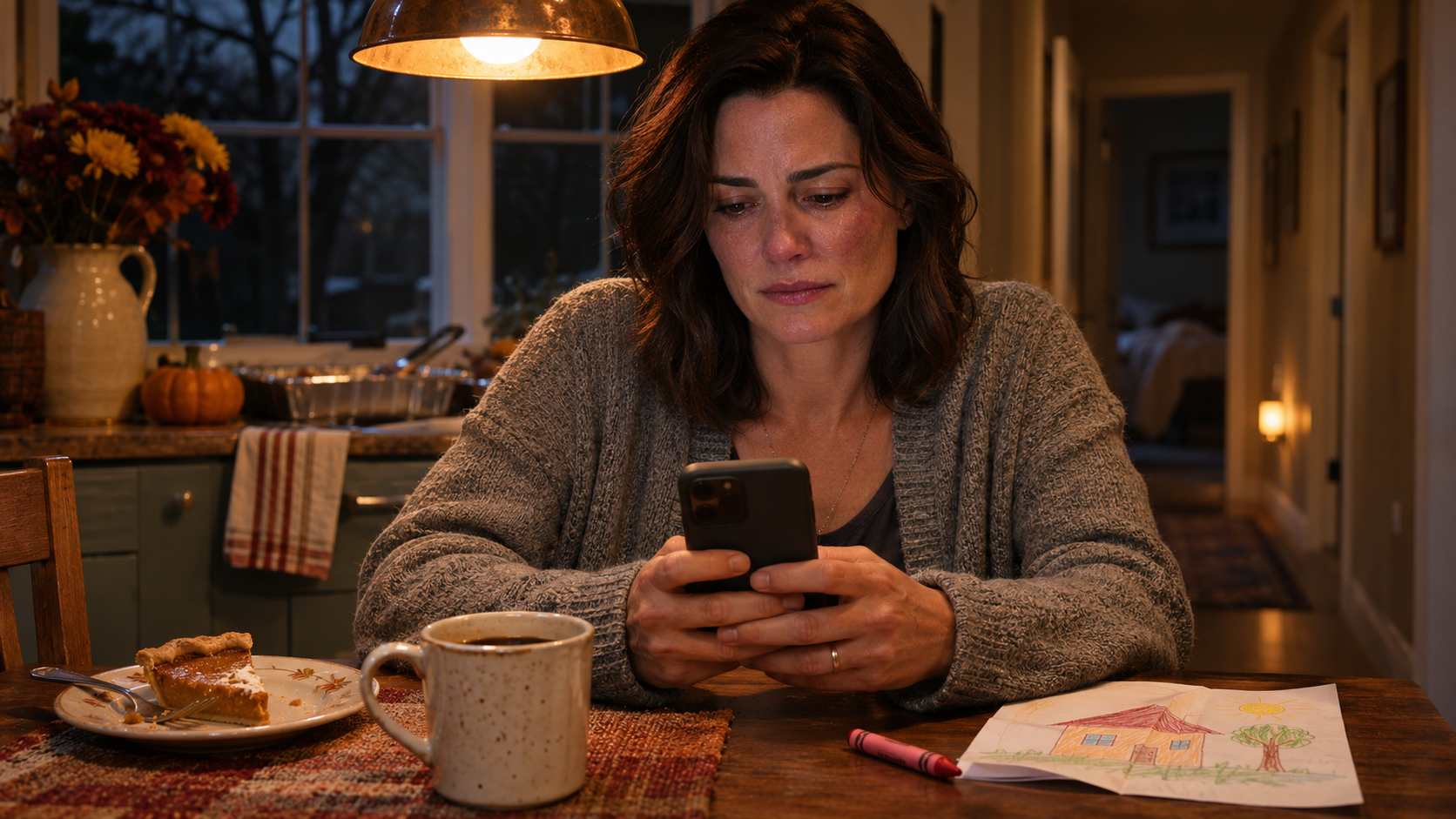
Lucy was sitting at the kitchen table in her pajamas, peeling the paper off a broken red crayon. She’d found it in the silverware drawer, where her brother kept things he wanted to be able to find again.
I put my coffee down.
“I should have taken you both out as soon as Aunt Meredith hit me. I stayed long enough to argue, and you had to stand there and hear it. I’m sorry.”
Lucy got the paper off in one long strip. She pressed it flat with her thumb.
“Did you ask her for too much money?”
“I asked her when she’d return money I loaned her.”
“Maybe she thought you meant right then.”
“She could have asked me what I meant.”
My eight-year-old son, Ben, came in with one bare foot and one sock on. He saw the crayon in Lucy’s hand and held out his palm.
“I’m using it,” she said.
“You took the wrapper off.”
“It kept peeling.”
He looked at me. I was about to tell Lucy to give it back when Ben pulled out the chair beside her and asked whether they could color the same picture.
They bent their heads over the table. Lucy drew the roof first, in red. Ben put a door on the side so the people would have another way out.
I stood at the sink for a minute after I’d finished washing my cup.
Then I went into my office and opened my banking app. I wanted to make sure the transfer still showed as canceled.
It did.
I took a screenshot, filed it with the fifty-four payments, and shut the laptop. That was the last time I checked to see whether the money had gone out.
On December first, my father sent me a picture of the payment screen.
The December installment was still outstanding. The amount was $1,600. Beneath the total was the name of the borrower, M&V Holdings, LLC.
He had cropped the picture around the amount due. Even so, the company name was there, small and black at the bottom.
His message said, Arthur says pay December while they look at the papers. I can cover nine hundred.
I read it at my desk between meetings. The old arithmetic was so familiar that I’d supplied the missing number before I reached the end of the message.
Seven hundred. I knew which account I could take it from. I knew how long it would take to move. Sitting there, I found myself working out whether I could do it before my next call.
I turned the phone over and finished eating my sandwich.
About twenty minutes later, Dad sent another message.
I should have asked Arthur how to handle the payment. I’ll call him.
I took a screenshot of that one, too. It was the first time in my life that Dad had asked me to clean up a problem and thought better of it without my having to say anything.
December got paid. I learned that a week later from Arthur Pendelton, who asked me to come in and talk to an attorney named Helen Cho. My parents had hired Helen to handle the property dispute. Arthur was going to give her the notes he’d made in 2021, when Dad asked him about protecting assets. Then he would step back from the case.
The meeting was in a smaller room than the one where I’d left my folder. My parents were already there. Dad had a yellow pad and the pen he used for signing Christmas cards. Mom had a canvas grocery bag tucked against her chair.
Helen asked if I was comfortable with them in the room.
“For this, yes.”
She started with a copy of the deed. There was something about seeing my parents sit side by side while another person explained what their signatures had done. Dad put his pen down as soon as Helen turned the page toward him. Mom left both hands in her lap.
Helen asked who had brought them the document.
“Meredith,” Dad said.
“Where did you sign it?”
“The shipping place on Alder. They have a notary.”
“What did you understand it to do?”
Dad glanced at Mom.
“Get it out of my company’s reach.”
“Did you think you were giving Meredith ownership?”
“No. I thought she was holding it for us. Until things passed.”
Helen asked if they’d read the deed.
“I read the first part,” Dad said.
Mom pulled the grocery bag onto her lap. She took out a rubber-banded bundle of envelopes. Some were stamped with the name of the lender. Others had her handwriting on them. She put the bundle on the table.
“He knew she was putting the house up for a loan,” she said.
Dad turned his head.
“Evelyn.”
“I knew, too,” she said. “We ought to say it here.”
The room was quiet enough that I could hear the ticking of a clock behind me.
Dad put his palm flat on his yellow pad.
“I thought the loan was for the business,” he told Helen. “My business. We’d lost a good part of a year. A contractor I worked under still owed me for two jobs. Meredith said we could bridge it and put the house back when the money came in.”
“Did money come into your business?”
“Some. I’d have to look at my records.”
“Did you ever see the closing statement?”
Dad said he thought he had. Then he asked what one would look like.
Helen asked for the records he still had, including the name of the contractor and the dates of the payments he remembered. She turned to Mom and asked who opened the lender’s mail.
“Meredith picked it up,” Mom said. “At first I used to put it by the fruit bowl. Then she asked me to put it in the bread box so Dad wouldn’t get upset when he saw it.”
“Did you ever open an envelope yourself?”
“One. I put it back because I couldn’t make sense of it.”
“What did you see?”
“A line that said principal. It was the same number I’d seen on something months before. I thought there had to be a mistake. We’d been paying by then.”
“We,” I said.
Mom closed her eyes briefly.
“You’d been paying.”
Helen made a note and asked whether I’d received any money from the loan. I told her I hadn’t. She asked why I’d set up the transfer.
“Meredith said they were about to lose the house. She told me the amount that had to go out every month. I asked if Dad could afford anything toward it. She said he couldn’t.”
“Did you ever ask your father yourself?”
I looked at the pen beside his hand.
“No. She told me he was ashamed.”
Dad turned the pen around so the point faced him.
“I probably would have been,” he said.
Helen asked me to send her my original emails with Meredith. The ones from the fall of 2021 would get her started. She explained that my own claim for money I’d paid, and any claim over the twenty-thousand-dollar loan, might give me interests separate from my parents’. I’d need someone who represented me if I wanted advice on either.
I wrote that down. Until then I’d been thinking about finding out what had happened and helping my parents get their house sorted out as if the two things were the same job.
Mom pushed the rubber-banded envelopes across the table. One fell sideways. On it she’d written a date and, underneath, Ask M.
“December is covered,” Dad said to me.
“I heard.”
“I took a small job replacing a set of back steps. Your mother put in the rest.”
Mom looked at him.
“I sold the silver.”
He stopped turning the pen.
“You said you took it out of savings.”
“I said I’d saved the money once already. I did. I saved it when I bought the silver.”
I remembered polishing those forks as a girl, each one in a separate sleeve. Mom had taught me to work a corner of the cloth between the tines. She’d say Meredith was too young to help. By the time Meredith was old enough, I was so good at it that it took less time if I did it myself.
Nobody asked how much Mom got for it. Dad took his pen and wrote something down.
When we got to the parking lot, Mom followed me to my car.
“I’d like to give Lucy and Ben their Christmas presents,” she said.
“You can leave them with me.”
“Will you say who they’re from?”
“Of course.”
She took a breath. There was more she wanted to ask, and I could see the moment she decided to ask it.
“Did Lucy hear what I called you?”
“Yes.”
“Did Ben?”
“I don’t know how much he heard.”
Mom looked down at a little mound of dirty snow melting beside my tire.
“I remember what I said,” she told me. “I’ve been hoping you heard something else.”
I waited.
“I called you jealous before I called you a loser,” she said. “I knew exactly what I was saying. I wanted your sister to see me take her side.”
She put her hands in her coat pockets.
“Thank you for telling me,” I said.
She nodded and went back to find Dad.
I sat in my car with the heat off. What I wanted, even then, was for her to come back and tell me she’d realized I was right about everything. I wanted it enough that I watched her in the mirror until she got into Dad’s truck.
She’d told me one true thing. I let it be one.
Meredith called nine times in four days. On the fifth day she emailed me at work.
The subject was Personal, please read.
You told Dad I could pay them instead of paying you. I accepted. You can’t make an offer and then pretend you didn’t. I want you to tell Arthur the loan is settled.
I forwarded the email to the attorney I’d hired, a woman named Priya Shah. When I met with her, I told her what I remembered saying on the phone. I’d proposed that Meredith pay our parents directly. In my anger I’d even gotten the wording backwards, calling it my debt to her.
“Did anybody pay your parents twenty thousand dollars?” Priya asked.
“No.”
“Did your father convey the offer to Meredith while you were on the phone?”
“No.”
“Do you actually want to release the loan?”
I thought about the red crayon. Lucy had asked whether I’d asked for too much money. I pictured her in twenty years, trying to decide how much of her own money she could ask to have returned.
“I want her to repay it,” I said.
Priya asked for the messages around the loan. At home that evening, I found them in an old conversation I’d muted because Meredith sent links to clothes after midnight.
There was her first message about the medical bill. She said she’d gone to a specialist, insurance was giving her the runaround, and she needed twenty thousand dollars by Friday. I’d tried to call her. She texted that she couldn’t talk without crying.
I’d offered to contact the billing office with her.
God, Mara. Can I have one thing to myself?
Then, eleven minutes later, she’d sent me the name of her agency and the routing number for its business account. She wrote that she’d used a business card to pay a deposit. I should send the money there to cover it.
I’d looked at that explanation and wondered about it. The evidence was right there in my reply.
I don’t understand why it goes to the agency.
Meredith had written back.
I’m so tired. Please.
I’d sent it the next morning. At 9:08 she’d confirmed she had it. She called it a loan and promised to pay me back in a year. At 9:12 she texted a picture of herself at a coffee shop. Her hand was wrapped around a white paper cup. On her finger was the wide square ring that had caught me across the cheek at Thanksgiving.
I hadn’t associated the ring with the loan until I saw that photograph.
There was a knock on my office door. Ben wanted a definitive answer about whether he could sleep in the top bunk if he and Lucy switched.
“What does Lucy say?”
“She says I kick in my sleep.”
“How does she know?”
“She says she can hear me.”
I got up and went down the hall with him. We agreed he could try it on Friday, when nobody had school the next morning. On the way back to my desk I heard him tell his sister that I’d made rules for the whole weekend. She said she wanted to hear them from me.
I emailed Priya the full conversation. It felt good to hit send, then go back down the hall and tell my children exactly what I’d said.
Two days before Christmas, an envelope came through the mail slot containing a family photograph. My parents were in front of the house with Meredith between them. Dad had written the date on the back in blue ink. It was from the summer they bought the place. I was seven. I remembered that day because the woman next door had brought lemonade in an ice tray after discovering my parents hadn’t unpacked any cups.
Under the photograph was a folded note.
I was going through pictures for the paperwork. This one’s yours if you want it. You took it. Dad.
I set the picture on the windowsill and studied the edge of Mom’s skirt. The person holding the camera had tilted it far enough to get half the maple tree but had cut off Dad’s shoes. Meredith’s hand was raised to her face. She was probably chewing on a sleeve.
I’d grown up seeing an enlarged version in the front hall. I’d always thought a neighbor had taken it on a day when I’d been somewhere else.
The memory came back while I was cutting apples for lunch. Dad had asked me to stand far enough away to fit the whole front of the house in. The camera had felt heavy. The strap kept falling over the lens, and I had wrapped it around my wrist three times. After I clicked the button, I’d asked if we could take one with me in it.
Dad had said there were five pictures left on the roll. We’d do it another day.
There were years when I had wanted to bring that framed picture down and ask somebody why we’d never taken another one. Instead I had learned to put the question away every time I came in the front door.
At Christmas I gave Lucy and Ben the presents Mom had left. Lucy got drawing pencils. Ben got a book about bridges with photographs of the different kinds of joints. Dad had written the names on the tags. Mom had put a small note in each package that said she was sorry for how Thanksgiving had ended and hoped they were having a good Christmas.
Ben asked me to read his note twice. Then he took his book to his room and opened it on the floor.
Lucy wanted to write back.
“Do I have to say it’s okay?” she asked.
“You can thank her for the pencils. You can tell her what you drew.”
She drew our kitchen from her seat at the table. The picture showed the legs of the chairs and the complicated bend in the faucet, which she’d erased three times before she liked it. She put Ben’s red crayon on the table in the picture. At the bottom, in neat block letters, she wrote, This is where I like to draw.
When I found an envelope for it, she asked me to keep the flap open. She wanted to put something else inside. The next day she sealed it herself. I never asked what she’d added.
I’d made too many plans for that Christmas. I’d thought I could get through it by filling every hour that used to belong to my parents. By noon we’d abandoned most of them. I watched a movie on the couch with Ben’s feet in my lap. Lucy opened the pencils again and drew the same bridge three times, trying to get the supports at the right angle.
At seven my phone rang. I could see from the screen that it was Mom. I let it go to voicemail and went back to the story Ben was telling me about a bridge that had lifted while a truck was still on it.
The following morning I played her message. She said thank you for Lucy’s picture. She said it had been a strange day, and she’d had a hard time keeping herself from calling again. Then she said she hoped we’d had a nice time and hoped I’d tell her about it whenever I felt like it.
I listened until I heard her hang up. She hadn’t brought up the house once.
After New Year’s, I met my parents for breakfast at a diner halfway between our homes. I chose a booth where I could see my car.
Dad arrived with a paper bag he put on the seat beside him. Mom got there two minutes later in her own car. I’d never seen them come separately to the same place. When Mom saw me looking toward the window, she explained that Dad had a job later and she wanted to stop at the library.
The waitress took our order. Dad asked for the full breakfast, then called her back and changed it to toast and eggs.
“I don’t know how much I’m supposed to spend anymore,” he said after she walked away.
Mom unwrapped her silverware.
“The hash browns cost two dollars.”
“I know.”
I had expected them to be competing to show me how well they were managing. Watching Dad weigh two dollars against a plate of potatoes, I thought of all the years my transfer had let him avoid that question.
He looked at the paper bag beside him.
“I brought you some things I found. I can give them to you when we leave.”
“What things?”
“Your old report cards. A receipt from when you were in college. Some other papers.”
At college I’d worked in the campus library. My parents had paid my first housing deposit, $400. Dad had mentioned it so often in the years since that for a second I thought he might have brought the receipt to put the amount back on the table between us.
“Which receipt?” I asked.
“Money you sent home.”
I remembered sending him a money order at the end of my sophomore year. He’d said his truck needed a new alternator and he’d be in trouble if he couldn’t get to a job.
“You kept it?”
“I kept a lot of things I never thought I’d have to look at again.”
He took the paper bag off the seat and set it on the table. I put my hand on it, but I didn’t open it. The waitress brought our coffee. Dad waited until she’d lifted the pot away.
“I said we didn’t need your money,” he said. “I wanted you to have to go out that door and spend the night thinking about whether we’d ever ask you back.”
I could see him preparing to let the rest out all at once. He couldn’t. He took a sip of coffee and set the cup down close to the edge of the table. Mom pushed it farther in.
“Then I looked at the payment first thing in the morning,” he said. “I looked before I came downstairs. I thought if you were really mad, that was the first thing you’d do. I knew exactly what it was worth. I was betting you’d be afraid to do it.”
I’d come prepared to ask him whether he was sorry only because I had stopped the money. I hadn’t prepared for him to tell me he’d known what I might do and had counted on my fear to keep him safe.
“Did you ever say thank you?” I asked.
“No.”
“Did you want to?”
Dad looked down at the table for a while.
“Sometimes,” he said. “When Meredith told me the first time, I went out to my truck to call you. I had the phone in my hand. Then I thought about you knowing the state I was in. I didn’t want to hear you being kind to me about it.”
Mom had been following a scratch in the tabletop with the side of her thumbnail. She stopped.
“I liked saying it came from an investment,” she said. “When those women from church asked how we’d managed through the bad years, I had something to tell them that made it sound as if we’d been clever.”
“Did you believe I made Meredith beg?”
Mom picked up her spoon, turned it over, and set it down.
“I let her tell me that. You’d call me after she left your house and ask if I thought she seemed better. You were always worried about whether you’d done enough. I knew what you were like.”
For years, I’d imagined an apology arriving at the end of a long argument in which I finally said something so clear that my mother could hear it. I hadn’t imagined her saying she’d heard me all along.
Our food came. I moved the bag so the waitress could set down my plate.
Dad ate half his toast before he asked whether he could apologize to Lucy and Ben in person. I told him I’d ask them. If either one wanted to wait, he would wait. We could meet somewhere they knew, for a short visit. I wanted both of my parents there.
They agreed.
We got up to leave after forty-five minutes. The waitress put the check in front of Dad. My hand went straight to my purse.
“Separate, please,” he told her.
He paid for his eggs. Mom paid for her pancakes. I paid for my own breakfast and left a tip. Outside, Dad handed me the paper bag.
“You did more than I remember,” he said.
I shifted the bag to my other hand.
“I remember most of it.”
That was what I wanted him to hear. I said it once, got in my car, and drove home.
The house began to look different in the documents after Helen got the full closing file. There was a chart with boxes for the money that went out. I’d seen enough at the recorder’s office to spot the big payment tied to Meredith’s business. The closing file put names and amounts on the rest.
The loan for $185,000 had paid off the federal tax lien and other debts belonging to the agency. There were lender fees and closing expenses. A remaining amount a little over eleven thousand dollars had gone to an account Meredith controlled. There was no payment to Dad’s contracting company. The money he remembered getting around that time had come from a contractor who’d finally paid one overdue invoice.
Helen sent the allocation to my parents. Mom asked if she could send it to me. When I opened it, I printed one sheet, set it on my desk, and put a ruler under each line as I read. I wanted to make sure I understood where my father’s money belonged in the picture.
It didn’t belong anywhere. My parents had put up a house they’d lived in for decades. The proceeds had gone somewhere else.
The emails mattered as much as the closing figures. Mom found one in an old account she kept for church newsletters. Meredith had written, Dad’s business is why the lender needs the house for this. I told you, it goes back in your names as soon as we’re through it.
Another message followed just before closing. Meredith told Mom to have Dad leave the insurance renewal under the bread box. It would need to be changed because some of the mail would go to the company.
There was also an email from Dad himself. It said, I understand they could take the property if I can’t pay. I’m doing it because you said this gives the business time.
When Helen showed him that one, Dad asked if she needed it for the case.
“Yes,” she said.
“Even though it makes me look like I knew?”
“It helps establish what you did understand.”
He gave her the entire thread. I learned that from him. He called me on a Sunday afternoon and told me he’d sat at his desk for ten minutes with the email open, wishing he’d never written it.
Then he said, “I sent it anyway.”
“How did it feel?”
“I felt stupid twice. First for signing. Then for thinking I could hand her only the parts I liked.”
In the years before Thanksgiving, I would have jumped in to tell him he wasn’t stupid. I would have found a way to give him enough comfort to let him get off the phone. That afternoon I listened. After a minute he asked me how Ben was getting on with the bridge book.
“He wants to build one across your wading pool,” I said.
“The plastic one?”
“Yes.”
“Tell him that’s a pretty long span. He’ll have to figure out where the weight goes.”
I told Ben. He drew a diagram with supports in the middle, then crossed them out because he wanted boats to pass underneath. He kept the drawing on his desk for two weeks before he asked if Grandpa could see it.
I sent Dad a picture. He wrote back with one question in capital letters.
HOW WIDE ARE THE BOATS?
Ben measured his biggest toy boat from side to side. They went back and forth like that for days.
In January, Meredith’s attorney offered to have her company turn the house back over to my parents immediately. My father told me about it before he’d sent his thoughts to Helen. He sounded so relieved I could hear his breathing change.
“She has a deed ready to go,” he said. “We can have the place back by next week.”
“Has Helen looked at it?”
“She’s looking.”
Dad could still turn a possibility into a decision as soon as he heard the part he wanted. This time he waited. Later he told me the proposal would have transferred the property with the loan still against it. It also required my parents to release every claim they had against Meredith and say they’d understood what the loan was for. The money due in May would still be due in May.
Dad asked Helen to turn it down.
“What did Meredith say?” I asked when he called.
“I don’t know. I didn’t call her.”
Until then I hadn’t realized how hard the distance had been for him. For years, if Meredith missed a call, he’d check the weather where she lived. If she went out of town and forgot to text, he’d look up her flight. They’d both behaved as though they could get back to that old life as soon as she put her name on the right paper.
One afternoon Mom admitted she was still opening the photos from Italy. She’d put a few of them in an album on her phone. There was one of Meredith in a dark green coat standing next to a stone fountain. Mom liked it because Meredith’s expression looked the way it had when she was about nine and had finally learned to dive.
“I took it off my screen after Thanksgiving,” she said. “I still look at it.”
“I’ve got pictures of her, too.”
“Can you stand to look at them?”
“Some days.”
Mom studied her hands.
“I thought there’d be a day when one of you could tell me the other was all right. I see now what I was asking you to do.”
I remembered telling Mom about Meredith on ordinary Sunday calls. She’d always wanted to know how my sister had sounded when I asked if she needed anything. I had thought I was reporting back because we both loved her.
Both of us did love her. Both of us had put that love to work in ways that left Meredith free to ask for more.
I agreed to meet Meredith once before the mediation. I chose a coffee shop far from work and gave myself an hour. I didn’t tell my parents I was going. I wanted to find out what my sister could say with the two of us sitting at a table, where she could look at me while she said it.
She got there early. My coffee was already waiting. She remembered the milk I liked, and she had turned the cup so the seam in the lid faced away from me. She used to do that in the car because otherwise it leaked on my shirt.
I took off my coat. The first thing I noticed was that she’d stopped wearing rings.
“Did you want me to see your hands?” I asked before I could stop myself.
She looked down.
“I haven’t worn them since that night.”
We sat there for a while. Over her shoulder I could see a shelf of bags of coffee with white labels. Someone had opened one and left it beside a grinder. Every few minutes the machine went off and there was nowhere for a sentence to go until the noise died down.
“You asked me at dinner,” Meredith said. “I keep coming back to that.”
“We’d been alone in the kitchen twice before we sat down. Both times you walked away when I tried to bring it up.”
“You could’ve called me later.”
“I could have.”
She lifted her cup, set it down, and looked at me.
“I hit you because I thought Dad would ask what you meant about the loan. I wanted the whole conversation to stop.”
It was the first thing she’d said that matched my memory of her face. I’d seen her turn quickly toward Dad before she raised her hand. I’d thought she was looking for him to intervene.
“He didn’t ask,” I said.
“He already knew enough to know he didn’t want to.”
She rubbed one bare finger with her thumb.
“Did the kids see my hand?” she asked.
“I know they heard it.”
“Can I tell them I’m sorry?”
“I’ll tell you if they ever ask to hear from you.”
Meredith took that in. She looked over at the window. The coffee shop hadn’t taken down the paper snowflakes from Christmas, though it was nearly February. One was peeling away from the glass.
“You figured it was a tax bill?” she asked.
“The twenty thousand? I figured there wasn’t a doctor.”
“There wasn’t. Two people who used to work for me were waiting to get paid. I paid one of them in full. The other one got enough to stop calling my clients.”
It was an answer I could imagine sending the money for, if she’d told me the truth and given me a day to think about it. I said so.
“That was the problem,” she replied. “I needed you to send it before you had a day to think.”
She could still surprise me. I’d imagined her defending the lie, then pictured myself patiently dismantling it. What she’d said left me with the woman I’d come to see.
“Were you ever going to tell me about the house?” I asked.
“If I could have sold the agency before the balloon came due, I would have paid everything, and you never would have had to know.”
“The same agency whose debt got paid with the house?”
“I started taking clients again. It had value if I could keep the clients.”
“What happened?”
“Two of them left. The person I was talking to about a sale wanted the contracts without me. I thought I could find somebody else.”
“When did that fall through?”
“August.”
“You booked Italy in September.”
“Yes.”
I’d asked myself that question over and over, trying to work out whether the vacation was supposed to make sense in a bigger plan. Her yes was small and plain. She had known the loan was coming due. She’d known there was no buyer lined up. She bought the ticket anyway.
“Mom told me she’d seen the principal on a statement,” I said. “She couldn’t understand why it wasn’t going down.”
“I told her I’d look into it.”
“You knew.”
Meredith held her cup near her mouth, then set it back on the table without drinking.
“I did,” she said.
A man at the next table got up, leaving two small crumbs near the leg of his chair. I watched an employee brush them into her palm.
“Do you remember my first consulting job?” I asked.
“You wore that navy suit you hated.”
“I’d been doing it for about a year when you told Mom to ask me to help you put together a portfolio.”
“I remember.”
“You said you thought I’d enjoy it because I was better at the boring part.”
She looked up. I knew the phrase had reached her before the memory of when she said it.
“I had a client deadline that weekend,” I said. “I did your work first because Mom told me how bad it would be for you if you didn’t get the interview. I missed a deadline for my own business and gave my client a discount. You got the job. At your birthday dinner, Dad told me he was waiting for me to find something I cared about as much as you cared about your career.”
“I don’t remember him saying that.”
“I do.”
Meredith picked at a corner of the holder around her coffee cup.
“I liked the way it worked,” she said finally. “I’d tell Mom something was a disaster. She’d call you. By the time the two of us talked I could say I hadn’t asked you for anything.”
There it was. I had wanted a reason that began in some bad year, with one deal my sister had almost managed to save. She gave me a description of regular days in our family.
“Did you ever think I might say no?” I asked.
“I thought you might after you had Lucy. You didn’t.”
I’d had Lucy in June. That August I answered a client’s call from the parking lot of a pediatrician’s office because I was supposed to be helping Meredith move the following Monday. Later that day she came to the house with a sandwich cut in half, took Lucy from me, and told me to eat. I remembered being so grateful to her I nearly cried.
Both memories belonged to the same afternoon. Putting them together hurt more than anything she’d said about the money.
“I’m sorry I hit you,” she said.
I looked at her hands again.
“The money still has to be dealt with. So does the house.”
“I know.”
“I’m going to give them the messages where you told me what the payments were for.”
The corners of her mouth tightened.
“You’d do that even after this?”
“Yes.”
She reached for her coat, then stopped and laid it back over the chair. The movement was so familiar that for half a second I was waiting for her to say she’d forgotten something and ask me to take her back for it.
“I thought you’d give me a little time,” she said.
“I gave you fifty-four months.”
She got up. She left the coffee she’d bought me sitting between us. I took a drink. It was cold, and it tasted exactly the way she knew I liked it.
I’d promised Lucy and Ben I would ask before setting up a visit with their grandparents. Lucy said she wanted to go if we could meet at our library. Ben said he would come if I stayed. I told both of them which door we’d use and where we’d sit. They could tell me when they wanted to leave.
Dad brought the bridge book. He’d put a paper clip on the page about arches. Mom came with empty hands, which took visible effort. She had always turned up with something to give the children.
We took a table by the window at the back. It was raining. Ben had brought his diagram inside a folder. I could see he wanted Grandpa to ask about it, but Dad began with something else.
“On Thanksgiving I told your mom to get out,” he said. “I knew that meant both of you would have to leave with her. I said it anyway, because I was mad. I’m sorry I made it scary to be in my house.”
Ben looked at me and then back at Dad.
“Were you mad at us?”
“No.”
“Did you know I was still putting my shoes on?”
Dad thought about it.
“I should have looked.”
Ben opened the folder. He aligned the bottom of his diagram with the edge of the table. He didn’t say anything else about the shoes. Dad waited until Ben had moved the diagram toward him before he put one finger on it.
Mom leaned a little closer to Lucy.
“I heard you crying,” she said. “I thought I could come find you later. Then Grandpa told you all to go, and I let you go. I’m sorry.”
Lucy’s chin lifted and then dropped again. I knew she was fighting the urge to say something to make Grandma feel better. I put my hand on the table where she could see it.
“I was crying because I thought you didn’t like her,” Lucy said.
Mom looked at me.
“I said something cruel to her. I knew it would hurt.”
“Why did you do it?”
“I wanted your aunt to think I’d always stand up for her. I thought your mom would get over whatever I said.”
Lucy was quiet a long time. She put her finger beside mine. Our nails touched.
“Did you mean disgusting?” she asked.
Mom’s eyes filled. She kept her voice level.
“I meant to hurt her. Your mom has never been disgusting to me.”
Lucy pressed her lips together. Then she asked if we could look for the book she’d put on hold. I got up with her. Ben stayed with Dad to see if he could widen the bridge, and Mom went to the checkout desk to return a book she’d kept in her car. We were there thirty-two minutes.
In the parking lot, Ben told me Grandpa thought the bridge could work if he built it with two arches.
“Did you have a good visit?” I asked.
“The bridge part was good.”
Lucy hugged her library book under her jacket to keep the rain off it.
“I liked Grandma saying she heard me,” she said. “I was really loud.”
We walked the rest of the way to the car. I let her get in before I asked what she wanted for dinner. She wanted grilled cheese with the corners cut off. I hadn’t cut the corners off her sandwiches since second grade.
That afternoon I did.
By March, the financial dispute had settled into a rhythm of letters and estimates. My parents got an independent appraisal. The house was worth enough to cover the lender even after ordinary selling costs. The problem was getting control of the sale and enough time to complete it. May was getting closer. The lender wanted to be paid. My parents were finally working from a plan that allowed them to see the whole process.
Arthur had raised a reverse mortgage early on because they believed getting the deed back might let them stay. Helen had them talk to someone who could run the numbers after hearing what the house needed. The roof had a soft spot above the den. The insurance had gone up. The furnace was nearly twenty years old. Even if they found financing and kept the house, they’d be starting again with less income and all the repairs still ahead of them.
Dad took the estimate for the roof out to the garage one Saturday. Mom found him at the workbench with the estimate flat under both hands.
“I built the den,” he said.
“I know.”
“I laid the floor and framed every wall.”
“I remember carrying the pieces out to you.”
Dad looked around the garage. He’d hung every wrench in size order on a board. A clean pencil, sharpened with a knife, lay beside the estimate.
“What are we going to tell people?” he asked.
Mom told me later that she considered making up something pleasant. They wanted less space. They’d always planned to move closer to the stores. Both things were true enough to say, and she knew how relieved Dad would be to hear her say them.
“We could tell people it got too expensive to keep,” she said instead. “It has.”
Then she asked him where he would put his workbench if they sold it.
He laughed because it was screwed into the wall and had been for thirty years. He got down on his knees to check the brackets. It was the first time, Mom said, that she could remember him doing anything toward leaving.
My parents authorized Helen to work toward a sale as part of a settlement. They wanted the proceeds after the lender got paid. Meredith wanted to avoid a lengthy public dispute, and she needed my parents’ help to get a sale done on time without a fight over control of the property. Once everyone accepted that the house might leave the family, there was something concrete to negotiate.
My own case stayed with Priya. I had records of every transfer. I also had a real chance of spending months and a significant amount of money arguing over what I had been told, what I would have done if I’d had the truth, and what Meredith could actually repay. Some of the money I had given voluntarily to keep my parents in the house. That fact lived alongside everything she’d hidden from me.
Priya asked me to decide what outcome I wanted enough to spend time getting.
I went home and looked at my children’s room. Both bunks were made, more or less. Lucy had clipped a sketch of the kitchen to the rail by her pillow; Ben had taped up a drawing of his bridge. There was nothing wrong with children sharing a bedroom. I had begun invoking it as proof of what I’d given up because I hadn’t known how else to say I wanted to spend money on our own lives.
I opened the savings accounts I’d set up for them. I moved six hundred dollars into each one. I left the remaining four hundred in checking because the washing machine had started making a noise on the spin cycle.
Then I wrote to Priya. I wanted the twenty-thousand-dollar loan recognized in a signed agreement and repaid on a schedule with a meaningful first payment. I wanted Meredith to write down what she’d told me before I made the first mortgage payment and what she’d withheld. I was willing to release my separate financial claim over those fifty-four transfers if the settlement were enough to get my parents back the equity they could still recover. I wanted my decision recorded as my own. Dad would have to hear it from me.
I told him on a walk near the library. He’d asked if we could talk in a place where neither of us would spend the whole time trying to see the other person’s face.
“What about what you paid?” he said.
“I know the amount. I have a record of it. I’ve been thinking about what it would cost to keep fighting for it.”
“Couldn’t you take some from what we get when we sell?”
“Would you have offered that before I stopped paying?”
We got as far as a park bench before he answered.
“I’d have told myself you didn’t need it.”
We kept walking. The sidewalk had been salted again, though there hadn’t been any snow, and we could both hear it crunching beneath our shoes.
“I’d like to make an offer anyway,” he said.
“Then you and Mom can decide what you can afford when you have the money. I don’t want you counting on me to say yes or no before you know where you’re going to live.”
Dad put his hands in his pockets.
“I was going to ask if you thought we should rent,” he said.
“What do you think?”
“I think I’d like a place where I can stop worrying about a furnace.”
“Tell Mom that.”
He looked ahead to where the sidewalk curved toward the library entrance.
“I think she’d like that, too,” he said.
At mediation, we waited in separate rooms. There were no family speeches. The mediator carried drafts from one side to the other. Priya read every version with me, including the one where Meredith offered five hundred dollars up front on the personal loan and monthly payments small enough to keep us tied together for years.
I asked for five thousand up front and fifteen hundred a month for ten months. What came back was four thousand up front and one thousand a month for sixteen months. If she missed a payment, there was a written process for addressing it. I accepted. I didn’t want to spend another afternoon setting a price on how often I’d have to think about my sister.
Under the proposed property settlement, Meredith’s company would cooperate with the sale, the lender would receive what it was owed at closing, and the remaining proceeds would go back to Mom and Dad. The agreement held back enough money to deal with closing expenses and gave my parents and their lawyer control over approving a buyer. Meredith agreed to cover a portion of the legal expenses out of her own funds under a separate schedule. Helen obtained a written extension from the lender to give the closing enough time, with a fee Dad read all the way through before he signed.
My agreement included the written acknowledgment I’d asked for. The first draft mentioned confusion about Dad’s business. I returned it. The second said Meredith had allowed me to believe the monthly payments were protecting my parents’ home from a debt incurred in connection with Dad’s company. It said the loan proceeds had been used for obligations tied to her own agency. It also confirmed she’d told our parents I wanted them to keep the payments unmentioned. I had never made that request.
The mediator left us alone for a few minutes. Priya went to get water. I sat with the paper in front of me, looking at those last two sentences.
When I was a child, Mom sometimes told me she’d given Meredith something of mine because she knew I wouldn’t mind. Usually I only found out when I went to use it. What I hated was the moment after I objected, when everybody acted surprised that it mattered to me. I’d end up giving permission so we could get past the awkwardness, and then we’d remember it as something I’d agreed to all along.
Here was another version of that sentence on a sheet of white paper. My signature would go directly underneath it.
I read the entire agreement again. Then I signed.
The house went on the market in April. My parents asked a real estate agent to set the price. Dad followed her around with a notebook the first time she came through, writing down what she said about the things he’d built. When she suggested taking the shelves out of the den to make it look bigger, he asked if buyers needed to see the whole place at once.
She said she hoped they’d have enough room to imagine their own lives in it.
He took down the shelves that evening.
Mom asked if I wanted anything before they made the donation piles. I said I’d come look through the photographs. When I arrived, there were shoe boxes all over the dining table, plus the roll of tape Dad used to mark boxes for storage.
It was the first time I’d walked into that house since Thanksgiving.
I had expected the living room to bring it back. Instead, it happened in the hallway. The coat hooks were still crowded. I looked down at the place where Ben had knelt to finish putting on his shoes. One corner of the mat had folded underneath itself. I bent and pulled it flat.
Mom stood at the dining room table and waited. I walked over when I was ready.
We started on a box from the eighties. There was Dad in his truck, Meredith asleep in the back seat, me holding a plastic bag of strawberries with a hole in one corner. Mom turned that one over and wrote my name on it even though it was obvious whose face it was.
“Do you remember you used to like picking them before breakfast?” she asked.
“I liked going with you before anybody else was awake.”
She put another picture down in front of me. It was a birthday party, ten or eleven children arranged on the back steps. At one end there was a gap the right size for a child.
“Where am I?” I asked.
“In the kitchen,” Mom said. “You’d gone to get more ice.”
I looked at the candles on the cake. They were still lit. I tried to calculate how many seconds I’d have been gone.
“It was my birthday.”
Mom nodded.
“Who took the picture?”
“Your dad.”
She stared at it a while, and I saw the moment she remembered what was going on outside the frame.
“I could have gotten the ice,” she said.
We kept sorting. An hour later she found a picture of Meredith and me on an old blanket. We were both covered in flour. I was grinning with my whole face. Meredith had her hand on my knee so she wouldn’t fall over. There was a bowl between us with a dent in the side.
“You were three the week I brought her home,” Mom said. “You turned four the next month. You kept asking if she was going to sit at the table with you.”
“What did you say?”
“I said she couldn’t sit up yet. You waited for her. You brought a chair into the kitchen every time I went in.”
She looked at the picture.
“You used to help so much. I was proud of you for it.”
I knew she was getting close to something she had spent years calling a compliment. I let her find the rest of it.
“Then I started telling you you were older every time I wanted to be done making a decision,” she said. “You could have the broken cup because you were older. You could sit in the back with the groceries. If you both wanted the same thing, I’d ask you to be grown-up about it. Before you ever were.”
I picked up the photograph of the two of us with the flour.
“Do you remember Dad saying he never had to worry about me?”
“He thought that was a compliment, too.”
“I used to wish I could do something that would make him worry the right amount.”
Mom moved her hand across the table. She stopped before she got to mine.
“I worried about what I’d do without you,” she said. “I thought about that all the time.”
It took me a while to put the photo down. I thought I might ask her if she could remember the first year I’d been useful enough for her to stop asking what I wanted. But we would have gone looking for a year, and there were pictures spread in front of us from every year we’d lived there.
I took three home. The strawberries. The one with the flour. The picture of the house I’d taken at seven, which I’d brought back so Mom could write the name of the woman who’d carried the lemonade over in an ice tray.
Mom had remembered it before I finished asking. Her name was Mrs. DiMarco. She’d worked nights at the hospital and gone to bed as soon as she got home. She had seen us trying to move boxes in the heat and come over before she’d even changed out of her uniform.
“I remember we put a glass of water by her steps the next morning,” I said.
Mom smiled once.
“That was you. I told you she had a whole kitchen full of water.”
I put the picture in one of the envelopes she’d emptied. On my way out I saw the dining room chairs were still arranged with the extra two from Thanksgiving pushed against the wall. Dad had left a stack of hand towels on one of them.
I could have folded the chair and put it away. I left it where it was.
The first buyer backed out after the inspection. When the agent told Dad, he went up into the attic with a flashlight to look at the roof. He stayed until Mom called up that if he put a foot through the ceiling she was leaving him there for the next buyer to find.
He came down and sat with her on the back steps. Then he called the agent and asked how to adjust the asking price.
The second buyer had been renting a few blocks away and knew the neighborhood. She wanted the house for herself and her son. She asked if my parents would leave the workbench. Dad had already measured it for several apartments and found he couldn’t take it anywhere. He said yes. Then he took the drawers out and sanded the places where they stuck.
At closing in May, the proceeds covered the lender’s principal, the amounts due under the extension, and the closing costs. Mom and Dad got the remainder. It was less than they would have had if they’d sold a house that was paid off. It was enough for them to move, set aside a reserve, and have room in their budget to pay their own bills.
Mom texted me a photograph of the final statement while Dad was at the bank. I could see her thumb covering part of the page and the silver edge of the diner table underneath.
Toast and eggs, she wrote. He ordered hash browns.
I called her. She told me they’d stood in the empty house that morning to check for things they were leaving behind. In the den, the pale rectangles where Dad’s shelves had been looked bigger without furniture around them. In the kitchen, the bread box was the last thing on the counter.
“Did you take it?” I asked.
“I gave it to the woman buying the house. She asked if I wanted it and I said I could do with a basket.”
“Did you want it?”
“I did for a minute. I brought it to the car and put it on my lap. Then I thought about all the things I put in there without opening.”
She’d carried it back into the kitchen. She put the spare keys where she used to keep the mail and called the agent to tell her where they were.
That evening Dad called and asked if he could come by the following Sunday. He’d found a table small enough to fit in the apartment they rented. He had two extra chairs. He wanted to know if the kids might come for lunch after he’d put everything together.
I asked the kids. Lucy wanted to see the apartment. Ben wanted to know how many floors up it was.
“One,” Dad said when I handed him the phone. “You’ve got to come up fourteen steps.”
“Do you have to pay to use the stairs?” Ben asked.
Dad laughed. He was still laughing when Ben handed me the phone back.
Four thousand dollars arrived from Meredith a few days after our agreement was signed. The next month, one thousand came through. Each transfer had a line of text that said Loan repayment. I’d set up one folder. I could follow the balance without opening a years-old conversation to remember what she’d promised.
For the first time since I’d seen the vacation photos, I thought about what I’d do with the original twenty thousand. I’d expected to send most of it to savings. I did that with the first payment. With the second, I bought a washing machine that worked and let Ben put the broken machine’s instruction book in his collection of things he planned to build from someday.
At the store, I stood in front of two machines. I liked the cheaper one. I checked the price of the other three times anyway, in case the difference bought something I was supposed to want. Then I bought the one I liked.
It was delivered on a Friday. The installer ran it through a short cycle. Lucy and I stood watching through the open laundry room door. The floor didn’t shake. We could talk in ordinary voices while it spun.
“I’m going to miss being able to tell from outside that the laundry’s done,” she said.
“You’ll get used to it.”
She walked back to the kitchen. I stood there until the last of the water ran out. It was a small, ordinary purchase. I’d had enough money to make it months before. I’d been holding a little aside in case somebody needed me more than I needed the thing I was standing in front of.
In late summer, my parents asked if they could give me five thousand dollars out of the sale proceeds.
Dad brought a single sheet listing what they’d set aside for rent, medical bills, and emergencies. Mom said she’d made him do the math before she’d agreed to ask. They wanted me to have the gift whether or not I came to dinner next week and whether or not I ever wanted to spend Thanksgiving together again.
I asked if they could leave the check with me for a couple of days.
I’d turned down money from them before. Sometimes I’d done it because I knew they couldn’t spare it. Sometimes I’d done it because I knew what it would buy them. I took the paper into my office after they left. Ben came in with a ruler and asked if I needed it because he wanted to use it.
“It’s yours,” I said.
“I mean, are you in the middle of using it?”
I lifted the paper. He slid the ruler out from underneath. He waited long enough to see that I was finished, then took it and went about his business.
On Tuesday I called my parents. I told them I would accept. I said thank you. Mom started to explain all over again that they could afford it. I told her I believed her. She took a breath and we both sat for a minute holding our phones. It had been a long time since either of us had allowed the other to take us at our word.
I used some of the gift to have a carpenter fit a shallow desk into the nook off our hallway. Lucy wanted a place to draw. Ben wanted a bigger surface for the bridge. We agreed to keep the desk clear in the evenings so either of them could start fresh the next day. There was a low shelf on each side. They put their things away themselves. Some nights everything went up on the wrong shelf and they swapped it in the morning.
I kept the rest as savings I could see. A choice I could make later.
Meredith missed her payment in August. I waited until the date specified in the agreement and sent the notice Priya had prepared. Meredith called that night. I let it go to voicemail.
She said a client had delayed paying her. She said she’d get the money to me. She started a sentence with, If you could just, and then stopped.
A day later she sent me an email with the date she expected to pay. She paid that afternoon. The next month’s payment came on time.
Sometime in September, she sent a letter for Lucy and Ben. It was in an unsealed envelope addressed to me. I read the two sheets. She’d written the same thing to each of them in her own hand, with their names at the top.
I hit your mother at Thanksgiving. I hurt her, and you had to see and hear things that were frightening. You didn’t do anything wrong. I’m sorry. You don’t have to write back.
I told them I had the letters. Ben asked me to put his away. Lucy wanted to read hers in the hallway by herself. I gave it to her. About five minutes later she came back and asked if she could keep it in the drawer where we kept old birthday cards.
“You can keep it wherever you like.”
“Do you want to know if I’m writing back?”
“If you want to tell me.”
She thought about this. Then she said she wasn’t writing back that day. She put the letter in the drawer and went to see how much room Ben’s bridge would need on the new desk.
Meredith and I didn’t spend much time together that year. She and Mom met once for coffee, just the two of them. Mom told me afterward because she wanted me to hear it from her. She said they’d talked about how Meredith was working. She said serving her a cup of coffee had been the first thing she’d done in months that didn’t involve making a plan for both daughters.
“I asked if I could see her again in a few weeks,” Mom said. “She asked what you’d think.”
“What did you tell her?”
“I said she could ask you if she wanted to know.”
Mom hesitated.
“And then I told her she ought to leave you alone unless she had a reason to call that was better than that.”
I heard the pride in her voice. I had to laugh a little because she was still my mother and she still thought she could end any conversation by giving an instruction.
“What’s funny?” she asked.
“I can picture you saying it.”
“So can I,” she said, and laughed too.
By the time I got off the phone, both children were at the desk. Lucy had measured enough space for her paper. Ben was on the floor with his bridge, trying to slide it sideways through the gap she’d left him.
“Do you need help?” I asked.
“Yes,” he said.
I knelt and held one end. Lucy lifted the other. Ben backed up a little and told us where he wanted it to go.
We made our own plans for Thanksgiving. Lucy wanted pie at our house in the afternoon. Ben wanted to show Grandpa the bridge. I wanted to be able to open the front door and know who was on the other side.
I invited my parents for dessert at two. I told them I’d asked only them. Mom said she and Dad would be there. There was a pause, and then she told me Meredith had been invited to a friend’s house. She was glad her daughter had somewhere to go.
“So am I,” I said.
A year earlier I would have spent the whole morning wondering whether to invite her too. I would have imagined her telling my mother I was cruel. Then I would have made an offer she could take without having to ask.
That morning I peeled potatoes. Lucy made place cards, then decided she’d rather have people choose their seats. Ben cleaned pieces of sawdust out of his bridge with the toothbrush we kept for hard-to-reach places. I put the extra chairs at the table and left them there.
My parents rang the bell at two. I could see Mom through the glass, holding a pie carrier with both hands. Dad was standing a step lower, where he’d have room to let her pass.
I opened the storm door first. Mom set the carrier down on the porch bench to give me a hug. She waited with both arms loose until I stepped forward.
“Apple,” she said when she picked the pie up. “I made it this morning. I couldn’t remember if you still like the kind with the crumbs on top.”
“I do.”
Dad knocked a little dirt off his shoes before he came in. Ben was already calling for him from the hallway. Dad put his coat on a hook and asked if the bridge could take the weight of a full cup of coffee. Ben said they could try empty cups and work up to it. Dad said that sounded sensible.
Lucy came into the kitchen while Mom was cutting the pie. She took the smallest piece, then changed her mind and asked for the one on the corner where the crust had folded over. Mom slid it onto another plate.
“Good choice,” she said. “I was hoping somebody would want it.”
I made coffee. Dad asked if he could have his in the chipped blue mug he’d used the first time he visited our house. I knew exactly which mug he meant. I found it in the back of the cupboard and set it beside his plate.
Nobody said anything about a new beginning. Ben told us how many pencils the bridge could hold. Lucy asked Grandma if she wanted to see the drawing she’d done of the apartment stairs. Mom took it to the window to see it better. In the picture, every step had its own shadow. The light came from above the landing.
“You made those stairs look nicer than they are,” Mom said.
“I tried to make them look like the way they feel going up.”
Mom studied the drawing for a little longer. She asked Lucy if she could have a copy. Lucy said the original was for her.
I went into the kitchen to get another knife. My phone was lying next to the sink. There was a message from Meredith.
Hope you and the kids have a good day.
I thought about the coffee she’d bought me, the letter Lucy had put in the drawer, and the little feet in the picture with the mixing bowl. I wrote, I hope you do, too. I left the phone on the counter and went back with the knife.
Dad was getting ready to stand. I asked what he needed.
“More coffee,” he said.
“The pot’s in the kitchen.”
He went to get it. I heard him open the wrong cupboard looking for a spoon. He called my name. I told him it was in the drawer under the cutting board. A minute later he came back and offered to top ours up.
When the pie was gone, Mom started stacking the plates. Lucy asked if we could stay at the table for a little while. She’d brought out the photograph of me and Meredith with flour on our clothes. She wanted to know whether I could remember what we’d been making.
“I can’t,” I said.
“Biscuits,” Mom said. “You gave her the bowl after you cut them out. She wanted to see the bottom.”
Lucy pointed to the picture. There was dough stuck where the dent curved inward. The bowl I used now had the same dent. I got it out of the cupboard for her.
Dad held it between his palms.
“I did that washing it,” he said. “It fell out of the dish rack. I tried to knock it back into shape and made it worse.”
I’d always thought it belonged to Mom. She said she’d given it to me when I moved into my first apartment. She remembered filling it with dishcloths, two forks, and a jar of sauce so I could have a hot supper on the first night.
I could still see the blue lid on the jar. I’d eaten standing at the counter because I didn’t have a chair yet. When she called, I had told her the sauce was good. I had said thank you for that one jar. She remembered.
My father set the bowl down carefully. Then he asked if he could see the front of the house in the photograph I had taken.
I got that picture too. It lived on a shelf in the kitchen now, in the same frame as the picture with the biscuits, one on each side. When I handed it to Dad, he held it upright and ran a finger down the back edge, where whoever had framed it had left a small gap.
“You know what I remember about that day?” he asked.
I waited.
“You had the strap around your wrist so tight it left a mark. I thought I ought to tell you I wouldn’t have minded if you dropped it.”
“What did you say?”
“I told you to hold it level.”
Lucy leaned over Dad’s shoulder and looked at the picture.
“You can tell you took it,” she said to me.
“How?”
“You got the whole tree.”
I could see the top of it, and the branch that had grown past the edge of the roof. I hadn’t remembered backing so far across the lawn. It must have mattered to me to fit the whole thing in.
I thought about the question I’d asked Dad after I took it. For a long time I had felt foolish for wanting a picture with the rest of my family. It had taken the sale of a house and the end of four years of payments for him to take that picture down and look at who was holding the camera. The people standing on the lawn hadn’t changed. What I knew about that little girl had.
“Will you take one now?” I asked him.
He looked up.
“Of course.”
He set the frame down. Lucy pulled her chair close to mine. Ben said he wanted his bridge in the picture and went running down the hall for it. Mom sat on my other side. Dad backed up to get all of us into the frame. When we were ready, he looked at the screen, then looked over the top of the phone.
“Mara,” he said. “Can you move your coffee? I want to see your hands.”
I moved the mug. Lucy put her hand on the table next to mine. By then Ben had brought the bridge in, and its shadow fell across both our wrists. Dad took the picture.
He handed me the phone. I looked at it for a moment, then opened up the camera and set it on the sideboard. There was a little timer button I knew how to use because Lucy had shown me. I tapped it, moved a chair around to the other side of the table, and told Dad to sit down.
He did. I had ten seconds to get back to my place. I used all ten.