Christmas used to be my favorite day of the year. Not for the presents.
Honestly, I’ve always been the kind of person who finds more joy in giving than receiving. I’m Aiden, 27 years old, the quiet one in a loud family. My mom always said I was easygoing.
“You never make a fuss,” she’d say with that proud little nod, like it was something noble.
But lately, I’ve started to wonder if that was just code for you’re easy to take advantage of.
It wasn’t always like this. When I was a kid, Christmas felt magical. The whole family squeezed into our warm living room, lights twinkling, fireplace crackling, everyone laughing too loud over eggnog and stories we’d all heard a thousand times.
But somewhere between me turning into the family’s financial safety net, and them pretending not to notice, that magic got smothered under the weight of expectations, mostly the ones they had of me.
Last year, I paid off my brother Luke’s car repairs. The year before that, I covered my aunt’s overdue rent just for one month, which somehow turned into 12. My sister Clara called me crying when she was short on tuition.
And even though I was saving for my own apartment, I wired the money without a second thought.
No one ever said thank you. Not really.
They just moved on like I was some kind of family ATM available 24/7. No PIN required.
I told myself it didn’t matter, that I didn’t do it for the gratitude. But deep down, I think I hoped just once they’d surprise me, show that they saw me, that they cared, that I mattered as more than a backup wallet.
So this Christmas, I decided to go all out. I’d been planning it for weeks.
Handmade cards with personal notes, crisp envelopes tucked with cash for each person. Not just money, but thoughtful amounts. Enough to clear debt, take a trip, or finally breathe easy.
I wrapped each envelope in red silk ribbon, wrote their names in gold ink, and packed them into my bag before heading over to my mom’s house.
It had snowed the night before. The kind of soft, perfect snowfall that made everything feel quiet and fresh, like maybe this year could actually be different.
I told myself not to expect anything. But some small, stupid part of me still hoped.
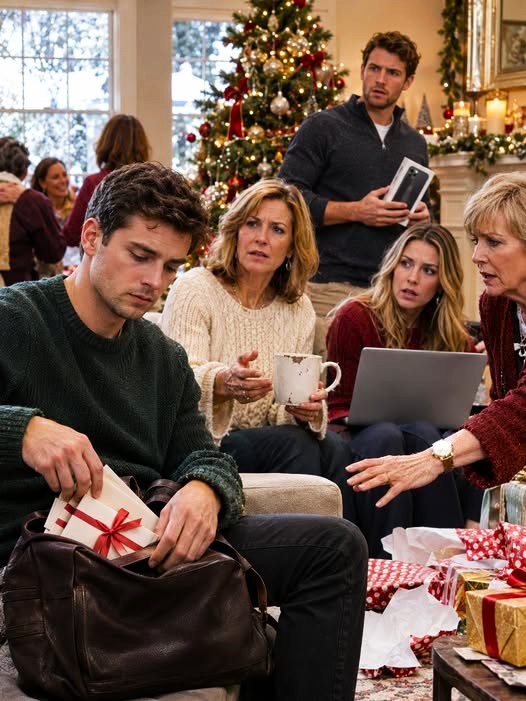
When I walked in, the living room was already chaos. My cousins were tearing through presents, paper flying everywhere.
Clara was squealing over her brand new MacBook, a silver one, exactly the kind she’d been dreaming about.
“Oh my god, mom, how did you know?” she gushed.
My mom beamed like she’d split Adams to make it happen.
Luke unwrapped the newest iPhone, still in shrink wrap.
“No way,” he yelled, immediately flipping the camera on to film himself.
My aunt clapped like it was a game show.
Everyone was loud and glowing. I stood in the doorway for a moment, snowflakes melting in my hair, clutching my carefully packed bag like it was something fragile.
When it came time for my turn, my mom handed me a small gift bag. It had a bent corner and looked suspiciously familiar.
I reached inside and pulled out a white mug. The same mug, in fact, that I’d given her last year.
I recognized the tiny chip near the handle. It even still had the faint stain of old coffee in the bottom.
“You always say you don’t need anything,” she said with a smile. “And you never make a fuss.”
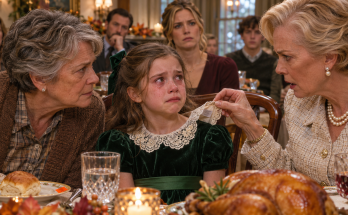
Everyone chuckled politely. No one looked twice.
My chest felt tight. Not angry tight, but disappointed tight. The kind that sneaks in when you realize slowly that you’re not invisible by accident.
You’re invisible because it’s easier for them that way.
I reached into my bag, fingers brushing against the ribbons and envelopes. I pulled them out, fanned them out like a dealer at a card table.
The room quieted just a little.
“Wo, what’s that?” Clara asked, eyes already sparkling like she knew.
“Something I prepared,” I said softly, my voice calm.
I looked around the room at the people who leaned on me, borrowed from me, depended on me.
My mom was still smiling like this with some sweet gesture. My aunt was already reaching for hers.
That was when I looked down at the envelopes again and quietly slid them back into my bag.
A flicker of confusion crossed my mom’s face.
“What’s wrong, honey?”
I zipped the bag shut.
“Nothing,” I said, standing. “Just realized something.”
I started walking toward the door. My boots squeaked on the floor.
I could feel their eyes following me, still not quite understanding.
But then I heard it, my aunt’s voice, high and sharp.
“Wait, where’s our gift?”
I turned around, the snow drifting in from the open door behind me.
“You already received your gift,” I told them. “I paid your rent all year.”
The room fell silent.
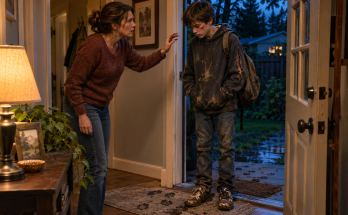
Mom and Clara rushed after me as I walked into the snow carrying the bag of envelopes I had planned to distribute as Christmas gifts.
Clara caught me beside my car. She apologized for the dirty, chipped coffee mug they had regifted to me and asked me to return for dinner.
Then her eyes moved toward my bag.
“Were those envelopes really for us?”
“They were.”
“How much?”
“Enough to make Christmas easier for everyone.”
She reached for my arm, but I gently removed her hand.
“This isn’t about the mug. Nobody sees me unless they need something. I have carried this family for years, and today, when I hoped someone might think about me, I received a used cup you didn’t even wash.”
I drove away before guilt could change my decision.
An hour outside town, I reached a quiet cabin I had rented secretly and furnished little by little. It contained everything I needed: warmth, food, a fireplace, and silence.
My phone immediately filled with calls.
Mom’s voicemail did not ask whether I was safe. She wanted to know whether I had canceled Aunt Janine’s rent payment because the landlord was already threatening action.
Other relatives accused me of being dramatic.
I opened a notebook and listed everything I had paid for without acknowledgment: Clara’s tuition, Luke’s car repairs, Janine’s rent, Mom’s credit-card balance, Dad’s medical bill, reunion accommodations, and years of Christmas groceries.
The list filled an entire page.
What I had called generosity had become servitude disguised as love.
Mom video-called again. This time, I answered.
“You’ve always been the one we could rely on,” she said.
“No,” I replied. “I’ve been the person you expected to rescue everyone.”
When she insisted that family needed me, I gave her the truth.
“I’m done being your safety net.”
For the first time, Mom had no answer.
Mom argued that the family had endured a difficult year. There was always another reason: Janine’s health, Luke’s employment, Dad’s expenses, or someone’s overdue rent.
“It is always something,” I said. “Yet none of you ever call simply to ask whether I’m all right.”
She insisted they loved me.
“You love what I do for you. That isn’t the same thing.”
Then I ended the call and turned off my phone.
The envelopes remained stacked on the cabin table, filled with thousands of dollars I had intended to give my relatives. Instead, I relabeled them for a women’s shelter, a food pantry, and a youth program that needed laptops.
I included handwritten notes but did not sign my name. I wanted the money to help people without purchasing praise.
On Christmas morning, I delivered the envelopes around town. At the shelter, a woman sweeping the sidewalk offered me a genuine smile and wished me Merry Christmas.
Back at the cabin, I made breakfast, read beside the fire, and experienced a peaceful holiday for the first time in years.
Two days later, I discovered more than forty emails and voicemails. Most contained blame or demands, but one message from my cousin Leah was different.
She apologized for assuming my support cost me nothing and thanked me without requesting anything in return.
The apology did not erase the past, but it proved that at least one person had finally seen me.
By mid-January, I canceled every recurring family payment. I removed myself from Aunt Janine’s lease arrangement, shut down the automatic transfers, and informed each service provider that I was no longer responsible.
The calls resumed, but I allowed them to reach voicemail.
For years, I had believed saying no was cruel.
Now I understood that continuously rescuing capable adults had taught them to treat my help as an entitlement.
I had not abandoned my family.
I had stopped abandoning myself.
And for the first time, my time, money, and peace belonged to me.
With my finances finally separated from my relatives, I began searching for ways to give that felt meaningful instead of compulsory.
I volunteered at a community center mentoring teenagers interested in technology. My first student was Bryson, a quiet sixteen-year-old who reminded me of myself at his age.
During our second meeting, he asked why I had volunteered.
“Because someone should show up,” I said.
He grinned. “You’re not like most people.”
“Neither are you.”
Helping Bryson felt different from paying another overdue bill. He did not treat my time as an obligation. He listened, practiced, asked questions, and brought new ideas to every meeting.
I was not rescuing him from consequences.
I was helping him build possibilities.
As the weeks passed, family calls gradually stopped. A few resentful messages arrived accusing me of selfishness, but the silence remained mostly intact.
I continued working, mentoring, and spending weekends at the cabin. The space no longer felt like an escape. It felt like a home I had deliberately chosen.
On Valentine’s Day, an unmarked envelope arrived.
Inside was a card written by Mom.
“Aiden, I’m sorry. Not because you’re gone, but because I didn’t recognize what I was doing until you left. I don’t expect forgiveness. I’m trying to become better—not for what I lost, but for what I might still become.”
I read the message twice.
Months earlier, I would have called immediately, desperate to repair everything and reassure her. This time, I placed the card on the mantel and continued with my day.
Maybe she meant it.
Maybe she would change.
Maybe she would return to the same behavior once the immediate discomfort faded.
I no longer needed to predict the outcome.
Her growth belonged to her.
My boundaries belonged to me.
Forgiveness, if it came, would not restore unlimited access to my money or make me responsible for every crisis.
For the first time, I understood that love could exist at a distance.
And distance could remain until respect made closeness safe.
The following Christmas, I did not return to the family gathering.
I stayed inside the same quiet cabin, wrapped in a blanket beside the fireplace. Snow covered the trees, and the only sounds were crackling logs and wind moving softly across the roof.
I drank hot chocolate from the chipped mug my family had regifted to me the year before.
Once, it had represented everything painful about my place in their lives: forgotten, convenient, and valued only for what I could provide.
Now it belonged to me for a different reason.
It marked the day I finally walked away.
During the past year, I learned that generosity did not require self-erasure. Support offered freely could be beautiful, but assistance demanded through guilt was exploitation.
The money once reserved for relatives had helped strangers find shelter, food, and educational opportunities. The time once consumed by family emergencies now allowed me to mentor Bryson and other young people who valued my presence more than my bank account.
Leah and I eventually began exchanging occasional messages. We moved slowly, without pretending the past had never happened.
Mom’s card remained on the mantel. I did not throw it away, but I did not treat it as a key that reopened every locked door.
An apology was a beginning.
Trust required evidence.
I had spent most of my life trying to prove I deserved a place in the family. I paid bills, solved problems, and gave until exhaustion felt normal.
Yet the moment I stopped financing their comfort, they accused me of becoming someone else.
They were right.
I was no longer the backup plan.
I was no longer an emergency fund disguised as a son, brother, or nephew.
I was a man allowed to choose where his money went, whom he helped, and which relationships entered his life.
I raised the chipped mug toward the silent room.
The object had not changed.
I had.
Outside, snow began falling again, softening the world beneath a clean white silence.
This time, nobody was chasing me down the driveway.
Nobody was asking for anything.
And I finally understood that peace was not what remained after every demand had been satisfied.
Peace was what began when I stopped answering them. THE END !
I’ve shared the complete story, and I truly hope it touched your heart. If this story moved you, Please leave a comment, like and share the post. Thank you for reading