Part 3
The cooks quietly slipped into the walk-in pantry. The server stepped through the swinging doors into the dining room, leaving only the four of us: Gus, me, Caleb… and the truth spilled out beside that backpack.
Gus crouched down and picked up a plain white envelope.
Written across the front in blue Sharpie were three words:
Mrs. Ruiz — September
He handed it to me.
Inside was exactly $240 in twenty-dollar bills.
“What is this?” I whispered.
Gus crossed his arms.
“That’s what I’ve been trying to tell you.”
I looked over at Caleb.
He was crying now, completely silently.
No loud sobs.
Just steady tears rolling down a face that suddenly looked much younger than thirteen.
Finally, Gus spoke.
“For the past six months, your son has been giving away almost every dime he earns.”
The kitchen seemed to tilt.
“Giving it away?”
Gus nodded.
“Every single Saturday.”
I stared at my boy.
“No…”
Caleb shook his head frantically.
“I wasn’t giving it away.”
“Then what were you doing?” I asked.
His bottom lip trembled.
“I was helping.”
I sank onto a stainless-steel prep stool because my legs refused to hold me up.
Gus knelt beside the scattered papers and began sorting them into neat stacks.
“This stack is prescription medicine.”
Another stack.
“This one is groceries.”
Another.
“Past-due utility bills.”
Another.
“School lunch balances.”
There were dozens of crumpled receipts.
Different names.
Different street addresses around Oregon.
Different dollar amounts.
Not a single one belonged to us.
I looked at Caleb in disbelief.
“How do you even know all these people?”
He wiped his cheek with his sleeve.
“I met one of them first.”
It had started nearly six months earlier.
During Caleb’s second weekend at the diner, an elderly woman came in around three o’clock on a Saturday afternoon.
Her name was Mrs. Elena Ruiz.
She always ordered the cheapest thing on the menu—a cup of vegetable soup and tap water.
One afternoon, Caleb noticed her quietly tucking two packets of saltine crackers into her purse.
Not out of greed.
To save for dinner later.
When Gus had his back turned, Caleb cleared her dishes into the kitchen.
“She reminded me of Grandma,” he said softly.
His grandmother had passed away before he was born, but he’d looked through enough family albums to picture her.
The following Saturday, Mrs. Ruiz didn’t show up.
One of the servers mentioned in passing that her electricity had been shut off because she couldn’t cover the bill.
Caleb asked where she lived.
The staff chuckled.
“Why do you ask, kid?”
“I just wanted to check in on her.”
They wrote down her address, thinking it was a sweet gesture.
After his shift ended, Caleb walked nearly two miles across town.
He found her sitting on her front apartment steps because the power inside was out.
“She was pretending she just wanted some fresh air,” Caleb whispered.
My heart shattered.
He took his entire day’s wages—every single dollar—and pressed it into her hand.
“She started crying,” he said.
“I told her it was just an advance from my bike savings.”
He offered a weak smile through his tears.
“She believed me.”
I pressed a hand over my mouth.
Gus picked up the story.
“I figured it out by pure accident.”
A month later, Gus noticed Caleb always asked to be paid in cash rather than a check.
He assumed the kid just liked counting his savings.
Then one evening after closing, Gus saw Caleb walk right past Cascade Outfitters without even glancing at the bike in the window.
Instead, he crossed the street into a neighborhood pharmacy.
Curious, Gus trailed behind from half a block away.
He watched Caleb pay for a box of insulin.
Not for himself.
For Mr. Whitaker, a retired auto mechanic whose health coverage had lapsed.
“I cornered him outside afterward,” Gus said.
“He begged me not to breathe a word to you.”
I looked at Caleb.
“You lied to me.”
He nodded miserably.
“I know.”
“Why?”
His answer came without hesitation.
“Because you already lost Dad.”
Those five words hit harder than anything else.
He took a small step closer.
“I didn’t want you lying awake worrying about strangers.”
I couldn’t find my voice.
He went on.
“You always tell me we can’t fix everyone’s problems.”
“I know.”
“Except I kept thinking…”
He swallowed hard.
“Maybe I could fix just one.”
Gus reached into a side pocket of the backpack and pulled out a smaller envelope.
Inside was a handful of printed snapshots.
He handed me the top one.
Caleb was carrying brown grocery bags up the steps of a mobile home.
The second showed him shoveling thick creek mud off someone’s flooded porch.
The third…
My breath caught in my throat.
Caleb stood beside a little girl in a wheelchair, both of them laughing with frosting on their noses while decorating cupcakes.
On the back, someone had written in neat cursive:
Thank you for making Chloe smile again.
I looked up at him.
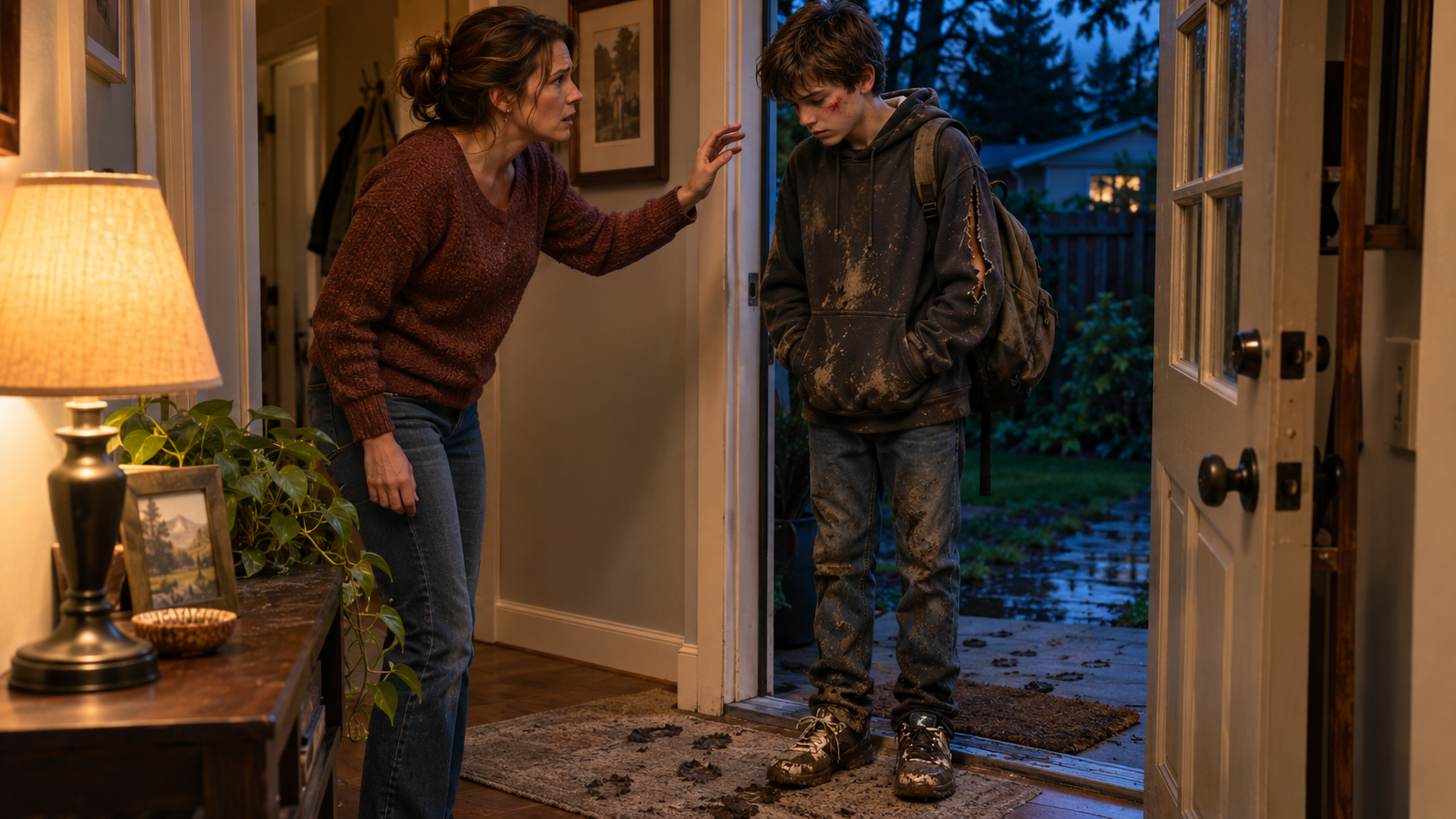
“The mud on your shoes…”
He nodded.
“That was after Amazon Creek overflowed.”
“You weren’t hurt?”
“I was helping Mr. Mercer haul his furniture out before the water ruined it.”
“And the ripped sleeve?”
“Caught it on a chain-link fence.”
I shut my eyes tightly.
Every dark scenario I had conjured up dissolved into something completely different.
Not theft.
Not trouble.
Not lies to hide bad behavior.
Just a thirteen-year-old boy quietly carrying burdens far too heavy for his shoulders.
“Then why today?” I asked Gus.
“Why did you call me right now?”
Gus let out a long sigh.
“Because today he went too far.”
He nodded toward the open backpack.
“Go ahead and tell her.”
Caleb shook his head, staring at his sneakers.
“Tell me what?”
Silence.
Finally, Gus answered for him.
“He tried to hand over his actual bike fund.”
I frowned.
“I thought he’d been spending all of it.”
Gus reached back into the bag and pulled out one last envelope.
It was noticeably thicker than the rest.
Across the front, in Caleb’s careful handwriting, were the words:
Bike Fund
Inside was $1,146.
Nearly enough.
Almost the exact sticker price of the bike he’d been dreaming about for half a year.
“I thought you said he wasn’t saving,” I murmured.
Gus smiled sadly.
“He finally started putting it away.”
Over the past seven weeks, Caleb had forced himself to hold onto one Saturday paycheck after another.
He stopped handing out envelopes.
He stopped dropping by Mrs. Ruiz’s apartment.
He stopped buying groceries for neighbors.
Every Saturday he walked past families who still needed help because, for once, he was trying to choose himself.
Until this morning.
“What happened?” I asked.
Gus lowered his voice.
“A little boy walked into the diner.”
His name was Owen.
Eight years old.
He had come in with his older teenage sister.
Their mother had collapsed at home the night before and was in the ICU at the hospital down the road.
The sister had four dollars and change in her pocket.
She asked if they could split a single order of pancakes.
Caleb overheard from the dish window.
He disappeared into the staff restroom with his backpack.
When he walked back out, he marched straight up to the front counter and emptied his bike envelope onto the laminate.
Every cent of the $1,146.
“I told him absolutely not,” Gus said.
“I shoved the cash right back at him.”
Caleb looked at me pleadingly.
“I only wanted to cover a couple nights at the hotel near the hospital.”
“You were going to give them every dollar you had.”
He nodded quietly.
“I still have two good legs.”
I stared at my son.
“What about the bike?”
“I can walk.”
Those three words broke whatever composure I had left.
I crossed the kitchen in two strides and pulled him into my arms.
For the first time in months, he cried like a kid.
Not silently.
Not trying to act tough.
He buried his face against my shoulder and wept.
“I’m sorry I lied, Mom.”
“I’m so sorry.”
I held onto him tighter.
“You don’t ever have to carry the whole world on your own.”
Behind us, Gus quietly dabbed his eyes with a clean dish towel.
Then he cleared his throat.
“There’s… one more thing you two ought to see.”
I looked over my shoulder.
The look on his face told me the biggest shock of the day hadn’t happened yet.
Gus reached beneath the counter and placed a thick cream-colored envelope into my hands.
Written across the front were signatures.
Dozens of them.
Every cook and server in the diner.
Every Saturday morning regular.
Even names I didn’t recognize at all.
Puzzled, I lifted the flap.
Inside was a bank cashier’s check.
I read the number once.
Then I read it again.
$7,500.
Tucked beneath it was a handwritten card:
For the boy who thought kindness had to stay a secret. It doesn’t.
I looked up in complete shock.
Before anyone could explain where the money had come from, the brass bell over the front door jingled.
And nearly every person whose name appeared on Caleb’s receipts began walking into the diner.
Part Four
The little brass bell above the diner door chimed once.
Then again.
And again.
I turned slowly, still clutching the envelope with the $7,500 check, as people began filing into the dining room one after another.
Mrs. Elena Ruiz walked in first, wearing the same faded lavender cardigan Caleb had described to me weeks ago. She leaned on a wooden cane, yet her smile seemed bright enough to light up the whole room.
Right behind her came Mr. Whitaker, the retired mechanic.
Then Mr. Mercer, whose flooded mobile home Caleb had helped save.
A young mother pushing a wheelchair.
A pediatric nurse still wearing blue scrubs.
A teenage girl holding the hand of her younger brother.
Within two minutes, nearly thirty people stood quietly among the booths.
Nobody said a word.
Every single pair of eyes was fixed on my son.
Caleb instinctively stepped half a pace behind me.
“Gus…” he whispered nervously. “What did you do?”
Gus smiled warmly.
“I told everybody the truth.”
The stories I never knew
Gus pulled two vinyl chairs into the center of the aisle.
“Sit down, you two,” he said.
I sat, still completely overwhelmed.
Mrs. Ruiz stepped forward first.
She opened her purse and pulled out a folded electric bill.
The word Paid was stamped across the top in red ink.
She laid it gently on Caleb’s knee.
“You kept a roof over my head,” she said softly. “I never got the chance to thank your mother.”
Tears welled up in my eyes.
“I had no idea,” I whispered.
She patted my hand kindly.
“He made me swear not to tell.”
One by one, the others stepped up.
Mr. Whitaker held up his insulin box.
“I was rationing one vial to last three weeks. Your boy noticed my hands shaking at the counter before anyone else did.”
A single dad named Marcus unfolded a crumpled supermarket receipt.
“My twin boys had dinner that week because of him.”
The teenage girl introduced herself as Hannah.
“When my little brother needed sneakers for gym class, Caleb left an unmarked envelope in our mailbox.”
She smiled through her tears.
“Except I recognized his handwriting from school.”
I turned to look at my son.
“How many people did you help?”
He gave a small, embarrassed shrug.
“I didn’t keep track.”
Gus answered for him.
“Twenty-three families.”
The dining room went completely still.
Twenty-three.
My thirteen-year-old son had quietly become the person neighbors leaned on when life fell apart.
And the whole time, I thought he was just saving up for a bicycle.
Why he kept it a secret
I took Caleb’s hand in mine.
“Look at me, sweetheart.”
He raised his eyes.
They were red and puffy from crying.
“You should have told me.”
“I wanted to.”
“Then why didn’t you?”
He drew in a shaky breath.
“Because right after Dad died…”
His voice broke.
“…everyone kept dropping off casseroles and grocery gift cards.”
I remembered those weeks vividly.
Neighbors.
Folks from church.
People from David’s office.
For months, quiet generosity had kept us going.
“I hated watching you cry every time somebody helped us,” he continued softly. “I figured if I became the one helping instead… maybe nobody else would have to feel that way.”
I couldn’t hold back the tears anymore.
There are rare moments when your child says something so honest it permanently changes how you see the world.
This was mine.
The envelope
Gus finally nodded toward the cashier’s check in my lap.
“Go on,” he told the room.
“Explain it to him.”
Mrs. Ruiz chuckled softly.
“Oh, honey… that isn’t a handout.”
Mr. Mercer nodded in agreement.
“Consider it paying back a debt.”
Caleb blinked in confusion.
“For what?”
Gus leaned back against the lunch counter.
“Three weeks ago, I caught you trying to quietly replace the tip jar cash you’d borrowed to buy groceries for Hannah’s family.”
Caleb’s ears turned bright red.
“I was putting every dollar back.”
“I know you were.”
“So I pinned a snapshot of you onto the community corkboard by the register.”
“You what?”
Laughter rippled through the diner.
Gus grinned.
“I wrote one line underneath it: Has this kid ever helped you out?”
Within forty-eight hours, regulars started stopping back in.
Some dropped off handwritten thank-you notes.
Others brought snapshots.
Dozens left cash in the jar.
Nobody was solicited.
Nobody was pressured.
They simply wanted to return a fraction of the kindness Caleb had poured into the neighborhood.
When Gus tallied it all up at the bank, it came to $7,500.
Not because Caleb needed rescuing.
Because gratitude had finally found its way back to his doorstep.
One condition
Caleb slowly slid the check back across the small table.
“I can’t keep this.”
Mrs. Ruiz furrowed her brow.
“Of course you can.”
“No…”
He shook his head firmly.
“That’s way too much money.”
Gus smiled broadly.
“That’s the exact answer I figured you’d give.”
He reached into his apron pocket and pulled out a second, smaller envelope.
“This one has your name on it.”
Inside was a cashier’s check for a much smaller amount.
$1,299.
The exact price of the matte-black bicycle with crimson lettering.
Caleb stared at the figures.
“You… you even included sales tax.”
Gus winked.
“And a decent helmet.”
The entire diner burst into laughter.
“What about the rest of it?” Caleb asked.
Gus glanced around at the crowd.
“We came up with a plan.”
The Neighbor’s Table
The very next Saturday, Gus closed the diner two hours early.
Not for cleaning.
For something brand new.
Working side by side, the neighborhood built what they named The Neighbor’s Table.
Just inside the front entrance stood a handcrafted pine cabinet stocked with canned goods, diapers, toiletries, school notebooks, and local grocery vouchers.
Anyone could take what they needed.
Anyone could leave what they had to spare.
No paperwork.
No questions asked.
No shame.
Mr. Whitaker started fixing neighborhood kids’ bikes on the back patio for free.
Hannah volunteered to tutor younger students at the corner booth after school.
The nurse organized free monthly blood-pressure checks.
Mrs. Ruiz knitted warm baby blankets for new mothers.
And Caleb?
Gus strictly forbade him from spending another dime of his own paycheck.
Instead, Gus appointed him official bookkeeper for The Neighbor’s Table.
“If you’re going to look out for folks,” Gus told him, “you might as well learn how to build something that lasts.”
For the first time, my son wasn’t trying to carry the entire neighborhood on his back.
The neighborhood was carrying itself.
The bicycle ride
Two days before his fourteenth birthday, I walked down Willamette Street with Caleb to Cascade Outfitters.
The same storefront window.
The same bike.
The shop manager grinned the second the door chime rang.
“I was wondering when you’d finally show up.”
Caleb glanced over at me.
“You knew?”
The manager chuckled.
“Half of Eugene knew, kid.”
He rolled the bicycle out onto the sidewalk.
Matte black.
Crimson lettering.
Every bit as sharp as Caleb had pictured.
As Caleb swung his leg over the frame, I spotted a small kraft-paper tag tied beneath the saddle.
To Caleb—Never stop moving kindness forward.
He pushed off slowly across the brick courtyard.
Then he picked up speed.
The widest, brightest grin I’d seen since his father passed away spread across his face.
For one golden afternoon, he wasn’t the boy shouldered with everyone else’s worries.
He was simply a fourteen-year-old kid riding the bicycle he had worked so hard for.
Watching him coast down the tree-lined sidewalk, I finally understood what Gus had grasped long before I did:
My son hadn’t lied because he wanted to deceive me.
He lied because he believed kindness works best when nobody knows who started it.
Sometimes the biggest hearts still fit inside a thirteen-year-old kid—and when a community steps up to protect that heart, generosity grows into something far bigger than one child could ever hold alone.
Part Five
Three months rolled by.
Life gradually settled into a rhythm that felt almost normal again.
Caleb still washed dishes every Saturday at Gus’s Diner, except now his wages went straight into a youth savings account we opened together at the credit union. He still helped stock The Neighbor’s Table, only now he wore a laminated volunteer badge instead of sneaking envelopes of cash around in his backpack.
For the first time since my husband died, I heard him laugh out loud every single day.
I truly thought the story had reached its ending.
I was wrong.
On a rainy Thursday afternoon in November, a certified letter arrived in our mailbox addressed to Caleb Miller.
Not to me.
To my fourteen-year-old son.
The return address belonged to an estate law firm in Portland I had never heard of.
Caleb looked at me nervously.
“Did I do something wrong?”
“I seriously doubt attorneys send teenagers birthday cards,” I teased, trying to ease his nerves.
Inside was a single sheet of letterhead.
We represent the Estate of David Miller. Please contact our office regarding unclaimed property belonging to your late father.
My fingers went numb.
David.
My husband.
He had been gone for over three years.
I had handled the memorial service, the life insurance, the medical bills, the probate paperwork—everything I believed existed.
What property could possibly still be out there in his name?
The forgotten storage unit
The attorney explained that during a statewide audit of delinquent commercial leases, a small storage facility on the edge of town had flagged a unit still registered under my husband’s name.
The company had been sending notices to an old work address for years.
Because David had passed away so abruptly, the automatic payments had quietly lapsed and the paperwork had slipped through the cracks.
Legally, the contents belonged to Caleb.
The following Saturday morning, we drove out to the facility.
The manager unlocked the padlock and rolled up the corrugated steel door.
Dust motes danced in the pale morning light.
At first glance, it looked like ordinary garage overflow.
Fly-fishing rods.
Foldable camp chairs.
Bins of tangled Christmas lights.
Then, pushed against the back wall, we spotted a solid cedar chest with David’s initials burned neatly into the lid.
D.M.
Caleb looked over at me.
“Can we open it?”
I nodded silently.
Inside were neatly labeled photo albums, leather-bound journals, my preserved wedding veil… and a sealed ivory envelope with my name written across the front.
Seeing his handwriting stole the breath right out of my lungs.
I slid my finger under the flap with trembling hands.
His father’s final letter
Sarah,
If you’re reading this, then something happened to me before I ever got the chance to bring this chest home.
I started putting this together for Caleb the week he was born. Every year on his birthday, I tucked away one thing I hoped he’d appreciate someday—not valuables, just reminders of where he came from.
If I’m not there, tell him the only thing I ever dreamed of was watching him grow into a good man. Not a wealthy man. Not a famous one. Just a genuinely good one.
By the time I reached the bottom of the page, tears blurred every line.
Caleb asked softly, “Can I read it?”
I passed the letter to him.
He read every word twice.
Then he pressed the paper flat against his chest.
“I think…” he whispered, “…Dad already knows.”
One last surprise
Tucked underneath the stack of journals was a small gray metal lockbox.
Inside wasn’t a fortune.
Just $4,860 in U.S. savings bonds David had purchased steadily over thirteen years.
Each certificate had a yellow sticky note attached to the corner.
Age 5 – For your first big dream.
Age 8 – For when you discover real adventure.
Age 13 – For the bicycle I know you’re going to want.
I let out a wet laugh through my tears.
“So your dad really did have you figured out.”
Caleb grinned so wide his cheeks ached.
“I wish I could tell him I already got one.”
The estate attorney helped us cash in the matured bonds the following week.
After interest and taxes, the total came to just over $6,100.
Enough to do real good.
Not enough to change our lifestyle.
Unless we decided to use it that way.
The decision
That evening, I assumed Caleb would talk about upgrading his bike gear or putting everything toward college tuition.
Instead, he spread the bank statement across our kitchen table and opened a spiral notebook.
“What are you working on?” I asked.
“Drafting a budget.”
I smiled.
“For what?”
He wrote one title neatly across the top line.
The David Miller Kindness Fund
I stared at the page.
“You don’t have to do that, Caleb.”
“I know.”
He glanced up at the framed wedding photograph of his father hanging above the mantel.
“I just want Dad’s name to keep helping folks around here.”
We sat down and worked it out together.
Half of the money went straight into Caleb’s college fund.
The other half became a dedicated emergency reserve managed through The Neighbor’s Table—set aside strictly for local families hit by sudden medical crises or utility shutoffs.
No press releases.
No ribbons to cut.
Just quiet, practical help.
Exactly the way David would have done it.
Exactly the way Caleb had been living all along.
Five years later
Gus’s Diner looked a little different now.
The dining room had fresh sage-green paint.
The vintage cash register had finally been retired for a digital screen.
Yet one fixture stood in the exact same spot.
Right beside the front door stood the pine cabinet of The Neighbor’s Table.
It had grown considerably over the years.
Three narrow shelves had expanded into twelve sturdy cubbies.
Local teenagers and retirees kept it stocked every single weekend.
Hanging directly above it was a framed photograph.
Not of a mayor.
Not of a wealthy donor.
Just a grinning thirteen-year-old boy holding a wet dish towel with a smudge of soap suds on his cheek.
The brass plaque mounted underneath read:
“Kindness grows when someone goes first.” — In honor of Caleb Miller, whose quiet generosity inspired this entire town.
I stood beside Gus during the five-year anniversary open house as high school volunteers unpacked boxes of pantry staples for families they’d never even met.
A little boy tugged gently on the sleeve of Caleb’s jacket.
He couldn’t have been more than seven or eight.
“Excuse me… are you Caleb?”
Caleb knelt down to eye level.
“Yeah, buddy. That’s me.”
The boy pointed up at the framed picture above the shelves.
“Is that really you?”
Caleb chuckled warmly.
“Sure is.”
“Were you famous or something?”
Caleb glanced over at me, then at Gus, and smiled the exact same gentle smile his father used to wear.
“No,” he told the boy.
“I was just a dishwasher.”
The little boy thought that over for a second.
Then he beamed.
“I think that’s way cooler.”
As I watched my nineteen-year-old son help him lift a crate of canned peaches onto the bottom shelf, I realized that matte-black bicycle had never really been the destination.
It was just the starting line.
And the greatest inheritance my husband ever left our son wasn’t locked inside a cedar chest or tucked into old savings bonds.
It was the quiet courage to choose kindness, even when nobody is watching.
The End