PART 2 : The Balances on Page Twenty-Eight
“Conrad, there’s something you need to see.”
Pierce moved his hand away from the keyboard.
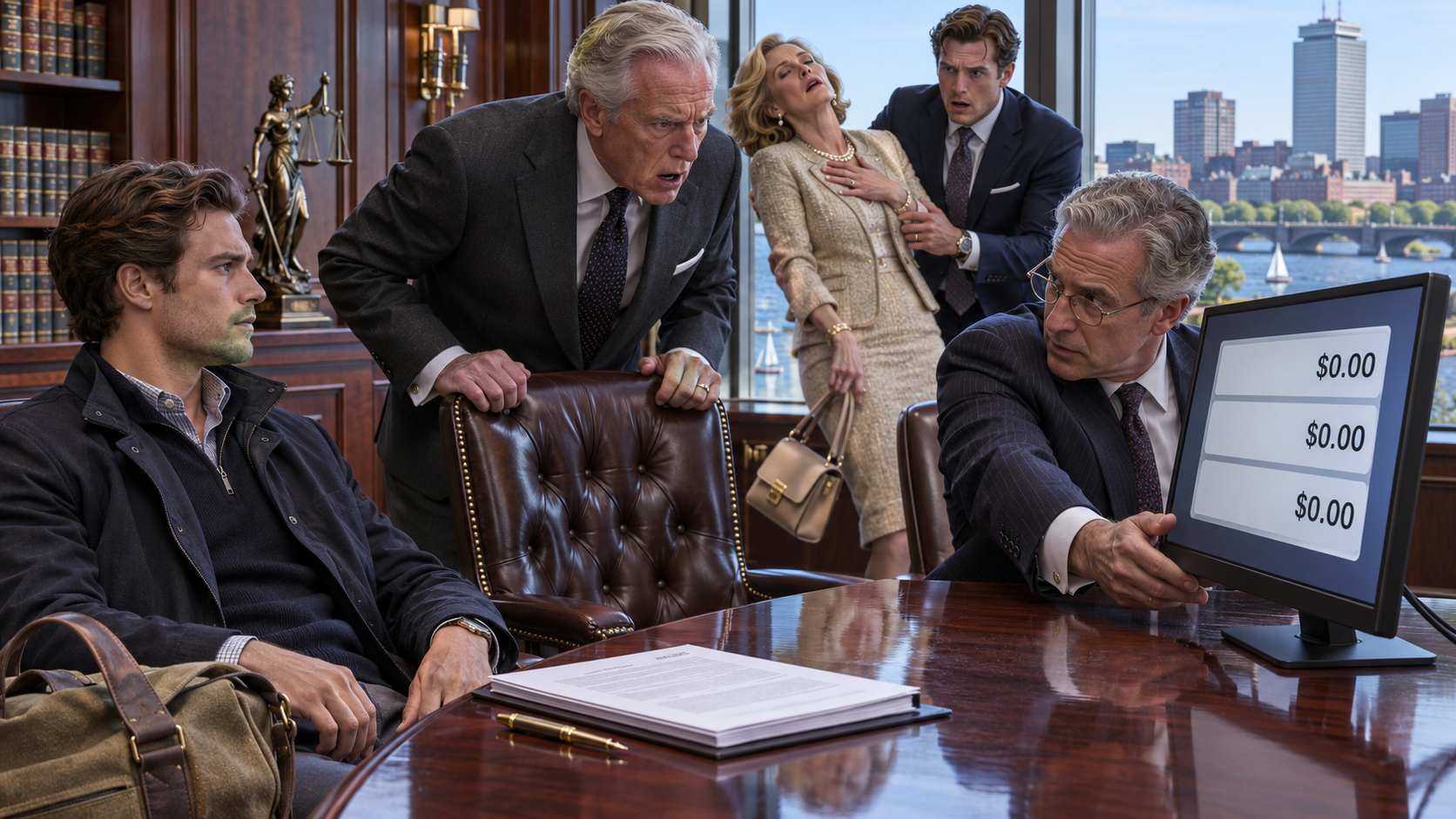
Three rows filled the wall monitor. I recognized the last four digits in each one. Below them, in the same plain type the custodian used for every statement I’d ever opened, were three balances of zero dollars and zero cents.
Dad bent over Pierce’s shoulder.
“You’ve got the wrong accounts.”
Pierce glanced down at page twenty-eight.
“These are the accounts in the agreement.”
“Then pull up yesterday.”
“That’s what I’m looking at.”
Behind me, a handbag hit the floor.
Desmond caught Mom under the arms. I got out of my chair to help him lower her, and Pierce called for someone at the front desk to get help. By the time one of the staff came in, Mom’s eyes were open. She kept asking why she was on the carpet.
Nobody mentioned lunch.
When the paramedics arrived, I moved the leather chairs so they could reach her. Dad stood beside the windows with his arms folded. He watched them ask her questions, but when one of them asked whether a family member could tell them what had happened, he looked at me.
“She fainted,” I said. “She was standing right there.”
Mom reached for my wrist as they helped her onto the stretcher.
“You’ll come with me?”
“Yes.”
Dad waited until they’d wheeled her into the hall.
“Preston. A word.”
I went back for my duffel. Dad had picked up the fountain pen and was rolling it between his palms.
“Where did you put it?”
Desmond stood by the door with Mom’s handbag tucked under one arm. He looked from Dad to me. For the first time all morning, he seemed willing to wait for an answer.
“With a different custodian,” I said. “Silas helped with the transfer. It finished last week.”
“You moved ten million dollars without telling me?”
“I told the people who needed to know.”
Pierce shut the folio. Dad put his palm on it before he could take it off the table.
“Change the account numbers.”
Pierce looked at Dad’s hand.
“Conrad. Let go of the folder.”
Dad did. I’d spent years watching people obey him because he could make a request sound like the last warning they were going to get. Hearing someone use that same tone on him was almost stranger than seeing all those zeros.
“You were going to sign,” Dad said to me. “You told your brother you understood.”
“I told Desmond I’d meet with Pierce.”
I took my copy of the agreement and opened it to page twenty-eight. The page listed every old account, followed by the powers Dad wanted over them. He could direct transfers and authorize payments to third parties. The signature lines near the end were highlighted in yellow. Nobody had marked the paragraph that mattered.
“I read this before I came,” I said. “Did you expect me to stop at the yellow tabs?”
Desmond put Mom’s purse on the table.
“You told me he didn’t know about Florida,” he said to Dad.
It was the first honest thing anybody in my family had said in that room. It came out so plainly that I almost missed it.
Dad turned on him.
“You could try keeping your mouth shut for once.”
“I know about the lawsuit,” I said. “I know they’re asking for nine and a half million.”
Desmond’s face went blotchy above his collar.
“That’s what they’re asking for. That doesn’t mean they’re owed it.”
“Then why did you need my signature before I left?”
He picked up Mom’s handbag again. One of the handles had folded under the other. He kept trying to straighten it with his thumb.
“The people I brought into the deal are calling me at home,” he said. “One of them is a guy I’ve known since college. He calls, I let it ring, and then I sit there trying to think when I started doing that.”
I’d expected to feel better when I finally heard him admit he needed something. All I could think of was that he could have called me and said exactly what he’d just said. I would have listened.
Dad pulled out a chair.
“Sit down, both of you. We can still work something out.”
“Mom asked me to go with her.”
“She’s being taken care of.”
“She asked for me.”
I slung the duffel over my shoulder. Before I left, I put the agreement back on the table in front of Pierce.
“Please send me an electronic copy of this exact version.”
He looked at Dad, then at me.
“I’ll send it this afternoon.”
I caught up to the paramedics at the elevator. Mom saw me and briefly closed her eyes. Then she held out her hand again, and I took it.
END PART 2
PART 3 TITLE: What My Mother Knew
At the hospital, a nurse asked if I could find Mom’s insurance card. I opened the handbag Desmond had handed over in the hallway and found three lipsticks, a packet of tissues, and a little zippered wallet I remembered buying her for Mother’s Day when I was sixteen.
The zipper still stuck at the corner. I remembered being embarrassed when she opened it because I’d paid for it with my own money and discovered too late that it came in a cardboard sleeve instead of a box.
I worked the zipper loose and gave the nurse the card.
Once we were alone again, Mom pointed at the duffel under my chair.
“Is that everything you’re taking to London?”
“My boxes went ahead. That’s what I need until they get there.”
“How many boxes?”
“Six.”
She nodded. She looked like she was trying to picture the contents of each one.
“Your father told me he was asking you for a loan.”
I waited.
“Then I saw the paperwork,” she said.
“When?”
“Last Sunday.”
She’d sent the sweet-boy text that morning. I unlocked my phone and found it again. I could see her watching my face as I read.
“You said he was proud of me.”
“I wanted you to come.”
“I would’ve come if you’d asked me to talk.”
“I know that now.”
I set my phone down on the edge of her bed.
“Did you know somebody tried to get into the accounts?”
She smoothed the paper blanket across her lap.
“I was there when your father tried. He said he wanted to see what was available before he spoke to you.”
“Before dinner?”
“Yes.”
I looked out into the hallway. A woman stood at the nurses’ station in socks, holding a cup of ice. I listened to her ask where she could get a spoon. I needed half a minute before I trusted myself to speak.
“I picked that restaurant because you said you’d always wanted to go,” I said.
Mom pressed her lips together.
“I remember.”
“I was going to ask if you wanted to see London with me before I started work. I already knew which hotel you’d like.”
She put her head back against the pillow.
“Why didn’t you ask?”
“By the time the check came, I didn’t want to anymore.”
I’d carried that detail around for six months. Saying it out loud took less time than it had taken the waiter to set down the check between us.
Mom asked if Desmond knew what Dad was planning to do with the authority in the agreement. I told her what he’d said after she left. Neither of us could say how much he knew. He’d spent so much of his life being told that Dad would handle things that I could imagine him seeing the signature page and choosing to stop reading there.
“Did Dad promise him the full amount?” I asked.
“He said he could buy him time to make a deal. He told me if it worked, you might never even know.”
I waited for her to soften it. She picked at a loose thread on her sleeve and let the words sit there.
“Do you remember the Porsche?” I asked.
“Of course.”
“I told you I didn’t have enough money for textbooks. You said to call your father.”
“I remember that, too.”
“He said to call you.”
Her hand went still.
“I thought we’d put the money back before you needed it,” she said.
“Did you ever start?”
“No.”
I could have told her what I’d earned on my first overnight shift at the data center. I knew it down to the cent for years because I used to divide my grocery bill by my hourly wage in the checkout line. I’d rehearsed telling her about those nights every time she mentioned how well I’d turned out. In the hospital room, after hearing her say no, I found I didn’t need to do it.
She asked whether I was still flying on Friday.
“Yes.”
“I thought you might stay a few more days after this.”
I reached down and zipped the duffel pocket I’d left open.
“Dad can come get you. If you’d rather go home with me, I’ll take you.”
She looked at the empty chair beside me.
“Would you take me home?”
I stayed until she was discharged, and we took a cab to the penthouse. I went up with her and filled the kettle. Dad’s wineglass from the night before was still on the kitchen counter. She saw me notice it and moved it into the sink.
“Will you tell me the name of the new place?” she asked.
For half a second, I thought she meant my street in London.
“The accounts,” she said. “I want to know you’re all right.”
“I am all right, Mom.”
She stood with her hand on the kettle until it clicked off. Then she asked if I wanted tea before I went. I said yes.
She poured two cups. She didn’t ask me again.
END PART 3
PART 4 TITLE: The Call Before Boarding
Pierce’s email arrived that afternoon. Attached was the agreement I’d seen, right down to page twenty-eight. In the office, with Mom on the floor and Dad still gripping a chair, I’d barely glanced at the signature line beneath my own.
The email gave me time to read it.
Dad was supposed to sign there to accept the authority I was giving him. His signature was already on the page. Mine was the only blank.
I sent the document to my own attorney. Then I called Silas.
“Did you sign anything?” he asked.
“No.”
“Did you give them any details about where the money went?”
“No.”
“Good. How are you doing?”
I’d been ready for more questions about the agreement. That one took me a second.
“My mother went to the hospital. She’s home now.”
“I’m glad she’s home.”
I heard him set something down on his desk.
“Did my grandmother ever tell you why she picked me?” I asked.
“She did.”
Silas waited. He’d known her long enough to pick up her habit of leaving an extra moment after a difficult question, in case the person asking it wanted to take it back.
“She told me you showed her your first pay stub from that overnight job,” he said.
“I did. I was trying to prove I could cover school.”
“She knew what you were doing. She also knew you were eighteen, and you’d come to her with a budget and a bus schedule because your parents had spent the money they promised you.”
I could still picture her spreading the bus schedule flat on her kitchen table. She had made me show her where I transferred after midnight. Then she’d gone to the pantry and put bread and peanut butter into a paper bag for me to take to work.
“She offered to help with tuition,” I said. “I asked her to give me a semester to see if I could do it myself.”
“She talked about that semester for the rest of her life.”
After we hung up, I sat on the floor of my apartment. My bed was gone. My kitchen held one fork and a coffee mug wrapped in a dish towel. I thought about calling my grandmother for so long that my thumb found her old entry in my contacts before I realized what I was doing.
I left her number there.
On Thursday evening, Desmond called. He asked if he could come by. I told him I’d meet him downstairs and found him on the front steps in jeans, turning his car keys over in his hand.
“I need to tell you something about the Porsche,” he said.
“You knew where the money came from.”
He looked up.
“Mom told me before we went to pick it up. Dad said there’d be more money by fall. I didn’t ask where it was supposed to come from.”
A bus stopped at the corner. A few people got off, and Desmond waited until they’d walked past us.
“The first week you were working nights, I remember you asking if I could drop you off. I said I had plans.”
“You did have plans.”
“I was going to a movie, Preston. I could’ve dropped you off.”
I remembered that night. It rained, and the paper lunch bag tore while I was waiting to change buses. One of the sandwiches fell out. I ate the other one at four in the morning and watched the clock until my shift ended.
I’d never told him. I told him then.
He sat down on the step.
“I’m sorry.”
I sat beside him. We watched a woman across the street back her station wagon into a parking space, pull out, and try again.
“Dad still thinks you’ll help if he can get you on the phone by yourself,” Desmond said.
“Do you?”
He put his keys in his pocket.
“I was thinking I’d ask you for the money when I got here.”
I looked at him.
“I know,” he said. “I heard myself say that, too.”
“Do you have a lawyer of your own?”
“Yes. I talked to her today. She asked for records I should’ve given her weeks ago. I’m bringing them in tomorrow.”
He rubbed his hands on his jeans. He’d come without a jacket. I could see he was cold, but neither of us got up.
Finally, he asked what time my flight was.
“Seven forty.”
“Want a ride?”
“I’ve already booked one.”
“Okay.”
He stood up and took two steps down the sidewalk. Then he came back and shook my hand. We’d never done that before. I put my other hand on his shoulder for a second, and he went home.
Dad called while I was waiting to board the next evening.
“I talked to a broker,” he said. “About selling the place on the Cape.”
I shifted the phone to my other ear. Across from me, a little boy was trying to lift a carry-on onto a chair while his father held it steady by the handle.
“Your mother and I bought it before you were born,” Dad went on. “You learned to swim out there.”
“I remember.”
I remembered him standing in water up to his chest, holding both hands out while I tried to make it from the ladder to him. He’d spent most of a Saturday doing that. When I finally reached him on my own, he lifted me so high out of the water that I could see the people eating lunch on the deck.
Dad cleared his throat.
“I told Desmond I’d cover the next bill from his lawyer. After that, we’ll see what the house is worth.”
I waited to see if there was a question coming.
“What gate are you at?” he asked.
I told him.
“You always hated that airport,” he said.
“You used to buy me those cinnamon rolls when you took me there.”
“You wanted the ones in the middle of the pan. You said the outside ones were too hard.”
They announced my boarding group. I stood up and put the duffel strap over my shoulder.
“I have to go, Dad.”
“All right.”
I heard him take a breath. He could have asked me for the money then. I stayed on the line long enough to let him decide.
“Call your mother when you land,” he said. “She’ll be awake.”
“I will.”
END PART 4
FINAL PART TITLE: The First Key That Was Mine
My boxes arrived in London on a wet Monday, twenty minutes before I needed to leave for work. The delivery driver carried the last one up the narrow stairs and asked if I’d just moved in.
“On Saturday,” I said.
He handed me a little black pen to sign for the delivery.
I counted all six boxes. I signed, gave him back his pen, and used my new key to lock the door behind me.
That evening I unpacked the coffee mug, two shirts, and the framed photograph of my grandmother I’d wrapped in a winter sweater. In the picture, she was sitting on the low wall outside her house with one hand raised to shield her eyes. I’d taken it while she was trying to get me to come inside for lunch.
I set it on the kitchen windowsill. From the street, I could hear the grocer next door pulling down his metal shutter.
My phone buzzed. Mom had sent a picture of the table by her kitchen window, where she kept an old clock nobody in the family knew how to set properly.
What time is it where you are? she’d written.
I told her. She sent back a photograph of a handwritten note she’d propped against the clock with the time difference on it.
For the next few months, we called on Sundays. At first there were some long silences. Without family business to discuss, she had to learn things like what I bought at the grocery store and whether I ate lunch at my desk. I learned she’d taken up swimming again, at a pool two blocks from the penthouse. She went at six in the morning because that was when she could get a lane to herself.
One Sunday, she asked if I remembered the name of the restaurant where I’d told them about London.
I told her.
“Before we went,” she said, “I called your aunt to tell her what your company had offered you. I read her the message you sent me about the job.”
“You did?”
“Twice. She said she could hear me smiling over the phone.”
I sat down at my small kitchen table.
“I should have said it to you while you were sitting across from me,” she said.
I let her finish.
“I was proud of you that night, Preston. I’m proud of you now.”
“Thank you, Mom.”
We stayed on the phone for another twenty minutes. She told me what was wrong with her swimming goggles. I told her there was a fox that crossed the street outside my flat in the early mornings. When we hung up, I realized I’d forgotten to turn on the lamp. I’d been sitting there watching the light go out of the sky.
Dad sold the Cape house the following spring. He told me himself after the closing. The new owners had two small children and wanted to know if he’d leave the old dock ladder in place.
“I said yes,” he told me. “Didn’t see any reason they should have to buy another one.”
He used part of the proceeds for Desmond’s defense. Desmond eventually told me the Florida case had settled. The agreement called for payments over time, and he’d gone back to work for another developer on a salary. He said the hardest part of the new job was sitting quietly when somebody else ran a meeting. Then he laughed at himself.
“Apparently people can finish a meeting without me talking,” he said.
“I waited a long time for you to make that discovery.”
He laughed harder at that. Afterward, he asked what I did all day in London. I told him. Once or twice I caught myself waiting for him to cut in. He stayed with me until I finished.
The first time I went back to Boston, I met Dad for coffee near my hotel. He was already in a booth when I arrived. He’d ordered two cinnamon rolls and slid one across the table to me.
He waited until I’d tried it.
“Middle of the pan?” he asked.
“Close enough.”
He smiled briefly. Then he folded the paper napkin under his cup until it was about the size of a postage stamp.
“I knew what was on page twenty-eight,” he said.
I put my fork down.
“I told Pierce to put it there. I thought if we got you all the way to the signature page before you had a chance to ask, you’d do what I said.”
“Were you going to tell me afterward?”
Dad looked at me. His mouth opened once before he spoke.
“I hoped I’d never have to.”
I could hear the espresso grinder behind the counter. A server stopped by with a coffee pot, and Dad covered his cup with his hand. She filled mine.
“I’m sorry I did that to you,” he said when she’d gone.
I held the cup in both hands for a while.
“I used to think you’d do something like that for me if I ever needed you,” I said. “When I saw the lawsuit, I realized what you were willing to do to me because Desmond needed you. I’m still getting used to knowing that.”
Dad looked down at the napkin he’d folded.
“I understand.”
I didn’t think he understood all of it. I believed he’d heard me. He stayed in the booth through the rest of the coffee, even when neither of us had much to say.
Before I flew home, I went to see Mom. She’d agreed to visit me in London that summer. We sat at her kitchen table and picked dates, and I pulled up the hotel I’d wanted to show her six months before that meeting. She leaned in to see the room with the little window seat.
“Could I have tea there in the morning?” she asked.
“We can have tea at my place. It’s a ten-minute walk.”
She pressed her finger to the dates on my screen so she could keep her place while she found a pen. I watched her write them on the back of an envelope and tuck it under the kitchen clock.
On the morning she arrived in London, she stood outside my building with the same handbag she’d dropped in Pierce’s office. She began to reach for it when I offered to carry her suitcase, then gave me the suitcase handle and kept the bag over her shoulder.
Upstairs, she noticed my grandmother’s photograph on the windowsill. She picked it up carefully, with both hands.
“I remember that sweater,” she said.
“She wore it all the time.”
“She did. I gave it to her.”
I put the kettle on. When I turned around, Mom had taken two cups from the open shelf and set them on the table. She pointed to the one with the chipped handle.
“Is that the mug you brought with you?”
“It’s the only one that fit in my bag.”
She gave it to me. I stepped back into the kitchen to get the milk while she pulled out her chair. By the time I sat down, she was telling me about the woman she’d met on the plane, and what she’d seen from the cab on the way over.
Outside, the grocer was raising his shutter. I’d taken the morning off.
I poured the tea and listened.