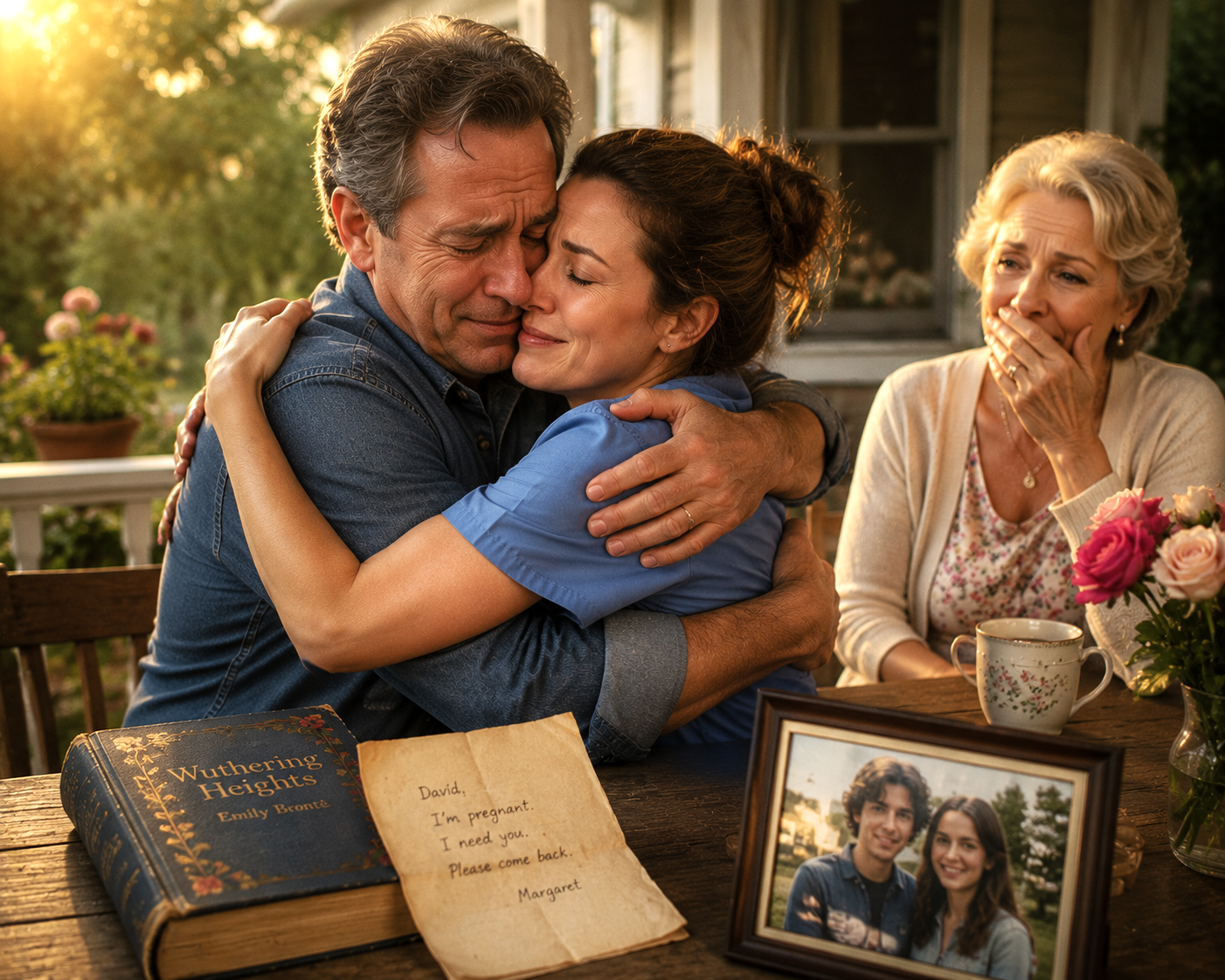
“There was a letter inside.” Silence. Not because I remembered immediately. Because some part of me already knew. Then the man spoke again, quieter this time. “It was addressed to David.” My knees nearly buckled. The pruning shears slipped from my hand into the grass. No one had said that name to me in years. Not like that. Not carefully. Not tenderly. My voice came out thin. “What did you say?” The man inhaled shakily. “I’m David Andrews.” For a moment, the world stopped. Actually stopped. No birds. No wind. No sound at all except the violent pounding of my own heart. Impossible. David was nineteen years old in my memory forever. Dark hair falling into his eyes. Laughing while driving too fast with the windows down. Kissing me behind the gymnasium after football games. Not an elderly stranger calling from a library sale. I gripped the porch railing hard enough to hurt. “You found the letter?” “Yes.” My chest tightened painfully. “Oh God.” “I almost didn’t read it,” he whispered. “But I saw my name and…” His voice cracked. Then softly, like he still couldn’t believe the words himself: “It said, ‘David, I’m pregnant. I need you. Please come back.’” I closed my eyes. Nineteen years old again. Terrified again. Pregnant and abandoned—or so I thought. Back then, David left for Chicago after his father got transferred for work. We promised we’d survive the distance. Promised to write every day. Then two months later, I found out I was pregnant. I wrote him immediately. No answer. I wrote again. Nothing. Then my mother sat beside me one night at the kitchen table and said quietly: “David called. He said he’s moved on and doesn’t want complications.” I remember feeling something inside me die. After that, I stopped writing. Stopped hoping. Stopped saying his name out loud. I raised our daughter alone. And somehow, despite everything, we built a beautiful life anyway. Emily is thirty-nine now. Brilliant. Kind. A pediatric surgeon in Boston. She inherited David’s eyes exactly. I used to notice it most when she laughed. On the phone, David spoke again. “What happened to the baby?” Baby. Not mistake. Not problem. Baby. My throat tightened instantly. “She’s a doctor in Boston,” I whispered. “She has your eyes.” The silence that followed was unbearable. Then I heard him crying. Not politely. Not quietly. Deep, shattered sobs from a man who had just lost forty years all at once. “I searched for you,” he choked out finally. “For ten years.” I stopped breathing. “What?” “After my mother died, I came back to Ashford looking for you.” My grip tightened on the railing. “Margaret… your mother told me you moved to California.” I stared blindly at the yard. “No,” I whispered. “I never moved to California.” Silence. Then one broken sentence: “She lied to both of us.” My mother. Strict. Proud. Obsessed with appearances. A teenage pregnancy had humiliated her. She spent years pretending Emily was practically adopted rather than mine. And suddenly, horrifyingly, everything made sense. The unanswered letters. The silence. The finality. She never mailed them. Or maybe she intercepted his. I slid slowly into the porch chair because my legs no longer trusted me. Forty years. Forty years stolen because one woman decided she knew best. David exhaled shakily. “I moved back here five years ago.” I covered my mouth. “Oh my God.” “And Margaret…” His voice cracked again. “I’ve been coming to that library every Saturday hoping somehow I’d run into you.” I started crying then. Not graceful tears. The kind that come from grieving decades you can never recover. Because suddenly I saw it all. Two nineteen-year-olds separated not by distance or choice, but manipulation. A father who never knew his daughter.A daughter who grew up believing she’d been abandoned. Two entire lives bent permanently by a lie. “Does she know about me?” David asked carefully. I wiped my face. “She knows your name. She knows I loved you.” “But she thinks I left.” I nodded once. His breathing hitched painfully. “I would never have left you.” That sentence destroyed me more than anything else. Because even after forty years, part of me had still wondered if maybe I simply wasn’t enough. Young love leaves scars like that. “I know,” I whispered. And for the first time in four decades, I finally did. We talked for nearly three hours. About everything. His marriages—two, both failed. My life as a single mother. The daughter we unknowingly shared from opposite sides of silence. At one point he laughed softly and said, “Does she still wrinkle her nose when she concentrates?” I blinked in surprise. “Yes.” “She did that in your ultrasound picture.” I completely broke apart after that. Because somewhere in a box in his attic, David had apparently kept the only ultrasound photo my mother allowed him to see before she erased me from his life. Before hanging up, he asked quietly: “Would she want to meet me?” I looked through the kitchen window at the framed photo of Emily smiling in her white coat. “My daughter spent her whole life wondering why her father never came back.” I paused. Then smiled through tears.
I think she deserves to know he was trying to find her.
The words came out softly, but saying them felt like opening a door that had been locked for forty years.
David was silent for a moment.
“Are you sure?” he asked.
I looked at the photograph again.
Emily, standing in her hospital coat, smiling with the same crooked smile David had when he was nineteen. The same eyes. The same habit of tilting her head slightly when she listened.
“Yes,” I whispered. “But we have to be careful.”
“Because she thinks I abandoned her.”
“Yes.”
A long silence passed between us.
Then David said something I would remember forever.
“I don’t want to walk into her life and make it about my pain.”
I closed my eyes.
Because that was the difference between the man my mother described and the man standing on the other end of the phone.
The man she told me had run away.
The man who supposedly didn’t care.
That man would have demanded forgiveness.
This man was afraid of hurting a daughter he had never met.
“I think she will want to meet you,” I said.
“How do you know?”
“Because she spent her whole life looking for pieces of you without knowing she was looking.”
He breathed out shakily.
“What do you mean?”
I smiled sadly.
“She became a doctor. She works with children. She says every child deserves someone who fights for them.”
David was quiet.
Then he whispered:
“That sounds like you.”
“No,” I said. “It sounds like both of us.”
I didn’t tell Emily immediately.
Not because I wanted to hide the truth.
Because I wanted to give her the truth in a way that didn’t feel like another wound.
For thirty-nine years, she had carried a story.
Her father left.
Her father chose not to come back.
Her father didn’t want her.
And even though I never spoke badly about David, children fill in the blanks adults leave behind.
Sometimes silence becomes its own answer.
Emily came to visit the following weekend.
She walked through my front door carrying a grocery bag and flowers, exactly like she had done a hundred times before.
“Mom, you look tired,” she said immediately.
“I’m fine.”
“You always say that when you’re not.”
I laughed softly.
Some things never changed.
We sat at the kitchen table where I had spent so many years packing her lunches, helping with homework, and pretending I wasn’t worried when she came home late.
The same table where my mother once told me a lie that changed everything.
Emily noticed the envelope beside my coffee cup.
“What’s that?”
I looked down.
The letter.
The one that had traveled through four decades waiting to be found.
“I need to tell you something.”
Her expression changed.
She put down her coffee.
“Mom?”
I took a breath.
“There is something about your father you never knew.”
She became completely still.
I told her everything.
Not dramatically.
Not with anger.
Just the truth.
The letters.
The unanswered calls.
My mother’s confession hidden inside her actions.
The phone call with David.
The book.
The letter.
The man who had spent years looking for us.
When I finished, Emily didn’t speak.
She just stared at the table.
For almost a full minute.
Then she whispered:
“He looked for us?”
“Yes.”
“All these years?”
“Yes.”
Her eyes filled.
“But I thought…”
“I know what you thought.”
She covered her mouth.
“I thought he didn’t want me.”
My heart broke.
Because that was the sentence I had spent forty years hoping she would never say.
I reached across the table and held her hand.
“He wanted you before he even knew you existed.”
She cried then.
Not loudly.
Just quietly.
The way adults cry when they finally meet the pain they have carried since childhood.
“Where is he?”
I swallowed.
“He’s still here.”
Her eyes lifted.
“What?”
“He lives twenty minutes away.”
She looked terrified.
Not angry.
Terrified.
“What if he doesn’t like me?”
I almost laughed through my tears.
Because she was thirty-nine years old.
A brilliant surgeon.
A woman who had saved hundreds of lives.
And suddenly she was a little girl wondering if her father would choose her.
“Oh, Emily,” I whispered. “He already loves you.”
We arranged the meeting at the same library where the letter had been found.
Neither of us wanted a restaurant.
Neither of us wanted strangers watching.
We wanted a quiet place.
A place where lost things were returned.
David arrived first.
I saw him standing near the window.
Older.
Gray hair.
Lines around his eyes.
But somehow, I still saw the nineteen-year-old boy underneath.
The same nervous smile.
The same hands twisting together when he was anxious.
When Emily walked in, he froze.
Completely.
I watched him look at her.
Not at her clothes.
Not at her career.
Not at the woman she had become.
He looked at the little girl he had missed.
Then he whispered:
“Your mother was right.”
Emily stopped.
“What?”
“You have my eyes.”
Her face broke.
And then something happened that none of us expected.
Emily walked across the room.
Not quickly.
Not dramatically.
Just slowly.
Like she was afraid the moment might disappear if she moved too fast.
David opened his arms.
And my daughter hugged her father for the first time.
A man she had waited thirty-nine years to meet.
A father who had waited forty years to hold her.
They cried together.
I stepped away and gave them the privacy they deserved.
Because sometimes love does not need an audience.
Sometimes it only needs a chance.
Months later, David became part of our lives.
Not in the way people imagine.
There was no magical replacement for the years lost.
No pretending forty years hadn’t happened.
You cannot erase decades.
You cannot give someone back every birthday they missed.
Every Christmas.
Every first day of school.
Every moment when a child needed a father.
But you can begin.
And they did.
David attended Emily’s birthday dinner.
He came to my garden and helped me plant roses.
He met the grandchildren she had one day hoped to have.
And every time he looked at Emily, there was still a sadness in his eyes.
Not because he regretted meeting her.
Because he regretted missing so much.
One evening, while we sat on my porch watching the sunset, David said:
“I used to think my greatest loss was losing you.”
I looked at him.
“What changed?”
He smiled sadly.
“Finding out I lost a daughter too.”
I reached over and held his hand.
“We both lost something.”
He nodded.
“But we found something too.”
A year after that phone call, I opened my copy of Wuthering Heights again.
The same worn cover.
The same yellow pages.
The same place where a letter had waited silently for forty years.
But this time, something else was inside.
A photograph.
Emily.
David.
And me.
Three people who should have been together from the beginning.
I used to think my mother stole forty years from us.
And she did.
But I learned something important.
A lie can separate people.
But the truth has a way of finding its way home.
Sometimes it arrives through a phone call.
Sometimes through an old book.
Sometimes through a letter you forgot you ever wrote.
And sometimes, after a lifetime of believing you lost everything…
you discover that the people you thought were gone were simply waiting for the right moment to return.