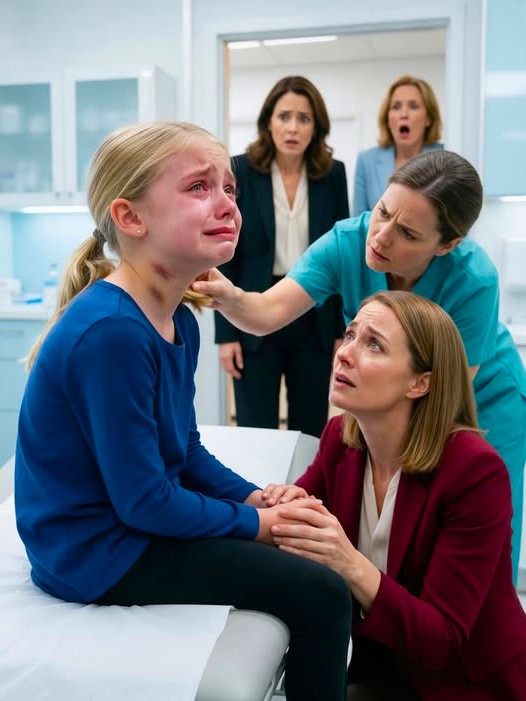
Part 1: What the Nurse Found Beneath Chloe’s Hair
At 12:15 on Tuesday afternoon, Oak Creek Elementary called to say my seven-year-old daughter was in the nurse’s office for the third time that week.
“She refuses to eat or drink,” the secretary said. “She says swallowing hurts, and she won’t stop crying.”
I left my work meeting immediately. During the drive, I remembered every warning I had noticed but explained away: Chloe tilting her head at breakfast, choosing applesauce over crackers, barely touching her meals, and sleeping with her chin tucked down beneath her blonde hair.
As a single mother juggling work, bills, and school schedules, I had blamed exhaustion. Now fear told me I had missed something important.
I reached the school at 12:27 and found Chloe curled inward on the examination table. Nurse Henderson stood beside her with a cup of water and an expression that suggested she had already reached a conclusion.
“No fever, no swelling, and her throat is clear,” she said. “Sometimes children discover that certain complaints get them sent home early.”
The calm dismissal angered me more than shouting would have. I knelt in front of Chloe and asked where she hurt.
“When I swallow,” she whispered. “And when I move.”
I noticed her chin pressed tightly against her chest and her hair covering her neck.
“Did anyone look beneath her chin?”
The nurse repeated that her throat was clear, but I was not asking about the inside. When I reached toward Chloe’s hair, she recoiled and covered her neck with both hands.
“Mommy, don’t.”
That was not stubbornness. It was fear.
I lowered my hand and asked Nurse Henderson to move Chloe’s hair. She hesitated, then gently lifted the blonde strands away from her neck.
A dark line stretched just above Chloe’s collarbone.
The nurse’s cup struck the counter as her expression changed completely.
“That isn’t a rash,” she whispered.
I took Chloe’s hands. “Sweetheart, what happened?”
Relief appeared in her tearful eyes because someone finally believed her.
“Evan called it a collar,” she said. “He told me not to tell.”
Then her voice dropped even lower.
“He said he would make it tighter next time.”
Chloe had never been pretending to avoid lunch. She had been hiding something she was terrified to explain—and the mark beneath her hair was the first evidence.
Part 2 – The Note in My Daughter’s Lunchbox Revealed What She Had Been Hiding
For a few seconds after Chloe said Evan’s name, nobody in the nurse’s office moved.
The hallway outside continued as normal.
Children laughed.
Shoes squeaked against the tile floor.
Teachers walked past carrying papers and coffee cups.
But inside that small room, everything had changed.
My daughter was no longer a child who “didn’t want to eat lunch.”
She was a seven-year-old girl who had been carrying fear around her neck and trying to survive it quietly.
Mrs. Henderson slowly stepped back.
The confidence she had walked into the room with was gone.
She looked at Chloe differently now.
Not as a difficult student.
Not as a child looking for attention.
As a little girl who had been trying to tell the truth.
“Chloe,” she said softly.
“Who is Evan?”
Chloe immediately looked down.
Her fingers tightened around the edge of her sweater.
I knew that expression.
She was afraid.
Not because she didn’t know the answer.
Because she knew what answering might cause.
I moved closer.
“Baby, you can tell us.”
“No one is angry with you.”
She swallowed carefully.
Then whispered:
“He said it was just a game.”
My stomach dropped.
“A game?”
She nodded.
“He said puppies have collars.”
“He said I had to wear one.”
I felt something inside me break.
Because children are supposed to come home from school talking about friends, homework, and playground adventures.
Not explaining why someone made them afraid to swallow.
Not explaining why they hid their pain.
Not explaining why they thought silence would keep them safe.
Mrs. Henderson immediately reached for the phone.
This time, there was no hesitation.
No frustration.
No assumption.
Only urgency.
“We need emergency services.”
The words came out quietly, but they changed the entire room.
The secretary appeared in the doorway holding Chloe’s blue lunchbox.
“I found something.”
Her voice was uncertain.
She looked between Chloe and me.
“It was underneath her thermos.”
She held up a small folded piece of pink paper.
My hands started shaking before I even touched it.
I knew.
A mother’s instinct doesn’t always know the details.
But it knows when something is wrong.
The paper had Chloe’s name written on the outside.
The letters were uneven.
Childlike.
Inside was a short message.
A few words.
Written by someone young.
But carrying something much darker than a child’s mistake.
It told Chloe not to tell anyone.
It said things would get worse if she talked.
I read it once.
Then again.
The room became blurry.
Because my daughter hadn’t been quiet because she was confused.
She had been quiet because someone had threatened her into silence.
Principal Wallace arrived moments later.
He walked into the nurse’s office with the calm expression of someone trained to handle difficult situations.
That expression disappeared when he saw Chloe’s neck.
Then he saw the note.
Then he looked at me.
“I need to contact her parents.”
I shook my head.
“First, call 911.”
My voice surprised even me.
It was calm.
Clear.
Certain.
No more waiting.
No more wondering.
No more giving adults the benefit of the doubt while my child suffered.
The principal nodded immediately.
Within minutes, the school that had treated Chloe’s complaints like a behavior problem became a scene of emergency response.
Paramedics arrived at 12:46 PM.
A woman named Denise knelt beside Chloe.
Unlike everyone before her, she didn’t rush.
She didn’t tell Chloe to be brave.
She didn’t tell her it would be quick.
She simply asked:
“Can I look at your neck, sweetheart?”
Chloe nodded.
That simple question mattered.
Because for the first time that day, an adult asked permission before touching her.
At Mercy Regional Hospital, everything moved quickly.
Bright lights.
Doctors.
Nurses.
Questions.
Forms.
I stood beside Chloe’s bed holding her hand while Dr. Priya Patel examined the mark beneath her chin.
Then she explained what had happened.
The dark line was not a bruise.
It was not a rash.
It was a thin black elastic cord.
The kind used for craft projects and cheap lanyards.
Someone had pulled it tightly around Chloe’s neck.
Her hair had hidden the back.
Her sweater collar had hidden the rest.
Every time she swallowed…
Every time she moved…
It caused pain.
I looked at my daughter.
Seven years old.
Still wearing her blue sweater.
Still clutching my hand.