“Maya Isabelle Hayes, please join me on stage.”
For 1 second, the whole auditorium seemed to tilt.
I stood because my body moved before my mind did.
When I turned toward my family, my father’s mouth was open.
My mother had stopped checking her watch.
Julian lowered his sunglasses.
I walked to the stage hearing every click of my heels against the floor.
Dean Mitchell placed a crystal award in my hands. It caught the light like ice.
“President’s Award for Undergraduate Research,” he said into the microphone. “For exceptional scholarship, discipline, and work with extraordinary medical promise.”
The applause hit me like heat.
Real applause.
Not pity.
Not politeness.
I looked into the crowd and found my family frozen in the same row where they had been so eager to be anywhere else.
For the first time in my life, they were looking at me the way they had always looked at Julian.
Like I was suddenly worth seeing.
I thought vindication would feel sharp.
It didn’t.
It felt quiet.
Because the award was not the secret.
The award was only the door opening.
Dean Mitchell turned back to the microphone.
“There is one more announcement regarding Miss Hayes,” he said.
My pulse slammed once, hard.
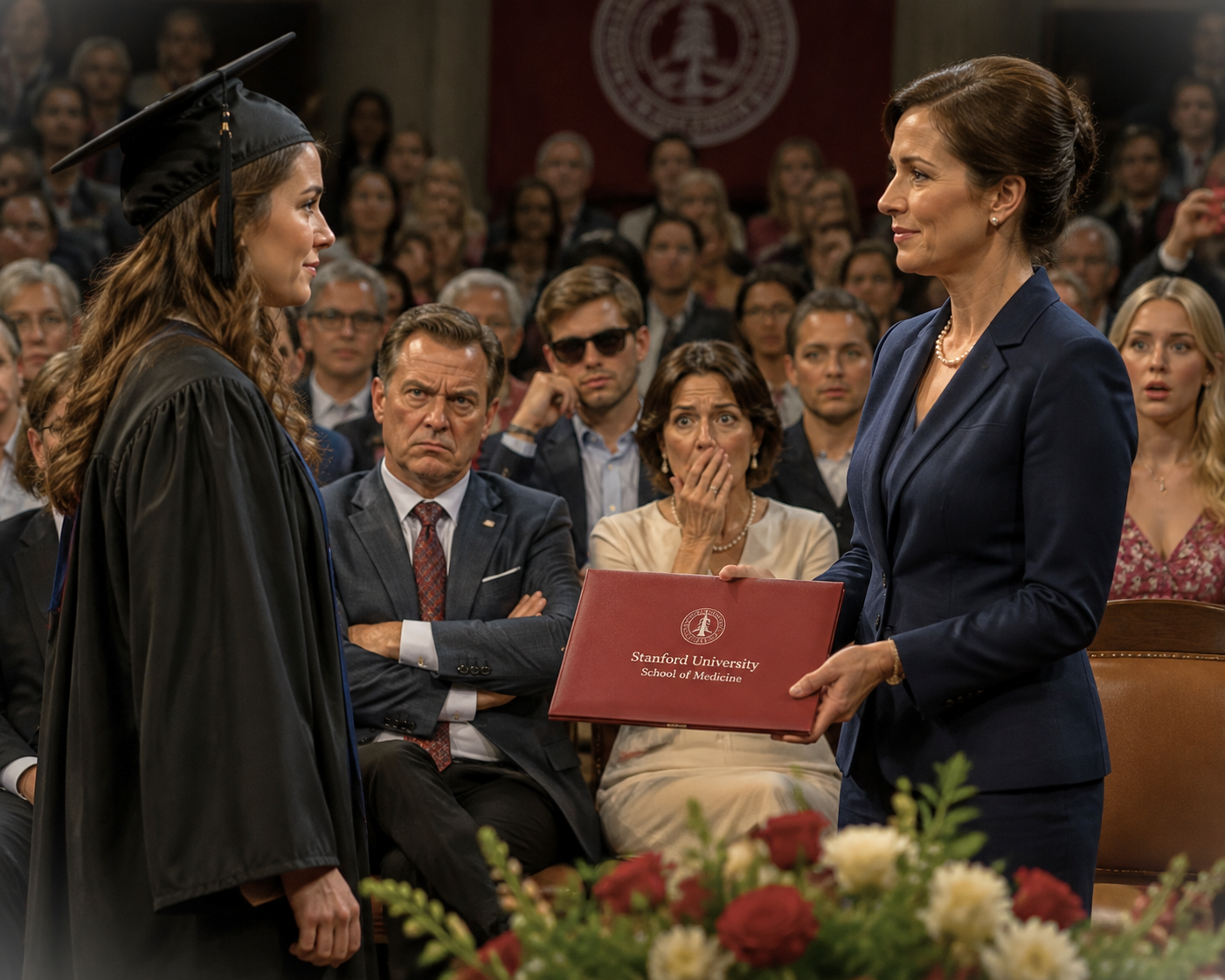
In the front row beside Professor Elena Vance, my research mentor, a woman rose to her feet.
Navy suit.
Stanford pin.
Cardinal-red folder in her hand.
Dr. Sarah Jenkins.
I had first seen her on a video call 6 months earlier, when she said the words I was afraid to repeat out loud in case the universe heard me and changed its mind.
My mother went pale before Dr. Jenkins reached the stage.
Julian straightened so fast his sunglasses slipped down his nose.
My father stopped pretending he was bored.
Dr. Jenkins shook my hand, placed the cardinal folder beside the crystal award, and looked out over the auditorium.
“With Maya’s permission,” she said, “Stanford University School of Medicine is proud to announce that she has been selected for our direct-entry MD-PhD program, with full tuition, a research stipend, and a place in our translational neuroscience lab this summer.”
For a heartbeat, no one moved.
Then the room erupted.
Students turned in their seats. Professors stood. Somewhere in the back, someone whistled.
I heard none of it clearly.
I was watching my parents.
My mother’s lips parted, but nothing came out.
My father blinked several times, as if waiting for someone to correct the mistake.
Julian looked from me to Dr. Jenkins and back again.
No one laughed.
No one corrected anything.
Dr. Jenkins continued.
“Many students impress us with intelligence. Very few impress us with resilience. Maya earned this acceptance while working 3 jobs and conducting research that has already drawn national attention.”
The applause came again, louder than before.
Professor Vance clapped with tears in her eyes.
She had known before anyone else.
She was also the only person who had ever looked at my grades before asking whether I had eaten dinner.
The ceremony ended in a blur. Students rushed toward their families. Cameras flashed. Flowers changed hands.
My family did not move at first.
Julian’s camera slipped from his hand and hit the floor beneath his chair with a sharp crack.
No one bent to pick it up.
My mother reached me first.
“Oh, sweetheart,” she whispered, grabbing both my hands. “We’re so proud of you.”
She had not called me sweetheart in years.
The word sounded borrowed.
“Thank you,” I said.
Nothing more.
She searched my face, waiting for warmth.
When it did not come, her smile faltered.
My father stepped closer.
“You never told us.”
His voice carried more confusion than anger.
“I tried,” I said.
He frowned. “When?”
“The high school scholarship letter.”
Silence.
“The sophomore internship.”
His jaw shifted.
“The first publication notice.”
My mother looked away.
“I left every acceptance letter on the kitchen counter until I learned that papers only mattered in our house when Julian’s name was on them.”
My father opened his mouth.
Closed it.
“I don’t remember that,” he said.
“I know.”
Three words.
No accusation.
No raised voice.
Just truth.
Sometimes truth hurts more because it doesn’t need to shout.
Julian stepped into the circle, his face pale.
“Stanford Medical?” he asked.
I nodded.
He laughed once, a short hollow sound.
“I thought you were just doing café shifts.”
“I was.”
“And the lab thing.”
“That too.”
“And school.”
“Yes.”
He looked down at the broken camera.
For once, the expensive thing in the room was not the center of anyone’s attention.
My father cleared his throat.
“So the stipend,” he said carefully. “How much is it?”
There it was.
Not pride.
Arithmetic.
My mother touched his arm, embarrassed, but she did not stop him.
“Julian has been under a lot of pressure,” Dad continued. “If your program is paid for, maybe this is a chance for the family to rebalance things.”
I almost smiled.
Rebalance.
That was what he called taking from the quiet child to protect the loud one.
Professor Vance stepped beside me, holding a slim envelope from the bursar’s office.
“Maya asked me to keep this until today,” she said.
I took it and handed it to my father.
Inside was not money.
It was a 1-page statement.
Total family contribution to my education: $4,120, paid during freshman year.
Total institutional scholarships, grants, wages, and research funding applied after that: everything else.
At the bottom was a note confirming that a donor fund had retroactively covered the $4,120 my parents paid freshman year, and the university had refunded the original payer 2 weeks earlier.
My father stared at the page.
My mother’s face went blank.
“You got the check,” I said quietly. “So you’re right. You’re done wasting money on me.”
Click Here to continues Read Full Ending Story👉 PART2 : My father called me a failure at my own graduation. He thought I would cross the stage, take my diploma, and disappear. Then the dean called my name, a woman in a navy suit stood up with a cardinal-red folder, and my entire family went silent.
My father called me a failure at my own graduation. He thought I would cross the stage, take my diploma, and disappear. Then the dean called my name, a woman in a navy suit stood up with a cardinal-red folder, and my entire family went silent.
Part 1 of 2