No one spoke.
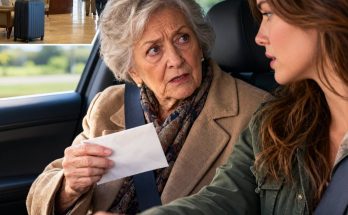
Professor Vance handed me a second envelope.
This one was old and soft at the edges.
“I think you should have this before you leave,” she said.
I recognized the handwriting immediately.
Mine.
I had written the letter during my first semester, after failing my first major exam and crying in the lab bathroom because I thought one bad grade meant everyone had been right about me.
Across the top, in shaky ink, I had written:
If I ever become the person I want to be, I hope she remembers the girl who kept showing up.
I pressed the paper to my chest.
That was when I almost cried.
Not because of Stanford.
Not because of the award.
Because someone had believed I would become the person who eventually read that letter.
Dr. Jenkins checked the time.
“Our car leaves in 15 minutes,” she said gently. “Traffic to the airport is already bad.”
My father looked up sharply.
“Airport?”
“Palo Alto,” I said. “Orientation starts early. I packed last night.”
“You’re leaving today?”
“I always was.”
He stared at me.
“When were you planning to tell us?”
I looked around the crowded lobby one last time.
“I just did.”
Outside, spring sunlight spilled across the campus lawns. Families laughed together while graduates tossed caps into the air.
Professor Vance helped carry one of my boxes to the curb. Dr. Jenkins loaded the other into the university car.
I had one hand on the door when I heard my father call my name.
“Maya.”
His voice sounded smaller than I had ever heard it.
I turned.
He held something faded and blue between his fingers.
My breath caught before I understood why.
It was the ribbon from my eighth-grade science fair.
The one that had disappeared with my project.
The one I had searched for until my mother told me to stop being dramatic.
My father’s hand trembled.
“I found it last night,” he said. “I was looking for Julian’s old camera case and found it buried in one of his boxes.”
Julian froze beside the curb.
My mother whispered, “Richard.”
Dad did not look at her.
“I kept telling myself today was not the time,” he said. “Then I heard what you said in there. About the kitchen counter. About the letters. And I realized there was never going to be a good time to admit what we did.”
My stomach turned cold.
Not what he did.
What we did.
“What are you talking about?” I asked, though some part of me already knew.
My father looked at Julian.
“Tell her.”
Julian’s face had lost all color.
“I was 19,” he said.
“Tell her,” Dad repeated.
Julian swallowed.
“I threw away your project.”
The campus noise seemed to fall back.
I saw myself at 13, tearing apart my closet, crawling under my bed, opening the garage cabinets again and again because if I just looked harder, surely I would find it.
“Why?” I asked.
Julian’s eyes filled.
“Because everyone was talking about you.”
My mother covered her mouth.
“Your teacher called home,” Julian said. “The principal said the regional fair could lead to scholarships. Dad kept saying maybe there was finally another serious student in the house.”
He gave a bitter laugh.
“I had already been warned at school for damaging property. If anyone found out I had destroyed something with borrowed equipment in it, I could have lost my college scholarship package. Mom and Dad knew that.”
I looked at my father.
“You knew?”
He nodded.
The answer hurt more than Julian’s confession.
“We found out the next day,” Dad said. “The school wanted to report the missing parts. Julian panicked. Your mother and I convinced them it had been a misunderstanding. We paid for the equipment and told them you had misplaced the project.”
I stared at him.
“You let me believe it was my fault.”
My father’s eyes filled with tears.
“Yes.”
No excuse.
No speech.
Just the ugliest word he had ever given me.
Yes.
“We thought we were protecting Julian’s future,” my mother whispered.
I looked at her.
“You sacrificed mine.”
She flinched.
This time, she did not deny it.
Professor Vance opened her folder and quietly handed me a photograph.
I knew what it was before I turned it over.
Months earlier, after one of our late-night lab meetings, I had told her about the project. I had not meant to cry. She had listened, then contacted the old district fair office. They still had archived photos.
In the picture, 13-year-old me stood beside a cardboard brain wired with tiny lights. My smile was huge and crooked and full of trust.
On the back, Professor Vance had written:
She deserved better.
My father saw the words and lowered his head.
“So did you,” he said.
I folded the photograph carefully and placed it inside the cardinal folder.
Julian wiped his face with the heel of his hand.
“I’m sorry,” he said. “I know that does nothing, but I am.”
I looked at him for a long moment.
“I believe you’re sorry.”
His shoulders sagged with relief.
“But that isn’t the same as forgiveness,” I said.
He nodded slowly.
“I know.”
“I hope you do.”
My mother stepped closer.
“Will you come home for Christmas?”
I thought carefully before answering.
“Maybe.”
It was not punishment.
It was not revenge.
It was honesty.
Trust is not rebuilt by one tearful afternoon.
It is rebuilt by choices.
One choice at a time.
Dr. Jenkins opened the car door.
I got in.
As we pulled away, I watched my family grow smaller in the side mirror.
For years, I had imagined leaving them would feel like winning.
It didn’t.
It felt like breathing.
Palo Alto was warmer than I expected, harder than I expected, and more beautiful than I knew how to admit.
Medical school did not magically erase what had happened. There were exams I barely passed, patients whose stories followed me home, and nights when the old voice in my head whispered that I had only fooled everyone for a little while.
On those nights, I unfolded the photograph of the girl beside her science project.
I reminded myself that someone had thrown away her work, not her worth.
Years later, on the day I received my white coat as a physician-scientist, Professor Vance sat in the front row beside Dr. Jenkins.
My parents came too.
They sat quietly.
They listened.
They did not make the day about Julian.
That was new.
After the ceremony, my father hugged me and whispered, “I am proud of who you became.”
I answered, “I became her before you noticed.”
He nodded.
He had learned, finally, not to argue with the truth.
My family and I rebuilt slowly after that.
Some holidays were awkward.
Some conversations ended early.
Julian apologized more than once, not because repetition erased the past, but because he understood that trust returns in pieces.
My parents changed too. Not perfectly. Not all at once. But enough that I could see them trying.
They listened more.
Compared less.
Celebrated without reaching for a receipt.
It was not a perfect ending.
It was a real one.
And sometimes real endings are stronger.
Because the greatest victory was not the crystal award.
It was not Stanford.
It was not becoming Dr. Maya Hayes.
The greatest victory was this:
A little girl once believed she was not enough because the people she loved could not see her clearly.
A woman grew up and discovered that her worth had been there all along.
No one, not even family, had the power to take it away.
They Planned a 20-Person Trip to My House Without Asking, Assuming …
Part 2 of 2