Chapter 1 — Two in the Morning
The text came at two in the morning, while freezing rain ticked against the tall windows of my office, and I read it three times before I let myself believe a person I had carried in my own body had actually sent it.
Mom, please don’t come to your grandson’s birthday tomorrow.
My mother-in-law says your presence makes people uncomfortable.
That was all.
My son Steven, thirty-four years old, asking his mother not to come to her only grandchild’s birthday party, because another woman had decided that her comfort mattered more than my place in my own family.
He had waited until two in the morning to send it, I understood, so that it could be done in the dark, without a conversation.
So that by the time I woke it would already be settled, and I would be expected to absorb it the way I had absorbed everything else for six years.
I sat very still for a moment.
Then I typed my reply, and I want to be honest about how calm it was, because the calm was the important part.
I understand.
Two words.
He would read them, I knew, with relief — would take them as surrender, as his mother once again folding herself smaller to keep a peace that had never once included her.
He had no way of knowing that something had changed in the sending of that message — a thing which had been bending in me for six years had, at two o’clock in the morning, at last broken.
The grief I had been carrying up the stairs to my office all evening evaporated, and what took its place was not more grief.
It was clarity — cold, and clean, and complete, the way the air goes clear and hard after the first hard freeze.
I understood, all right.
I understood, for the first time in six years.
And I got up from my chair, and I crossed the room to the safe.
Chapter 2 — The Blue Folder
The wall safe behind my desk is a heavy old thing, steel, with a dial you have to spin by hand.
I spun it, and the mechanism gave its familiar series of clicks, and the door swung open, and I reached inside and took out a thick blue folder that had been waiting in the dark for six years for a night like this one.
I laid it open on the desk.
I knew everything in it, but I looked anyway, because I wanted to be looking at the truth when I made the call I was about to make.
There were the property deeds, the ironclad ones, drawn up by lawyers who did not make mistakes, every page of them bearing my name and only my name.
There were the bank transfers, six years old, documenting to the penny the fortune I had moved to pull my son out of the fire.
And there, near the back, folded soft from handling, was a letter Steven had written me six years ago, in the worst week of his life, in his own hand, the ink blurred in one corner where something wet had fallen on it while he wrote. I owe you my life, Mom. Five words.
He had meant them, then.
I believed he had meant them.
I held that letter for a moment beside the memory of the text message glowing on my phone, the two of them together, the boy who had owed me his life and the man who had banned me from his son’s birthday to please a woman who despised me.
Somewhere in the six years between those two pieces of writing, my son had made a trade, and he had not thought his mother would ever make him pay for it.
He had assumed my love was a thing without a bottom, a well he could draw from forever while spitting into it.
It is an easy assumption to make about a mother.
A great many sons make it.
Most of them are even right.
That is the quiet tragedy underneath this entire story, and I have made myself look at it squarely rather than pretend I was only a victim in it.
A mother’s love really is, for most practical purposes, bottomless — that is not a flattering exaggeration, it is simply the biology and the truth of the thing — and so a child learns, very early and very deep, that it is the one resource in his life he never has to be careful with.
He can be careless with friends and they will drift away.
He can be careless with a wife and she will leave.
But he can be as careless as he likes with his mother, spill her, waste her, take her utterly for granted, and she will still be there in the morning, still loving him, still ready to catch him.
Most sons trade on this their whole lives and are never punished for it, because most mothers never do present the bill, and so the son goes to his own grave never once having learned that the love was not, in fact, free.
I do not blame Steven, wholly, for assuming what nearly every son assumes.
What I could not, in the end, forgive was the particular use he put the assumption to — not merely taking my love for granted, which I could have borne forever, but spending it, actively, as currency, to purchase the approval of people who held me in contempt.
There is a difference between a son who forgets to thank his mother and a son who trades her away.
I had raised the first kind, I thought.
At two in the morning I learned I had raised the second.
I was about to teach mine that he had assumed wrong.
Chapter 3 — Six Years Ago
To understand the blue folder, you have to go back six years, to the week everything Steven had built came apart in his hands.
He had been riding high — his own business, his own money, a beautiful fiancee named as the daughter of the well-known Vance family, a wedding being planned on a scale that made the society pages.
And then, slowly and then all at once, it collapsed.
A bad partnership, a worse loan, a market that turned at the wrong moment, and my son found himself facing not just failure but ruin — bankruptcy, the public kind, the kind that would have ended the engagement and the standing and the entire glittering life he had built, before it had properly begun.
He came to me.
Of course he came to me; I was his mother, and I had money, having spent thirty years building Sterling Holdings from nothing into something, alone, after his father left us with little more than a name.
And I did what I had sworn, when he was a baby in my arms, that I would always do.
I caught him.
But I did not catch him foolishly.
I had not built a company over thirty years by being foolish about money, not even for my own son.
I bought the estate outright — ten million dollars, the Westside property, the great stone house with the wrought-iron gates — and I placed it inside Sterling Holdings, deeded to the company, deeded to me.
And then I let Steven and his new bride live in it under a residential agreement, a conditional tenancy, structured by my attorney Eric with a care that, at the time, felt almost paranoid.
There were conditions.
There was, in the language Eric liked to use, a nuclear option — a clause that let me take the whole thing back, in full and at once, if certain lines were ever crossed.
I signed it hoping I would never need it, the way you buy insurance hoping the house never burns.
And I kept all of it secret.
That was my one truly soft decision in the whole hard arrangement.
I let Steven present the house to the world as his own triumph, his own recovery, his own success.
I let his new in-laws believe he had clawed his way back on his own.
I did it to protect his pride, to let him keep his dignity in front of the family he was marrying into.
I did not understand, then, that I was also teaching them all the most dangerous lesson a family can learn about a mother: that her sacrifices are invisible, and can therefore be taken for free.
I have thought about that decision more than any other, because it was the one real mistake I made, and it was made out of love, which is how the worst mistakes usually get made.
I hid what I had done because I wanted to protect Steven’s pride.
I did not want him standing in front of his glamorous new in-laws as a man who had been bailed out by his mother; I wanted him to stand there as a man who had recovered on his own, and so I swallowed the credit and let him have it, gladly, the way mothers gladly swallow so many things.
But a sacrifice that no one can see is a sacrifice that no one can weigh, and a thing that cannot be weighed is assumed to weigh nothing.
By keeping my rescue invisible, I did not only protect Steven’s pride.
I erased my own significance.
I made it possible for an entire family to look at the woman who had bought the roof over their heads and see, instead, an inconvenient old relative with no obvious claim on anything, because there was nothing visible to contradict that reading.
Stephanie could seat me below the cousins precisely because she did not know — because I had made sure she did not know — that she was a guest in my house and I was its owner.
My secrecy, meant as a gift to my son, became the very instrument of my erasure.
If I had it to do again, I would still catch him.
But I would let him feel the weight of the catch.
I have learned, too late to spare either of us, that invisible generosity does not protect the people you love.
It only trains them to undervalue you, and undervaluing is the soil that every later cruelty grows in.
Chapter 4 — The Servant at the Table
The erasure did not happen all at once.
If it had, I might have stopped it.
It happened the way these things always happen, one small degree at a time, each degree too small on its own to make a scene about.
It began with the mother-in-law, Stephanie Vance, and her genius for the insult you could not name.
At the first holiday dinner in the new house, I was seated at the far end of the table, below the cousins.
At the second, I was not seated at all until someone noticed and fetched a chair.
My clothes were remarked upon, gently, with a little laugh, in a way that made clear they were not the right clothes.
When the family photographs were taken, I was somehow always the one asked to hold the coats, or to step out of frame because the light was better with fewer people, and when the photographs appeared, framed, on the walls of the house I had bought, I was not in a single one of them.
Stephanie did it all with a smile, and never once with a word you could object to, because that was the art of it.
To protest would have been to seem paranoid, grasping, difficult — the oversensitive mother making everything about herself.
So I did not protest.
I held the coats.
I sat where I was put.
I watched myself be slowly edited out of my own son’s life inside the walls of the house I had given him, and I told myself, each time, that it did not matter, that I was above it, that a woman secure in what she had done did not need to be thanked for it.
And Steven let it happen.
That was the part that went deepest.
He saw all of it — he was not a stupid man, only a weak one — and he chose, every single time, the path of least resistance, which ran directly over his mother. Just let it go, Mom.
You know how Stephanie is.
It’s easier not to make waves. Easier for him.
It was never easier for me.
But I had raised him, and somewhere in the raising I had apparently taught him that my feelings were the ones that could always be safely spent, because I would never present the bill.
Chapter 5 — I Understand
People who hear this story sometimes ask me why I endured it for six years.
Why a woman with my resources and my spine sat and held the coats and let herself be erased, when a single hard conversation, or a single line drawn early, might have stopped the whole slow humiliation before it built.
The answer is that I was a mother, and that a mother’s patience is not a virtue so much as a kind of blindness, a beautiful and dangerous blindness that lets you absorb almost any injury as long as absorbing it seems to protect your child.
Every insult I swallowed, I swallowed because making an issue of it would have created tension in Steven’s marriage, and I did not want to be the reason his marriage had tension.
Every erasure I accepted, I accepted because fighting it would have forced my son to choose between his mother and his wife’s family, and I was terrified — genuinely, deeply terrified — that if I made him choose, he would not choose me.
So I made sure he never had to.
I kept myself small and quiet and grateful precisely so that I would never have to learn the answer to the question I was most afraid of.
And then, at two in the morning, reading a text that banned me from my own grandson’s birthday, I understood at last that I had already learned it.
He had already chosen.
He had been choosing, over and over, every day for six years, and I had refused to see the choice because seeing it would have cost me the comfortable fiction that my patience was working.
It was not working.
It had never been working.
My silence had not been buying my son’s love.
It had been subsidizing his cowardice, the same way my money had subsidized his lifestyle, and both subsidies had produced the very man who now texted his mother out of his family in the dark.
This was the hardest thing I had to face that night, harder than the text itself, because it turned the blame partway back on me.
For six years I had told myself a flattering story in which I was the long-suffering good mother, patiently enduring, taking the high road, and everyone else was behaving badly around my saintly forbearance.
But patience, I understood at last, is not always a virtue.
Sometimes patience is just fear wearing a virtue’s clothes.
Every time I had swallowed an insult to keep the peace, I had taught Stephanie that insulting me carried no cost, and so she had reached for a larger insult.
Every time I had let Steven off the hook for his silence, I had taught him that his silence was acceptable to me, and so he had grown bolder in it, until banning me from a birthday felt, to him, a manageable thing.
I had trained them both.
My endurance, which I had imagined as a kind of noble strength, had functioned in practice as a reward system, paying out approval and continued generosity in exchange for worse and worse treatment, until the arrangement produced its inevitable result.
A person who is never once made to feel the cost of their cruelty does not become kinder over time.
They become bolder.
I had spent six years being kind to people in a way that made them crueler, and calling it love, and the bill for all that misplaced kindness came due, at last, at two o’clock in the morning, glowing on a phone.
I understand, I had written.
And I did.
That was the moment the patience ended — not in an explosion, but in a kind of terrible arithmetic finally coming out even.
I had given and given and given, on the theory that love given without limit returns as love.
The theory was wrong.
Love given without limit, to the wrong person, returns as contempt, because a person who never has to earn a thing stops believing it has any worth.
I had loved my son into believing I was worthless.
The only thing left that might teach him otherwise was to show him, at last, precisely what I was worth.
Chapter 6 — The Call to Eric
I picked up the phone and dialed my corporate attorney.
It rang four times before he answered, thick with sleep.
“Betty?” Eric’s voice was gravel.
“It’s two in the morning.
Is everything all right?”
“I am perfectly fine, Eric,” I said, and I heard my own voice come out level and sharp, an edge I had not used in six years.
“But I need you awake.
It’s time.
I want full control of the Westside property restored.
Activate the eviction clause, and terminate their residential agreement, effective immediately.”
There was a silence on the line, and then the rustle of sheets as Eric sat up in his bed, fully awake now, because he understood at once what I was saying and what it would mean.
“Betty,” he said carefully.
“We built the nuclear option into that contract for a reason, and I’ve never once regretted it.
But I need you to hear me clearly, as your lawyer and your friend, before you say the next thing.
If you pull this trigger, you don’t just move some furniture around.
Steven’s marriage, his standing, the entire life he’s built inside that house — it all comes down, and it comes down in public, and there is no putting it back together afterward.
You could lose your son.
Permanently.
I need to know you understand that before I lift a finger.”
I looked out the window at the dark, empty, rain-slicked street below, and I felt the last of six years of swallowed humiliation slide off my shoulders and fall away into the night, and I discovered that under it I was not sad at all.
I was free.
“That,” I said, “is what I want.
Have the paperwork ready by eight o’clock.” I paused.
“And Eric?”
“Yes, Betty?”
“Bring the court officers.
And a notary.” I looked at the blue folder open on my desk.
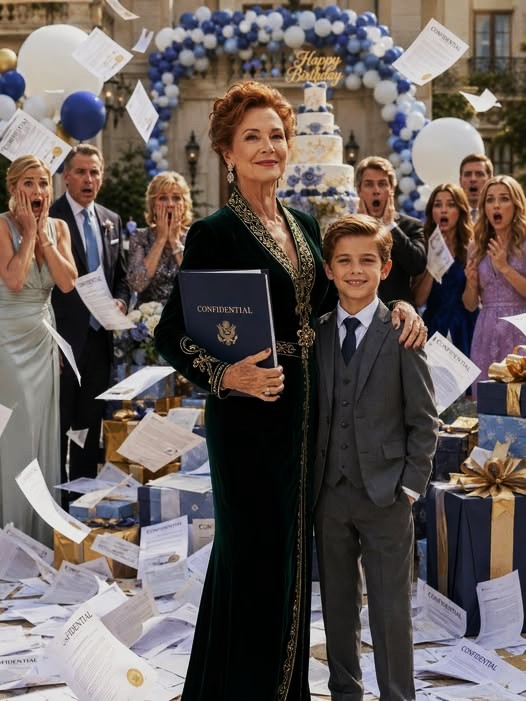
“This morning, we’re going to a birthday party.”