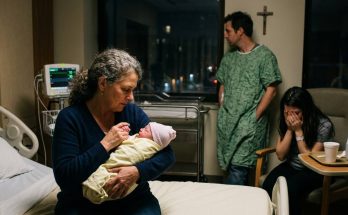
The research center settled into its rhythm over the following months. There were no grand announcements anymore, no cameras waiting at the entrance, no reporters asking Harper to explain her childhood for the hundredth time. There were simply families arriving with questions, children testing devices, therapists adjusting measurements, and engineers learning that the best solution was often the one a child could use without being reminded that it had been designed for them.
Harper liked it that way.
One Tuesday morning, she found Elise sitting at a worktable beside a nine-year-old girl named Nora. Nora had been struggling with a writing tool, and Elise was showing her how to adjust the angle.
“Don't grip it so hard,” Elise said.
“I have to.”
“No, you don't.”
“It slips.”
“Then we'll fix the slipping.”
Nora looked at Harper.
“Is she an engineer?”
“Not yet.”
Elise looked offended. “I'm fifteen.”
“Exactly.”
Nora giggled.
Harper watched from across the room. She remembered herself at that age, convinced that every problem had to be conquered alone. Elise was different. She knew when to ask for help, but she also knew when to tell someone else that help was unnecessary.
That balance had taken Harper decades to learn.
When the session ended, Nora's mother approached Harper.
“I don't know how to thank you.”
“You don't have to.”
“She keeps asking why she can't have a normal pen.”
Harper glanced toward Nora, who was packing her things.
“Tell her there are thousands of pens,” Harper said. “She only needs one that works for her.”
The mother smiled through tears.
“That sounds simple.”
“It isn't always.”
Harper returned to her office later that afternoon and found an email from the hospital committee. They wanted her to speak to a group of new pediatric residents.
She almost declined.
Then she remembered the maternity ward.
Not the old room itself, but the moment before anyone knew what Harper would become. The doctors had facts. The nurses had procedures. Her parents had fear. Her grandmother had only the child.
She accepted.
The lecture was held in a small conference room. Twenty residents sat with notebooks open.
Harper stood at the front without slides.
“I want to tell you something that sounds obvious,” she began. “A newborn is a person before the diagnosis is a story.”
One resident shifted in his chair.
“You'll be asked to explain what might happen,” Harper continued. “That's your responsibility. But don't confuse explaining possibility with predicting destiny.”
She told them about the first hours of her life without naming David or Sarah.
She explained how easily a frightened parent could hear a list of potential difficulties and imagine that the list was the child's future.
“You don't need to make the situation prettier than it is,” she said. “You need to make it accurate.”
Afterward, one of the residents approached her.
“My sister had a baby with a limb difference,” he said. “I wish someone had explained it this way to my family.”
Harper looked at him.
“Then maybe that's why you're here.”
He nodded.
That evening, Harper drove home alone.
The road was familiar. The same grocery store. The same intersection. The same old tree near the corner where she had once waited for the bus as a teenager.
She stopped at a red light and looked at her reflection in the windshield.
For years, she had thought healing meant reaching a place where the past no longer hurt.
She no longer believed that.
Some memories stayed sharp because they mattered.
The goal was not to erase them.
It was to stop letting them choose the next sentence.
When she arrived home, Daniel was making dinner.
Elise was at the table with a college brochure.
“You're looking at universities again,” Harper said.
“I found one with a robotics program.”
“You said you wanted veterinary medicine last week.”
“I contain multitudes.”
Daniel looked impressed. “That's a strong answer.”
Harper sat beside her.
“Do you like the school?”
“I don't know yet.”
“Then visit.”
“Really?”
“Really.”
“What if I don't like it?”
“Then we cross it off.”
Elise smiled.
There was no pressure in the answer.
That was deliberate.
Harper knew too well what happened when adults confused a child's future with a problem that needed to be solved immediately.
Two weeks later, the family took a trip to visit the university.
Elise spent an hour in the robotics lab.
She asked questions until the graduate student guiding them finally laughed.
“You're going to have to come here just so I can get some work done.”
Elise grinned.
On the drive home, she stared out the window.
“I think I like it.”
“You don't have to decide tonight,” Harper said.
“I know.”
“You're allowed to change your mind.”
“I know.”
Harper smiled.
“You're going to keep saying that until I stop.”
“Probably.”
That night, the narrator sat on the porch with a blanket over her knees.
Harper joined her.
“How was the visit?”
“She liked it.”
The narrator nodded.
“Then let her go.”
Harper looked at her.
The words were simple, but they carried weight.
“I know.”
“No,” the narrator said. “You understand it. That's different.”
Harper smiled.
“You're still teaching me.”
“I'm old. I have to be useful somehow.”
Harper leaned her head against the chair.
“What if I'm afraid?”
“You will be.”
“What if she gets hurt?”
“She will.”
“What if I can't protect her?”
“You can't.”
Harper looked at her.
The narrator took her hand.
“You don't protect a child by preventing every painful thing. You protect her by making sure she knows where home is.”
Harper's eyes filled.
She looked away.
“I hate when you're right.”
“I know.”
They laughed.
Later that night, Harper walked upstairs and found Elise asleep with the university brochure beside her pillow.
Harper stood in the doorway for a long time.
She remembered another baby.
Another room.
Another frightened father.
Another woman deciding whether to stay.
And she understood something she had never fully understood before.
Her grandmother had not raised her to remain dependent on her.
She had raised her to become someone who could leave the house and still know she belonged somewhere.
That was the gift.
Not being kept.
Being prepared to go.
Click here to continue reading: PART 18: Leaving the Door Open
The Room Went Quiet When My Son Looked at His Newborn Daughter and Decided Her Difference Was a Reason to Let Her Go
Part 17 of 20