Harper's fourth year began with a problem none of us expected.
The prototype worked.
That was the good news.
The bad news was that making it affordable would require serious investment.
The university offered laboratory space.
A foundation offered a small grant.
A manufacturer expressed interest.
But the manufacturer wanted control.
Harper refused.
“They want to redesign it so they can sell a premium version.”
David read the contract twice.
“They aren't asking for control.”
“They're asking for exclusivity.”
“For five years.”
“That is control.”
He looked at her.
“You're right.”
She blinked.
“You don't have to agree with me.”
“I don't.”
She folded her arms.
“You just did.”
“I agree with your interpretation.”
She smiled despite herself.
Their partnership had changed.
David no longer treated Harper as a fragile daughter who needed protection.
He treated her as a young engineer whose judgment he respected.
That mattered more than any apology.
Still, their relationship had limits.
Harper rarely asked him about the past.
David rarely brought it up.
Both understood that silence was not necessarily peace.
Sometimes it was simply a door neither person knew how to open.
That changed one evening when Harper found an old photograph.
It was tucked inside a box at my house.
She had come home for the weekend to help me clean the attic.
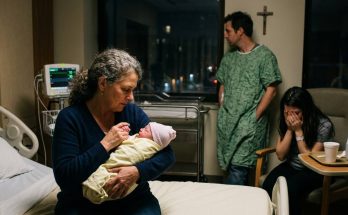
The photograph showed David and Sarah in the hospital shortly after Harper's birth.
Sarah was sitting in bed.
David stood beside her.
Between them was a tiny bundle.
Harper held the photograph for a long time.
“Who took this?”
“I don't know.”
She turned it over.
There was a date written on the back.
The day she was born.
Her eyes moved between their faces.
“Dad looks terrified.”
“He was.”
“Mom looks happy.”
“She was.”
Harper sat on the floor.
“Why did they look like that if they were about to give me away?”
I sat beside her.
“I don't know everything that happened in those hours.”
“You told me she held me.”
“Yes.”
“But you never told me what happened immediately before that.”
I hesitated.
She noticed.
“You know.”
“I know some things.”
“Tell me.”
So I did.
Not every detail.
Not every private conversation.
But enough.
I told her about David's panic.
About the doctor explaining that her missing arm did not mean she was unhealthy.
About Sarah crying.
About the temporary placement paperwork.
About how quickly fear had taken over the room.
Harper listened without interrupting.
When I finished, she said, “He didn't even ask whether I was okay.”
“No.”
“He asked whether someone else could take me.”
“Yes.”
She stared at the photograph.
Then she asked the question I had known would eventually come.
“Did he ever regret it?”
“Almost immediately.”
“That's not the same as undoing it.”
“No.”
She nodded.
“I know.”
That evening, Harper called David.
I did not hear the conversation.
I only saw her face afterward.
She looked older.
Not physically.
In some other way.
She had finally asked him the question she had been carrying since infancy.
“What did you see when you looked at me?”
David answered honestly.
He told her he saw every difficulty he had ever been afraid of.
Medical bills.
People staring.
Questions he didn't know how to answer.
A daughter who might need help.
A future he couldn't control.
And beneath all of that, he admitted something harder.
He was afraid of being a father to a child who might force him to become a different man.
Harper listened.
Then she said, “You weren't afraid of me.”
“No.”
“You were afraid of yourself.”
David cried.
“Yes.”
Harper ended the call after that.
She didn't speak to him for several days.
When she finally called me, she said, “I hate that I understand him.”
I knew exactly what she meant.
Understanding does not equal approval.
Sometimes it makes anger more complicated.
“He told me he was ashamed.”
“Are you?”
“Of him?”
“Yes.”
I thought about it.
“I was.”
“And now?”
“Now I think shame is useful only if it makes someone behave differently.”
She considered that.
“That sounds like something you'd say.”
“I've had a long time to think.”
She smiled faintly.
The silence between Harper and David lasted nearly three weeks.
Then David sent her an email.
No apology.
No request.
Just a photograph.
It showed a workbench.
On it sat a new prototype.
He had redesigned one of the manufacturing components based on Harper's notes.
Under the photograph, he wrote:
I thought this might solve the problem you mentioned.
Nothing more.
Harper stared at the message.
Then she replied:
It does.
He answered:
Good.
She typed:
Thank you.
Then she stopped.
Deleted it.
Typed again.
Thank you, Dad.
She pressed send.
That was the first time she had called him Dad in writing.
He did not reply for several minutes.
When he did, it was only one sentence.
You're welcome, Harper.
I later learned he had saved that message.
Not printed it.
Not framed it.
Saved it.
Because some people spend years trying to recover a single word they once believed they had no right to hear.
Sarah's relationship with Harper deepened differently.
They talked about ordinary things.
Recipes.
Movies.
Travel.
Work.
Sarah never tried to replace my role.
One Sunday afternoon, she told Harper about the dress she had worn on the day she gave birth.
Harper laughed.
“That is such a strange thing to remember.”
“I remember everything about that day.”
“Even the dress?”
“Especially the dress.”
“Why?”
“Because I remember thinking I was supposed to be happy.”
Harper became quiet.
Sarah continued.
“I was happy.”
“But?”
“I was terrified.”
Harper nodded.
“Everyone keeps using fear to explain everything.”
Sarah lowered her eyes.
“Sometimes fear is an explanation.”
“Not an excuse.”
“No.”
They sat together quietly.
Then Sarah said, “I don't expect you to call me Mom.”
“I know.”
“I don't expect you to love me the way you love your grandmother.”
“I know.”
Sarah smiled sadly.
“I just want to be someone you can call.”
Harper reached across the table.
She touched Sarah's hand.
“I can do that.”
It was enough.
The company behind Harper's project eventually withdrew its offer.
For several weeks, she was devastated.
The team had lost access to manufacturing.
Funding was running out.
A deadline for the grant approached.
Harper wanted to quit.
She called me late one night.
“I can't keep doing this.”
“You can.”
“I don't want to.”
“That is different.”
“I've been fighting for years.”
“Yes.”
“I'm tired of explaining why this matters.”
“You shouldn't have to explain it forever.”
“But someone has to.”
“No.”
She was silent.
“Let other people carry part of it.”
The next morning, Harper called her team together.
She told them the truth.
She was exhausted.
She was angry.
She couldn't promise success.
Then one of the students said, “Neither can we.”
Another said, “But we can promise to keep working.”
Harper looked at them.
Something changed.
She stopped treating the project as something she alone had to carry.
David helped with manufacturing contacts.
Sarah helped with community outreach.
The university supplied equipment.
The foundation extended the grant.
And Harper learned a lesson she had resisted for years.
Independence did not mean doing everything alone.
It meant choosing who was allowed to help.
Her first production run was small.
Two hundred units.
They sold out within forty-eight hours.
Harper did not celebrate immediately.
She stared at the sales numbers.
Then she whispered, “Two hundred kids.”
David stood beside her.
“Maybe more.”
She looked at him.
He smiled.
“Your grandmother would say not to get sentimental.”
“She'd be right.”
I was standing behind them.
“I heard that.”
They both laughed.
The project grew.
Then came the first letter from a parent.
It was handwritten.
A little girl had received one of Harper's devices.
The parent said her daughter had stopped asking adults to button her coat.
She had dressed herself for school.
Harper read the letter twice.
Then she handed it to David.
He read it.
When he finished, he looked at his daughter.
“You changed that child's morning.”
Harper shook her head.
“The device did.”
“You designed the device.”
She smiled.
“Then maybe I changed the morning a little.”
David nodded.
“That sounds right.”
Later that night, Harper and I sat outside.
The air smelled like rain.
“Grandma?”
“Yes?”
“Do you ever think about that baby in the hospital?”
“All the time.”
“What do you think she'd think if she could see me now?”
I looked at her.
“I think she'd be confused.”
“Why?”
“She'd wonder why everyone had taken so long to figure you out.”
Harper laughed.
Then she leaned her head against my shoulder.
For several minutes, we listened to the rain begin.
She had grown into the answer to a question no one in that hospital room had known how to ask.
Not whether she could have a normal life.
Whether the people around her were willing to imagine a bigger one.
Click here to continue reading: PART 7: The Invitation to Speak at the Hospital Where Harper Was Born Forced All of Us Back Toward the Place Where Her Life Had Nearly Been Decided
The Room Went Quiet When My Son Looked at His Newborn Daughter and Decided Her Difference Was a Reason to Let Her Go
Part 6 of 20