The invitation arrived on a Monday morning.
Harper opened the email while sitting at my kitchen table.
She read it twice.
Then she pushed the laptop toward me.
The hospital wanted her to speak at a medical conference about adaptive design and patient-centered care.
I smiled.
“That sounds wonderful.”
“It is.”
“You don't sound convinced.”
She pointed at the hospital name.
“I was born there.”
I looked at the screen.
“Yes.”
“I don't know if I want to go back.”
I understood.
Some places remain ordinary for everyone except the person who was hurt there.
For me, that hospital was where I had first held Harper.
For David, it was where he had failed.
For Sarah, it was where she had become a mother and then watched fear take control.
For Harper, it was the beginning of everything.
She closed the laptop.
“What would you do?”
“I wouldn't decide for you.”
She groaned.
“I knew you were going to say that.”
“You're twenty-two.”
“That doesn't make decisions easier.”
“No.”
“Sometimes I miss when you told me what to do.”
“I never told you what to do.”
“You told me not to touch the soldering iron.”
“That was good advice.”
“It was.”
She smiled.
Then she opened the laptop again.
“I'll go.”
The conference was six weeks away.
During those weeks, Harper became increasingly thoughtful.
She did not talk much about the speech.
She did, however, ask questions.
“What did the room look like?”
“What room?”
“The one where I was born.”
I described what I remembered.
The narrow window.
The pale walls.
The bassinet.
The chair beside Sarah's bed.
The small table with the paperwork.
She listened carefully.
“Were you angry?”
“At David?”
“Yes.”
“Yes.”
“Did you hate him?”
“No.”
“Why not?”
“Because he was still my son.”
She looked down.
“That must have been hard.”
“It was.”
“Would you have forgiven him if he hadn't changed?”
“No.”
She looked surprised.
“I thought forgiveness was important to you.”
“It is.”
“Then why not?”
“Because forgiveness isn't permission to keep hurting people.”
Harper thought about that.
Then she said, “I like that.”
The night before the conference, David came over.
He was nervous.
More nervous than Harper.
“You're speaking tomorrow,” I reminded him.
“I know.”
“You're not the speaker.”
“I know.”
“Then why are you pacing?”
He stopped.
“I haven't been back there since.”
I knew.
He had avoided the hospital for years.
Not because he hated it.
Because he remembered himself there.
Harper came downstairs.
“Dad?”
He turned.
“Yeah?”
“Are you okay?”
He smiled.
“No.”
She laughed.
“At least you're honest.”
He looked at her.
“Do you want me there tomorrow?”
Harper hesitated.
“Yes.”
That single word nearly broke him.
The next morning, all four of us entered the hospital together.
Me.
Harper.
David.
Sarah.
The lobby smelled exactly as it had years earlier.
Disinfectant.
Coffee.
Something faintly floral from a vase near the reception desk.
Harper stopped walking.
“You okay?”
She nodded.
“I thought it would feel bigger.”
“Everything feels bigger when you're small.”
She looked at me.
“Maybe.”
The conference room was filled with doctors, nurses, therapists, engineers, and parents.
Harper stood at the podium.
She did not speak about herself for long.
Instead, she spoke about design.
About asking patients what they actually need.
About avoiding assumptions.
About making equipment adaptable rather than forcing people to adapt themselves to equipment.
Then she said:
“Sometimes the greatest barrier isn't the body. It's the expectation placed around the body.”
I watched several people begin taking notes.
David sat beside Sarah.
His hands were folded tightly.
Harper continued.
“A child does not need to prove that their life is worthwhile before we invest in making that life easier.”
Her voice was steady.
“They need adults who are willing to imagine possibilities before declaring limitations.”
When she finished, the room stood.
I didn't.
I couldn't.
My legs were shaking.
Afterward, a nurse approached her.
She was older, with silver hair.
She looked carefully at Harper.
Then at me.
“Were you here twenty-two years ago?”
I felt the air leave my lungs.
“Yes.”
The nurse's eyes widened.
“I thought I recognized you.”
Harper looked at her.
“You were here?”
The nurse nodded.
“I was working that night.”
David went still.
Sarah covered her mouth.
The nurse looked at Harper.
“I remember you.”
Harper's expression changed.
“Do you remember me?”
“You were tiny.”
A smile appeared on the nurse's face.
“You had an impressive grip.”
Harper laughed.
The nurse looked toward David.
“I remember your father too.”
David lowered his eyes.
The nurse didn't accuse him.
She simply said, “You were frightened.”
He nodded.
“I was.”
“I remember.”
There was a pause.
Then the nurse looked at Harper.
“You know what I remember most?”
Harper shook her head.
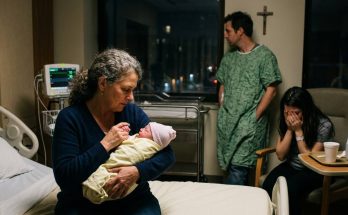
“You were crying,” the nurse said. “Your mother was crying. Your father was standing by the window. And your grandmother walked over to the bassinet.”
She looked at me.
“You picked up that baby before anyone had figured out what they were going to do.”
I smiled faintly.
“I remember.”
The nurse continued.
“You held her and said something.”
Harper turned toward me.
“What did I say?”
I shook my head.
“I don't remember.”
The nurse smiled.
“You said, ‘She's staying with me.’”
I stared at her.
I had forgotten.
Twenty-two years.
And those words had disappeared somewhere inside all the other memories.
Harper's eyes filled.
“You said that?”
I nodded.
“I don't remember saying it.”
The nurse laughed softly.
“You were very convincing.”
David looked at me.
Then at Harper.
“I remember.”
I turned toward him.
“You remember?”
“I do.”
He swallowed.
“I remember thinking you were making a decision that wasn't yours to make.”
Harper looked at him.
“And now?”
He looked at his daughter.
“Now I know you were making the decision I was too afraid to make.”
No one spoke.
Sarah began crying.
Harper walked toward her.
She took her hand.
“It's okay.”
Sarah shook her head.
“No, it isn't.”
Harper squeezed her fingers.
“No.”
Sarah looked at her.
“But we're here.”
“Yes.”
That was enough.
After the conference, Harper asked to see the maternity floor.
The nurse led us there.
The room where Harper had been born was no longer in use.
The hospital had renovated that section.
The old bassinet was gone.
The walls were different.
The window was larger.
Harper stood in the doorway.
“This is where it happened?”
“Yes,” I said.
She stepped inside.
David followed.
Sarah remained near the door.
Harper touched the windowsill.
Then she looked at her father.
“Do you remember what you said?”
David closed his eyes.
“Yes.”
“Say it.”
He looked frightened.
But he did.
“I said we should let another family take you.”
The words hung in the room.
Harper nodded.
“I needed to hear you say it.”
He looked at her.
“Why?”
“So I know you aren't going to turn it into something softer.”
He nodded.
“I won't.”
She took a breath.
“Good.”
Then she walked toward him.
For a second I thought she might hug him.
Instead, she touched his shoulder.
“I don't need you to pretend you weren't that man.”
His eyes filled.
“I need you to remember that I survived him.”
David covered her hand with his.
“I will.”
Sarah approached slowly.
Harper turned.
“You too.”
Sarah nodded.
“I remember.”
The four of us stood in that empty room.
There was no baby there.
No paperwork.
No nurse waiting for an answer.
Only four adults carrying different versions of the same beginning.
On the drive home, Harper was quiet.
Finally she said, “I thought going back would make me feel angry.”
“Did it?”
“No.”
“What did you feel?”
She looked out the window.
“Finished.”
I smiled.
“Finished?”
“Not my life.”
“I understood.”
“The story I had been carrying.”
That night, Harper asked me to stay in her guest room.
We sat on the porch after dinner.
“Grandma?”
“Yes?”
“Thank you for staying.”
I looked at her.
“I was never going to do anything else.”
“I know.”
She leaned back.
“But I think I finally understand something.”
“What?”
“You didn't save me from that hospital.”
“No.”
“You saved me from being defined by it.”
I smiled.
“No, sweetheart.”
She looked at me.
“You did that.”
She smiled.
“Maybe.”
I reached for her hand.
Her fingers closed around mine.
The same way they had twenty-two years earlier.
Only now they were strong enough to pull me toward her.
Click here to continue reading: PART 8: Years After the Hospital, Harper Returned With a Child of Her Own and Faced the Question That Had Haunted Her Family Since Her Birth
The Room Went Quiet When My Son Looked at His Newborn Daughter and Decided Her Difference Was a Reason to Let Her Go
Part 7 of 20