Harper married at twenty-four.
His name was Daniel.
He was patient, dryly funny, and completely unimpressed by the fact that Harper could repair equipment most people would be afraid to touch.
Their wedding was small.
There were no speeches about overcoming anything.
No one described Harper as brave.
She hated that.
Instead, there was music.
There was too much cake.
David danced badly.
Sarah cried during the vows.
I cried before the vows.
Harper accused me of stealing her moment.
I told her that was my privilege.
Daniel's parents embraced her as though they had known her forever.
That mattered.
Not because she needed anyone's approval.
Because family should sometimes feel uncomplicated.
Two years later, Harper called me from the hospital.
I answered on the first ring.
“Is everything okay?”
Her voice trembled.
“Yes.”
Then she laughed.
“She's here.”
I sat down.
“She?”
“Yes.”
I closed my eyes.
“Is she healthy?”
“Yes.”
“Harper?”
“She's perfect.”
There was silence.
Then Harper whispered, “Grandma, she's missing her left hand.”
My heart stopped.
Not because I feared the child.
Because I knew immediately what Harper was remembering.
The hospital.
The bassinet.
David's voice.
The paperwork.
Fear.
I drove there as quickly as I could.
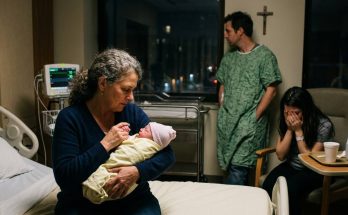
When I entered the room, Harper was sitting in bed with the baby against her chest.
Daniel stood beside them.
His face was exhausted.
His eyes were red.
But he was smiling.
I walked closer.
The baby was tiny.
Pink.
Furious.
Perfect.
Harper looked at me.
“I keep thinking about that room.”
“I know.”
“I understand Dad now.”
I sat beside her.
“That doesn't mean you have to repeat him.”
She looked at me.
“I know.”
Daniel reached down and touched the baby's head.
“I didn't know what to say when the doctor told us.”
“What did you say?”
He laughed nervously.
“I asked whether she was okay.”
Harper smiled.
“And then?”
“I asked what we needed to learn.”
I looked at him.
“Good answer.”
He nodded.
“I had a very good example.”
Harper began crying.
“I thought I'd be different.”
“You are.”
“What if I'm scared?”
“Then be scared.”
She looked at the baby.
“What if I make the wrong decision?”
“You will sometimes.”
“That is not comforting.”
“It isn't supposed to be.”
She laughed through her tears.
“You're impossible.”
“I've had practice.”
The baby's little fingers curled around Harper's.
Harper looked down.
“I don't want her growing up thinking she has to be extraordinary because she has one arm.”
“Then don't make her.”
“I want her to know she can do anything.”
“Tell her that.”
“But what if she can't?”
“Then help her find something else.”
Harper stared at me.
“That sounds simple.”
“It isn't.”
“No.”
“It never was.”
David arrived an hour later.
He stood outside the room before entering.
When he saw the baby, he stopped.
Harper noticed.
“Dad?”
He wiped his eyes.
“She's beautiful.”
“Yes.”
He walked closer.
“What's her name?”
Harper looked at Daniel.
Daniel smiled.
“We haven't decided.”
David laughed softly.
“That sounds like you.”
Harper looked at him.
“What do you think?”
David froze.
“You're asking me?”
“I'm asking everyone.”
He looked at the baby.
Then he looked at Harper.
“I think she should have a name that belongs to her.”
Harper smiled.
“I like that.”
Sarah arrived later.
She brought food.
Too much food.
She hugged Harper.
Then she looked at the baby.
She cried quietly.
Harper handed her the child.
Sarah held her carefully.
“This is your granddaughter,” Harper said.
Sarah looked up.
“I know.”
“She is not a lesson.”
Sarah nodded.
“She is not a miracle.”
Sarah nodded again.
“She is not a punishment.”
“I know.”
“She is just a baby.”
Sarah smiled.
“The most beautiful baby I've ever seen.”
Harper laughed.
“You're biased.”
“Absolutely.”
The baby's name became Elise.
It was simple.
It belonged to her.
As the months passed, Harper learned what every new parent eventually learns.
Love did not remove fear.
It gave fear somewhere to go.
She worried about Elise's future.
Would people stare?
Would children be cruel?
Would school accommodate her?
Would she need a prosthetic?
Would she want one?
Would she hate it if people called her inspirational?
Would she become angry?
Would Harper know when to help?
Would she know when to step back?
One afternoon, she called me.
“Grandma?”
“Yes?”
“I'm scared.”
“Good.”
She laughed.
“You always say that.”
“Fear means you're paying attention.”
“I don't want Elise to grow up thinking she's different in a bad way.”
“Then don't teach her that.”
“I won't.”
“And don't teach her she has to be special every minute.”
Harper was quiet.
“That one's harder.”
“I know.”
She looked toward the crib.
“She keeps trying to grab things.”
“Let her.”
“She drops them.”
“Let her.”
“She gets angry.”
“Let her.”
“She looks at me like I'm supposed to fix it.”
I smiled.
“She'll learn.”
Harper laughed.
“She already has your personality.”
“Poor child.”
Years passed.
Elise grew.
She was stubborn.
Curious.
Loud.
She hated naps.
She loved dinosaurs.
She dismantled anything with screws.
She had Harper's temper and Daniel's sense of humor.
And, just like Harper, she eventually became fascinated by how things worked.
When she was five, she asked why her sleeve looked different.
Harper sat beside her.
“You were born that way.”
“Why?”
“Sometimes bodies grow differently.”
“Is mine broken?”
“No.”
“Then why is it different?”
Harper thought for a moment.
“Because different and broken are not the same thing.”
Elise accepted this.
Then she asked whether she could have ice cream.
Harper laughed.
“Yes.”
That evening, I watched them from the porch.
Harper sat beside Elise with a bowl between them.
Elise was explaining something about a toy robot.
Her small voice carried through the open window.
I thought about the first time I had seen Harper.
A newborn.
A missing arm.
A frightened father.
A crying mother.
And one terrible suggestion.
Let another family take her.
The sentence had once sounded like the end of something.
It wasn't.
It became the beginning of a different story.
Not a story about pity.
Not a story about a child who overcame a defect.
A story about people learning, sometimes painfully, that fear is not prophecy.
David changed.
Sarah changed.
I changed.
Harper changed all of us.
But she never needed to become extraordinary to justify being loved.
That was the lesson I had understood in pieces over twenty-four years.
Love should arrive before achievement.
Before independence.
Before courage.
Before a child proves anything.
Harper's life did not become valuable because she built devices or graduated from university or gave speeches.
Her life was valuable when she took her first breath.
Everything after that was simply living.
One summer evening, Harper and I sat together while Elise played in the yard.
“Do you ever think about what would have happened if you hadn't come to the hospital?” Harper asked.
“Yes.”
“What do you think?”
“I don't know.”
“You really don't?”
“No.”
She leaned against my shoulder.
“Me neither.”
We watched Elise chase a butterfly.
Then Harper smiled.
“But I'm glad you came.”
“So am I.”
She took my hand.
Her fingers wrapped around mine.
For one strange second, she was both twenty-four and newborn.
The same grip.
The same stubbornness.
The same certainty that she belonged exactly where she was.
I looked at her hand.
Then at Elise.
And I remembered something the nurse had said years earlier.
You were very convincing.
I finally understood what she meant.
Harper had never needed someone to convince the world that she deserved a place in it.
She had spent her whole life convincing herself.
And now she was teaching her daughter the same thing.
Not that nothing would ever hurt.
Not that everyone would understand.
Not that fear would disappear.
Only that none of those things had the authority to decide who she would become.
Harper squeezed my hand.
“Grandma?”
“Yes?”
“Thank you.”
I smiled.
“You've thanked me enough.”
“No.”
She looked toward Elise.
“I think I'll keep saying it.”
I laughed.
“Fine.”
She leaned her head against mine.
Across the yard, Elise called for her mother.
Harper stood.
“I'd better go.”
“Go.”
She walked toward her daughter.
I watched them together.
Mother and daughter.
Two generations connected by a difference that had once frightened an entire room.
And I thought of David.
Of Sarah.
Of that hospital bassinet.
Of the paperwork that had nearly become a child's destiny.
The truth was simple.
No one had saved Harper by making her life perfect.
She had simply been given the chance to live it.
That was all I had wanted that night.
That was all she had ever needed.
And sometimes, when I think back to the moment I picked her up, I can almost feel that tiny hand around my finger again.
She had been helpless.
But she had not been hopeless.
None of us knew what she would become.
We only knew that she was ours.
And this time, when fear came knocking, no one opened the door.
Click here to continue reading: PART 9: Elise’s First Day of School Brought Back Every Fear Harper Had Promised Herself She Would Never Pass Down to Her Daughter
The Room Went Quiet When My Son Looked at His Newborn Daughter and Decided Her Difference Was a Reason to Let Her Go
Part 8 of 20