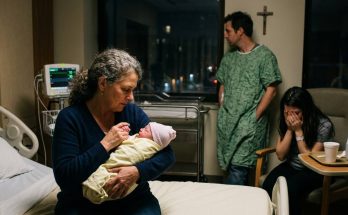
The morning after the fellowship ceremony, the house felt strangely ordinary. There were dishes in the sink, two mugs beside the coffee maker, and a stack of unopened mail leaning against the fruit bowl. Nothing in the kitchen suggested that yesterday Harper had stood in the hospital where she was born and spoken about the decision that had shaped nearly every relationship in her life.
Elise sat at the table with a screwdriver in one hand and a small mechanical assembly spread across a dish towel in front of her. At fifteen, she had inherited Harper’s habit of taking things apart simply to understand why they worked. She had also inherited Daniel’s refusal to admit defeat when something went wrong.
“This piece is backwards,” Harper said from the doorway.
Elise looked up. “No, it isn't.”
“It is.”
“I checked it twice.”
Harper walked over, leaned against the table, and studied the mechanism without touching it. “Then check it a third time.”
Elise narrowed her eyes. “You enjoy this.”
“I enjoy being right.”
“You enjoy being annoying.”
“That too.”
Daniel entered carrying groceries and glanced at the scattered components. “Should I ask?”
“No,” Harper and Elise said together.
He smiled. “Good. I’ll put these away before someone blames me for the missing washer.”
The exchange was so ordinary that the narrator stood in the hallway for a moment listening to them. Years ago, she had wondered what Harper’s life would look like. She had never imagined it would include this particular kind of morning: a daughter arguing over a screw, a son-in-law putting vegetables away, and Harper standing barefoot on the kitchen floor with coffee cooling behind her.
Later, Harper found the narrator sitting in the backyard beneath the old shade tree. The October air was warm, and somewhere beyond the fence a lawn mower started and stopped in uneven bursts.
“You disappeared,” Harper said.
“I moved twenty feet.”
“That counts.”
The narrator smiled. “You were busy.”
Harper lowered herself into the chair beside her. For several minutes they said nothing. Harper had always been comfortable with silence around the narrator. It was one of the first things they had learned together.
“I keep thinking about the room,” Harper said eventually.
“The hospital room?”
Harper nodded.
“I thought yesterday would make it feel smaller.”
“Did it?”
“No.” She rubbed her thumb across the side of her hand. “It made it feel more accurate.”
The narrator waited.
“I spent years thinking my whole story began with my father looking at me and deciding he couldn't do it,” Harper said. “Then I thought it began with you picking me up. Yesterday I realized neither one is exactly true.”
“What is true?”
“I began before either of those decisions.”
The narrator looked at her.
“I was already a person,” Harper continued. “Nobody created me by accepting me. Nobody destroyed me by being afraid of me. They made choices around me. Big choices. But I was already there.”
The narrator felt something tighten in her chest, though she kept her expression steady.
“You've been carrying that distinction for a long time,” she said.
“I think I finally understand it.”
That afternoon, Harper returned to her office. The company had outgrown the small workspace where the first prototypes had been assembled, but she had kept one battered workbench against the far wall. The surface was scarred from years of cutting, drilling, testing, and rebuilding.
Her operations manager had left three folders on her desk.
The first contained quarterly numbers.
The second concerned the research center.
The third was a letter from a family in another country whose child had received one of the company's donated devices.
Harper opened the letter first.
The handwriting was uneven. The father described his daughter struggling with ordinary classroom tasks, then learning to use the adaptive tool Harper's team had developed. He did not call his daughter inspirational. He did not describe her as courageous.
He simply wrote that she had stopped asking her mother to button her coat.
Harper read the sentence twice.
Then she folded the letter carefully and placed it in the drawer where she kept the first note she had ever received from a parent.
That evening, David came by the house carrying a box of old tools.
“I found these in the garage,” he said.
Harper looked inside.
Precision screwdrivers. Small wrenches. A soldering iron still in its original case.
“You kept all this?”
“I apparently kept everything.”
“That sounds like you.”
David smiled faintly. “Your grandmother says I have a problem.”
“She’s right.”
He set the box down.
For a while they talked about ordinary things. The weather. A supplier. Elise's latest project. Daniel's attempt to repair a leaking faucet that had somehow made the leak worse.
Eventually David said, “I thought about what you said yesterday.”
Harper looked at him.
“In the hospital.”
“I know.”
“I keep wondering what would have happened if your grandmother hadn't been there.”
Harper was quiet.
“I don't mean that I want to imagine a different life,” David said quickly. “I don't. I just…” He stopped and looked down at his hands. “I understand now that I don't get to call what happened inevitable.”
“No.”
“I made a choice.”
“You were scared.”
“I was.”
“That doesn't make the choice disappear.”
“I know.”
Harper reached into the box and picked up one of the screwdrivers.
“You don't have to punish yourself forever,” she said.
David shook his head. “I'm not trying to.”
“What are you trying to do?”
“Remember accurately.”
That answer stayed with her after he left.
Because that was what she had asked of him all along.
Not excuses. Not self-hatred. Not some dramatic performance of regret.
Just the truth.
That night, Harper found the narrator in the kitchen washing a glass.
“Dad gave me the tools.”
“I saw.”
“You knew?”
“He called first.”
Harper laughed softly. “Of course he did.”
The narrator dried her hands.
Harper looked toward the dark window. “Do you ever think about what would have happened if you had said no?”
“To what?”
“To taking me.”
The narrator considered the question.
“I don't know,” she said.
Harper turned toward her.
“I could tell you that I would have fought harder,” the narrator continued. “Maybe I would have. I could tell you I would have found some other way. But I don't know what the hospital would have decided, or what another family might have done, or what your father would have done later.”
Harper nodded.
“What I do know,” the narrator said, “is that when I picked you up, I wasn't looking at the rest of your life. I was looking at that moment.”
“You didn't know I'd become an engineer.”
“No.”
“You didn't know I'd start a company.”
“No.”
“You didn't know I'd have Elise.”
The narrator smiled.
“I didn't even know whether you'd like carrots.”
Harper laughed.
The narrator reached across the counter and squeezed her fingers.
“That was the point,” she said. “You didn't have to earn your place in the world by becoming something impressive.”
Harper looked down at their hands.
“I know.”
And for once, the narrator believed that she truly did.
Click here to continue reading: PART 14: What Elise Wanted to Know
The Room Went Quiet When My Son Looked at His Newborn Daughter and Decided Her Difference Was a Reason to Let Her Go
Part 13 of 20