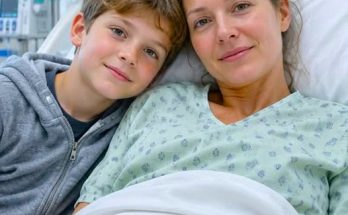
The first thing I understood was that someone was holding my hand.
The second was pain.
It seemed to live everywhere at once—deep behind my ribs, across my abdomen, in my throat, even in the muscles around my eyes when I tried to open them. A machine pulsed steadily somewhere to my left. Air moved through a vent above me with a dry mechanical hiss. Beneath the hospital smells of disinfectant and warmed plastic, I caught the faint sweetness of flowers.
Then I heard crying.
I forced my eyes open.
Ryan sat beside my bed with both hands wrapped around mine. His hair was flattened on one side, his shirt was wrinkled, and dark stubble covered his jaw. I had seen my husband exhausted before, but never hollowed out like that. When he realized I was looking at him, his mouth tightened. Tears spilled down his face.
“Hey,” he whispered. “You’re awake.”
I tried to speak. My tongue felt too large for my mouth. “Babies?”
That one word changed him.
His gaze dropped to our joined hands.
A coldness that had nothing to do with the room passed through me.
“Ryan.”
He closed his eyes.
“I’m sorry.”
I stared at him, waiting for the rest.
“They saved Caleb.” His voice cracked. “But Noah…”
He could not finish.
I remember looking at the ceiling because looking at Ryan suddenly required more strength than I had. One fluorescent panel buzzed faintly. A hairline crack ran through a corner tile. Those meaningless details became unbearably sharp while my mind refused to understand the only detail that mattered.
“Noah died?”
Ryan nodded.
“No.”
I said it softly at first.
Then again.
“No.”
He bent over my hand, pressing it against his forehead.
The tears came before I had enough strength to stop them. I tried to turn onto my side and pain tore through my abdomen. A monitor began beeping faster. Ryan stood immediately and told me not to move.
A nurse appeared.
There were questions. Medication. A hand on my shoulder. Someone telling me to breathe slowly.
None of it mattered.
One of my sons was dead.
I had carried two boys for thirty-eight weeks. I knew where each of them liked to settle. Caleb kicked high beneath my ribs; Noah seemed determined to occupy the lowest possible part of my abdomen. Ryan used to joke that their personalities had already been assigned—one restless, one stubborn.
Now there was only Caleb.
“What happened?” I asked when the medication softened the edges of the pain.
Ryan sat again.
“You collapsed at home. There was an emergency. They had to deliver them immediately.”
“I remember the pain.”
“That’s about all you would remember. You lost consciousness.”
“How long?”
His thumb moved across my knuckles.
“Three days.”
Three days.
The number frightened me almost as much as Noah’s death. Three days had disappeared from my life, and apparently an entire world had changed inside them.
“Can I see Caleb?”
“Soon. He’s been in the NICU.”
“Is he okay?”
“He’s doing well. They’re watching him closely.”
“And Noah?”
Ryan’s hand stopped moving.
I wished I could pull the question back, but I needed an answer.
“Did I see him?”
“You were unconscious.”
“Did you?”
A pause.
“Yes.”
That answer seemed to cost him something. His shoulders folded inward.
I squeezed his fingers as well as I could.
“I’m sorry you had to do that alone.”
He looked at me then, and the grief in his face seemed unmistakable.
“I’m sorry you weren’t there.”
For the next two days, I measured time by nurses, medication, and Ryan’s movements around the room. He seemed determined to become useful enough for both of us. He filled my water cup before I asked. He helped raise the bed when sitting upright became necessary. He took phone calls in the hallway so I could sleep.
Flowers appeared on the windowsill. Ryan said they were from his office.
My sister Rachel called repeatedly, but I was rarely awake long enough to speak. Ryan handled most of those conversations too.
“She says she loves you,” he told me after one call. “I told her you need rest.”
I nodded.
Rest was the only thing anyone seemed to want from me.
When a doctor came in to discuss my recovery, Ryan answered several questions before I could.
“She’s still having quite a bit of pain.”
“She hasn’t eaten much.”
“She gets dizzy when she sits up.”
At first, I was grateful. Speaking exhausted me.
But there was one moment when the doctor mentioned the emergency delivery and I asked what exactly had happened to Noah.
Ryan shifted beside me.
The doctor glanced toward him, then back at me.
“There were significant complications during the delivery. I’d prefer to go over the complete sequence once you’re stronger and we have all the records available.”
“What complications?”
Ryan touched my arm.
“Not now, Emma.”
I turned toward him.
“I want to know.”
“I know. But you almost died too.”
The doctor quietly added that there would be time to review everything.
Ryan gave me that careful, protective look he had used throughout my pregnancy whenever I became anxious.
“You need to get better for Caleb.”
The words worked.
Of course they did.
Caleb was alive.
So I let the question go.
Still, lying awake later, I remembered things I had barely noticed before the delivery.
Ryan had changed during the final months of my pregnancy.
Not dramatically. Nothing I could have pointed to and called alarming.
He simply seemed preoccupied.
There were phone calls he took outside, even when the weather was cold. Conversations that ended the moment I entered a room. He had become strangely interested in paperwork—insurance forms, hospital documents, financial projections.
Whenever I asked what he was doing, he gave some version of the same answer.
“Taking care of boring stuff so you don’t have to.”
I had appreciated it.
Pregnancy with twins left me exhausted. By thirty-five weeks, putting on shoes felt like a construction project.
But Noah’s name sometimes produced an odd reaction in him.
We had chosen the names separately. I wanted Caleb because it had been my grandfather’s middle name. Ryan suggested Noah after rejecting half a dozen alternatives.
Then, strangely, he seemed to cool toward it.
One evening I had been folding two sets of tiny sleepers on the couch and said, “I think Noah will be the quiet one.”
Ryan, staring at his laptop, had answered, “You don’t know that.”
“I’m guessing.”
He closed the computer harder than necessary.
“We shouldn’t build whole personalities for babies who aren’t even born.”
I laughed because the comment seemed ridiculous.
“What’s wrong with you?”
“Nothing.”
Later he apologized and blamed work.
That memory returned now with an unpleasant clarity.
I told myself grief was making ordinary moments look sinister.
Ryan had lost Noah too.
I watched him sitting by the window that afternoon, elbows on his knees, face in his hands. Whatever questions I had dissolved.
A grieving person could act strangely.
A frightened husband could become controlling without meaning harm.
I had nearly died.
He had been forced to watch everything happen.
I decided that explained it.
The following morning, Ryan arrived earlier than usual carrying coffee and a paper bag from a bakery near our house.
“I got the cinnamon thing you like.”
“I can barely eat toast.”
“Then I’ll eat it.”
That made me smile.
For perhaps three seconds, we were ourselves again.
He sat beside me and told me the NICU team hoped Caleb could spend time in my room that morning.
My heart jumped.
“Really?”
“He’s doing great.”
I began crying immediately.
Ryan laughed through his own tears and wiped my cheek.
“Come on. Save some for when he gets here.”
I tried.
I failed.
Around ten, there was a knock.
A nurse I had seen once before entered pushing a bassinet.
Her badge said DIANA.
Ryan stood so quickly his chair scraped the floor.
“There he is.”
I forgot everything else.
Caleb looked impossibly small beneath the blanket. His face was pink, his nose slightly flattened, his dark hair brushed forward. One fist had escaped the swaddle.
I held out my arms.
Diana smiled.
“Give me just a second, Mom.”
She checked something on the bassinet, then moved closer to the bed.
Ryan stood on the opposite side, grinning down at our son.
“Look at him, Em.”
Diana lifted Caleb carefully.
My body hurt when I adjusted myself, but I hardly noticed.
Then Diana leaned toward me.
Her smile remained.
Her voice changed.
“Don’t react.”
I thought I had misheard her.
She placed Caleb against my chest.
“Just smile,” she murmured.
My arms tightened instinctively around him.
Ryan was watching us.
I forced the corners of my mouth upward.
Diana tucked the blanket around Caleb with deliberate care.
“I sent something to your phone.”
My pulse accelerated.
“What?” I whispered.
She spoke without looking at me.
“Not now.”
Then louder, in an ordinary cheerful voice, she said, “He seems very comfortable with Mom.”
Ryan laughed.
“Already choosing favorites.”
Diana straightened.
For one instant our eyes met.
Whatever I saw there was not casual concern.
It was fear.
She moved around the bassinet, pretending to rearrange supplies.
Then she leaned close again.
“Wait until your husband leaves.”
My mouth went dry.
Ryan was talking about Caleb’s fingers and did not appear to notice.
I wanted to demand an explanation.
Diana gave the smallest shake of her head.
Her final words were almost soundless.
“What you were told about your other baby isn’t the whole story.”
The room seemed to tilt.
Caleb moved against my chest.
I looked down at him because Diana had told me not to react.
His tiny mouth opened and closed in his sleep.
Ryan touched his head.
“Our little survivor.”
I looked at my husband’s hand.
For the first time in eleven years, I felt afraid of what it might mean that I did not know something he knew.
Click Here to continue read next: PART2: The Nurse Told Me to Keep Smiling Beside Ryan, While Every Forgotten Detail of My Pregnancy Began Looking Different
I Woke Three Days After Losing One Twin, and My Husband’s Grief Seemed to Explain Everything Until the Nurse Arrived
Part 1 of 8