People later described me as a woman who finally discovered her strength after her husband betrayed her. I understand why that version is appealing. It has a clean beginning and a satisfying transformation.
It is also wrong.
I was capable before Christopher met me. I was capable while I loved him. I remained capable while our marriage deteriorated. My problem was never that I lacked strength.
My problem was that my strength had become useful to everyone around me, including me, and usefulness is surprisingly easy to mistake for love.
After the 2017 crisis, Vextor grew quickly. Christopher hired people who could do pieces of what I had once done for free. A controller appeared. Then a finance director. Eventually there were outside counsel, auditors, consultants, and investors.
I should have become less necessary.
Instead, I became necessary in quieter ways.
Christopher would come home with a problem and leave the folder beside my laptop. He would ask me to "take a quick look" at an agreement. He would mention that a board member had raised a question about a forecast. Sometimes he would send me documents during my own workday with nothing more than, "Thoughts?"
I always had thoughts.
Usually good ones.
At first he thanked me. Then he assumed I would help. Eventually neither of us described it as help at all.
Marriage is full of invisible labor, but ours had an unusual balance sheet. I was simultaneously Christopher's wife, informal financial adviser, emergency strategist, editor, sounding board, and institutional memory.
I also had my own career.
That detail disappeared most easily from Christopher's later stories.
I worked long hours. I had clients who called me because they trusted my judgment, not because I was married to anyone. I built relationships that had existed before Vextor and would exist after it.
Still, when Christopher's company became successful, its success began to occupy more space than anything else in our lives.
At parties, people asked him questions.
They asked me whether I was proud.
I was.
That is another detail I refuse to rewrite.
I loved watching Vextor succeed. I knew exactly how close it had come to disappearing. I knew what eight frightened employees looked like when a company could not make payroll. I knew what the first institutional check had meant. I knew how much work Christopher had done.
He did work hard.
He was talented.
A person does not have to be incompetent to exploit other people. Sometimes competence makes exploitation easier because everyone can point to the parts he genuinely earned and stop examining the parts he didn't.
The first time I noticed Christopher altering our shared history, I corrected him afterward.
We had been at dinner with investors. He told a story about negotiating the Series A valuation.
"You didn't negotiate that number," I said in the car.
He glanced over.
"What?"
"The valuation. You told them you pushed them up."
"I did."
"I negotiated the term sheet."
"Victoria, obviously you helped."
"That's not what you said."
He sighed.
"I was telling a story."
"It was inaccurate."
"You know what I mean."
I did know.
That was the problem.
He reached across the console and squeezed my knee.
"Nobody is trying to erase you."
I looked through the windshield.
"I didn't say anyone was."
We drove home.
I forgot the conversation for several years.
The change was gradual enough that I could always explain it. Christopher was the chief executive. Of course he represented the company publicly. Investors preferred a clean founder narrative. Nobody wanted a ten-minute footnote about his wife's financial work whenever he discussed Vextor's early years.
Reasonable explanations are excellent hiding places.
By 2018, another subject had entered our marriage.
Children.
We had talked about them before we married. Neither of us had wanted them immediately. We wanted careers established, savings accumulated, the company stable.
At thirty-four, I decided the timing was finally right.
Christopher agreed.
At first we were relaxed about it. We traveled. We worked. We assumed pregnancy would happen when it happened.
Fourteen months passed.
Nothing happened.
I began tracking dates.
Then temperatures.
Then appointments.
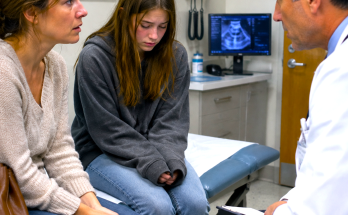
Eventually we went to a fertility specialist in La Jolla.
I remember the waiting room more clearly than I remember the doctor's face. Pale upholstery. A water dispenser with paper cups. A framed photograph of the ocean that looked as if it had been chosen specifically because nobody could object to it.
They tested me.
They tested Christopher.
The results were normal.
We waited.
Still nothing.
A second specialist repeated much of the process.
Normal.
Then another practice.
Again, normal.
There is a particular cruelty in being told repeatedly that nothing is wrong while the thing you want continues not to happen.
If someone had pointed to a damaged structure or a hormone level or a specific defect, I could have built a plan around it. Facts are painful, but facts have edges.
We were given uncertainty.
Uncertainty has no edges.
It spreads.
At first Christopher behaved kindly.
He attended appointments. He asked questions. He held my hand when doctors explained percentages that meant less each time I heard them.
His mother, Evelyn, was less disciplined.
Evelyn Lawson lived in Paradise Valley and treated the Lawson family name almost as a public institution. Her late husband had come from money. She understood family as lineage, continuity, inheritance, and obligation.
At gatherings, she asked when we intended to give her grandchildren.
I smiled.
Christopher sometimes changed the subject.
As the years passed, her questions became less playful.
One Thanksgiving she looked directly at me and said, "The doctors haven't found anything wrong with Christopher, have they?"
The table became quiet.
Christopher was cutting meat.
"No," I said.
Evelyn nodded.
She had asked only half a question, which meant she did not have to take responsibility for the other half.
Christopher said nothing.
In the car afterward, I asked why.
"Why what?"
"Why didn't you say the doctors hadn't found anything wrong with me either?"
He stared through the windshield.
"I didn't realize you needed me to."
That sentence stayed with me.
Not because it was cruel.
Because it was sincere.
We moved to IVF.
The first cycle failed.
The second produced hope for long enough to make the failure worse.
Michelle drove me home from Newport Beach after one retrieval because Christopher had an important board dinner.
I was the person who told him to attend it.
"Go," I said. "There's nothing you can do sitting in a waiting room."
"Are you sure?"
"Yes."
Michelle arrived with sunglasses pushed into her hair and two bottles of water in her bag. She made no attempt to cheer me up.
That was one of the reasons I loved her.
We had been friends since our freshman year at UCSD, when we met because a washing machine stole her quarters. Michelle was funnier than I was, warmer than I was, and better at maintaining friendships.
She remembered birthdays.
She remembered names.
She called after appointments without needing reminders.
After the retrieval, she drove me home, helped me onto the sofa, took off her shoes, and sat nearby.
She did not tell me about someone else's miracle pregnancy.
She did not tell me to stay positive.
She asked what the procedure room had looked like.
It was such an oddly precise question that I answered.
Later, I mentioned wanting soup from a Vietnamese restaurant on El Cajon Boulevard. I had spoken about it once months earlier.
Michelle stood.
"Where are you going?"
"To get your soup."
"That's ridiculous."
"You're a nightmare when you're hungry."
She drove across town and returned with it.
I remember watching her put the container on my coffee table.
If someone had asked me that afternoon which person outside my marriage I trusted most, I would not have needed time to answer.
Michelle knew everything.
She knew the clinic names.
She knew the test results.
She knew what I feared.
She knew what Christopher said after failures.
She knew the exact places where our marriage had become fragile.
And because I trusted her, I never wondered what she might learn from watching us.
The third IVF attempt failed in 2023.
Christopher did not come to the follow-up appointment.
I drove back to San Diego alone and took a client call from my car before I reached home.
Five weeks later, Christopher stood in our kitchen and said perhaps we should stop trying.
"Yes," I said immediately.
He blinked.
"Really?"
"Yes."
"You don't want another round?"
"No."
He studied my face as though he had expected resistance.
"I'm finished," I told him.
Something in his shoulders loosened.
Then he came around the counter and held me.
For years afterward, I searched that memory for evidence that the embrace had been false.
I never found any.
Christopher pressed his cheek against my hair and told me that the two of us were enough.
I believed him.
I still believe he meant it at that exact moment.
That is one of the hardest things about what happened afterward. People prefer betrayal to erase sincerity retroactively. It does not always work that way.
A person can mean one thing on Tuesday and betray it on Wednesday.
A person can love you in one room and construct another life in a second room you do not know exists.
By the time Christopher held me in that kitchen, that second room already existed.
He had begun seeing Michelle months earlier.
And two months after he told me that the two of us were enough, Michelle sent him a message containing two words that would eventually explain almost everything.
It worked.
Click Here to continue read next: PART3: Three Clinics Found Nothing Wrong With Either of Us, Yet Somehow Everyone Decided My Body Was the Failure
Ninety Minutes After Our Marriage Ended, Christopher Sent Me a Photograph He Expected Would Finally Make Me Break
Part 2 of 12