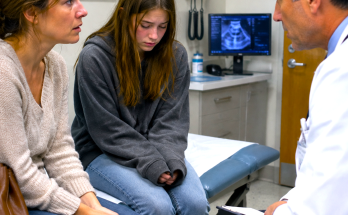
The clinic's review took place on a Monday morning.
I attended alone.
Deborah offered to come.
I told her no.
This was not litigation yet.
It was not about Vextor.
It was not about Christopher's lawyers, Michelle's choices, Daniel's shell companies, or the note.
For once, I wanted an answer that belonged only to me.
The reproductive endocrinologist who met me was not one of the physicians who had treated us.
Her name was Dr. Anika Shah.
She had reviewed the embryology records, genetic information, laboratory logs, medication protocols, and the later documentation concerning Christopher's diagnosis.
She placed a folder on the table.
"Before we begin, I want to say something clearly."
I waited.
"You were given incomplete information."
My throat tightened.
"By the clinic?"
"Some by the clinic. Some because information about your former husband was not available to your treating physicians."
I nodded.
"Tell me what happened."
She began with Christopher.
The genetic abnormality affected sperm function at a level not obvious in routine semen analysis.
It did not make biological fatherhood impossible.
But it significantly reduced the probability of producing embryos capable of normal development without additional intervention.
"Would you have changed our treatment?"
"Yes."
"How?"
She explained.
Different laboratory techniques.
More targeted genetic evaluation.
Possibly different fertilization methods.
Possibly donor sperm if we chose it.
The word chose mattered.
"What were my chances?"
She hesitated.
"Medicine doesn't allow a precise retrospective percentage."
"I understand."
"Your personal testing did not identify a clear factor that would independently explain the repeated failures."
I stared at her.
"Say that again."
"We found no evidence that you were incapable of carrying a pregnancy."
The room went quiet.
I had imagined hearing those words.
In some versions, I felt vindicated.
In others, furious.
What I actually felt was tired.
"Could there still have been something wrong with me?"
"There can always be factors medicine doesn't detect."
"So you can't tell me I definitely could have had a child."
"No ethical physician could tell you that."
I appreciated her for refusing the easy answer.
"What about the second cycle?"
She opened another section.
That was where the clinic had failed.
One embryo had been graded incorrectly because two entries were transposed during documentation.
The embryologist selected an embryo believed to have a stronger developmental profile.
In reality, another embryo may have been the better candidate.
"Would the other embryo have implanted?"
"We cannot know."
"Did the mistake cause the cycle to fail?"
"We cannot say that."
"But it reduced the quality of the decision."
"Yes."
The clinic had already identified procedural changes made since then.
They offered reimbursement for that cycle and compensation through their insurer.
I barely heard the financial part.
"So there isn't one answer."
Dr. Shah shook her head.
"No."
"Christopher's condition mattered."
"Yes."
"The lab mistake may have mattered."
"Yes."
"Chance mattered."
"Always."
"And maybe factors nobody identified."
"Yes."
I leaned back.
For years, everyone around me had wanted one answer.
Evelyn wanted the answer to be me.
Christopher needed the answer not to be him.
I needed an answer because uncertainty felt unbearable.
But biology had never owed us a villain.
The villainy came afterward, when people used uncertainty to protect themselves at someone else's expense.
"Thank you," I said.
Dr. Shah looked surprised.
"For what?"
"For not pretending certainty exists where it doesn't."
I accepted the clinic's formal acknowledgment of error.
The financial settlement went into a foundation I created several months later.
Not a fertility charity.
That would have felt too neat.
I funded grants for patients who needed independent medical-record reviews after complicated diagnoses.
People deserve access to their own facts.
That was the only lesson I wanted to institutionalize.
The Point Loma house remained mine.
I considered selling it.
Instead, I renovated it.
Not into a monument to my parents.
A home.
I replaced the windows.
Repaired the deck.
Kept the kitchen table.
That table was one of the few pieces of furniture from my childhood still there.
The wood had a burn mark from a pan my father set down without a trivet sometime in the 1980s.
I could have refinished it.
I didn't.
Some marks are evidence.
Christopher and Michelle stayed together for another fourteen months.
I know that because eventually mutual friends stop understanding which information you do and do not want.
Then they separated.
I did not celebrate.
Their relationship had never been the central question of my life, though for a while it felt as if it should be.
They shared custody of Samuel and Noah.
Both boys became healthy.
That was the only detail I allowed myself to keep.
Evelyn occasionally sent a holiday card.
The first year, I returned nothing.
The second year, I sent one back.
We never became close.
We became accurate.
Sometimes that is enough.
Daniel Rasmussen retired completely from consulting.
His settlement with Vextor remained confidential.
The research entities were dissolved.
Halvard disappeared.
North Vale disappeared.
Sierra Praxis disappeared.
Carden Biomedical disappeared.
Names that had once occupied entire sections of my glass wall became inactive records in state databases.
Vextor survived them all.
Priya became permanent chief executive.
Three years later, the company was acquired.
The price was higher than anyone expected.
My eleven-point-nine-two percent converted into a sum large enough that journalists covering the acquisition briefly tried to understand how the founder's former wife had become one of the largest individual shareholders.
Some called it a divorce settlement.
That irritated me.
It wasn't.
The shares came from a debt.
The debt came from $410,000 I raised against my parents' house.
The loan saved the company.
The company acknowledged the obligation.
Then it failed to pay.
The agreement did what agreements are designed to do.
No revenge was necessary.
Paper had a longer memory than Christopher.
When the acquisition closed, Martin sent me a message.
Your dad's loan did pretty well.
I stared at it.
Then laughed.
That evening I opened a bottle of wine and poured one glass.
I carried it onto the Point Loma deck.
The ocean was visible only as a strip between houses.
My father would have complained about the acquisition price.
Not because it was low.
Because he believed complaining was part of negotiation.
My mother would have asked whether I had accounted for taxes.
I could hear both of them clearly enough to smile.
I raised the glass toward nobody.
"Your paperwork held up."
The wind moved through the eucalyptus trees.
That was celebration enough.
My own work changed too.
I left the firm where I had spent most of my career and started a small advisory practice.
I limited the clients.
I charged properly.
I stopped solving problems for people who refused to participate in solving them.
That last rule cost me business.
I considered that a benefit.
For the first time in adulthood, competence stopped feeling like a public utility.
I traveled alone.
At first I hated it.
Then I learned the difference between loneliness and solitude.
Loneliness is wanting someone who isn't there.
Solitude is discovering that nobody is missing.
I dated eventually.
Not quickly.
Not dramatically.
There was no handsome stranger waiting in the final chapter to prove that I remained desirable.
My life did not require that kind of evidence.
I met people.
Some stayed for dinner.
A few stayed longer.
One relationship became important.
Whether it lasts is a question I no longer need answered in advance.
That may be the largest change Christopher left me.
Not distrust.
Tolerance for uncertainty.
Michelle wrote to me once more.
Four years after our divorce.
The envelope came to Point Loma.
I recognized her handwriting.
For an hour I left it unopened on the kitchen counter.
Then I made tea and sat at my parents' table.
The letter was three pages.
She wrote about the boys.
Briefly.
She wrote about therapy.
Also briefly.
She did not ask me to restore the friendship.
She said she had finally understood that apology was not a transaction that obligated the injured person to provide relief.
Then she wrote about the day she drove me home from the fertility clinic.
She remembered the soup.
So did I.
She said that memory had troubled her because she had spent years trying to decide whether the kindness was false in light of what she later did.
Her therapist told her the question was useless.
A good act does not become fake because the same person later commits a terrible one.
I read that paragraph several times.
Then I reached the end.
I am sorry that I became someone unsafe while still believing I loved you.
I folded the letter.
I did not answer that day.
Or that week.
Three months later, I sent a card.
No forgiveness speech.
No invitation.
No promise.
I wrote six words.
I believe you loved me too.
That was all.
It was enough.
Christopher and I saw each other only once after the Vextor acquisition.
A mutual friend died.
We both attended the memorial.
He had gone gray at the temples.
I had too.
For a while we stood on opposite sides of a crowded room, each pretending not to notice the other.
Eventually he walked over.
"Victoria."
"Christopher."
He smiled slightly.
"How are you?"
"Good."
"Really?"
"Really."
He nodded.
"So am I."
"I'm glad."
We talked about the friend who had died.
Nothing else.
Then Christopher said, "I heard Vextor treated you well."
"Eventually."
He laughed quietly.
"I deserved that."
"I wasn't making a joke."
"I know."
There was a pause.
"Do you still have the original note?"
I looked at him.
"Of course."
That made him laugh for real.
For a second, I remembered the man from 2013.
The founder with a dying company.
The man pacing behind my laptop while I told him he would miss payroll.
The man who asked whether I could fix it.
"I should've read it," he said.
"Yes."
"I've thought about that more times than you can imagine."
"The note wasn't your biggest mistake."
His smile disappeared.
"I know."
"Good."
He looked across the room.
"I've tried to figure out which one was."
I shook my head.
"Don't."
"Why?"
"Because there wasn't one."
He looked at me.
"You keep searching for the single decision where everything went wrong. That's not what happened."
He waited.
"You kept making small choices that required the next bad choice. You hid the test. Then you had to hide why. You used Daniel. Then you had to hide the money. You turned to Michelle. Then you had to hide her. You told yourself each choice was temporary until the temporary choices became your life."
Christopher said nothing.
"The note was different."
"How?"
"It didn't change."
He looked down.
"No."
"It said what it said from the beginning."
He nodded.
"That's probably why I hated it."
"Probably."
Someone across the room called his name.
Christopher glanced over.
Then back at me.
"Victoria?"
"Yes?"
"I'm sorry."
There was no request inside it this time.
No need for absolution.
No argument.
Just the sentence.
I believed him.
"Thank you."
He walked away.
I never saw him again.
The original note is still in a fireproof document box in my office.
The pages are ordinary.
Black print.
Signatures.
Notary stamp.
No dramatic language.
Nothing about betrayal.
Nothing about children.
Nothing about love.
It simply records that on a particular date, one party gave another something of value, and both agreed what would happen if the obligation was not honored.
For years, I thought the note mattered because Christopher failed to read it.
I was wrong.
It mattered because I had read it.
I had understood what I was risking.
I had protected myself before I knew I would ever need protection.
That difference became the foundation of everything that followed.
People sometimes ask whether I regret lending him the money.
No.
Without it, Vextor might have failed.
Dozens of careers would have taken different paths.
I would never have received the eventual return.
And more importantly, regretting the loan would mean pretending that the woman I was in 2017 should have known the man Christopher would become.
She couldn't.
She loved her husband.
She believed in his company.
She also called an attorney.
I am proud of all three things.
People ask whether I regret the marriage.
That question is harder.
Eleven years cannot be reduced to the worst things that happened inside them.
Christopher betrayed me.
He also made me laugh.
We built things.
We traveled.
We buried my parents.
We failed together until he decided the failure needed to belong to me.
The good does not erase the harm.
The harm does not require me to declare every good memory fraudulent.
I no longer need the past to become simpler before I can live with it.
That may be the closest thing to peace I have found.
The photograph Christopher sent after our divorce is gone.
I deleted it years ago.
Not because seeing him with Michelle hurt.
Not because the twins hurt.
I deleted it because I finally understood what the photograph had been trying to prove.
That he had moved on.
That he had won.
That biology had rendered a verdict on me.
That his new family exposed something defective in the woman he left behind.
None of those things were true.
Samuel and Noah were not evidence.
Michelle was not evidence.
Christopher's company was not evidence.
My inability to become pregnant was not a moral fact.
And the ending of a marriage was not proof that one person had succeeded while the other failed.
The actual evidence had always been quieter.
A medical test.
A payment record.
A vendor registration.
An email.
A handwritten annotation.
A notarized agreement.
Facts Christopher kept believing he could outrun.
Facts I kept because facts do not become cruel merely because they are inconvenient.
On the anniversary of my father's death, I sometimes take coffee onto the Point Loma deck before sunrise.
The neighborhood is quiet then.
A few porch lights remain on.
The air smells faintly of salt.
I think about my parents building security slowly, without ever knowing what their house would eventually make possible.
I think about the $410,000.
I think about the notary asking Christopher whether he wanted to read before signing.
I think about his grin.
I married my due diligence department.
For years, that memory made me angry.
Now it makes me smile.
He thought diligence was something I performed for him.
He never understood that it was part of who I was.
And when everything else disappeared—the marriage, the friendship, the story we had told about our family—that part remained.
I kept the receipts.
I kept the truth.
Most importantly, when the time came, I finally kept myself.
The End
Read more original stories on Feel Every Story.
Ninety Minutes After Our Marriage Ended, Christopher Sent Me a Photograph He Expected Would Finally Make Me Break
Part 12 of 12