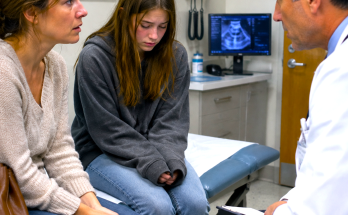
Dad died on a rainy Tuesday morning with Rosie sitting beside him.
There was no dramatic last-minute crisis.
No frantic rush.
His body had simply grown tired.
For several days, the doctors had told us his organs were failing.
We understood what that meant.
Understanding did not make anything easier.
The family rotated through his room.
Mom slept in a reclining chair.
I brought coffee.
Daniel handled phone calls.
Ben transported children between school, home, and hospital.
Rosie spent more time there than any of us.
On the final night, Dad drifted in and out.
He had become thin.
His hands looked unfamiliar.
Rosie sat beside him holding one.
At midnight, I whispered, "You should rest."
"No."
"You've been here twelve hours."
"No."
"He'd understand."
"I know."
"Then why—"
Rosie looked at me.
"I stay."
There was nothing else to say.
So I stayed too.
Around two in the morning, Dad woke.
His eyes moved slowly around the room.
Mom was asleep.
I sat near the window.
Rosie leaned forward.
"Hi."
Dad looked at her.
His mouth moved.
Rosie leaned closer.
"What?"
He whispered again.
This time she heard him.
"Ben?"
Rosie smiled.
"Home with kids."
Dad nodded.
A few minutes passed.
Then he whispered something else.
Rosie's expression changed.
"What did he say?" I asked.
She shook her head.
"Me."
Private.
I respected it.
Dad squeezed her hand.
Then, surprisingly, he laughed.
Just once.
A faint breath of sound.
Rosie laughed too.
Later I learned what he had said.
He had apologized.
Not for one specific decision.
For all the years he had worried about what would happen to Rosie after he was gone.
Rosie answered him with the kind of brutal simplicity only she could manage.
"You wasted lots of time."
Dad laughed.
Then she told him it was okay.
Not that his fear had been correct.
Not that the secrecy had been justified.
Only that she understood he had loved her while being afraid.
Near dawn, Ben arrived.
He stood quietly at the door.
Rosie looked up.
"You came."
"Of course."
He kissed her forehead.
Then he sat on the floor beside her chair.
That image remains clearer in my memory than Dad's funeral.
Ben on the floor.
Rosie holding Dad's hand.
No speeches.
No performance.
Just presence.
At seven-ten, Dad's breathing changed.
The nurse entered.
Mom woke.
I moved beside her.
Daniel arrived moments later.
We gathered around the bed.
Dad did not open his eyes again.
Rosie never released his hand.
At seven-twenty-three, the nurse turned off one monitor.
Mom made a sound I had never heard before.
I held her.
Ben closed his eyes.
Rosie looked at Dad for a long time.
Then she leaned forward and kissed his forehead.
"You can stop planning."
I cried then.
So did Ben.
Even the nurse looked away.
The funeral was four days later.
Dad had written instructions years before, naturally.
He wanted no elaborate service.
No long eulogies.
No expensive flowers.
Mom ignored the last request.
The church overflowed anyway.
People told stories.
Some I knew.
Some I didn't.
A former coworker described Dad secretly paying for another man's car repair.
A neighbor remembered him shoveling snow while recovering from surgery.
Someone from church talked about his obsession with keeping emergency flashlights in every room.
Rosie leaned toward me.
"Planning."
"Yes."
When it was time for family remarks, I stood.
I had written six pages.
I used none of them.
I looked at the room.
Then at Rosie.
Then at Ben.
"My father spent a large part of his life trying to make sure the people he loved would be safe after he was gone."
My voice shook.
"He was very good at planning."
A few people laughed.
"He was less good at accepting that some things cannot be planned."
Mom smiled through tears.
I continued.
"For years, he worried about my sister Rosie."
I saw several heads turn toward her.
That old instinct.
The assumption that everyone knew what that sentence meant.
I changed direction.
"But if Dad were here, I think he would tell you he eventually realized something important."
I looked at Rosie's face.
"He wasn't the only one who could care for her."
I paused.
"Rosie cared for him."
Silence filled the church.
"She organized his medication. She called after appointments. She sat with him when he couldn't sleep. She held his hand when he died."
My throat tightened.
"Our family spent years talking about who would take care of Rosie someday."
I looked at Ben.
"We should have spent more time noticing how often she was already taking care of us."
Rosie wiped her eyes.
I finished quickly.
"Dad understood that before the end."
After the service, people approached Rosie differently.
Some hugged her.
Some shared memories of Dad.
Nobody praised Ben for caring for her.
At least not within my hearing.
Perhaps Dad had finally taught us something after all.
Several weeks later, we gathered at Mom's house to go through his belongings.
Dad had labeled almost everything.
TAX.
INSURANCE.
HOUSE.
MEDICAL.
WARRANTIES.
Rosie found a box marked IMPORTANT.
Inside were spare batteries.
She looked at me.
"Not important."
"To Dad, apparently."
Ben found the old folder eventually.
The one I had seen in Dad's study before Rosie's wedding.
He carried it into the kitchen.
"Cathy."
I recognized it immediately.
My stomach tightened despite all these years.
We opened it together.
Inside were the earliest drafts of Dad's plans for Rosie.
Legal notes.
Insurance calculations.
Names of potential trustees.
Lists of questions.
Ben's name appeared several times.
So did mine.
Near the back, we found a handwritten page.
Dad's writing.
The date was from years before Ben and Rosie started dating.
At the top:
If something happens to us, Rosie needs people, not just money.
Below it were several names.
Mine first.
Then Ben.
Then relatives.
Friends.
Support services.
At the bottom Dad had written a sentence.
Ben has never treated Rosie like helping her makes him special.
I read it twice.
Ben turned away.
Rosie took the page.
"What?"
I pointed.
She read slowly.
Then she smiled.
"Dad knew."
"Apparently."
Ben rubbed his eyes.
"Can we put that away?"
Rosie looked at him.
"You cry."
"No."
"You cry."
"Your father just died."
"So?"
"So I'm allowed."
She handed him the page.
"Okay."
Ben folded it carefully.
There was another document behind it.
A note from Dad written much later.
This one had been added after Rosie and Ben's wedding.
I read aloud.
I once thought Ben's greatest gift to Rosie was that he would take care of her. I was wrong. His greatest gift is that he expects her to take care of herself whenever she can.
Rosie's expression softened.
Then I continued.
And Rosie's greatest gift to Ben is that she never lets him believe loving her makes him a better man than everyone else.
Ben laughed through his tears.
"That sounds like him."
Rosie nodded.
"Also true."
We kept the notes.
Not because they had legal importance.
They didn't.
The trust had already been restructured.
Rosie controlled her own accounts.
The children's funds were separate.
My role as trustee had mostly ended.
The papers mattered because they preserved Dad's change.
Fear had built his first plan.
Trust had dismantled it.
After Dad's death, Mom stayed in the family house for another two years.
Then she decided it was too large.
Rosie suggested selling.
Mom protested.
"It's your childhood home."
"So?"
"I thought you'd be sentimental."
Rosie shrugged.
"House is house."
Ben laughed.
"She's never forgiven that upstairs bathroom."
"Too small."
The house sold.
Mom moved into a smaller place ten minutes from us.
Rosie and Ben stayed in their town.
The twins grew.
Henry became obsessed with astronomy.
June became a goalkeeper and seemed happiest throwing herself toward objects traveling directly at her face.
Nora worshiped both of them.
Rosie eventually left the nursery and started a small plant-care service with another woman she met through work.
Ben built the website.
Badly.
Rosie made him redo it.
He did.
Their marriage became what most long marriages become.
A thousand private systems.
Coffee.
Bills.
School mornings.
Arguments.
Birthdays.
Apologies.
Inside jokes.
Wet towels.
Too many throw pillows.
Sometimes Rosie needed Ben.
Sometimes Ben needed Rosie.
Most days they simply needed whoever had remembered to buy milk.
On their fifteenth anniversary, our family gathered in their backyard.
There was no vow renewal.
Rosie thought those were "too much talking."
Instead, Ben grilled.
The children complained about photographs.
Mom brought a cake large enough for fifty people.
Daniel and I brought wine.
As evening settled, I found Ben sitting alone on the back steps.
"You hiding?"
"Five minutes."
"From your wife?"
"Mostly your mother."
"Reasonable."
I sat beside him.
Through the window, Rosie was arguing with June about whether fifteen was old enough to dye the ends of her hair purple.
"How's marriage?" I asked.
Ben looked at me.
"You're asking fifteen years late."
"I like delayed evaluations."
He smiled.
"Good."
"Just good?"
"Sometimes difficult."
"That's more believable."
"Sometimes really difficult."
"Better."
He looked toward the window.
"Mostly good."
We sat quietly.
Then he said, "Do you remember when you asked why I married her?"
I looked at him.
"I never actually asked."
"You didn't have to."
I winced.
"Was I that obvious?"
"Painfully."
"Sorry."
"It's fine."
"No. It wasn't."
Ben considered this.
"Okay."
I laughed.
"You could pretend."
"I've lived with Rosie fifteen years. Pretending has been trained out of me."
Fair.
I looked toward my sister.
"Would you answer differently now?"
"Answer what?"
"Why you married her."
Ben thought.
"I don't know."
"Come on."
He rubbed his palms together.
"The reasons change."
That surprised me.
"What does that mean?"
"I married her because I loved who she was then."
He looked through the window.
"I stay married because I love who she keeps becoming."
I let that sentence settle.
It was not the kind of answer Ben would have given for a newspaper article.
Too quiet.
Too specific.
Probably why I believed it.
Rosie opened the back door.
"What you doing?"
"Talking about you," I said.
"Bad?"
"Mostly."
She walked outside.
"Ben."
"Yeah?"
"June says purple hair."
"I heard."
"No."
He looked toward me.
I stood.
"This seems like a marital issue."
"Coward," he said.
"Correct."
I went inside.
Years earlier, I would have lingered.
I would have listened.
I would have evaluated whether Ben answered correctly.
I no longer needed to.
That was perhaps the last thing Rosie taught me about love.
You cannot prove it by watching closely enough.
Care is not a performance.
It is repetition.
It is being there often enough that being there stops looking remarkable.
It is making lunch.
Calling doctors.
Arguing about paint.
Driving ninety minutes.
Sitting on a hospital floor.
Letting someone make their own mistakes.
Apologizing.
Staying when staying is difficult.
Leaving space when space is needed.
And allowing the person you love to care for you in return.
A year after that anniversary, Rosie found one final item among Dad's papers that Mom had forgotten in a desk drawer.
A photograph.
Three children beside a chain-link playground fence.
Me at seven.
Rosie at six.
Ben beside us.
I had forgotten anyone took it.
Rosie was holding two dandelions.
And through the buttonhole of Ben's school shirt was a third, badly crushed yellow flower.
On the back Dad had written the date.
Nothing else.
Rosie brought the photograph to my house.
"You remember?"
"Every part."
She smiled.
"Ben looked stupid."
"He did."
"Still does."
"Often."
We sat at my kitchen table.
For a long time, neither of us spoke.
Then Rosie touched the little boy in the photograph.
"People say he took care of me."
"Yes."
She touched the picture of herself.
"I took care of him too."
"I know."
Then her finger moved to the small figure standing between them.
Me.
"And you."
My eyes burned.
"Sometimes."
Rosie frowned.
"Lots."
I smiled.
She put the photograph back on the table.
When we were children, I believed my role was to stand between Rosie and anything that could hurt her.
Ben believed something different.
He stood beside her.
For years I thought that made him extraordinary.
Eventually I understood that he had never wanted praise for it.
Neither had Rosie.
They wanted what everyone wants from the people who love them:
To be seen clearly.
To be allowed to choose.
To receive help without becoming helpless.
To give help without becoming heroic.
And to know that when life became frightening, complicated, disappointing, or painfully ordinary, somebody would still pull up a chair.
Rosie looked at the photograph one more time.
Then she slipped it into her purse.
"Mine."
"I thought we were sharing it."
"No."
"Why?"
She stood.
"Because Dad wrote date."
"So?"
"I keep."
I laughed.
"Fine."
She walked toward the door.
"Rosie."
She turned.
"I love you."
Her expression immediately became suspicious.
"Why?"
"Do I need a reason?"
"You're being weird."
"Probably."
She opened the door.
Then looked back.
"Love you too."
And that was all.
No speech.
No lesson.
No promise about forever.
Just my sister standing in the doorway of the life she had built for herself, already impatient to get home to the husband everyone once assumed was sacrificing himself for her.
Ben had spent years quietly caring for Rosie.
That part was true.
What took the rest of us much longer to understand was that Rosie had spent those same years caring for him.
And for me.
And for our parents.
And eventually for the children who would grow up knowing nothing unusual about being loved in both directions.
The End
Read more original stories on Feel Every Story.
The Promise Ben Made to My Little Sister Long Before Any of Us Understood What It Would Eventually Cost Him
Part 12 of 12