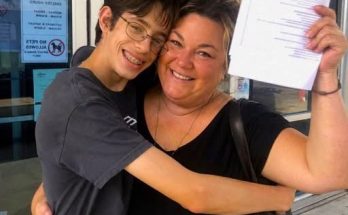
Luke came home the following Friday carrying the same worn duffel bag he had taken to college.
He set it down beside the door.
Then he stood there.
Emma looked at him from the kitchen.
"You've been gone six days."
"I know."
"You look different."
"I've been gone six days."
"Exactly."
Luke laughed.
I came out of the kitchen and hugged him.
He hugged me back.
Then he pulled away.
"What's for dinner?"
I smiled.
"Meatloaf."
He looked at Emma.
"She promised?"
"I didn't promise anything."
"You didn't have to."
He dropped his bag and walked toward the kitchen.
For a few minutes, everything felt exactly as it had before.
That was comforting.
It was also misleading.
Because college had changed him.
Not dramatically.
Not in the ways people write about.
He had simply begun making decisions without checking whether everyone else approved.
He had met people who knew nothing about his case file.
They didn't know about the ten placements.
They didn't know about Emma.
They didn't know about the packed bag.
They knew him as Luke.
That mattered.
At dinner, he told us about his roommate, Daniel, who apparently believed dirty laundry belonged on the floor.
"How bad?"
"There's a chair you can't see anymore."
Emma laughed.
"Have you told him?"
"Yes."
"And?"
"He said the clothes are clean."
Luke stared at her.
"They're not."
She laughed harder.
I watched him.
He was talking with his hands now.
He had always been expressive when he felt safe, but I hadn't realized how much of that part of him had been buried beneath caution.
After dinner, he disappeared upstairs.
When I passed his room later, he was sitting on the floor with the photograph album open.
"You okay?"
"Yeah."
He touched the picture of him and Emma as children.
"I showed this to Daniel."
"What did he say?"
"He asked who she was."
"Emma?"
"Yes."
"What did you tell him?"
Luke smiled.
"My sister."
There was no hesitation.
No complicated explanation.
Just my sister.
I stood in the doorway.
He noticed.
"What?"
"Nothing."
"You have that look."
"What look?"
"The Mom look."
I laughed.
"Go to sleep."
He grinned.
The next morning, Luke and Emma repaired the porch together.
They argued for nearly an hour.
Neither knew exactly what they were doing.
Eventually I took the tools away.
"You two are making it worse."
Luke looked offended.
"We're learning."
"You're learning how to create a larger hole."
Emma pointed at him.
"He started it."
Luke pointed at her.
"She distracted me."
I shook my head.
"Coffee?"
"Yes," they said together.
We stood on the porch afterward.
The repaired board looked slightly crooked.
Luke studied it.
"Looks good."
Emma nodded.
"It does."
I looked at the board.
"It looks terrible."
They both laughed.
It was one of those moments I wanted to keep forever.
But that evening, Luke became quiet.
He was sitting at the table scrolling through his phone.
I recognized the expression.
"What happened?"
He locked the screen.
"Nothing."
I waited.
He sighed.
"Someone from the agency contacted me."
My stomach tightened.
"Why?"
"They're reviewing old sibling cases."
"Because of what happened with us?"
"Maybe."
He looked uneasy.
"They asked whether I'd be willing to talk about my experience."
I sat across from him.
"Do you want to?"
"I don't know."
"Then don't decide because someone else wants an answer."
He nodded.
"I keep thinking about other kids."
"That's understandable."
"What if there are more siblings who think they've been forgotten?"
I didn't answer immediately.
Because I knew what he was really asking.
Could his pain become useful without becoming his entire identity?
He didn't need to become a spokesperson.
He didn't need to turn his childhood into a public lesson.
But if he wanted to speak, that choice could belong to him.
"I think you should decide based on what you can live with," I said.
He looked at me.
"Not what makes me look good?"
"No."
"Not what makes them feel better?"
"No."
"What I can live with."
"Exactly."
He thought about it.
"I might do it."
"Then I'll support you."
He nodded.
The following week, Luke agreed to a private interview with the agency.
He spoke for nearly two hours.
When he returned home, he looked exhausted.
Emma was waiting.
"How was it?"
"Hard."
"Did you tell them?"
"Everything."
She hugged him.
He stood there for a moment.
Then hugged her back.
Later, he told me the most difficult part wasn't describing what happened to him.
It was realizing how ordinary the failures had been.
Nobody had woken up intending to destroy two children's relationship.
There had been paperwork.
Delays.
Transfers.
Assumptions.
One person expecting another person to handle something.
A letter put into the wrong file.
A question not asked.
A call not returned.
The damage had grown from ordinary neglect.
That frightened him more than a single villain would have.
"Because it means it can happen again," he said.
I understood.
"Then maybe that's why telling the truth matters."
He nodded.
"But I don't want my whole life to be about what happened."
"It shouldn't be."
"What do I do with it, then?"
"Carry it differently."
He looked at me.
I smiled.
"You don't have to drag it."
He was quiet.
Then he nodded.
When he returned to college, he took the photograph of himself and Emma.
He left the old photograph at home.
"I want this one."
I understood why.
The old photograph represented what they had lost.
The new one represented what they had chosen to keep.
Before he left, Emma gave him a list.
"What's this?"
"Things you have to remember."
He unfolded it.
The first line said:
Call your mother.
The second:
Call your sister.
The third:
Eat something that isn't instant noodles.
He laughed.
"You're impossible."
"You're welcome."
He folded the paper carefully and put it into his wallet.
Then he looked at me.
"I'll see you in two weeks."
"Drive safely."
"I will."
He hugged me.
Then he hugged Emma.
Then he left.
I watched his car disappear again.
This time, the house felt quiet.
But the quiet no longer scared me.
Because I knew he would come back.
And more importantly, I knew he didn't have to.
He could build a life away from us and still belong to us.
That was the difference between attachment and possession.
Luke was finally learning it.
So was I.
Click here to continue reading: PART 10: Luke’s Story Reached Someone Else Who Had Been Separated From Family, and Suddenly His Private Pain Became Another Child’s Question
Ten Homes Had Already Closed Their Doors Behind Him, Yet the Quiet Boy by the Window Made Me Want to Sit Beside Him
Part 9 of 12