The first flakes came just after dusk, thin and hesitant against the dark windows of the lobby. I noticed them while carrying a stack of envelopes from the office toward the front desk. For a moment, my body reacted before my mind did. My shoulders tightened. My hand stopped halfway to the mail tray.
A year earlier, snow had meant an emergency room, an oxygen mask, my mother's blue-white face beneath hospital lights, and Daniel asking about groceries before asking whether Evelyn was alive. That memory had been carved so deeply into me that even a few flakes could bring it rushing back.
Then I heard my mother's voice behind me.
"Don't freeze in place," she said.
I turned. Evelyn stood near the lobby doors wearing her old gray coat and a knitted scarf. She had insisted on coming downstairs when she saw the forecast, even though I had offered to bring her tea upstairs instead. Her hair had more silver in it than it had a year ago, but there was something steadier in her face now.
"You said you wanted to go outside," I reminded her.
"I did."
"It's getting colder."
"I noticed."
"You could change your mind."
She smiled. "So could you."
I looked through the glass. Snow was beginning to collect along the edges of the sidewalk, softening the dark pavement. The building lights reflected in the windows, and behind us a few tenants were moving through the lobby with groceries, backpacks, and winter coats. Someone had left a small paper snowflake taped to the bulletin board.
Evelyn held out her hand.
"Come on."
I took it.
We stepped outside together.
The cold struck my cheeks immediately. I inhaled and smelled winter air, damp stone, and the faint wood smoke drifting from somewhere down the block. Nothing dramatic happened. No siren sounded. No hospital doors opened. No voice called my name.
Snow simply fell.
Evelyn tilted her face upward.
"For years," she said, "I thought being strong meant pretending something hadn't hurt."
I glanced at her.
"And now?"
"Now I think it means remembering that it hurt and refusing to let it decide everything that comes after."
We stood there quietly.
Across the street, a child in a bright coat tried to catch flakes on her tongue while her father laughed. A delivery driver hurried toward a van. Someone opened an umbrella even though there was barely enough snow to cover the pavement.
Ordinary life continued around us.
That was what moved me most.
The snow had once made the whole world feel dangerous. Now it was just weather falling on people who had places to go.
Evelyn reached into her pocket and pulled out a folded piece of paper.
"What is that?" I asked.
"Something I've been carrying around for weeks."
She unfolded it carefully. It was a list.
At the top, she had written: Things We Are Still Allowed To Do.
Underneath were simple things.
Travel somewhere without asking anyone's permission.
Paint the lobby.
Take a vacation.
Say no.
Invite people over.
Laugh loudly.
Change our minds.
Sleep late.
Make mistakes.
Start something new.
I looked at the page for a long time.
"You wrote this?"
"Yes."
"You forgot one."
"What?"
"Go outside when it snows."
She laughed.
"That's going on the list."
We went back inside after a few minutes. Evelyn pinned the paper beside the community-fund notice and the tenant bulletin board. It looked almost childish among the legal forms and maintenance schedules.
But nobody removed it.
Over the next week, the building settled into winter routines. The heating system ran more often. Tenants carried wet boots through the lobby. The community fund paid for emergency heating repairs in two apartments and school supplies for three children whose parents were struggling.
The work was not glamorous.
That was exactly why I liked it.
There was no grand rescue. No dramatic speech. Just people helping other people because someone had decided there should be a way to do it.
One afternoon, I found Evelyn in the office reviewing the fund records.
She looked up over her glasses.
"We're going to need a better filing system."
I smiled.
"That's your big announcement?"
"It's important."
"It is."
She pushed a folder toward me.
"Also, Mrs. Alvarez asked whether we could help her grandson with his college application."
"Then we'll help."
Evelyn nodded.
I realized then that the building had become something different without either of us announcing it. It was still property. Still an inheritance. Still the asset Daniel had tried to turn into a transaction.
But it had stopped being only those things.
It had become a place where choices were possible.
That evening, I walked home to my apartment downstairs with a folder under my arm and snow melting from my coat. I passed the framed winter photograph in the hallway.
The picture showed the building covered in snow, its windows glowing warmly against the gray evening.
For a long time, I had thought of that night as the moment everything broke.
Now I understood something else.
It was also the moment the truth finally became impossible to ignore.
Daniel had believed the snowstorm would make Evelyn weaker. He had believed exhaustion would make her compliant, fear would make me quiet, and family loyalty would keep everyone from asking difficult questions.
Instead, the night had exposed him.
The truth had not arrived dramatically.
It had arrived in small pieces.
A phone taken from a woman's hand.
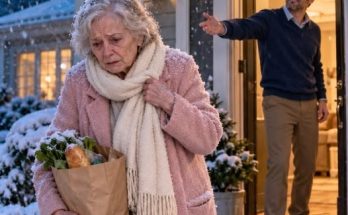
A grocery bag abandoned in the snow.
A forged signature.
A hospital record.
A camera recording.
A spreadsheet.
A box of documents.
One piece after another, until the story he had constructed could no longer stand.
I closed my apartment door behind me.
For the first time, I realized I wasn't waiting for another piece.
There was nothing left to uncover.
And that felt like freedom.
Click here to continue reading: PART 18: WHAT REMAINS
My Mother Was Unconscious in the Snow, Yet My Husband’s First Concern Was the Dinner She Had Been Sent Out to Buy
Part 17 of 20