At 2:46 p.m., Detective Thorne returned to Chloe's hospital room.
The afternoon light had faded behind the clouds, leaving the window the color of dull steel. Chloe had slept for nearly an hour, though her rest had been interrupted whenever a nurse adjusted the warming blanket or checked her vital signs. When the detective entered, she opened her eyes and tried to sit straighter.
“You don't need to move,” he told her. “I just wanted to give you an update.”
I watched his face carefully.
“Julian and Beatrice are in custody,” he said. “The search is continuing, and the district attorney's office will review the evidence to determine the appropriate charges.”
Chloe stared at him for several seconds.
“They actually arrested him?”
“Yes.”
She looked toward the window again. I could see her trying to reconcile the words with the man she had known for six years. The person who had once waited outside her office with flowers, who had promised to build a life with her, was now in police custody because investigators had found evidence supporting her account.
“What about Olivia?” she asked.
“Her connection to the financial records is being reviewed separately. We haven't established that she participated in the assault.”
Chloe nodded slowly.
The room fell quiet except for the steady rhythm of the heart monitor. I wanted to tell her that everything was over, that Julian could never hurt her again, that the worst part was behind us.
But I could not promise any of those things. An arrest was not a conviction. A protective order still had to be obtained. The financial investigation had barely begun, and Chloe would have to recover from injuries that would not disappear simply because the truth was finally being documented.
So I reached for her hand.
“You're here,” I said. “You're getting treatment. We can deal with the next thing when it comes.”
She squeezed my fingers, then began to cry.
“I should have left him months ago.”
I moved my chair closer to the bed.
“Maybe there were moments when leaving would have been safer. Maybe there were signs you understand differently now. But none of that makes you responsible for what he chose to do.”
“I kept making excuses for him.”
“I did too.”
She turned toward me, surprised.
“I believed you when you told me he was under pressure. I thought the problems were ordinary marriage problems. I heard the way he talked about you, and I told myself you would tell me if things became dangerous.”
“You couldn't have known.”
“Neither could you know how far he would go.”
I had spent years listening to victims describe the gradual erosion of their confidence. Rarely did a person wake up one morning and decide to accept cruelty. More often, there was a series of small concessions: an apology accepted, an insult explained away, a promise believed because the alternative was too painful to contemplate.
Chloe had not stayed because she was foolish. She had stayed because she had loved someone who kept offering her reasons to believe that the person she loved was still there.
That did not make the danger less real. It simply meant she needed care rather than another accusation.
After the detective left, Chloe noticed the leather wallet beside my handbag.
“Is that your old credential?”
I looked down at it. The gold edge had slipped out of the worn leather.
“Yes.”
“Why did you bring it?”
I considered the question. When I had left home that morning, I had not deliberately packed it. I had picked up my handbag, my keys, and the first warm clothes I could find. Yet the wallet had come with me, as though some part of my mind had anticipated that I would need a reminder of the woman I had once been.
“I wanted something that would remind me to think like a prosecutor before I reacted like a mother,” I said.
Chloe gave a tired laugh that turned into a wince.
“Those sound like the same person to me.”
“They aren't always.”
I explained that the badge did not give me authority over the investigation. It did not allow me to direct the police, demand special treatment, or decide what happened to Julian. If anything, my background meant I had to be especially careful not to interfere.
“What I can do,” I continued, “is help you preserve your rights, make sure you have competent legal representation, and support the people who are doing their jobs properly.”
Chloe studied me.
“Julian really doesn't know who you are, does he?”
“Not yet.”
He learned the next morning.
At the initial bail hearing, I sat in the courtroom gallery behind Sarah Lin. Julian entered wearing a county-issued orange jumpsuit. His hair was untidy, and his usual expression of relaxed superiority had been replaced by a look of disbelief.
He had hired an expensive defense attorney, who was reviewing the dispatch summary and the initial evidence when he stopped turning pages.
The report identified me as a retired federal prosecutor who had practiced under the name Evelyn Vance.
The attorney looked toward the gallery. Then he leaned close to Julian and whispered something.
Julian turned his head so sharply that the bailiff ordered him to face forward.
“Evelyn Vance?” he blurted.
Several people in the courtroom looked up. I did not move.
The name was not famous, but it was known in certain legal circles. I had handled complex financial cases, public corruption investigations, and prosecutions in which seemingly respectable people had used their positions to conceal wrongdoing. I had spent decades learning how to separate what someone claimed from what the records established.
Julian had assumed my retirement meant I had become irrelevant. He had never considered that my experience might make me more difficult to deceive.
The judge denied bail after reviewing the circumstances and the arguments presented. As deputies led Julian away, he twisted toward me.
“Why didn't you ever tell me who you were?”
I stopped near the wooden gate separating the gallery from the courtroom floor.
“Because nobody should need to read my résumé before deciding whether to treat my daughter like a human being.”
He stared at me, his mouth slightly open.
Then the deputies escorted him through the door.
I did not feel triumphant. I felt tired, angry, and deeply relieved that Chloe would not have to face him alone while the case proceeded.
His ignorance of my career had never been the central problem. He had been free to ask questions. He had been free to learn what I did and what I believed.
Instead, he had decided that a quiet older woman with a modest house and a retired government job was someone he could dismiss.
The following nine days brought new information.
The state laboratory confirmed that Chloe's preserved blood sample contained a substantial level of zolpidem. Pharmacy records established that Beatrice's prescription bottle had been filled four days before the assault and that fourteen tablets were missing.
The laboratory findings, the bottle, and Chloe's account gave investigators a stronger basis for examining whether she had been drugged without her consent. The toxicology results did not, by themselves, answer every question about who had administered the medication or exactly when it had entered her body. But when considered alongside the other evidence, they became a significant part of the case.
The financial investigation was slower.
Chloe's forwarded email gave investigators a starting point. The spreadsheet contained vendor names, payment schedules, and project codes that led to three offshore shell companies. One was registered to Beatrice's Florida condominium. Another was legally controlled by Olivia's brother. The third used a post-office box funded through Julian's personal credit card.
Over eighteen months, Apex Medical Supply had paid more than $1.2 million for construction services and heavy equipment that did not exist.
The missing eighty thousand dollars from Chloe and Julian's joint investment account had not been stolen by Chloe. Investigators determined that Julian had transferred the money through a dummy account to cover a shortfall caused by his own scheme. He intended to replace it when another fraudulent vendor payment cleared, before the company's internal audit uncovered the gap.
The confession he had prepared for Chloe was meant to solve two problems at once. It would give him an explanation for the missing money, and it would make her appear unreliable if she tried to expose the fraudulent invoices.
Olivia's involvement also became clearer. She had approved several questionable payments, accepted expensive jewelry purchased with money tied to the scheme, and agreed to sit beside Julian at Thanksgiving while he presented his wife as a woman who had voluntarily left.
Investigators found no evidence that she had planned the physical assault. But the financial records showed that she was deeply involved in the fraudulent transactions.
Faced with the messages and bank records, Olivia eventually agreed to a plea arrangement involving a lesser wire-fraud charge, restitution, and cooperation with investigators. Her testimony helped explain how Julian had used the vendor-payment system to conceal the theft.
Beatrice's attempt to shift blame onto her son failed for a different reason.
Her own messages showed that she had helped plan the confrontation and participated in the cover-up. One message, sent the evening before Thanksgiving, instructed Julian to obtain Chloe's signature before taking her anywhere. It also referred to a story they had rehearsed, relying on Richard's belief that Chloe was unstable.
Another message, sent shortly after Chloe had been abandoned at the terminal, referred to the hidden rug, the bleach, and the instruction to call me.
The messages did not describe every blow or every movement. They did, however, undermine Beatrice's claim that she had been unaware of the plan.
Apex hired an independent auditing firm, and Richard surrendered his phone and the relevant company records. He later acknowledged that he had accepted Julian's descriptions of Chloe without giving her a chance to speak for herself.
He was not implicated in the theft, and his cooperation helped investigators trace and recover a substantial portion of the misappropriated funds.
Chloe remained in the trauma ward for two nights.
When the doctors discharged her, I brought her to my house. I had prepared the spare bedroom with clean sheets, extra pillows, and a glass of water on the bedside table. She moved slowly through the doorway, one hand pressed against her ribs, and stood looking at the bed as if she were unsure whether she was allowed to rest.
“You can leave your things wherever you like,” I told her.
“I'm sorry I'm bringing all this into your house.”
I set her bag down.
“You're not bringing trouble into my house. You're recovering here.”
The first few weeks were difficult. She startled whenever the ice maker dropped a fresh batch of cubes into its bin. She checked the deadbolts repeatedly before bed. Sometimes she woke abruptly, convinced she could hear Julian moving through the hallway.
Her fractured ribs made ordinary tasks painful. She apologized when she needed help washing her hair or carrying a basket of laundry.
Each time, I reminded her that needing help was not a debt.
Sarah secured a protective order and began the divorce proceedings. The financial claims required additional work, and the courts would determine how the disputed accounts and property should be handled. Federal investigators pursued the corporate fraud, while the state case concerning the assault moved forward.
Julian tried to portray the investigation as a conspiracy. From custody, he suggested that my former colleagues had used their connections to engineer his downfall.
The accusation was convenient for him. It allowed him to imagine himself as the target of a powerful enemy instead of a man whose own decisions had been recorded and documented.
But I had not called my former office to ask anyone to intervene. I had not directed the investigation or influenced the charging decisions. I had made an emergency call, preserved my daughter's account, requested that relevant footage be secured, and provided information when asked.
The evidence had come from the cameras, the recovered phone, the medical examination, the financial records, and the messages Julian and Beatrice had written themselves.
I had not needed to manufacture anything.
Eight months after Thanksgiving, Julian pleaded guilty in state court to aggravated assault, unlawful restraint, administering a harmful substance without consent, reckless endangerment, and felony evidence tampering. Beatrice pleaded guilty to assault, criminal conspiracy, and evidence tampering.
At Julian's sentencing hearing six weeks later, his attorney described him as a successful executive whose life had collapsed after a single terrible night.
Chloe requested permission to read a victim impact statement.
She walked to the podium without assistance. She wore a navy blazer and almost no jewelry, except for the gold bracelet whose broken link had been recovered from the kitchen floor and later repaired.
Her voice trembled at first. Then she looked directly at the judge.
“My ex-husband's choices weren't made in one terrible night,” she said. “He made them over months. That night was simply when he could no longer hide what he had been doing.”
She described how he had tried to make her appear unstable so that people would stop asking questions about his conduct. She spoke about the unsigned confession, the false story about the missing money, and the humiliation of being treated as though she could be removed from her own home without consequence.
Then she turned toward me.
“My mother didn't save me because she used to be a federal prosecutor. She saved me because she believed me when I told her what happened. She got me medical help, and she made sure the truth had a chance to survive.”
I had delivered closing arguments in federal courtrooms without losing my composure.
That morning, I could not stop my hands from shaking.
Chloe turned back to the judge.
“I want the official record to show that I wasn't a hysterical woman who imagined what happened to her. I wasn't something to be thrown away. I didn't steal that money. I didn't agree to leave my marriage under those circumstances. I was hurt, and I deserved to be protected.”
The judge looked at her for a long moment.
“The record will reflect your statement, Ms. Vance.”
Chloe returned to her seat beside Sarah. She did not look at Julian again.
Eleven months after the assault, Julian pleaded guilty in federal court to wire fraud and criminal conspiracy. Beatrice also admitted her role in laundering money through the shell companies. Their federal sentences were imposed separately from their state sentences, reflecting the financial crimes as well as the violence.
By then, Chloe had begun to rebuild her life. She returned to work gradually, met with her accountant, and made decisions about her finances without asking permission from anyone. She still had difficult days, but they no longer defined every day.
One year after the morning I found her at Bay Six, we hosted Thanksgiving dinner at my house.
There were eight people around the table: my sister Diane, two of Chloe's closest college friends, Sarah and her husband, and our elderly neighbor, who had brought casseroles and checked on Chloe throughout the year.
Chloe wrote the place cards herself.
Mine read: Evelyn Vance — Mother, Master Baker, Terrible Driver, Retired Federal Prosecutor.
I raised an eyebrow.
“Terrible driver?”
“You hit the curb twice on the way to the hospital.”
“The roads were slippery.”
“Mom, you did it in the parking garage.”
I laughed, and so did she. It was the first time since the assault that I had heard her laugh without a trace of strain behind it.
Before we served dinner, Chloe placed one empty chair near the bay window.
“Who is that for?” I asked.
“Nobody.”
She adjusted the chair so that it faced the table.
“For months, I couldn't stop thinking about that dinner at Julian's house. Olivia sitting where I should have been. My name torn up and thrown away. Everyone eating while he told them I had chosen to disappear.”
She rested her fingertips on the back of the chair.
“I don't want an empty seat to frighten me anymore. It's just a chair. I get to decide what it means in my own home.”
We left it empty.
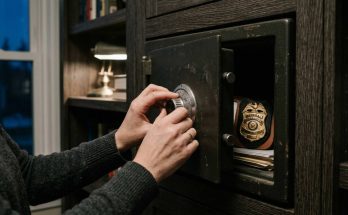
Later, while the others argued cheerfully over who should take the last piece of pumpkin pie, Chloe followed me into the hallway. I opened the closet to get her a sweater, and she noticed the gray steel lockbox on the top shelf.
“Is your old badge in there?”
“Yes.”
“Do you think you'll ever need it again?”
I considered the question. For years, I had thought of the badge as a reminder of the person I had been: the prosecutor who could stand in a courtroom, examine the evidence, and argue for justice with confidence.
But the morning I found Chloe, none of that had mattered as much as I thought it would. I had not needed to threaten Julian with my résumé. I had not needed to call an old colleague or use a title to make my daughter's injuries real.
I had needed to recognize the danger, call for help, and refuse to let a carefully prepared lie replace what had happened.
“No,” I told her. “I don't think I do.”
I closed the closet door.
From the dining room came another burst of laughter. Chloe leaned against me for a moment, then went back to join the others.
The badge remained in its box, where it belonged.
The most important thing I had carried into that terrible morning had never been locked away with it. It was the discipline to look closely, the patience to let evidence speak, and the certainty that a person did not need influence or authority to deserve protection.
Julian had believed he could erase my daughter from his home, his dinner table, and the story he told the world. He had mistaken her trust for weakness and my quiet life for helplessness.
In the end, his own records contradicted him. His own messages exposed him. His own decisions brought the police to his door.
And my daughter, who had once been left alone in the cold because someone wanted her place at a table, was now sitting in a warm house surrounded by people who were glad she was there.
That was the outcome I wanted to remember.
Not the handcuffs. Not the courtroom. Not the moment Julian finally understood my name.
The laughter coming from the dining room was enough.
Click here to continue reading: PART 5: The First Thanksgiving Without Julian Exposed How Much of Chloe’s Old Life Had Been Built Around Keeping Him Comfortable
The Phone Call Before Sunrise Revealed What My Daughter’s Husband Believed He Could Get Away With
Part 4 of 12