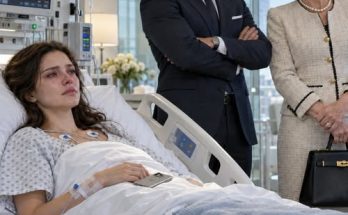
Two days later, the cardiology team allowed me to sit in a chair beside the window for twenty minutes at a time. It was a small improvement, but I treated it like an achievement. I washed my face without assistance, combed my hair, and asked the nurse to bring me a proper breakfast instead of the bland toast I had been pushing around the tray.
My condition remained serious. The doctors still wanted to monitor my heart closely, and they had warned me against exertion. But I could think more clearly now, and the fog that had followed the worst episodes was gradually lifting.
That morning, Evelyn arrived with news about Jennifer.
"Her lawyer has arranged for her to provide the material she saved," she said. "She wants the process documented, and she has asked that any personal information unrelated to the property or the financial guarantee remain private."
"That's fair."
Evelyn nodded. "We will respect that request as far as the law permits."
She explained that the evidence would need to be authenticated and examined in context. Messages could establish what someone said or intended to communicate, but they did not automatically prove every allegation. The relevant financial records would also need to be checked against the original documents.
I was grateful for her caution. I wanted the truth established, not merely a collection of accusations that sounded convincing because I was angry.
Jennifer arrived that afternoon with her lawyer. She stood near the door for several seconds before approaching my bed. Without her usual makeup and immaculate office clothes, she looked younger than I remembered. Her hands were clasped tightly in front of her.
"Thank you for agreeing to see me," she said.
"I agreed because you said you had information. You don't need to thank me."
Her lawyer remained beside the window while Evelyn took a seat near the table. Jennifer placed a sealed envelope on the table but didn't push it toward me.
"These are copies of the messages Daniel sent me," she explained. "My lawyer has retained the originals and can arrange access to them if they're needed."
"What do they show?"
She glanced at her lawyer before answering.
"That he was planning to marry me after your death. That he expected his mother to take control of the house. And that he believed the transfer would prevent you or your father from interfering."
I looked at the envelope.
"Did he tell you how he intended to obtain my signature?"
"He said he would bring the papers to the hospital and make sure you understood there was no time to delay."
"That isn't what he said to me. He told me the transfer was a practical arrangement."
Jennifer lowered her eyes.
"He told me different things depending on what he wanted me to do."
Her admission was simple, without the theatrical self-pity I had expected. I still disliked her. I still remembered the late-night messages, the hotel receipt, and the way she had smiled at me during company dinners while knowing my husband was sleeping with her.
But I could recognize a fact without forgiving the person who had brought it to me.
"Why did you contact me?" I asked.
She rubbed her thumb against the edge of her handbag.
"At first, I thought I was helping Daniel. I believed you were dying, and I thought the house would eventually belong to him. I didn't ask enough questions because I wanted the life he promised me."
She paused.
"Then I saw the draft transfer. He had written instructions about how quickly it should be signed and what would happen if you refused. It wasn't the way he described it to me. He was treating you as an obstacle."
I felt a familiar tightness beneath my ribs and waited for it to pass before speaking.
"You knew he was married."
"Yes."
"You knew I was his wife, not just a name on a document."
"Yes."
"Then don't ask me to make you feel better about what you did."
Jennifer's face reddened.
"I'm not asking that."
"Good."
For several seconds, neither of us spoke. The hospital's ventilation system hummed above us. Somewhere in the corridor, a trolley rattled over a seam in the floor.
Finally, I asked her about the financial guarantee.
Her expression changed.
"Daniel told me the problem had been resolved years ago. He said you'd agreed to help him, and that your father had paid the debt because he wanted to protect you."
"That's partly true. I helped resolve the debt. But I never signed the guarantee."
Jennifer looked at me.
"He told me you had signed it."
"Then he lied to you, too."
She drew a breath and opened her handbag. From it, she removed a second envelope containing copies of emails. Her lawyer explained that these records had been retained in the ordinary course of her work and would be supplied through the appropriate process.
One email, sent by Daniel to Jennifer months earlier, referred to the old guarantee. It included a sentence about making sure the issue never resurfaced if I were no longer able to challenge it.
Evelyn read the message carefully.
"Do you know what he meant by this?"
Jennifer shook her head. "Not for certain. I assumed he meant the company debt."
"That is one possibility," Evelyn said. "We won't infer more than the evidence supports."
I studied the page. Daniel's words were vague enough to permit more than one interpretation, but the timing troubled me. He had been discussing the guarantee long before my health deteriorated. His desire to control the house and his wish to prevent scrutiny of the old documents might be connected, but we would need evidence to establish how.
"Was there anything else?" I asked.
Jennifer hesitated.
"There is one more thing. He told me your father had no legal claim to the property because he was dead. He said you had invented the trust to keep me from getting what was rightfully Daniel's."
I looked at Evelyn.
"The trust records can answer that."
"Yes," she said. "And the original documents are already being reviewed."
Jennifer stood, her lawyer signaling that the meeting was over.
Before she left, she turned toward me.
"I know you may never forgive me."
I didn't answer immediately.
"I don't know what I'll feel in a year," I said. "Right now, I'm trying to recover. You should concentrate on telling the truth and taking responsibility for your own choices."
She nodded once.
Then she left.
Afterward, Evelyn arranged for the copies to be catalogued and secured. She explained that any formal investigation would determine which records were relevant and whether additional evidence was needed. I wasn't asked to confront Daniel, and I wasn't encouraged to threaten him with the contents of the messages.
That evening, my father came to the hospital with an update from the trust administrator. The property was secure, and the attempted transfer had been recorded in the file. He had also arranged for the locks to be changed once the legal advisers confirmed the appropriate procedure.
"Will Daniel be able to come back?" I asked.
"Not without authorization. We'll make sure the arrangements are clear."
I looked at the photograph of the roses.
"Did you ever think I'd end up here?"
"Which part?"
"Married to someone who would plan my funeral before I'd even died."
My father took a long breath.
"I hoped you would be happy. I knew you loved him. I also knew you didn't want my money or my influence to determine whom you married."
"I wanted to make my own choices."
"And you did."
I looked down at my hands.
"That doesn't mean every choice was right."
"No," he said gently. "But it means you are allowed to make a different one now."
I slept poorly that night. I kept remembering Daniel's expression when my father introduced himself, the shock giving way to anger as he realized that the story he had built around my family was collapsing.
Part of me wondered whether I had contributed to the problem by keeping my father's identity private. I had done it to protect my independence, but my silence had also allowed Daniel to make assumptions.
Still, I had never asked him to steal from me.
I had never asked him to lie.
And I had never asked him to plan a wedding while I lay in a hospital bed fighting to stay alive.
The following morning, Dr. Harris told me that my readings had improved enough for the team to begin discussing discharge arrangements, provided the progress continued and the follow-up plan was firmly in place.
It wasn't a promise that I would be well. It was permission to imagine a life beyond the hospital.
I asked for my phone and sent one message to Evelyn.
When I leave, I want the house prepared for my return. Daniel must not have access.
Her reply arrived a few minutes later.
We'll handle the arrangements properly.
For the first time, the future seemed to contain something beyond the next confrontation.
Click here to continue reading: PART 7: My Husband Arrived With Flowers and an Apology, but the Question He Asked First Told Me Everything
Three Days to Live, and the Two People Already Dividing Everything I Had Spent Years Protecting
Part 6 of 12