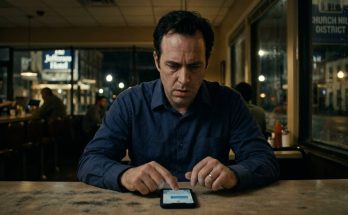
Six months after I moved into the apartment, Claire sent me a message asking whether we could meet in person. She suggested the coffee shop where I had first seen her with David Vance. The location made my stomach tighten, but I agreed without asking why she had chosen it.
I arrived ten minutes early and took a table near the window. The afternoon was clear this time, sunlight falling across the wooden floorboards and illuminating the dust that drifted above the counter. Outside, people passed with shopping bags and takeaway cups, going about their lives without knowing that this small café had become the setting for two very different moments in my marriage.
I remembered standing across the street, furious at the sight of Claire's hand beneath David's. I had felt betrayed before I understood what she was doing there. I had been certain that she owed me an explanation, even though I had spent years giving her explanations that weren't true.
Now I waited with both hands wrapped around a cup of coffee, aware that the conversation ahead might change the rest of my life.
Claire arrived wearing a dark green coat, carrying the leather bag she used for work. She looked tired from a long day, but there was a steadiness in her expression that I had come to recognize. She greeted me, took the seat opposite mine, and ordered tea.
For a few minutes, we talked about the children. Leo had been selected for a new soccer team, and Lily had submitted a painting to a school exhibition. Claire told me that the studio had secured another client, a small company that wanted a complete redesign of its packaging.
I congratulated her, and she thanked me. There was no awkwardness in those few minutes, only the careful politeness of two people who had learned to cooperate without pretending that their old intimacy remained unchanged.
Then Claire placed her cup on the table.
"Marcus, I've made a decision."
My heart began pounding before she finished the sentence.
"I want a divorce."
The words were quiet, almost ordinary. A spoon clinked against a saucer at the next table, and the espresso machine released a burst of steam behind the counter. I stared at Claire, waiting for some indication that she was opening a discussion rather than telling me what she had already decided.
"You're sure?"
She nodded.
"Yes."
I felt the old instinct rise in me: the urge to argue, to remind her of everything we had shared, to present the changes I had made as reasons she should reconsider. I wanted to tell her that I had stopped seeing other women, that I was attending therapy, that I was becoming more involved with the children, and that I had begun to understand the damage I had caused.
All of it was true.
None of it changed the question she had answered.
"I've changed, Claire," I said. "I'm not the man I was when you found those messages."
"I know you're trying."
"I haven't been with anyone else since we separated. I've been honest about the finances. I've kept my commitments to the children. I'm doing the work."
She listened without interrupting, her fingers resting around the handle of her cup.
"I believe you, Marcus."
For a moment, hope returned so forcefully that I almost leaned across the table. If she believed me, perhaps the remaining distance between us was something we could still cross. Perhaps she had simply needed time to see whether my promises would become actions.
"Then why are we doing this?" I asked.
Claire looked toward the window. A young couple walked past, sharing an umbrella despite the absence of rain. She followed them with her eyes until they disappeared beyond the corner.
"Because I don't want to spend the rest of my life wondering whether I can trust my husband."
I lowered my gaze.
"I would never go back to the way things were."
"You may never behave that way again. I hope you don't." Her voice softened. "But every time you used to tell me you were working late, I believed you. Every time you said there was nothing wrong, I believed you. When you accused me of being suspicious and difficult, I began to question my own judgment."
She paused to collect herself.
"I can't forget how that felt just because you've started telling the truth now."
I wanted to say that she didn't have to forget, that we could build something new, that I was willing to spend the rest of my life proving I could be trusted. I had imagined that genuine remorse would eventually bring us to a point where our shared history mattered more than the pain I had caused.
But Claire was not describing a failure to forgive me. She was describing a future she no longer wanted to risk.
"I still love you," I said.
Her eyes filled with tears.
"I still care about you too."
The answer was both a comfort and a wound. I had spent years believing that love was the strongest argument I could make for keeping our marriage intact. Now I was hearing from the woman who had loved me longest that affection alone could not make her feel safe beside me.
"Is there someone else?" I asked.
The question sounded different from the accusation I had made six months earlier. I was no longer looking for evidence that she had betrayed me. I was searching for a reason that would make her decision easier to understand, something outside my own behavior that might explain why she was leaving.
Claire shook her head.
"No. This is about me and what I need."
I nodded slowly.
"I understand."
She watched me, perhaps expecting the next argument. I could see how easily I might have launched into one. I could have reminded her that we had children, that divorce would complicate their lives, that we had once promised to remain together through every difficulty.
Instead, I remembered the letter from Sarah. A loving home was not simply one in which both parents lived under the same roof. I remembered Lily asking whether she had done something wrong, and the shame I had felt when I realized how frightened my daughter had become of losing the stability she had always known.
I could not use the children as a reason to keep Claire in a marriage she no longer wanted.
"Are you absolutely certain?" I asked, my voice barely above a whisper.
She nodded again.
"Yes."
I looked at the woman across from me. Her eyes were wet, and her hands trembled slightly as she lifted her cup. She was not celebrating the end of our marriage. She was grieving it while choosing not to return to it.
For the first time, I understood that her decision could be painful without being cruel.
"Then I won't stand in your way," I said.
Claire covered her mouth with one hand. Tears slipped down her cheeks, and she reached for a napkin from the holder beside her cup.
I felt my own eyes burning, but I didn't ask her to comfort me. I didn't tell her that I couldn't imagine life without her or insist that she reconsider because I was hurting. I sat across from her and allowed the consequences of my choices to exist without making them another burden she had to carry.
We remained in the café for nearly an hour. We discussed the children, the house, the outstanding loan, and the next steps our attorneys would need to take. Claire wanted the process to remain as calm as possible, particularly where Lily and Leo were concerned. I agreed that we should keep the details of our marital problems private and explain the divorce in a way the children could understand without asking them to take sides.
When we finally stood, Claire slipped her bag over her shoulder.
"Thank you for listening," she said.
I almost replied that I would always listen to her, but the words sounded too grand. I had spent years failing to hear what she was telling me.
"I'm sorry it took me so long," I said.
She looked at me for a moment.
"So am I."
We walked toward the door together. At the threshold, she turned and gave me a small, sad smile before heading toward her car. I watched her go, then remained on the pavement for a while, listening to the traffic and the distant chatter of people leaving nearby shops.
I had once believed that seeing Claire with another man was the moment our marriage had become endangered. I had imagined that I was standing at the edge of a betrayal that had happened without my knowledge.
Now I understood that the real turning point had come years earlier, each time I chose a lie over an uncomfortable conversation, each time I made Claire feel unreasonable for asking for the truth, and each time I treated her loyalty as something I could rely on without respecting it.
The coffee shop had not taken my wife away from me.
It had merely shown me that she had a life, thoughts, and decisions that existed beyond my control.
When I returned to the apartment, I called my therapist and asked for an additional appointment. I told him that Claire had decided to divorce me and that I was struggling with the feeling that all my efforts had come too late.
He asked whether I believed the work I had done was meaningless because it hadn't saved the marriage.
"No," I said after a long pause. "I don't think it was meaningless."
"Then what are you grieving?"
I thought about the house, the children, and the years I had assumed would continue indefinitely. I thought about Claire's laughter at the café and the version of myself I had presented to other women while hiding behind the comfort of my family.
"I'm grieving the life I thought I could keep without having to change."
He let the silence settle before asking what I intended to do next.
I told him I would continue therapy, cooperate with the legal process, repay Claire's loan, and remain present for the children. I would not make promises about the future or try to persuade Claire that she had made the wrong decision.
The answer did not make the grief disappear. But it gave me something I could do with it besides turning it into another argument.
Over the next several weeks, our attorneys exchanged documents and worked through the financial settlement. We discussed the family home, the children's schedules, and the arrangements that would allow both parents to remain involved in their lives. There were difficult conversations, and sometimes we disagreed about practical details, but neither of us used the disagreements as an excuse to reopen the decision itself.
I made the payments outlined in our agreement and continued to provide the financial records my attorney requested. My business remained under pressure, but I no longer treated that pressure as permission to hide information from the people affected by it.
Claire's studio continued to grow. She began taking on more ambitious projects and spoke about eventually hiring another designer. When she told me about the possibility, I felt a mixture of pride and sadness.
She was building a future she had once imagined sharing with me. I could admire it without assuming I belonged in it.
One afternoon, Lily called from Claire's house to ask whether I could help her with a school project over the weekend. I said yes and wrote the deadline in my calendar. Before hanging up, she told me that her mother had been helping her choose colors for a painting.
"Mom says I should use the colors that make me feel happy," she explained.
"That sounds like good advice."
"She said you could help me too."
I felt a small warmth in my chest.
"Then we'll work on it together."
After the call, I looked at the family photograph still sitting on my apartment shelf. We were all smiling on a beach, the children small enough to be lifted into our arms. I no longer saw it as proof that I deserved to have Claire back. I saw it as evidence that good years had existed alongside the choices that eventually destroyed our marriage.
The past had not been entirely false. Our love had been real, our children were deeply loved, and some of our happiest memories remained worth keeping.
But none of those truths required Claire to return.
The divorce process continued into the following months. We learned to speak about the future without treating every conversation as an opportunity to change one another's minds. I began to understand that accepting Claire's decision was not the same as approving of the pain it caused. It meant respecting her right to choose a life in which she no longer had to live with my dishonesty.
When the final documents were ready, I signed them without asking for another chance.
For years, I had wanted Claire to believe that I was a good man despite the things I did in secret. Now I was learning that becoming more honest required me to stop managing how other people saw me.
The marriage was ending. My responsibilities were not.
Click here to continue reading: PART 7: Signing the Divorce Papers Ended Our Marriage, but It Did Not End My Responsibility for the Family I Had Hurt
The Afternoon I Mistook My Wife’s Quiet Smile for Proof That She Had Betrayed Me
Part 6 of 16