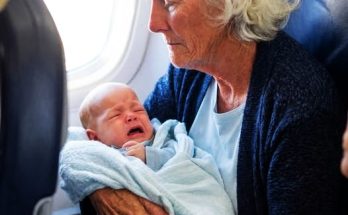
I wish I could tell you that I suddenly understood everything that day.
I wish I could say that Lily's outstretched hand revealed some answer that had been hidden from me, or that the silence around us turned into a clear explanation.
But I would be telling you more than I knew.
I was sixty-five.
I was tired.
I was grieving my daughter and trying to raise her child with a pension that left very little room for mistakes.
I had boarded a plane because a friend had offered to help me.
Then Lily had cried, a stranger had shouted at me, and I had stood in the aisle feeling smaller than I had in years.
After that, my granddaughter became quiet and reached toward someone in front of us.
The cabin noticed.
I noticed.
And for a few moments, I could do nothing except hold her and wait.
I cannot pretend to know what every passenger thought.
I cannot say what the person before us understood about Lily's gesture.
I can only remember what happened inside me.
At first, I wanted to escape.
I wanted to get away from the stares and hide somewhere I could cry without anyone seeing.
I wanted to return to the quiet life I had known before my daughter's death, even though I knew that life was gone.
Then I looked down at Lily.
She was calm.
Her tiny hand was still reaching outward.
And I realized that I had been so concerned about making the people around me comfortable that I had nearly forgotten the one person who truly depended on me.
My granddaughter did not need me to make strangers happy.
She needed me to be her grandmother.
That was the responsibility I had accepted when I brought her home.
It had not become less important because someone found her crying inconvenient.
I adjusted her blanket.
I checked that her head was resting comfortably.
Then I took a slow breath and stood where I was.
I no longer felt the need to explain every detail of our lives to the people watching.
They did not need to know how my daughter had died.
They did not need to know about the note her husband had left behind.
They did not need to know how many weekends I had worked or how long I had saved for an economy-class ticket.
Those things were part of my life.
They were not a defense I had to present to earn the right to hold my granddaughter.
I had paid for my seat.
I had followed the rules.
I had tried to soothe my baby.
That was enough.
I still felt hurt by the man's words.
I would be lying if I said otherwise.
There is something particularly painful about being spoken to cruelly when you are already doing everything you can.
You begin to wonder whether the problem really is you.
You search your own actions for some failure that might explain the way another person treated you.
I had done that during the flight.
I had replayed each attempt to comfort Lily, wondering whether I should have fed her sooner or packed something else.
I had considered whether I should have been more prepared.
But babies are not machines.
They do not follow instructions simply because adults are tired.
Sometimes they cry.
Sometimes they need more than one attempt to settle.
And sometimes the person caring for them needs patience too.
I had needed patience that day.
I had not received it from the man beside me.
That did not mean I had failed Lily.
The distinction mattered.
It mattered more than I could explain at the time.
I looked at my granddaughter again.
Her hand had lowered slightly, though her attention remained fixed ahead.
I held her close and felt her breathing against my chest.
She was warm.
She was safe in my arms.
For the moment, that was all I needed to know.
I thought about my daughter.
I wished she could have been there.
I wished she could have seen how her little girl looked when she finally settled.
I wished she could have told me what to do when I felt overwhelmed.
I had so many things I wanted to ask her.
There were nights when I still caught myself thinking I should call her.
Then I remembered that I couldn't.
Grief had not become easier simply because I had learned to keep moving.
It had become something I carried alongside everything else.
I carried it while washing bottles.
I carried it while folding tiny clothes.
I carried it while counting money at the kitchen table.
And I carried it onto that plane.
I had thought I needed to hide the grief so I could take care of Lily.
I was beginning to understand that the two things could exist together.
I could miss my daughter and still laugh when Lily made a funny face.
I could feel frightened about money and still be grateful for the warmth of my granddaughter sleeping against me.
I could be tired without regretting the choice I had made.
I could need help without being weak.
That last thought was the hardest one.
For so long, I had believed that asking for help meant admitting I could not cope.
But I had reached a point where pretending had become more exhausting than the truth.
I could not do everything alone.
I could not make my pension larger by worrying about it.
I could not bring my daughter back by refusing to talk about her.
And I could not make Lily's life perfect simply by sacrificing every comfort of my own.
I could only keep doing the work in front of me.
One bottle.
One meal.
One difficult night.
One day at a time.
The journey continued around us.
The plane's steady hum never changed.
People began to settle into their seats again, though I could still feel the occasional glance in our direction.
I did not know whether the man beside my seat would ever think about the way he had spoken to me.
I did not know whether he would feel embarrassed or simply forget the encounter once the plane landed.
His feelings were no longer something I needed to solve.
I had enough to carry.
I had Lily.
I had the memory of my daughter.
I had a home to return to and bills waiting on the table.
I had a friend who had offered to help, and I intended to accept that help without apologizing for needing it.
That was a small decision.
It was also an important one.
I had spent too much time trying to prove that I could manage everything alone.
I wanted Lily to grow up knowing that love was not measured by how much pain someone could endure in silence.
I wanted her to understand that caring for another person did not mean allowing everyone else to treat you however they pleased.
I wanted her to feel safe enough to ask for help when she needed it.
To teach her those things, I would have to begin with myself.
I looked down at the small hand resting against my blouse.
I covered it gently with my own.
"I'm here, Lily," I whispered.
My voice was quiet, but it no longer sounded like an apology.
I didn't know what the rest of the journey would bring.
I didn't know how many more difficult days lay ahead of us.
I only knew that I had stood up when a stranger told me to leave, and I had nearly let his anger convince me that I did not belong.
I was not going to carry that belief home.
Lily belonged with me.
And I belonged beside her.
When I thought back on that flight, I would remember the crying, the humiliation, and the sudden silence that had made the cabin turn toward us.
But I would also remember something else.
I had begun the journey believing that my task was to avoid troubling anyone.
I ended that part of it understanding that my task was much simpler.
I had to love my granddaughter.
I had to care for her.
And when the world became impatient with her, I had to remember that she was still a child who needed someone to stand beside her.
I could not promise to make every day easy.
I could not promise that I would never feel exhausted or frightened again.
But I could keep my arms around her when she needed them.
I could keep trying when the first thing did not work.
And I could stop apologizing for the fact that a baby sometimes cried.
That was what I had to offer her.
It was not everything.
But it was real.
And when I held Lily close, I finally understood that it was enough to begin with.
The End
Read more original stories on Feel Every Story.
I Thought the Hardest Thing Was Learning to Raise a Baby at Sixty-Five, Until a Stranger Made Me Feel Ashamed of Loving Her
Part 8 of 8