Wendell came to supper the following Sunday.
He brought a small bag of rolls and set it on the kitchen counter.
I was finishing the vegetables.
He asked whether my drive the previous Thursday had been difficult.
I told him it was fine.
Then I admitted I had spent most of it wondering whether I was making a terrible mistake.
He stood quietly beside the counter.
I could see that he understood I wasn't talking only about the drive.
I asked him to sit down.
We ate supper before discussing anything serious.
That was how we had always done things.
I didn't want every meal between us to become a hearing where one person had to prove the other wrong.
After we finished, Wendell carried the plates to the sink.
I dried them while he washed.
For a while, we worked in silence.
Then I asked him about the ramp.
He set down the plate he was holding.
He said he had wanted to tell me everything once the work was ready.
He had imagined showing me the house when it was finished, explaining what he had done, and letting me understand the purpose of it without seeing a half-completed project.
I told him I understood wanting to finish something before showing it to another person.
But I also told him that asking me to wait without explaining why had left too much room for worry.
He nodded.
He said he could see that now.
I asked him whether he had expected me to keep waiting until Christmas.
He gave a small, embarrassed smile.
He admitted he had not thought far enough ahead.
That answer was more believable than a perfect excuse would have been.
He had made a decision without considering how it would feel to me.
I had made assumptions without knowing what he was doing.
Neither of us had handled it well.
I told him I didn't want us to keep secrets simply because we were afraid of an uncomfortable conversation.
He said he didn't want that either.
We stood beside the sink for a moment.
Then he asked whether I would like to visit the house again when he had finished the work.
I said yes.
This time, I told him I wanted to go with him, not arrive secretly because I had run out of patience.
He smiled.
He said he would be glad to have me.
I believed him.
That did not mean I suddenly knew everything about Wendell.
Trust isn't a switch you flip.
It is built from ordinary moments, and sometimes it has to be repaired after somebody makes a poor choice.
I had learned that in my marriage.
I had learned it in the hospital.
I was still learning it now.
The following week, Wendell invited me to see the house again.
I drove out with him rather than taking my own car.
The trip felt different when I wasn't treating every mile as part of an investigation.
We talked about ordinary things.
He asked whether my knees had been bothering me.
I told him the weather had made them stiff.
He said he hoped the next few days would be warmer.
When we arrived, the pecan tree shaded part of the yard.
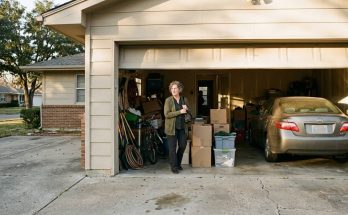
The garage door was open.
The country radio was playing, just as it had been the first time.
I smiled when I heard it.
Wendell noticed.
"You remember the music."
"I remember being scared out of my mind."
He laughed softly.
Then he held the door for me.
I walked into the garage and looked at the ramp again.
The rails were secure.
The surface was smooth.
A few tools remained near the wall, but the work looked closer to completion.
I ran my hand along the wood.
I had been so certain that I was about to uncover a betrayal.
Instead, I had found something that required care and patience.
Wendell showed me the changes he had made inside the house.
He explained the parts he had finished and the parts that still needed attention.
I listened.
I asked questions.
This time, I didn't have to wonder whether he would let me see the next room.
He showed it to me himself.
The house was still modest.
It wasn't a place meant to impress anybody.
But it was beginning to feel like a home where somebody had thought carefully about how another person might move through it.
I noticed the space beside the doorway.
I noticed the clear path between the furniture.
I noticed that the ramp led directly toward the entrance without an awkward turn.
All those details had a purpose.
I still didn't know every part of the story behind the work.
Wendell had not finished explaining everything that mattered to him.
But I knew enough to understand that he had not been building a secret life designed to take advantage of me.
He had been building something that mattered to him.
And he had been too determined to keep the result private to see what his silence was doing to the woman he claimed to care about.
I could forgive that mistake without pretending it had been harmless.
On the drive home, I thought about my children.
I loved them.
I understood why they worried.
They had watched me lose their father, and they didn't want to see me hurt again.
But their fear had become a kind of authority they assumed they could exercise over me.
I had helped that happen by letting Zach take over my finances without setting clear limits.
I had helped it happen by telling Megan I was fine when I wasn't.
I had helped it happen by staying quiet whenever their concern made me feel small.
I couldn't blame them for every part of that.
I had to take responsibility for the parts I could change.
A few days later, Zach came over.
He stood in the kitchen while I made coffee.
He asked whether I was still seeing Wendell.
I told him I was.
He shook his head.
He said he didn't understand why I was willing to risk being hurt.
I put the coffee pot down.
Then I told him I was not asking him to approve of my relationship.
I was asking him to respect that it was mine.
He looked away.
I could tell he wanted to argue.
Instead, he asked whether I was certain Wendell wasn't after the insurance money.
I told him Wendell had never asked me for money, and I had no reason to believe he intended to.
Zach said people could hide their intentions for a long time.
I told him that was true.
It was also true that suspicion could make a person see wrongdoing where there was none.
I said I would remain careful with my finances.
I would not give away money because somebody asked.
I would not sign documents I didn't understand.
But I would not end a relationship simply because my son disliked the fact that I had one.
He stared at me.
I knew he was not accustomed to hearing me speak that firmly.
Then I told him something else.
I said he could no longer handle my bank account as though it belonged to him.
If I wanted his help, I would ask for it.
He looked hurt.
I felt bad about that.
But I did not take the words back.
After a moment, he nodded.
He said he had only wanted to keep me safe.
I told him I believed that.
Then I explained that safety included being allowed to make decisions, even when those decisions involved a risk.
He didn't apologize that day.
I didn't demand one.
We were going to have to learn a different way of speaking to each other.
That would take time.
Megan called later in the week.
I told her I was still seeing Wendell.
She said she hoped I would be careful.
I told her I would.
Then I asked her to remember that I had been a nurse for thirty-four years and a mother for longer than that.
I had made mistakes.
I would probably make more.
But I was still capable of recognizing when something needed attention.
She laughed a little.
It was the first easy sound I had heard from her about Wendell in weeks.
We talked about the grandchildren before hanging up.
Afterward, I went into the living room.
Dwight's recliner stood beside the window.
I sat in the chair next to it and looked at the place where the afternoon light fell across the floor.
For a long time, I had thought moving forward meant leaving something behind.
I had worried that caring for another man meant weakening my connection to the husband I had lost.
But the two things were not the same.
I could miss Dwight.
I could keep his chair.
I could remember the years we had shared and still allow another person to bring coffee into my kitchen.
I could laugh at supper.
I could visit a house beyond Ferris.
I could be sixty-four and still have questions about what came next.
The following Sunday, Wendell arrived with another bag of rolls.
I had cooked enough for both of us.
He placed the bag on the counter and asked whether I had heard from the children.
I told him I had.
I said they were worried, but I was working through it with them.
He nodded.
Then he asked whether I wanted him to sit in Dwight's recliner while I finished supper.
I looked at the chair.
For a moment, I felt the familiar ache.
Then I smiled.
"You can sit wherever you're comfortable, Wendell."
He sat down carefully.
I returned to the kitchen.
The radio wasn't playing there, of course.
There was only the sound of the stove and the clatter of dishes.
I looked at the table where Zach had once opened my bank account and accused a man he barely knew.
I remembered how small I had felt that evening.
Then I remembered the ramp.
The new lumber.
The pale paint on Wendell's knuckles.
The open garage door that had frightened me before I understood what I was seeing.
I had driven to that house expecting to discover a lie.
What I discovered instead was that fear could make a person certain of things they had never actually proved.
Wendell had given me reason to worry by refusing to explain himself.
My son had given me reason to hurt by assuming worry gave him the right to take over.
And I had spent too long believing that keeping the peace was more important than speaking honestly.
I couldn't undo any of that.
I could only decide what I did next.
I carried the food to the table.
Wendell rose from the recliner and came to help.
We sat down together.
For once, I didn't feel the need to explain our arrangement to anybody who wasn't sitting there with us.
I didn't know exactly how our relationship would turn out.
Neither of us could promise that there would never be another misunderstanding.
But I knew what I wanted from him now.
Honesty.
And I knew what I owed myself.
The freedom to choose.
The brown recliner remained by the window.
The porch light still worked.
And somewhere beyond Ferris, a ramp of fresh pine stood at the entrance to a small white house, built carefully by a man who had wanted to finish his work before he let anyone see it.
I would remember that ramp for a long time.
Not because it answered every question.
Because it reminded me that sometimes the truth was there in front of us, waiting for us to look at it without fear.
The End
Read more original stories on Feel Every Story.
My Son Thought the Widower at My Sunday Table Wanted My Money, but I Had Noticed Something He Couldn’t Explain
Part 8 of 8