I used to think a man could protect his family if he worked hard enough.
I was wrong.
At forty-three, I sat in a courtroom in Ohio and watched the life I had spent years building get divided up between lawyers.
My house was gone.
My construction company was gone.
And the worst part was that I could no longer tuck my eight-year-old son into bed whenever I wanted.
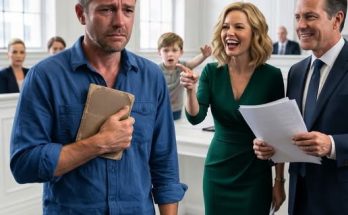
Across the aisle, Vanessa looked almost relaxed.
She wore a dark jacket and kept her hands folded in front of her, as if we were attending an ordinary business meeting.
Richard Blake sat beside her.
He was her attorney, a man who seemed to enjoy the moments when other people had nothing left to say.
His expensive watch caught the light whenever he moved his wrist.
I had learned to recognize that little gesture.
He did it whenever he thought he was winning.
The judge finished reviewing the settlement documents.
My attorney had already explained what signing them would mean, but I had been fighting the numbers for so long that they had stopped feeling real.
The house would go to Vanessa.
The division of our marital property would leave me with substantial obligations.
My business, already crippled by frozen accounts and unpaid bills, had been valued at a fraction of what I believed it was worth.
I would also have to live under strict conditions to see Noah.
Supervised visits.
Scheduled hours.
Someone else watching me spend time with my own child.
I signed where they pointed.
My hand did not shake until I reached the last page.
Then I put the pen down.
Richard gathered the papers into a neat stack.
He looked at me with the kind of smile people use when they have won something they never had to work for themselves.
“You might have saved yourself a lot of trouble if you had accepted our first offer.”
I looked at the table.
I didn't trust myself to answer him.
Vanessa stood and slipped her purse over her shoulder.
For a moment, I thought she might say something about Noah.
Maybe she would remind me of his school schedule or ask whether I had his favorite baseball cap.
Instead, she watched me put my copy of the settlement into a folder.
“You really believed you could beat us, Daniel?”
There was no question in her voice.
She already knew what she wanted me to say.
I said nothing.
Outside the courthouse, the afternoon air felt colder than it should have.
People walked past carrying coffee cups and talking about ordinary things.
I stood near the steps with my folder under one arm, trying to figure out how a person was supposed to begin again when nearly every decision had already been made for him.
Vanessa came out a few minutes later.
Richard was beside her.
She stopped when she reached me.
“Think about Noah for once,” she said.
“I do. Every day.”
“Then ask yourself what kind of life you can give him now.”
I looked at her.
She gave a short laugh.
“You don't even have anything left, Daniel. How are you supposed to take care of your own son?”
Richard didn't interrupt.
He didn't need to.
The two of them stood there while I tried to find an answer that wouldn't make things worse.
I couldn't think of one.
Vanessa turned away first.
I watched her walk toward the parking lot, where the car we had bought together waited in the sun.
Then I went to my pickup truck.
I sat behind the steering wheel for a long time without starting the engine.
The keys were in my hand.
The settlement papers lay on the passenger seat.
I had spent fifteen years building Carter Construction from a small operation into a company that employed twelve people.
I knew how to read blueprints, negotiate with suppliers, manage crews, and solve problems when a project went wrong.
I had worked through winters when the ground was too hard to dig and summers when the heat made every hour miserable.
I had never imagined that I would be sitting outside a courthouse wondering where I could sleep.
But that was where I was.
Three months earlier, I had still believed I could save the company.
The first trouble had come when the business accounts were frozen during the divorce proceedings.
I couldn't pay suppliers on time.
Suppliers stopped extending credit.
Customers grew nervous when promised work fell behind schedule.
Some canceled their contracts, and others hired different contractors before I could explain what was happening.
Every canceled project left another hole in the books.
I tried to keep my employees working.
I used what little money I could reach to cover wages and keep essential equipment running.
I told myself that if I could make it through the legal fight, I could rebuild the company's reputation.
Then the bills came faster than the work.
By the time the divorce was finalized, the business I had built over fifteen years was no longer functioning.
My employees had to find other jobs.
I had to tell people who had trusted me that I couldn't keep giving them work.
I still remembered one of the older men standing beside the shop door, holding his hard hat against his stomach.
He had worked for me for years.
He didn't accuse me of anything.
That somehow made the conversation harder.
I had failed people who had never done anything to deserve it.
And I was so angry at Vanessa and Richard that I barely noticed how much shame I was carrying myself.
Looking back, that was one of my worst habits.
I spent so much time thinking about what they had done that I didn't always admit what I could still control.
But by then, the damage had spread too far for me to repair it quickly.
That evening, I parked behind a gas station and folded my jacket beneath my head.
I locked the doors and leaned the seat back as far as it would go.
A truck passed on the road every few minutes.
The refrigeration unit behind the building hummed through the darkness.
I kept my phone close because I was afraid of missing a call about Noah.
No call came.
I tried to sleep.
Every time I closed my eyes, I saw the courthouse table and the papers Richard had collected.
Then I saw Noah's face.
He was eight.
He didn't understand financial settlements, business valuations, or why his parents could no longer sit together at a school event.
He only knew that things had changed.
I worried about what Vanessa was telling him.
I worried about what he believed.
Mostly, I worried that he might eventually stop asking when he could see me.
The thought hurt more than the cold.
The next morning, I washed in a gas station restroom and bought the cheapest breakfast I could find.
I had enough money for a few basic things, but not enough to rent a place without knowing what would happen next.
My attorney's fees were still outstanding.
The truck needed repairs.
I had debts I couldn't pay and no steady income.
I began looking for temporary work, but explaining my circumstances to employers was harder than I expected.
I didn't want sympathy.
I wanted a chance to earn money.
A few days later, I returned to the storage unit where I had placed several boxes of family belongings.
I had rented the unit years earlier when we moved into the house.
After the separation, I had put some old photographs, books, and keepsakes there because I didn't know where else to keep them.
The unit smelled of dust and cardboard.
I worked through the boxes slowly, deciding what I could carry in the truck and what I would have to leave behind.
There were old photographs of my parents.
A cracked picture frame.
Some railroad memorabilia that had belonged to my grandfather, Samuel Carter.
He had died years earlier, long before my marriage began to fall apart.
I remembered him as a quiet man who never wasted words.
He had worked as a railroad engineer for most of his life.
His clothes were plain, his tools were well cared for, and he never seemed interested in impressing anyone.
He rarely talked about money.
If he had savings, he kept them private.
When I was younger, I had sometimes asked him whether he regretted not buying a bigger house or a newer car.
He would shrug and tell me that there were more important things to worry about.
I had assumed he simply preferred a modest life.
While sorting through the photographs, I found a worn leather envelope beneath a stack of papers.
It was flattened at the corners and soft along the edges.
I almost tossed it into a box marked for disposal.
Then I noticed my grandfather's name written on the front.
Samuel Carter.
I opened it carefully.
Inside was a small savings passbook.
The leather cover had split near the spine.
The pages were yellowed, and the ink on the oldest entries had faded.
I sat down on the edge of a box and turned through the pages.
The first transaction was dated June 14, 1951.
I stared at the date.
My grandfather had been a young man then.
The book contained account entries I couldn't make sense of, along with an account number and the name of a bank.
I rubbed a thumb across the cover.
I didn't know why he had kept it for so long.
I didn't even know whether the account still existed.
But I remembered something he had said to me before he died.
We had been sitting at his kitchen table.
He had a cup of tea beside him and a newspaper folded near his elbow.
He looked at me for a long moment before speaking.
“If life ever takes away everything you thought you could depend on, Daniel, don't assume you've reached the end of what your family left you.”
At the time, I had thought he meant the lessons he had taught me.
Patience.
Honesty.
The willingness to start over when something went wrong.
I had thanked him and changed the subject.
Now I sat alone in a storage unit, holding the one object I had never thought to ask him about.
I wondered whether the passbook might contain a few forgotten dollars.
Even a small amount would help.
I could use it for food, a room, or the truck repairs I kept putting off.
It wasn't much of a plan.
But it was the first possibility I had found in days that didn't begin with a bill I couldn't pay.
I slipped the passbook into my jacket pocket.
Then I gathered my things and headed for the bank printed on its cover.
I had no idea that the little book my grandfather had left behind was about to force me to reconsider everything I believed about my family's past.
Click here to continue reading: PART 2: The Old Passbook That Made a Bank Manager Stop Talking and Turn His Computer Toward Me
The Day My Marriage Cost Me Everything, and the Forgotten Book I Almost Threw Away
Part 1 of 6