By the time the final legal decisions were in place, the house no longer felt like a crime scene in my mind.
The locks were new.
The security system was under my control.
The old iPad had been removed from my accounts, and I had changed the passwords connected to my private records.
The boxes that had once sat in Christopher's truck were accounted for.
My belongings had come home.
So had the brass lamp.
I had placed it on the table beside the living room window, where I could see it from the front entrance.
It was a small thing, but I liked seeing it there.
The lamp had survived the move, the storage unit, and the mess Christopher had brought into my life.
Its base still carried the same dark mark.
Its shade still leaned a little to one side.
I could have replaced it with something newer.
I didn't want to.
It reminded me that something could be imperfect without being broken.
The financial award changed my circumstances.
The eighty percent of the concealed funds awarded to me gave me security and options I had not possessed before the investigation.
I could maintain the house.
I could plan for the future.
I could make decisions without calculating how Christopher might use money to influence me.
For the first time in a long while, my finances were something I could look at without feeling that an important piece was being kept from me.
I reviewed the accounts with my attorney and made sure I understood the arrangements.
I kept copies of the court orders.
I organized the documents in a place I could reach easily.
It felt good to know where everything was.
I had once thought that being independent meant doing everything alone.
Now I understood that independence also meant choosing who could help me and insisting that the help be honest.
I didn't need to distrust every professional I hired.
I needed to ask questions, verify important details, and refuse to confuse politeness with proof.
Those habits made my life feel steadier.
The criminal case had ended, but the memories did not disappear on the same day.
I still remembered the morning of the alert.
I remembered the exact time displayed on my phone.
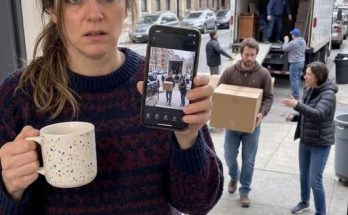
I remembered the yellow truck backing into the driveway and the soundless image of Christopher stepping onto the pavement.
Most clearly, I remembered the green light on the keypad.
That little light had once meant the lock was working.
Now it reminded me that the person entering a place might know how to open the door without having any right to be there.
I learned to live with that memory without allowing it to decide how I felt about the house.
I could be careful and still feel safe.
I could remember what happened without expecting it to happen again.
And I could let the house become ordinary.
That was important to me.
For months, every room had carried some trace of the intrusion.
The living room reminded me of the television Christopher had placed on the floor.
The staircase reminded me of how confidently he had walked upstairs.
The primary closet reminded me of the way he and Brenda had pointed out where they wanted their things to go.
The side entrance reminded me of the forged agreement and the compromised keypad.
I had to reclaim those spaces one at a time.
I rearranged the living room.
I moved a chair beside the window and placed a small table near it.
I unpacked my books and arranged them according to no particular system except what felt right to me.
I put the kitchen supplies where I wanted them.
I hung photographs that had spent weeks in storage.
I chose where the lamps belonged.
No one questioned my choices.
No one suggested that I was wasting space or spending too much time on something unimportant.
The freedom was ordinary.
That was what made it meaningful.
One afternoon, Laura came over to help me finish unpacking.
She carried a box into the kitchen and set it on the counter.
We worked quietly for a while.
Then she found an old photograph of the two of us as children.
She held it by the edges.
"Do you remember when this was taken?"
I looked at the picture.
We were standing outside our childhood home, squinting into the sun.
I remembered the day, though not every detail.
"I think we had just come back from visiting our grandparents."
Laura smiled faintly.
We stood together for a moment, looking at the photograph.
There was a time when I would have felt compelled to make the conversation lighter.
I might have told a joke or tried to reassure her that everything would return to normal.
I didn't do that.
Some things did not return to normal.
We could love each other and still carry the knowledge of what had happened.
Laura placed the photograph on the counter.
"I'm glad you have this house," she said.
I looked around the kitchen.
"So am I."
She didn't ask me to say anything about Chloe.
I didn't ask her to explain her daughter's choices again.
We had already talked through the facts.
Repeating them would not change what had happened.
Instead, we finished unpacking.
When Laura left, I walked her to the door and watched her car pull away.
Then I locked the door behind her.
The click sounded ordinary.
I liked that.
There were no dramatic moments left to anticipate.
No new messages demanding that I give up the property.
No unfamiliar person claiming to have permission to enter.
The house was quiet.
I began spending more time in Columbus rather than thinking of the property as a place I had to defend.
I took care of small repairs.
I learned which windows needed extra pressure to close properly.
I found the best place to keep the spare batteries for the security sensors.
I bought groceries without checking my phone every few minutes.
I sat in the living room and read until I became sleepy.
Some evenings, I made dinner and ate at the kitchen counter.
Other evenings, I used the dining table even when I was alone.
I stopped treating solitude as something I had to justify.
For twenty-seven years, my life had been organized around another person's expectations.
I had learned to anticipate Christopher's moods and adjust my choices before he objected.
Even after the divorce, I sometimes caught myself preparing an explanation for something he would never be asked to approve.
I would consider buying a chair and imagine what he might say about the price.
I would plan a weekend and wonder whether he would call it irresponsible.
Then I would remember that he no longer had any say in my decisions.
The thought became easier to accept with practice.
I didn't need to prove that every choice was perfect.
I only needed to make it honestly and live with the result.
The legal proceedings had also taught me to look more carefully at the past without becoming trapped in it.
I couldn't change what Christopher had concealed.
I couldn't undo the trust I had given Karen or the access Dennis had retained.
I couldn't make Chloe choose differently.
I could only decide what those facts meant for my future.
I would no longer share sensitive information merely because someone was family.
I would no longer assume that a friendly professional had completed a task without checking.
I would no longer treat my own discomfort as evidence that I was being unreasonable.
Those were not grand promises.
They were practical decisions.
I kept my important documents organized.
I made sure I understood who had access to my accounts.
I asked for confirmation when a task involved my property or personal information.
And when someone gave me an answer that didn't make sense, I allowed myself to keep asking.
The first few times felt uncomfortable.
Then they became normal.
I realized that Christopher had benefited from my reluctance to make people uncomfortable.
He had turned my desire for peace into a way of avoiding accountability.
I had believed that if I stayed calm and reasonable enough, he would eventually do the same.
Instead, he had learned that I could be persuaded to abandon a concern if he challenged it long enough.
The police report had broken that pattern.
I had seen what happened.
I had called for help.
I had provided the evidence.
I had not waited for Christopher to agree that I had a reason to be upset.
That choice had changed more than the outcome of the case.
It had changed the way I understood my own judgment.
I didn't need to become hard or suspicious of everyone.
I needed to stop abandoning myself whenever someone else insisted I was wrong.
The distinction mattered.
There were still days when I missed parts of my old life.
I missed the familiar routines that had once made the marriage feel stable.
I missed the idea that someone would always be there to help with a difficult decision.
I did not miss being afraid to ask questions.
I did not miss the arguments that left me doubting my memory.
And I did not miss the feeling that my own home could become a place where I had to defend my right to exist.
My new house gave me room to understand those differences.
It was not a perfect house.
A few floorboards creaked near the stairs.
One cabinet door needed adjusting.
The yard required more work than I had expected.
But those were ordinary problems.
I could decide how to handle them.
I could call a contractor, compare estimates, or fix something myself.
No one could use a minor repair as an excuse to take control of the entire project.
The house was mine in ways that went beyond the deed.
I had chosen it.
I had protected it.
And I was finally learning to live in it without waiting for someone else to tell me I deserved the space.
Click here to continue reading: PART 8: I Finally Stood in My Own Doorway Without Fear, Knowing Christopher Could No Longer Decide What My Home or My Future Was Worth
Eleven Days of Peace Were All I Got Before My Ex-Husband Drove a Moving Truck Into the Life I Had Started Over
Part 7 of 8