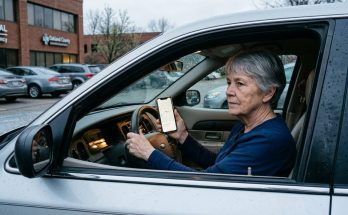
I left my sweater at Gordon's house.
I didn't realize it until a few days after Denise called to tell me the assignment was ending.
It was an ordinary sweater, nothing expensive, the kind I wore on cold evenings when the house felt drafty. I had taken it off during a shift and laid it over the back of a chair.
I could have asked someone to bring it out.
Instead, I decided to go myself.
I told myself I was only collecting my property.
There was no reason to turn a sweater into a farewell. I had left things in other clients' homes before, and I had never needed to make a ceremony out of retrieving them.
But this was Gordon's house.
I knew that before I got into the car.
The drive felt shorter than it had on my first night there. I had grown used to the route, the turns, and the familiar approach to the street.
When I pulled into the driveway, I sat for a moment before getting out.
The porch light was on.
I noticed it automatically.
I wondered whether Gordon had asked about it lately, and whether anyone had answered him the way I used to.
Then I got out and walked to the door.
Charlene opened it.
She looked tired, but she was dressed neatly, as she usually was when I arrived for work. She seemed to recognize why I had come before I explained.
“I'm here for my sweater,” I said.
“Of course.”
She stepped aside to let me in.
I entered the house slowly.
I had been there so many times that I knew where to put my bag, where the medication list lay, and which hallway light sometimes needed an extra push on the switch.
I had no reason to use any of those familiar habits now.
I was a visitor.
That distinction felt larger than it should have.
Charlene pointed toward the living room.
“He's in there.”
I looked past her.
Gordon was sitting in his recliner with the television on. A woman I had never seen before sat in a chair nearby, holding a clipboard.
The new aide.
She was close enough to help him if he needed to stand, but not so close that he seemed crowded. She looked up when I entered, then returned her attention to Gordon.
He was watching the screen.
For one brief moment, I wanted him to look at me.
I wanted him to recognize something about my face, even if he couldn't find my name. I wanted a small sign that thirty-one years had left some mark that dementia could not reach.
He didn't look up.
I stood there longer than I needed to.
The new aide asked him a question. He turned toward her and answered, though I couldn't make out the words.
She nodded and wrote something on her clipboard.
The ordinary nature of the scene hurt more than I expected.
Someone else was doing the work now.
Someone else would learn where Gordon kept his socks and how he wanted his blanket folded. Someone else would discover that he liked his soup very hot and sometimes asked the same question five minutes after receiving an answer.
She would learn his habits because it was her job.
She would not need to know who he had been to me.
That was probably better.
I went to the chair where I had left my sweater.
It was folded over the back, just as I remembered. I picked it up and ran my hand over the sleeve to smooth a crease.
Charlene remained near the doorway.
“He slept better last night,” she said.
I looked at her.
“I'm glad.”
I meant it.
I didn't ask whether the doctor had reviewed the medication. I didn't ask whether Trent had helped with the organizer or whether the conservatorship paperwork was still on hold.
I hoped those things were being handled properly.
But I had been told that the assignment was ending, and I understood that the family needed room to continue without me.
There was nothing useful in turning my visit into another discussion of what had happened.
Charlene watched me fold the sweater over my arm.
For a moment, I thought she might say something about the meeting.
She might have asked why I had never told her that I was Gordon's former wife. She might have said that she felt betrayed by the fact that I had entered her home under a name she recognized but a history she didn't.
I would not have blamed her for asking.
I had kept that history to myself.
But she didn't ask.
She simply stood there, holding the door open between the living room and the hall.
I could hear the television and the faint sound of the new aide's pen moving across the clipboard.
Then Gordon spoke.
“Do you know where my shoes are?”
The question carried down the hall.
I stopped.
It was the same question he had asked me on so many nights. The words were ordinary, almost casual, but they brought back the moment he had gripped my sleeve and begged me not to tell Charlene he was lost.
I turned toward the living room.
The new aide answered before I could.
“We'll look for them together.”
Gordon seemed to accept that.
She set the clipboard aside and rose from her chair. He watched her as she moved toward the hallway.
I remained where I was.
I wanted to step forward and tell him that the shoes were near the door. I wanted to point out the place where we had found them before and spare him the effort of searching.
But he had someone to help him now.
I didn't need to be the person who answered every question.
That was one of the hardest things I had to accept about leaving the assignment. I had become familiar with his needs, and familiarity had started to feel like a responsibility I could not put down.
It wasn't.
I had a responsibility to report what I saw and to do my job properly while I was there. I had a responsibility to act when I believed he might be in danger.
I had done those things.
I could not promise to stay in his life simply because I knew his habits.
I couldn't make myself his wife again through a series of small acts of care.
And I couldn't ask him to remember me in exchange for the help I had given.
I picked up my bag.
Charlene moved aside.
I walked toward the front door with the sweater folded over my arm. I didn't look back until I reached the threshold.
Gordon was still in the living room.
The new aide had found his shoes, and he was looking down at them as though he had just been introduced to something familiar.
She said something I couldn't hear.
He nodded.
I stood there for one more second.
Then I left.
The drive home was quiet.
I kept the sweater on the passenger seat. At a stoplight, I reached over and straightened it, although it hadn't moved.
I was surprised by how much I wanted to cry.
I hadn't been his wife for years. I hadn't been invited into that house as family. I had accepted a paid job and carried out the work as carefully as I knew how.
Still, I had wanted to matter to him.
Not because he owed me anything.
Not because I wanted Charlene to know what I had once been to him.
I wanted to matter because I had mattered once, and I couldn't entirely bear the thought that all of that history had become invisible.
I knew dementia did not erase the past simply because a person could no longer reach it.
But knowing that and feeling it were different things.
At home, I hung the sweater in my closet.
Then I sat down and thought about the picture in the shoebox.
My Wanda.
I had not taken the photograph with me. I had left it where I found it, alongside his father's watch and the mass card from his mother's funeral.
I had no claim to it.
The photograph belonged to a life we had shared, but it did not belong to the life we were living now.
I had to let that be true.
I also had to let it be true that I was glad he had kept it.
For years, I had wondered whether Gordon ever thought about the life he had left behind. I had wondered whether the marriage had meant as much to him as it had to me.
Finding that photograph had not answered those questions.
It had only shown me that he had once kept a piece of our history.
I couldn't turn it into an apology he had never given.
I couldn't use it to rewrite what happened in 2003.
And I couldn't demand that a man who no longer remembered me explain why he had saved it.
I put those thoughts away as best I could.
The next morning, I made my coffee and sat at the kitchen table.
There was no shift to prepare for.
No medication list to check.
No need to remember which drawer held the socks.
I should have felt free.
Instead, I found myself wondering whether Gordon had eaten breakfast and whether the new aide had managed to keep the blanket over his feet.
I let myself wonder for a while.
Then I drank my coffee.
I had done what I could.
That did not mean I stopped caring.
It meant I was finally learning that caring and staying were not always the same thing.
Source: blog.giatheficoco.com
Click here to continue reading: PART 7: I Had Kept Every Fact in Its Proper Place, Yet the Hardest Truth Was the One I Could Never Put Into an Agency Report
I Accepted an Ordinary Caregiving Job Until I Recognized the Address and Realized Whose Nights I Was Being Paid to Sit Through
Part 6 of 8