The photograph stayed on the table for several days after I showed it to the boys.
Naomi sent me a message one evening to say that Theo had asked whether the telescope in the picture still worked.
I told her it did, although I had not used it in years.
She said he wanted to know whether I could bring it sometime.
I agreed to look for it.
Then I put my phone down and returned to the file Martin had left with me.
I had been reading the correspondence in short stretches, usually after work, when I could give it my full attention.
The more I read, the less comfortable I became with the decisions I had made during the divorce.
I had trusted Gordon Pierce to handle the legal details. I had trusted my mother to tell me when something required my attention.
Neither arrangement had required me to ask many questions.
That had suited me.
Now I was discovering how much could happen while I was satisfied with not knowing.
Martin called the following morning.
He had found another group of papers among the archived divorce records. Some had been filed with the correspondence from Gordon's office, while others had been placed in a separate envelope.
He wanted me to review them in person.
I drove to his office after my first meeting.
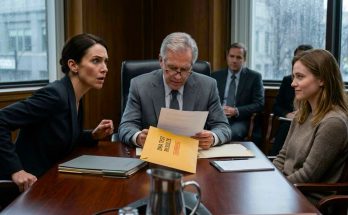
He greeted me, closed the door, and placed the envelope on the desk.
“This material wasn't included in the first group I reviewed,” he said. “I want you to read it before we discuss what it might mean.”
I sat down.
The first documents were routine.
There were copies of letters, notes about telephone calls, and a few pages that appeared to have been printed from an office correspondence system.
Then I found a handwritten letter.
My mother's name appeared at the bottom.
I recognized her handwriting immediately.
It was the same neat script she used on birthday cards and the envelopes she sent to relatives. She had always taken pride in making her writing look orderly.
The letter was addressed to Gordon.
I read the opening paragraph.
Then I read it again.
My mother had written about Naomi's pregnancy and the possibility that the children would have a legal connection to the Calloway family.
She was concerned about the consequences for the family estate and the money that would eventually pass to me.
She also wrote that I was not to be drawn back into the marriage.
The language was controlled and deliberate.
There was no mention of concern for Naomi's health or the children she was carrying.
There was no question about whether I wanted to know.
Instead, she described the pregnancy as a complication that needed to be contained before it affected the family's plans.
I felt my stomach tighten.
I continued reading.
My mother had explained that she believed I would be angry if I learned how much information had been withheld from me. She wanted Gordon to keep communications organized through his office and prevent the situation from becoming a personal dispute.
The final paragraph was the one I could not stop reading.
She wrote that the family needed to protect what had been built and that I should not be forced into a decision that could alter the future of the fortune.
I lowered the page.
For years, my mother had described herself as the person who protected our family.
I had imagined that meant protecting me from embarrassment, bad investments, and people who might take advantage of my success.
Now I was looking at a letter in which she had treated my unborn children as a threat to the money they might one day inherit.
“Was this sent?” I asked.
Martin turned the page over.
“The copy is in the file. We need to distinguish that from proof of delivery.”
“So we don't know whether Gordon received the original?”
“The correspondence around it suggests it was prepared for him, but I want to verify what we can before making a definitive statement.”
I nodded.
I was beginning to understand that the truth was not always contained in a single document.
Sometimes it was in the pattern.
Naomi had sent a letter.
My mother had known about the pregnancy.
Gordon's office had instructed Naomi to stop contacting me directly.
And now I had found a letter showing that my mother had been thinking about the family fortune while Naomi was trying to tell me I was going to be a father.
I looked at Martin.
“Did I ever authorize anyone to make decisions about whether my children could contact me?”
“Not in the documents I've reviewed.”
“Did I ever ask my mother to handle my personal correspondence with Naomi?”
“Not that I can find.”
I sat quietly.
I could no longer pretend that this had been an ordinary misunderstanding.
I still did not know every conversation that had taken place, but the letter showed that my mother had considered the consequences of the pregnancy and had chosen to act without involving me.
The children had been real.
Their claim on my life had been real.
And my mother had decided that the safest solution was to keep them outside it.
I thought about Theo's face when he asked why I had not come before.
I thought about Eli handing me the drawing of two blue circles.
They had not asked to be born into a family with money.
They had not asked to become part of a dispute over an estate.
They had simply arrived in the world and grown up with the mother who was there for them.
I had been the one missing.
“What happens now?” I asked Martin.
“That depends on what you want to do. There are legal questions about the records, but there are also family questions that won't be resolved by a letter.”
I knew that.
I wanted my mother to explain herself.
I wanted Gordon to tell me why his office had responded to Naomi as though I had personally rejected her.
I wanted someone to give me a clear account of how the pregnancy had been kept from me.
But I also knew that no explanation would change the fact that I had failed to ask questions when it mattered.
I asked Martin to preserve the documents and make copies for the file.
I told him I wanted a complete review of anything connected to the pregnancy, the divorce, and the subsequent correspondence.
He agreed.
I did not ask him to threaten anyone.
I did not tell him to begin a public fight.
I wanted the truth established before I decided what legal steps, if any, were appropriate.
When I left his office, I carried a copy of my mother's letter in a folder.
I did not read it again in the car.
I placed it on the passenger seat and drove back to work.
The rest of the day passed in a blur of meetings and decisions.
At one point, an executive asked whether I wanted to move forward with a proposed investment.
I looked at the figures, asked two questions, and gave him an answer.
I had not become incapable of doing my job.
But I was no longer willing to treat work as the only part of my life that deserved my full attention.
That evening, I called my mother.
She answered warmly, as though our previous conversations had not happened.
“Preston. I've been waiting to hear from you.”
“I found your letter to Gordon.”
The warmth disappeared from her voice.
“What letter?”
“The one about Naomi's pregnancy and protecting the family fortune.”
There was a long pause.
Then she said, “I wondered whether you would eventually find it.”
I closed my eyes.
“So you remember writing it.”
“Of course I remember.”
“Why didn't you tell me she was pregnant?”
My mother exhaled.
“Because you were finally moving forward.”
“That wasn't your decision to make.”
“You were devastated when she left.”
“I was angry. That doesn't mean I wanted to be kept from my children.”
She did not respond immediately.
I could hear her moving around the room.
When she spoke again, her voice was quieter.
“You had worked so hard to build the company. You had a future ahead of you, and I didn't want everything to become complicated because Naomi was unable to accept the divorce.”
I looked at the copy of her letter.
“You knew she was pregnant.”
“Yes.”
“You knew she was trying to contact me.”
“I knew she was contacting the office.”
“And you decided that the children were a financial problem.”
“That's not what I said.”
“It's what you wrote.”
She became defensive.
“I was thinking about the consequences. You don't understand how many people depend on the family's stability.”
I almost laughed.
I had spent years studying risk. I knew how a business could be damaged by a bad decision, how money could be lost, and how quickly a carefully built enterprise could become vulnerable.
But my sons were not a liability to be managed.
They were children.
“They were not an investment, Mother. They were my children.”
“I understand that now.”
“Do you?”
She did not answer.
I thought about the words in her letter.
Protect what had been built.
Prevent the situation from becoming a personal dispute.
Keep me from being drawn back into the marriage.
Everything had been written as though my life were an arrangement she could maintain by keeping inconvenient facts away from me.
“I need some distance from you,” I said.
“Preston, don't do this.”
“I am not asking you to agree with me. I'm telling you what I need.”
She began talking about everything she had done for me.
She reminded me of the years she had supported my ambitions, the family responsibilities she had handled, and the sacrifices she believed she had made.
I listened.
Some of those things were true.
My mother had helped me in ways I would never deny. She had been present during difficult years and had offered support when my business was still uncertain.
But none of that gave her the right to decide whether I should know my own children.
“I appreciate what you've done for me,” I said. “That doesn't make this acceptable.”
She went quiet.
I ended the call after telling her I would contact her when I was ready.
For several minutes, I remained seated at the kitchen counter.
I felt angry, but I also felt something close to grief.
The woman who had taught me to be careful with money had used that same instinct to justify keeping my sons from me.
I could not make those facts fit together neatly.
I did not want to.
The next morning, I took the copy of the letter to Martin and asked him to keep it with the other records.
Then I went to see Naomi.
I had asked whether she was comfortable meeting for a short conversation before my next visit with the boys.
She agreed.
When I arrived, she was sitting at the kitchen table with a stack of school papers beside her.
She moved them aside and offered me a chair.
I placed the copy of the letter on the table.
“I found this in the divorce file.”
She read it without speaking.
Her expression changed as she reached the final paragraph.
When she finished, she set the page down.
“I wondered whether your mother had been thinking about money.”
“She was.”
Naomi rubbed her thumb along the edge of the paper.
“I thought she wanted to protect you from me.”
“She wanted to protect the family fortune.”
For a moment, neither of us spoke.
Then Naomi pushed the letter back toward me.
“I don't want the boys to grow up thinking they're the reason their grandmother and father stopped speaking.”
“They aren't.”
“I know that. But children hear things, Preston. They make connections adults don't intend.”
I nodded.
I had not considered how easily my anger could become another burden for them.
“I won't involve them in this.”
“And I don't want them used to prove a point about your family.”
“Neither do I.”
She looked at me carefully.
“I need you to understand something. I didn't spend those years waiting for your family to accept me.”
“I know.”
“I was trying to raise my sons.”
The correction was gentle, but necessary.
I had been thinking about the life Naomi had been denied.
She was reminding me that she had built a life anyway.
She had taught, cared for the boys, found help when she needed it, and made decisions without knowing whether I would ever return.
I could regret what had happened without treating her as a person who had spent five years standing still.
“I understand,” I said.
She folded the letter and placed it back in front of me.
“Then let's keep the boys out of the argument.”
I agreed.
When I left, I carried the letter with me.
It was proof of what my mother had chosen to do.
It was not a solution.
The solution, if there was one, would have to begin with the children whose lives had continued long after the adults stopped speaking.
Source: 1millionstories.net
Click here to continue reading: PART 10: I Could Not Give My Sons Back the Years I Had Missed, but I Could Stop Letting My Family’s Money Decide What Their Future Would Mean
I Went Into a South Side Bakery Thinking About a Business Deal, Then Saw the Woman I Had Spent Five Years Avoiding
Part 9 of 12

One Comment on “PART 9 – The Letter My Mother Had Hidden Explained Why She Wanted Naomi Gone, and I Finally Understood What She Meant by Protecting Our Fortune”