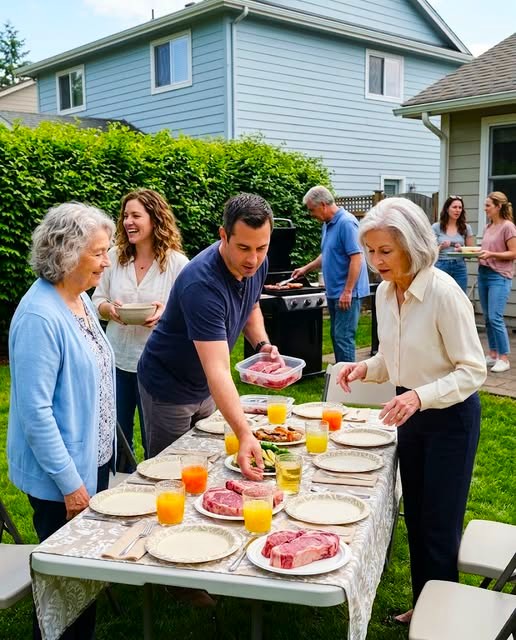
Three Words
Nobody in the yard moved. A sausage hissed on the grill. Down the block, a lawn mower droned and stopped, as if it too had heard.
Rachel’s mouth stayed open. Stella’s hand went to the clasp of her enormous handbag. And my son stood with his fingers still curled around air where the container had been, looking at me the way you look at a stranger who has your mother’s face.
“Mom,” Julian said. “What are you doing?”
“Putting this down.” I set the container on the patio table, on my mother’s green tablecloth. “Where it belongs.”
I should tell you who I am, because for sixty-five years I told myself it was enough to be useful.
My name is Betty Miller. I grew up in Zanesville, Ohio, the daughter of a glassworker and a church cook. At eighteen I started at the cafeteria of a hospital in Columbus, and for thirty-six years I ran its kitchen: nine hundred meals a day, four cooks, a budget I could recite in my sleep. I retired with a pension of $2,380 a month and a reputation for never letting a nurse go hungry on a double.
Tom and I married in 1983. He was a lineman for the electric co-op, big-handed and patient, who proposed over a plate of my chicken and dumplings and said, “I’d like to eat this for the rest of my life.” We bought the house on Linden Street in 1989 for $64,000. We paid it off in 2011. In the backyard sits a stone patio Tom laid himself, a brick grill he built over three summers, and the long oak table my father made.
We had one child. Julian is thirty-two, an assistant manager at a car-rental company, soft-spoken, with my mother’s gray eyes and a habit of agreeing with the last person who spoke. He married Rachel four years ago, in a rented hall that cost her parents $19,000 and that, I noticed, nobody ever stopped mentioning.
Rachel is thirty, polished, a dental-office manager with a smile like a showroom. She calls me “Betty,” never “Mom,” in a tone that makes my name sound like a minor expense. She was never rude to my face. She was thorough.
At Thanksgiving, she asked whether the turkey was “supposed to be that dark.” At Julian’s birthday, she photographed my cake and posted it with the caption homemade (sort of). She wrinkled her nose at my kitchen, my furniture, my tablecloth. Everything I owned was, in her view, a charming relic of someone who hadn’t been told things had moved on.
Her mother, Stella, was worse in a quieter way. She’s sixty, silver-blond, a retired bank teller from Dublin, who dresses for every occasion as if it will be recorded. She said “thank you for having me” like a woman accepting a refund.
I’d told myself for four years that they were nervous. That Julian loved her. That love is a long game and mothers, God help us, play it on the losing side.
I’ll give you the Sunday you already have, quickly, because it matters only for what I felt and what I did next.
I’d been up since seven. Thirty-three pounds of meat from Mr. Davis at the market on Fourth, prime rib, short ribs, flank, pork belly, and the receipt in my purse said $250.40. Tom, over his glasses, had asked if it was a bit much for eight. I’d said, “I’d rather have too much than not enough,” and I’d meant everyone.
My nieces came first, Erica with a warm apple pie and Louisa with fruit salad and a bottle of red she’d been saving. They asked what they could do. That is the whole difference between people who love you and people who merely arrive.
Then Julian, and Rachel in a red dress and heels, and Stella in a beige suit. No dessert. No bottle. Not even a bag of chips. A cloth bag that clattered.
I heard the containers before I saw them.
I won’t repeat all of it. They sat while we worked. They said my flowers looked wilted, my tablecloth looked faded. Rachel served herself the biggest piece of prime rib and sighed that it was overdone, and Tom’s jaw tightened at his own grill. They ate every cut they’d criticized. They photographed the spread. Stella said, “My friends will think I have a very generous family.”
Then the containers came out. Julian, my boy, stood up and began packing the best of it into Rachel’s bags. Mom always cooks too much. Better take it before it goes bad.
And I took the container out of his hands, set it on my mother’s tablecloth, and looked at Rachel, and Stella, and last at my son.
“Get the hell out,” I said.
Rachel found her voice first. “Excuse me?”
“You heard me.”
“Betty, this is ridiculous. We were only taking leftovers.”
“There are no leftovers. People are still eating.”
“There’s thirty-three pounds.”
“Thirty-three pounds I bought for people who came to eat with us,” I said. “Not for people who came to shop.”
Stella drew herself up. “I’ve never been spoken to this way.”
“I imagine not. Nobody’s ever had to.”
“Julian,” Rachel said, turning. “Are you going to let her talk to us like this?”
My son’s face was gray. He looked at his wife, then at me, with the stricken, flickering look of a man standing between two weather systems.
“Mom,” he said. “Please. You’re embarrassing everyone.”
I had waited sixty-five years to hear whom I was embarrassing.
“Julian,” I said. “Sit down.”
“I don’t…”
“Sit down, honey. Please. This won’t take long.”
He sat on the edge of a patio chair. Erica and Louisa, by the salad bowl, had gone very still. Tom had set down his tongs and was watching me with an expression I hadn’t seen in thirty years, the one he’d worn the day I told him I’d bought the house on Linden without asking.
“I want everyone to hear this,” I said. “I’m not angry. That’s the odd part. I expected to be. I’ve been rehearsing a scene for four years in which I shout, and tonight I find I don’t need to.”
Rachel crossed her arms.
“I raised my son to say thank you before he asked for more,” I said. “I’m not sure when it stopped. Maybe it was my fault. I fed him so well he forgot that food has a source.”
“Mom.”
“Let me finish.” I looked at Rachel. “You came to my home. You brought containers and no dish. You criticized every item you ate. You posted about it. And you intended to carry home eighty dollars’ worth of prime rib while the people who actually helped me cook went without.”
“We were guests.”
“Guests bring something. Even a bag of chips. It isn’t about the money, Rachel. It’s that you walked in knowing exactly what you’d take, and you didn’t think it was worth a sentence.”
Her face colored. “You’re making a scene.”
“I’m ending one.”
I’d like to tell you what I felt, because it wasn’t triumph.
It was grief, arriving the way a tide arrives, without drama. I looked at my son, a thirty-two-year-old man with his father’s shoulders, sitting on a patio chair with his hands between his knees, and I realized I was mourning someone who wasn’t dead. A boy who used to run into my kitchen asking for extra potatoes. He’d stopped being that boy and I’d kept setting a place.
“Julian,” I said. “I need to ask you something, and I’d like an honest answer.”
He looked up.
“When you started packing the prime rib, did you ask me?”
“I figured…”
“Did you ask?”
“No.”
“Why not?”
His throat moved. “Because I knew you’d say yes.”
I let that sit.
“That’s it,” I said quietly. “That’s the whole thing. You knew I’d say yes. So you didn’t ask. And a person who doesn’t have to ask isn’t being given something. He’s being used.”
“I wasn’t using you.”
“Not on purpose.”
“I just wanted Rachel to be happy.”
“I know you did, sweetheart.” My voice cracked, finally, and I let it. “I wanted you to be happy too. For thirty-two years. I think I’ve been so busy making the table big that I never noticed you’d stopped looking at who was sitting at it.”
Stella gathered her handbag. “Rachel, we’re leaving.”
“Stella,” said Tom.
It was the first time he’d spoken. He’d stepped away from the grill, wiping his hands on a dish towel, and stood at the edge of the patio with the sun behind him, tall and quiet in his apron.
“Before you go,” he said, “I’d like to say one thing. And I’d like it to be polite.”
She stiffened.
“That prime rib was perfect,” said Tom. “I cooked it. I checked it with a thermometer. It came off at one-thirty-one. Medium-rare. Not overdone.” He folded the towel. “I’ve been grilling for forty years. I won’t be told by a woman who’s never lit a charcoal chimney that I’ve ruined a roast.”
Somebody, I think Louisa, made a small choking sound.
“And that tablecloth,” he added, “was Betty’s mother’s. It’s seen four weddings and two funerals. It’s not faded. It’s been loved.”
Rachel’s eyes flicked to the green linen, and for just a second, something crossed her face. Not shame. Something near it. A flicker, as of a person seeing a thing for the first time that she’d been looking at for years.
“We’ll go,” she said stiffly.
“I think that’s best,” said Tom.
They left through the side gate. Stella first, in her beige suit, clutching the handbag like a shield. Rachel followed in her red dress, with her cloth bag of empty containers clattering at her side, and I heard, as she passed, a very small sound, almost a hiccup.
At the gate, she stopped. She didn’t turn around.
“Julian?” she said. “Are you coming?”
My son sat on the patio chair. His face was wet. He’d put his elbows on his knees, and his head in his hands.
“Not yet,” he said.
She stood there a long moment, her back very straight, her shoulders rigid. Then she pushed open the gate and was gone.
I heard the car doors. I heard the engine, then tires on gravel, fading. A mockingbird landed on the fence and sang a long, liquid, unbothered song.
Erica came over and put her arm around me. “Aunt Betty,” she whispered. “I’ve wanted to say that to them for two years.”
“I know, honey.”
“Are you okay?”
“I don’t know.” I laughed, shakily. “I think I’m going to throw up.”
“Sit.”
I sat. Louisa brought a glass of water. Somebody turned the sausages.
We ate. That surprised me. At two o’clock in the afternoon, in the aftermath of what I’d done, the six of us sat around the long oak table under the maple, with the green tablecloth and a mountain of meat, and ate like people who’d earned it.
The prime rib was perfect. I’ll say it. Tom had taken it off at the exact moment, and the crust had a dark salty crackle, and the middle was rosy and warm. The short ribs fell off the bone. Erica’s apple pie, still warm, with a scoop of vanilla ice cream from a carton in the freezer, was the best I’d tasted.
Julian ate slowly. He’d moved to the end of the table, and he sat with his shoulders hunched, chewing with a kind of dazed concentration. Nobody pressed him. At some point Tom, without comment, put a second slice of prime rib on his plate.
“Dad,” said Julian.
“Eat.”
“I should go after her.”
“You should eat first.”
He looked at his father, and something went across his face, and he picked up his fork.
It was nearly four before he spoke again.
The others had drifted into the kitchen, loading the dishwasher, wrapping leftovers in foil. Real leftovers, this time, for Erica and Louisa to take home. Tom was scraping the grill. I sat at the table in the thin gold light, with a cup of cold coffee, and my son sat across from me, turning a fork in his fingers.
“Mom.”
“Yes.”
“I want to tell you something. And I’m afraid it’ll sound like an excuse.”
“Say it anyway.”
He swallowed. “Rachel’s family doesn’t have much.”
I raised an eyebrow. “Her father’s a retired orthodontist.”
“He was. He lost it.” Julian rubbed his face. “In 2021. A bad investment. A friend’s startup. Eight hundred thousand dollars. They sold the house in Dublin. Stella lives in a rented condo now, and Rachel’s father is, he doesn’t talk about it. He works at a hardware store.”
I said nothing. I put down my cup.
“She’s ashamed,” said Julian. “Rachel. She’s been paying her mother’s rent for two years. Eleven hundred a month. She’s been, we’ve been short, Mom. I didn’t tell you.”
“Why not?”
“Because I knew you’d help.”
“Yes.”
“And I couldn’t stand it.” He pressed the heel of his hand against his eye. “I’m thirty-two. I’m an assistant manager. I wanted, for once, to be the one who.”
“Who what?”
“Who provided.”
I sat very still.
“So when she said she wanted to take food home,” he said, “I thought, I can do this. I can give her something. And I didn’t think about whose it was.” His voice cracked. “I just wanted to be the guy who could.”
I understood then what I had been looking at.
It wasn’t greed. Not entirely. It was a man’s pride and a woman’s panic, folded together and carried out in plastic containers. A thirty-year-old woman in a red dress, trying to bring her mother a week of meals. A son who couldn’t say, we’re drowning.
It didn’t excuse the insults. It didn’t excuse the posing, or the tablecloth, or the word faded. But it was a human thing, and I’d cooked for humans for fifty years.
“Julian,” I said. “How short are you?”
He told me. It took a while. A car loan at $487 a month. Credit cards, $14,300. Her mother’s rent. His own student debt, still $9,600. They were, by his count, about $600 a month underwater, and had been for eighteen months.
“You should’ve told me.”
“I know.”
“I’d have helped. Not with a wallet. With a table.” I took his hand. It was big and warm and a little callused. “There’s always a seat for you. There’s a plate for her, too. You know that.”
“I don’t know if she does.”
“Then she doesn’t know me.”
“She thinks you don’t like her.”
“I don’t,” I said, honestly. “Not yet. But I’d like to find out whether I could.”
He laughed. It broke in the middle, and turned into something else, and I got up, and went around the table, and held my son’s head against my apron the way I had when he was six and had skinned his knee. He cried quietly, with his whole back.
Tom stood in the doorway with the grill brush in his hand. He didn’t come in. He just stood there, a big, quiet man in a stained apron, and I saw his lips move. I think he said, good.
Julian drove home that night. He didn’t tell me what happened. I learned the rest on Wednesday, when he came for dinner alone and sat at my kitchen table, and told it in pieces, like a man describing an accident.
Rachel had been in the bedroom when he got back, with the door shut. He’d knocked. She hadn’t answered. He’d sat on the floor outside the door for forty minutes, with his back against the wall, and said, through the wood, “I’m not going to go away.”
At nine, she’d opened it.
Her face was swollen. Her makeup was gone. She stood in the doorway in a gray T-shirt, and she said, in a small, flat voice, “I’ve never been so humiliated in my life.”
“I know.”
“Your mother threw me out.”
“She did.”
“I wasn’t, I don’t think I was that bad.”
He told me he’d looked at her for a long time. Then he’d said the hardest thing he knew.
“You were.”
She’d flinched.
“You didn’t bring anything. You said her flowers were wilted. You called Dad’s roast overdone. You took pictures of food you’d insulted.” His voice shook. “And I stood there and packed it. And I think that’s the worst part. Because if I’d been a man, I’d have said something.”
She’d stared at him.
“I’m not saying it to hurt you,” he’d said. “I’m saying it because I love you, and I think we’re both so scared that we stopped being kind.”
And Rachel, my daughter-in-law, who in four years had never once cried in front of me, sat down on the edge of the bed and put her face in her hands.
She came to see me on Saturday.
I’d been expecting it, the way you expect a bill. At ten in the morning, the doorbell rang. I wiped my hands on my apron, and went to the door, and found her on the porch in jeans and a gray sweater, with no makeup, and a casserole dish in both hands.
It was a glass baking dish, with a foil lid. It trembled a little.
“Betty.”
“Rachel.”
“May I come in?”
I stepped aside.
She stood in my kitchen, holding the dish, looking at the cabinets, the old tile, the framed photograph of Julian’s first communion over the sink. She didn’t speak. I put the kettle on. She set the dish on the counter, very carefully, as if it might go off.
“It’s lasagna,” she said. “I made it. It’s, I looked up a recipe. I don’t know if it’s any good.”
“Let’s see.”
I lifted the foil. It was a mess. The noodles were stuck together, and the cheese had slid off one corner in a rubbery sheet. It smelled, faintly, of burnt garlic. I looked at it for a long moment.
“It’s perfect,” I said.
She laughed, wetly. “Don’t.”
“It’s a very honest lasagna.”
“Betty.” She pressed her lips together. “I came to apologize. I’ve been practicing for three days.”
“Go on.”
She took a breath.
“I was awful,” said Rachel. “Not just on Sunday. For four years. I’ve been, I’ve been looking at you like a, like a thing that was in the way.” Her voice shook. “I didn’t know how to be, I don’t know what it is to be a daughter-in-law. My mother never taught me. She taught me how to look like I had it together.”
“She’s afraid.”
“She’s terrified.” Rachel wiped her eyes with the heel of her hand. “My father lost everything. We never talked about it. She’s been, she told everyone it was a ‘downsizing.’ And I thought, if I could just look like we were fine, if I could be the girl in the red dress, nobody’d see.”
I handed her a tissue.
“I took the food because we needed it,” she said. “I want you to know that. I’m not saying it as an excuse. I looked at thirty-three pounds of meat and I thought, that’s three weeks of dinners for my mother. And I was so ashamed that I made it into a joke.”
“You criticized it.”
“I criticized it because I couldn’t stand being grateful.”
I put down the kettle.
I’d like to say I understood her at once. I didn’t. But I heard it, in the quiet kitchen, with the lasagna steaming faintly on the counter. I couldn’t stand being grateful. It’s a sentence I might have said myself, at thirty, with a baby on my hip and a hospital cafeteria to run.
“Sit down,” I said.
We talked for two hours. It wasn’t smooth. There were silences that went on too long, and a moment when Rachel started to say something about Julian and stopped, and a moment when I said something sharper than I meant, about the tablecloth, and she flinched.
“I’m sorry,” I said. “That was unkind.”
“It was true.”
“It was both.”
She almost smiled.
I told her about the tablecloth. My mother’s, from Zanesville. How she’d embroidered it herself, in 1952, the winter my father was laid off from the glassworks, with a border of tiny green leaves, one for every member of the family. How the cloth had been at every table in my life, and how, each year, one of the leaves had faded a little, from washing, until I’d stopped noticing which was which.
“I didn’t know it was hand-stitched,” said Rachel, quietly.
“Look.”
I’d brought it from the linen closet. I spread it on the kitchen table, under the window. In the sunlight, you could see the stitching, tiny, careful, slightly uneven. A border of leaves in three shades of green.
Rachel leaned over it. She touched the edge with one finger, gently, the way you’d touch a sleeping child.
“It’s beautiful,” she said.
“It’s faded.”
“It’s been loved.” She looked up, wet-eyed. “That’s what Tom said.”
“He’s a wise man.”
“He’s terrifying.”
“Only when someone insults his roast.”
She laughed, and put her hand over her mouth, and I laughed too, and for a moment two women stood at a kitchen table, laughing over a tablecloth, in the thin gold light of a Saturday morning.
I’d like to tell you that everything was repaired. It wasn’t.
I did something slower. I told Rachel what I wanted.
“I’m going to say it plainly,” I said. “I’d like you to come to Sunday dinners. Not as a guest. As family. That means you bring a dish. It doesn’t have to be good. It just has to be yours.”
“I can do that.”
“It means you help clear the table.”
“Yes.”
“It means that if you and Julian are struggling, you tell me. Not with a plastic container. With a sentence.”
Her eyes filled. “I don’t know how.”
“Nobody does. You say, ‘Betty, we’re short this month.’ And I say, ‘Sit down, I’ll make a plate.’” I took her hand. “I won’t give you money. I want to be clear. But I’ll give you a table. As often as you want.”
“Why?”
“Because you’re married to my son.” I squeezed. “And because I think, under all of it, you’re a frightened girl who wants to be told she belongs.”
She was crying openly now. She didn’t try to hide it.
“And Stella?” she whispered.
“Bring her.”
“She’ll hate it.”
“Then she’ll hate it at my table.”
Rachel let out a startled, damp laugh. “Betty, you’re impossible.”
“I’ve been told.”
Stella came on the second Sunday.
I hadn’t been certain she would. She arrived at noon, in a plain gray dress, with her silver hair pulled back and her enormous handbag tucked under her arm. She stood on the porch like a woman at the edge of a pool.
She held out a foil-wrapped tray.
“I made brownies,” she said stiffly. “From a box.”
“Come in.”
She entered. She looked around my living room, the sagging sofa, the framed photographs, the knitted afghan, and I saw her take it in, and I saw something in her face loosen.
“It’s a very warm house,” she said.
“It’s a very old one.”
“My mother had a house like this. In Newark.” She pressed her lips together. “I haven’t thought of it in years.”
I took the brownies. I led her to the kitchen. She stood at the counter, watching me stir a pot of green beans, and for a long time she said nothing.
“Betty.”
“Yes?”
“I should say something. About last Sunday.”
“You don’t have to.”
“I do.” She drew herself up. “I was rude. I took things from your table. I told myself it was, that it was a courtesy. That you wanted to share.” She swallowed. “It wasn’t. I knew it wasn’t. I’ve never, in sixty years, taken food I hadn’t earned. And I stood in your yard and packed it up like a, like…”
“Like a woman who needed it.”
Her face crumpled.
“Yes,” she whispered.
I turned off the burner. I wiped my hands. I did what I’d have done for anyone who walked into a hospital cafeteria at four in the morning with that look. I took her by the elbow, and sat her down at the kitchen table, and put a plate in front of her.
“Eat,” I said.
“I’m not hungry.”
“That isn’t what I asked.”
She stared at the plate. Green beans, a slice of roast, a spoonful of mashed potatoes. She picked up a fork, and her hand shook, and she took a bite. Then another. She ate the whole plate in silence, slowly, with her head bowed, and I stood at the counter, and let her.
When she finished, she set down the fork.
“Thank you,” she said.
“You’re welcome.”
“It’s very good.”
“It’s just dinner.”
“It isn’t,” said Stella, and she began, very quietly, to cry.
I’ll skip some months.
The Sunday dinners became a thing. Rachel brought dishes, and they were, by turns, burnt, bland, or surprisingly good. Stella, once she’d decided to stay, turned out to have a gift for pies. She made a lemon meringue in September that Tom pronounced “the best thing I’ve ever put in my mouth, Betty, don’t tell anyone.”
Her husband, Gordon, whom I’d never met, came in October. He was a quiet, stooped, silver-haired man of sixty-three, with an orthodontist’s careful hands and the bruised, shy look of someone who’d been told for two years that he’d failed. He shook my hand and said, “Mrs. Miller. Thank you for having us.”
“Betty.”
“Betty.” He cleared his throat. “I brought something.”
He set a paper bag on the table. Inside was a small, wrapped box. I opened it.
It was a tablecloth.
A plain white linen one, with a border of embroidered blue flowers. Handmade, I could see, with a slight irregularity in the stitching. A tiny label on the corner, in faded ink: Stella Pruitt, 1984.
“She made it for her hope chest,” said Gordon. His voice cracked. “She’s never used it. She said she was saving it for a house worth setting a table in.”
I looked at Stella. She stood by the stove, rigid, with her hands twisted in her apron.
“I thought,” she said, “you might want a second one. For, for when the first is being washed.”
I couldn’t speak.
I took it out of the box. It was beautiful. I laid it over the green one, on the long oak table, and stood back, and looked at the two of them, a faded green cloth with leaves, and a white one with flowers, one on top of the other.
“It’s perfect,” I said.
“It doesn’t match,” said Stella.
“No,” I said. “That’s why.”
It’s been a year.
I’m sixty-six now. Julian and Rachel are doing better. They’ve restructured the debt with a credit counselor in Westerville, a squat, cheerful woman named Rosalind Park, who has a laminated poster that says DEBT IS A SHAPE, NOT A SENTENCE. They sold the leased car and bought a used one. Rachel took a night course in bookkeeping, and in June, she got a promotion at the dental office, with a raise of $9,000.
Stella and Gordon have moved into a small two-bedroom in Worthington. Gordon works part-time at the hardware store and does, I’m told, quiet, excellent work. Stella volunteers at the church bake sale. She told me, last month, over a pan of cornbread, that she’d never felt so useful.
“I thought I’d have to be someone,” she said. “A woman of a certain kind. It turns out I only had to be someone who brought a pie.”
I told her it was the whole of it.
On Sundays, we have fourteen at the table now. Tom grills. Erica and Louisa come, with their husbands and children. Stella makes dessert. Rachel, who has taken, to everyone’s astonishment, to the role of chief salad assembler, arranges bowls with a precision that would make a surgeon weep.
And nobody leaves empty-handed.
I mean that literally. At the end of every Sunday, I stand at the counter, with a stack of containers I bought at the dollar store, and I pack leftovers. Every person who’s been at the table gets a bag. Not because they’ve earned it. Because that’s what a table is for.
Last week, as I was handing out the last of the prime rib, Rachel took her bag, and paused.
“Betty.”
“Yes?”
“May I ask you something?”
“Of course.”
“At the barbecue. When you said it. The three words.” She looked at the floor. “Why those?”
I thought about it.
“Because they were the first ones that came,” I said.
“They were terrifying.”
“They were rude.”
“They were the truest thing anyone had said to me in years.” She looked up. Her eyes were wet. “I’ve been trying to figure out why it worked. And I think it’s because you didn’t ask me to leave. You told me. You treated me like an adult.”
I considered that.
“I think I was treating myself like one,” I said. “For the first time.”
She nodded slowly. Then she did something I hadn’t expected. She stepped forward, and hugged me, quickly and awkwardly, with the plastic bag dangling from her wrist.
“Thank you,” she said.
“For what?”
“For throwing me out.”
I laughed. I put my arms around her, my son’s wife, a tall, slender, anxious woman in a gray sweater, smelling of dish soap and, faintly, of lemon.
“You’re welcome back anytime,” I said. “Bring a dish.”
That night, after the dishes were done, after Tom had gone up to bed, I stood alone in the kitchen with the lights off.
The moon was coming through the window over the sink, laying a long pale square across the tile. I could see the yard, the stone patio, the brick grill Tom built with his own hands. And the long oak table, under the maple, with two tablecloths still spread across it, one green, one white, in the dark.
I thought about a Sunday in June. About a sound, dry and small, like the clatter of plastic lids in a cloth bag.
I’d like to tell you I’m glad of it. I’m not. I’d have preferred a sweeter road. But I’ve learned, in sixty-six years, that you can’t always choose how a thing breaks. You can only choose what you set on the table afterward.
I took the green tablecloth from the back of a chair, and held it a moment against my cheek. It smelled of woodsmoke and rosemary and decades of cooking. I could feel, under my thumb, the tiny stitched leaves, each one faded in its own way.
One for every member of the family, my mother had said.
I counted them. There were eleven.
I’d always thought that was the number of people she’d had at her table, in 1952. I’d never counted again.
Tonight, in the moonlight, in my own kitchen, I counted once more, and found there were twelve. The newest, near the corner, was darker than the rest, a deep, fresh green, stitched in a slightly different hand.
I stood very still.
Then I understood. A stitch is not a thing that happens by accident. At some point in the last year, somebody had added a leaf.
I didn’t need to ask who.
I folded the cloth, very carefully, and put it back in the linen closet, on top of the white one.
And I turned off the light, and went to bed, in a house that was, for the first time in a long time, entirely full.