I stepped out of my car before I had even turned off the engine.
The silver Buick sat beneath a flickering parking-lot light, its windows fogged from the inside.
Behind the rear window, Owen was watching us.
He was nine years old.
Nine.
And he looked like a child who had spent far too many nights wondering whether anybody was coming for him.
“April?” Beth’s voice came through my phone. “Please tell me what’s happening.”
“I found him,” I whispered. “He’s here. I’m getting him out.”
Finn was already reaching for his seat belt.
“Stay beside me,” I told him.
We walked toward the Buick together.
As we approached, Owen slid down in the back seat, almost as though he were trying to hide.
Finn knocked gently on the window.
“Owen, it’s me.”
Nothing.
“It’s okay. My mom knows.”
A small hand appeared against the glass.
Then the rear door opened.
The smell hit me first.
Stale air. Damp fabric. Old food.
There were empty water bottles on the floor, a crumpled fast-food bag, and a little plastic flashlight with a cracked handle.
Owen sat curled against the opposite door, wearing a gray sweatshirt that looked far too thin for the November cold.
His lips trembled when he saw me.
“Mrs. Bennett?”
I crouched beside the open door.
“Hi, sweetheart.”
His eyes moved toward Finn.
“Did you tell her?”
Finn nodded.
Owen immediately began crying.
“I’m sorry.”
I felt something inside me break.
“Why are you apologizing?”
“Because Wade said if anybody found out, Mom would lose her job, and we’d have to move away.”
Beth heard every word through my phone.
For several seconds, neither of us spoke.
Then I heard her inhale sharply.
“Owen?”
The little boy froze.
“Mom?”
“Baby, it’s Mommy.”
His face changed so suddenly that I almost couldn’t bear to watch.
“Mom?”
“I’m here, sweetheart. April has me on the phone.”
Owen grabbed the phone with both hands.
“Mom, I didn’t tell anybody. I promise. Finn just got scared.”
Beth’s voice cracked.
“You didn’t do anything wrong.”
“But Wade said—”
“I don’t care what Wade said.”
I had never heard Beth speak that firmly.
“Listen to me, Owen. You’re coming home with April. I’m leaving the hospital, and I’m coming straight to you.”
Owen began shaking.
“Is Wade going to be mad?”
“No,” she said. “You don’t have to worry about Wade anymore.”
I helped him out of the Buick.
His legs were stiff, and when he tried to stand, he leaned against me.
Finn slipped his arm around Owen’s shoulders.
“See?” he whispered. “I told you my mom would help.”
That was when I noticed something tucked inside Owen’s sweatshirt pocket.
A folded piece of yellow notebook paper.
He kept touching it nervously.
“What’s that, honey?”
Owen looked away.
“Nothing.”
I wasn’t going to pressure him.
Not there.
Not while he was cold and frightened.
I guided both boys toward my car and turned the heater up.
Then I called the police.
I explained where we were, that two children had reportedly been left overnight in a parked vehicle, and that one of them had been sleeping there repeatedly while his mother believed he was somewhere else.
The dispatcher asked us to remain in a safe location.
I locked the car doors.
And then I called Beth again.
She had already arranged for another nurse to cover her patients.
“I’m on my way,” she said.
“Beth, there’s something you need to understand.”
“What?”
“Finn says this has been happening for eight weekends.”
Her breathing changed.
“Eight?”
“He says Wade sends Owen out whenever you leave for your night shifts.”
“But Wade told me Owen was staying with you.”
“I know.”
“He showed me messages.”
I went still.
“What messages?”
“Texts. From you.”
I stared through the windshield.
“Beth, I haven’t texted you about a sleepover in weeks.”
She didn’t answer.
“April, every Friday, Wade showed me his phone. He said you were confirming the boys had arrived.”
A terrible realization settled over me.
“Wade has my number saved under another contact, doesn’t he?”
“I don’t know.”
“Beth, check your phone. Look at the messages Wade forwarded or showed you. See whether they actually came from my number.”
There was a pause.
Then I heard tapping.
“Oh, my God.”
“What?”
“They’re screenshots.”
“Of what?”
“Messages that look like they’re from you.”
I closed my eyes.
Anyone could create a fake conversation.
And Wade had apparently been using those screenshots to convince his wife that her son was sleeping safely at my house.
But that still left one question.
Why?
Why would a grown man go to so much trouble just to keep a little boy out of his home?
I looked into the rearview mirror.
Owen was sitting beside Finn.
The two boys were sharing a blanket I’d kept in the trunk.
“Owen,” I said gently, “can I ask you something?”
He nodded.
“Where was Wade when he left you here?”
Owen glanced at Finn.
“At home.”
“Was anybody with him?”
The boy became completely still.
Then he whispered something I almost didn’t hear.
“A lady.”
I felt my stomach tighten.
“What lady?”
“I don’t know her name.”
“Had you seen her before?”
He nodded.
“She comes every Friday.”
Beth was still connected to the call.
I heard her say, very quietly, “What lady?”
Owen’s eyes filled again.
“Wade said she’s his work friend.”
Beth made a small sound.
Not quite a gasp.
Not quite a sob.
Then Owen added something worse.
“He said she doesn’t like kids.”
I gripped the steering wheel.
“Is that why he made you stay outside?”
Owen nodded.
“At first, we stayed behind the garage. But last night, he said the neighbors were starting to ask questions.”
I looked toward the Buick.
“So he drove you here?”
“Yes.”
“Did he know Finn was with you?”
Owen looked surprised.
“Of course.”
That answer made my blood run cold.
Wade hadn’t simply neglected his stepson.
He had knowingly left two nine-year-old boys alone overnight in a public parking lot.
One of them wasn’t even his child.
And for eight weekends, he’d been allowing me to believe Finn was safely inside his house.
The first police cruiser arrived a few minutes later.
An officer approached my window and listened as I explained what had happened.
He checked on both boys, called for additional assistance, and asked whether they needed medical attention.
Owen said he was hungry.
Finn said he was tired.
I wanted to cry.
Instead, I asked the officer whether I could take them somewhere warm after they had given their initial statements.
He told me to remain until another officer finished speaking with us and Beth arrived.
We waited.
Owen ate the granola bar I found in my glove compartment.
Finn kept asking whether his friend could stay at our house.
“Of course,” I said.
But Owen didn’t seem relieved.
He just kept touching that folded yellow paper.
Finally, I asked again.
“Sweetheart, you don’t have to show me anything you don’t want to. But is that something important?”
He looked at me for a long moment.
Then he slowly unfolded it.
There were three words written across the top in a child’s uneven handwriting.
IF SOMETHING HAPPENS
Underneath was a list.
My mother’s phone number.
Finn’s home address.
The name of Owen’s school.
And one final sentence.
Please tell my mom I tried to be good.
I couldn’t speak.
Finn leaned forward.
“He wrote that last weekend,” he whispered.
“Why?”
Finn looked at Owen.
Owen stared down at his hands.
“Because Wade said one day he might drive the car somewhere far away and forget where he left it.”
I turned toward the window.
I didn’t want either boy to see my face.
For eight weekends, Owen had been trying to prepare himself for the possibility that no one would find him.
And Finn had been the only person who knew.
The officer returned just as Beth’s car pulled into the parking lot.
She didn’t park properly.
She stopped across two spaces, jumped out, and ran toward us.
“Owen!”
The back door opened.
Owen practically fell into her arms.
Beth dropped to her knees on the pavement.
She held her son so tightly that his little sneakers lifted off the ground.
“I’m sorry,” she kept saying. “I’m so sorry.”
Owen buried his face against her shoulder.
“I thought you knew.”
Those four words destroyed her.
She pulled back just enough to see his face.
“Baby, why would you think that?”
“Because Wade said you didn’t want me keeping you awake after your shifts.”
Beth shook her head.
“No. Never.”
“He said you were happier when I wasn’t there.”
“No, sweetheart.”
“He said you married him because you wanted a better family.”
Beth covered her mouth.
I watched her struggle to breathe.
Then she cupped Owen’s cheeks.
“You are my family.”
Owen started crying harder.
“You’ve always been my family.”
Finn stepped quietly behind me.
I put my arm around him.
He was watching Beth hold Owen with an expression I couldn’t understand.
Until he whispered, “I told him you wouldn’t stop loving him.”
I pulled Finn against my side.
“You were right.”
The police took statements from Beth and me separately.
They photographed the Buick and documented what the boys had told us.
Beth showed them the screenshots Wade had used to convince her that Owen was staying at my house.
I showed them the messages proving that I’d never agreed to any such arrangement.
Then I showed the officer the parking notice Finn had carried home.
It had a date and time printed near the bottom.
Saturday.
11:18 P.M.
The officer examined it carefully.
“Do you know how long the children were in the vehicle before this was issued?”
Owen answered before anyone else could.
“Since seven.”
“Seven last night?”
“Yes, sir.”
“Did anyone come back to check on you?”
Owen shook his head.
“Did you have a phone?”
“No.”
“Food?”
“Some crackers.”
“Was the vehicle running?”
“No.”
I felt Finn press closer against me.
The officer asked a few more careful questions and then stepped away to speak with his colleague.
Beth looked at me.
Her eyes were red.
“April, I don’t understand how I missed this.”
“You were being lied to.”
“But Owen—”
“Beth, he was told that speaking up would hurt you.”
She looked toward her son.
Owen was sitting on the curb beside Finn, still holding his granola-bar wrapper.
“And Finn?” she whispered. “Why didn’t Finn tell you?”
I glanced at my boy.
“Because he was trying to protect his friend.”
Beth began crying again.
There was something neither of us wanted to acknowledge.
Two children had spent weeks trying to manage a situation the adults around them hadn’t recognized.
And they’d done it because one little boy believed his mother’s happiness depended on his silence.
Around six-thirty, an officer told us that another unit had gone to Wade’s house.
Beth was asked not to return there until the situation had been assessed.
She agreed immediately.
Then her phone rang.
Wade.
I saw his name appear on the screen.
Beth stared at it.
It stopped.
A moment later, it rang again.
She showed the officer.
He asked her to let the call go to voicemail.
Wade left a message.
Beth played it on speaker at the officer’s request.
“Hey, honey. Just checking in. Hope your shift went okay. Owen’s having a great time at April’s place. I’m going to grab breakfast and pick him up later. Love you.”
Nobody spoke.
Then Beth whispered, “He’s still lying.”
The officer asked her to preserve the voicemail.
Less than twenty minutes later, Wade called me.
I didn’t answer.
He left a message too.
“April, hey, it’s Wade. Just wanted to make sure Finn’s doing okay. The boys stayed up pretty late playing games, so I’m letting them sleep in. Call me when you get a chance.”
I stared at my phone.
Even after both children had been found, he was still trying to maintain two different versions of the same weekend.
Beth told one story.
Me another.
And the truth was sitting in the back seat of a dirty Buick.
By seven-thirty, the boys had been checked by medical personnel, and the officers had gathered the initial information they needed.
Beth and Owen came home with us.
I made pancakes.
Neither boy wanted much.
Finn ate half of one before falling asleep against the kitchen bench.
Owen sat beside his mother, holding her hand while he ate.
Every few minutes, he looked toward the front door.
As though he expected Wade to walk through it.
Beth noticed.
“He’s not coming here,” she reassured him.
“Are you sure?”
“Yes.”
“Even if I told?”
“Especially because you told.”
Owen studied her face.
Then he asked a question that made me turn away from the stove.
“Do we still have to live with him?”
Beth shook her head.
“No, baby.”
“Promise?”
“I promise I’ll do everything I can to keep you safe.”
He thought about that.
Then he whispered, “Can Finn sleep over next Friday?”
For the first time that morning, Beth smiled through her tears.
“Yes.”
Owen looked at me.
“Inside?”
I had to grip the edge of the counter.
“Inside, sweetheart.”
“With pillows?”
“With as many pillows as you want.”
“And the door won’t be locked?”
I swallowed.
“No. You’ll be safe here.”
A little after nine, Beth received another call from the police.
Wade had been located.
The officers were investigating the children’s reported treatment and the conflicting accounts he’d given the two mothers.
They explained that additional interviews and evidence would determine what charges, if any, were appropriate.
Beth ended the call and sat silently at my kitchen table.
Then she said something I still remember.
“I married a man who kept telling me I was lucky he accepted a woman with a child.”
I sat opposite her.
“He used to say most men wouldn’t want the responsibility.”
She looked toward the living room, where Owen and Finn were now asleep beneath separate blankets.
“I thought he was helping me give Owen a stable home.”
Her voice broke.
“Instead, my son was sleeping in a car while I was working to pay for that home.”
I reached across the table and took her hand.
She cried for a long time.
There wasn’t anything I could say that would make those eight weekends disappear.
So I stayed with her.
Over the following days, Beth worked with investigators, arranged support for Owen, and began taking steps to separate from Wade.
The investigation continued, and the authorities reviewed the children’s statements, the photographs, the parking notice, and the messages Wade had shown Beth.
The woman Owen had mentioned was also identified during the investigation.
Beth learned that Wade had been bringing her to the house while Beth worked overnight.
But by then, the affair wasn’t what mattered to her.
What mattered was that her son had been treated as an inconvenience.
As someone who could simply be put somewhere else when he wasn’t wanted.
There were difficult weeks afterward.
Owen had nightmares.
He didn’t like dark rooms.
He kept a flashlight beside his pillow.
And for a while, he asked Beth every evening whether she had to go to work.
She changed her schedule temporarily and arranged trusted childcare for the times she couldn’t be home.
Finn struggled too.
He became upset whenever I mentioned sleepovers.
One evening, while we were folding laundry, he asked me something that I will never forget.
“Mom, are you disappointed in me?”
I stopped folding.
“Why would I be disappointed?”
“Because I didn’t tell you sooner.”
I sat beside him.
“Finn, you were nine years old. What happened was not your responsibility.”
He stared at the carpet.
“I thought if I told, Owen would lose his mom.”
“Who told you that?”
“Wade.”
I closed my eyes for a moment.
Then I pulled my son into my arms.
“Sweetheart, helping a friend doesn’t mean you have to keep dangerous secrets. If a grown-up tells you that something terrible will happen because you ask for help, that’s exactly when you need to tell someone you trust.”
Finn nodded slowly.
“But I didn’t leave him.”
“No,” I whispered. “You didn’t.”
He looked up.
“Was that good?”
I held his face between my hands.
“Being kind to Owen was good. Staying beside someone you love came from a very brave heart. But next time, the bravest thing you can do is come and get me right away.”
He thought about that for a moment.
Then he nodded.
“Okay, Mom.”
Three months later, Owen came over for his first real sleepover at our house.
Beth brought him at six on a Friday evening.
He arrived with a small backpack, his favorite stuffed dinosaur, and a brand-new green sleeping bag.
Finn had already set up the living room.
There were pillows everywhere.
Popcorn on the coffee table.
A stack of movies.
Two glasses of lemonade.
Everything looked exactly the way a sleepover between two nine-year-old boys should look.
But when Beth kissed Owen goodbye, he caught her hand.
“Mom?”
“Yes, baby?”
“You’re really coming back tomorrow?”
She knelt in front of him.
“Absolutely.”
“What time?”
“Ten in the morning.”
He looked at the clock.
“Promise?”
Beth smiled.
“Promise.”
Then Owen turned toward me.
“Mrs. Bennett?”
“Yes, sweetheart?”
“Can I ask something?”
“Anything.”
He looked toward the front door.
“You’re not going to make us sleep outside, right?”
The room became very quiet.
Finn immediately spoke.
“No, silly. My mom would never do that.”
Owen smiled a little.
But he was still looking at me.
So I knelt beside him.
“Owen, this is a home. And when you’re here, you’re welcome in it. You never have to earn a warm place to sleep.”
His chin trembled.
Then he stepped forward and hugged me.
It wasn’t a quick hug.
It was the kind of hug a child gives when he’s finally beginning to believe that the world might be safe again.
That night, around ten-thirty, I checked on the boys.
The movie had ended.
The popcorn bowl was empty.
Finn was asleep on one side of the couch.
Owen was curled up on the other, his stuffed dinosaur tucked beneath his chin.
His new sleeping bag lay open on the floor.
He’d chosen to sleep on the couch instead.
I reached for the remote to turn off the television.
Then I heard Owen whisper.
“Mrs. Bennett?”
I turned.
His eyes were barely open.
“Yes?”
“Can you leave the little hallway light on?”
“Of course.”
He nodded.
I started walking toward the door.
Then he spoke again.
“Mrs. Bennett?”
“Yes, Owen?”
“Thank you for coming to get me.”
I stood there for a moment, unable to answer.
Finally, I whispered, “I’ll always be glad you came home with us.”
He closed his eyes.
And for the first time since that Sunday morning, he fell asleep without asking whether somebody was coming back.
I stood in the hallway for a long time.
Thinking about that morning at 4:37.
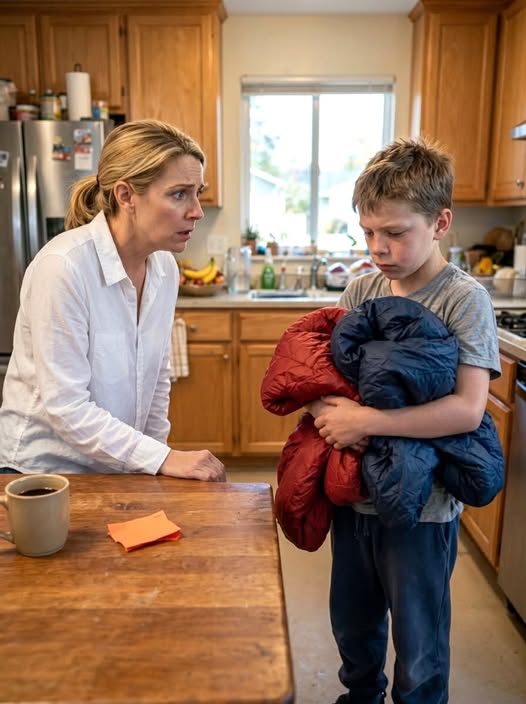
About my son standing in our kitchen with dirty sleeping bags.
About the orange Walmart parking notice.
About a frightened little boy sitting alone in an old Buick, believing he had somehow failed to be good enough to deserve a bed.
And about the yellow piece of paper he’d carried in his pocket.
Please tell my mom I tried to be good.
I still have a copy of that note.
Beth has the original.
She keeps it in a small box with Owen’s baby pictures and drawings.
Not because she wants to remember what Wade did.
But because she never wants to forget what her son endured, what it took for him to speak, and how hard they both worked to feel safe again.
There is one thing I think about more than anything else.
For eight weekends, Finn could have come home alone.
He could have told me that he didn’t want to stay.
He could have left Owen in that car and saved himself from the cold, the fear, and the sleepless nights.
But in his nine-year-old mind, leaving his best friend alone felt worse than staying.
That didn’t make the situation his responsibility.
It never should have been.
Still, it revealed something about the little boy I was raising.
He saw somebody who was scared.
And he refused to pretend he hadn’t.
Today, both boys are doing better.
They still spend weekends together.
They still argue over video games, steal each other’s snacks, and laugh so loudly that I have to remind them to keep their voices down.
And whenever Owen comes over, Finn makes sure the hallway light is on before bedtime.
He doesn’t make a big deal about it.
He just walks over, flips the switch, and goes back to whatever they’re doing.
Sometimes the smallest gestures carry the most love.
I used to think the most important thing I could teach my son was to be brave.
Now I understand that bravery isn’t always standing up to someone bigger than you.
Sometimes it’s knowing when to ask for help.
Sometimes it’s telling the truth even when someone has frightened you into silence.
And sometimes it’s a nine-year-old boy walking a mile through the dark, carrying two dirty sleeping bags, because he knows his mother will listen.
That Sunday morning, my son came home carrying two sleeping bags.
But what he was really carrying was a truth two frightened children had been forced to keep for far too long.
And I’m grateful he finally brought it home.
THE END