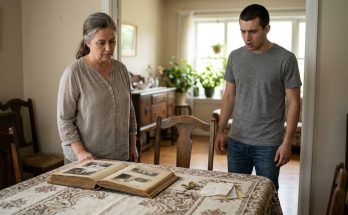
The night my husband threw me out, the rain was falling so hard the street shimmered like black glass. He didn’t even allow me to take an umbrella.
“Three years,” Adrian said, standing in the doorway of the house I had paid half the mortgage for. “Three completely wasted years, Mara. No child. No legacy. Nothing.”
Behind him, his mother smiled calmly over the edge of her teacup.
His new woman, Celeste, lounged against the staircase wearing my silk robe.
My silk robe.
I stared at the suitcase Adrian had packed for me. Two sweaters. One pair of shoes. My grandmother’s photograph with a crack running across her face.
“That’s all?” I asked quietly.
Adrian’s mouth curled. “You should be thankful I’m not demanding compensation.”
“For what?”
“For wasting my youth.”
His mother laughed softly. “Don’t make a scene, dear. Women like you age terribly when they cry.”
I didn’t cry.
That seemed to bother them more than anything else.
Adrian stepped closer and lowered his voice. “The allowance ends tonight. The accounts are frozen. My attorney will contact you. Sign quietly, and maybe I’ll leave you enough money to rent a room somewhere.”
“You froze my accounts?”
“Our accounts,” he corrected.
Celeste lifted her hand, flashing the diamond ring I had once discovered hidden inside Adrian’s desk drawer. “Don’t worry. I’ll give him children.”
Those words hit harder than the freezing rain.
For three years, I endured injections, surgeries, tests, whispers. Adrian never once agreed to take a fertility test himself. His mother insisted real men never needed to prove anything.
I picked up the suitcase slowly.
“You’re making a mistake,” I told him.
Adrian laughed. “No, Mara. I finally fixed one.”
Then the door slammed shut.
I stood there in the rain until headlights swept across me.
From the neighboring porch, a man’s voice cut through the storm. “You’ll catch pneumonia before you catch justice.”
I turned.
The neighbor watched me beneath the yellow porch light. Everyone called him Captain Hayes, the lonely veteran living in the old brick house next door. He walked with a cane, rarely spoke to anyone, and strange black cars visited his home at midnight.
His face carried scars. His eyes were calm and cold like winter steel.
“I don’t need pity,” I said.
“Good,” he replied evenly. “I don’t offer pity.”
Then he opened his front door.
“I offer contracts.”
I stared at him.
He glanced toward Adrian’s brightly lit windows.
“Come inside, Mrs. Vale,” he said quietly. “Your husband just declared war on the wrong woman.”
For the first time that night, I smiled.
“My name is Mara,” I said.
“And mine,” he answered, “is not Hayes.”….
Part 2
Inside the veteran’s house, there were no dusty military medals, no faded family photographs, no cheap furniture.
There were surveillance screens.
Wall safes.
A private elevator.
A medical-grade refrigerator humming behind locked glass.
I should have run immediately.
Instead, I sat dripping wet at his kitchen table while he placed a towel beside me as neatly as evidence in a courtroom.
“You know what Adrian did,” I said quietly.
“I know far more than that.” He slid a thick folder across the table. “I know he moved marital assets through three shell corporations. I know his mother forged your signature on fertility clinic consent forms. I know Celeste was receiving company money long before she officially became his mistress.”
My fingers went numb.
“How?”
The old man’s expression never changed. “Because your husband tried to buy my land last year. When I refused, he sent men to intimidate me.”
“And?”
“They apologized.”
I opened the folder.
Bank transfers. Property documents. Fertility clinic records. And a medical report Adrian had hidden from me.
Male factor infertility: severe.
My breath stopped.
“He knew,” I whispered.
“Yes.”
“All those injections. All those nights I blamed myself.”
Captain Hayes remained silent. Somehow, that silence felt kinder than comfort.
Then he made the strange offer.
“I run a foundation,” he said. “Veterans. Orphans. Medical research. I need someone with discipline, discretion, and nothing left to fear. Take the position. Salary, housing, legal protection. In return, you stop thinking like a victim.”
A sharp, broken laugh escaped me. “That’s your offer?”
“No.” He opened another file. “That’s merely the beginning. You froze embryos three years ago before your first surgery. Adrian signed the consent forms, then buried the paperwork after learning his own fertility results. Legally, the embryos belong to you.”
The room tilted around me.
“My embryos?”
“Your embryos.”
Six weeks later, I was living in the guest wing of his estate under a different name.
Three months later, I was directing the public health division of the Hayes Foundation.
Five months later, Adrian sued me for “fraudulent abandonment” and accused me of stealing from him.
He looked smug arriving at court in charcoal gray, Celeste hanging from his arm while his mother stood behind him like a crowned serpent.
“You look exhausted, Mara,” he said outside the courthouse. “Poverty suits you.”
I touched the sleeve of my plain black coat. “Does it?”
Celeste’s gaze drifted toward my stomach.
Not visible yet.
Not enough.
Adrian leaned closer. “You should have signed quietly. Now I’ll destroy whatever pride you still have left.”
I looked past him at his lawyer. Then toward the cameras gathered outside the courthouse doors.
“You always loved having an audience,” I said calmly.
His mother smiled. “Poor girl. Still pretending she has cards left to play.”
That afternoon, Captain Hayes brought me to a private clinic occupying the top floor of a hospital with no name on its entrance.
Doctors I recognized from magazine covers greeted him with the respect reserved for royalty.
One had delivered a prime minister’s child.
Another pioneered fetal surgery.
A famous silver-haired obstetrician shook my hand warmly. “Mrs. Vale, we’re going to take excellent care of you and the twins.”
Twins.
I covered my mouth with both hands.
Captain Hayes stood beside me, his cane silent against the marble floor.
For the first time in months, my composure shattered.
“Why are you helping me?” I asked him.
He looked through the tall glass windows toward the city below.
“Because Adrian Vale destroys people and calls it business. Because I once had a daughter. Because you remind me of someone who deserved backup and never got it.”
That same night, I signed one final document.
Not a divorce surrender.
A counterclaim.
Fraud. Asset concealment. Medical coercion. Defamation. Emotional abuse. Corporate embezzlement.
At the bottom of the paperwork, the attorney listed one name as lead witness.
General Elias Thorn.
The most decorated intelligence commander of his generation.
The billionaire founder behind the Hayes Foundation.
The lonely veteran next door.