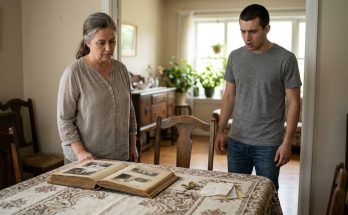
“Adrian Opened Mom’s Storage Unit”
Apparently my mother had been paying for a storage unit for nineteen years.
Nineteen.
Which honestly felt impossible considering there were months growing up when we could barely afford groceries.
I found out because Adrian received an automatic payment notification during breakfast.
He frowned down at his phone immediately.
“What storage unit?”
Gael looked up from his waffles.
“What storage unit?”
Leonardo slowly lowered his coffee cup.
And suddenly all three brothers had the exact same expression:
the one that meant Mom had apparently managed to emotionally surprise them from beyond the grave again.
An hour later, we stood inside a dusty storage facility in Queens while fluorescent lights buzzed overhead.
The place smelled like cardboard and old memories.
Rain tapped softly against the metal roof while the manager unlocked the unit with a giant key ring.
“You folks inherited this after the final payments stopped processing,” he explained casually.
My chest tightened painfully.
Final payments.
Meaning Mom paid this bill right until she died.
The metal door rolled upward slowly.
And all four of us froze.
Boxes.
Dozens of them.
Carefully labeled in Mom’s handwriting.
AUTUMN
BOYS
BIRTHDAYS
PHOTOS
CHRISTMAS
SCHOOL
The air disappeared from my lungs.
Gael whispered first.
“Oh my God.”
Leonardo actually sat down on an old folding chair like his knees stopped functioning emotionally.
And Adrian—
the man who negotiated billion-dollar deals without blinking—
looked completely shattered.
I stepped forward slowly.
Dust floated through pale fluorescent light while rain echoed softly overhead.
Everything smelled faintly like old paper and time.
I touched the nearest box carefully.
AUTUMN — AGE 5
My hands started shaking immediately.
Inside:
drawings
school papers
tiny birthday candles never used
photographs
old hair ribbons
handwritten notes
Entire pieces of my childhood Mom secretly preserved while pretending we owned almost nothing.
I opened another box.
BOYS — CHRISTMAS
Inside sat wrapped presents.
Unopened.
Tags still attached:
Adrian
Leonardo
Gael
My throat closed instantly.
“She bought them gifts.”
Leonardo made a broken sound somewhere behind me.
Because suddenly we all understood:
Mom never emotionally left any of us.
She simply ran out of power fighting people stronger than herself.
Gael carefully picked up one tiny wrapped box labeled:
GAEL — AGE 12
His hands trembled violently.
“She kept everything.”
Adrian moved deeper into the storage unit slowly like a man walking through grief physically preserved in cardboard.
Then suddenly he stopped.
In the far back corner stood an old plastic container sealed with faded tape.
Mom’s handwriting stretched across the top:
FOR WHEN THEY’RE TOGETHER AGAIN
Nobody breathed.
Rain hammered softly against the roof while fluorescent lights buzzed overhead.
Leonardo whispered:
“She thought we’d find each other.”
Adrian crouched carefully beside the container.
For one brief second,
he looked terrifyingly young.
Not billionaire-young.
Little-boy-young.
The kind of young grief creates when old hope suddenly returns.
He opened the lid slowly.
Inside sat:
- photographs of all four of us
- birthday cards never mailed
- letters
- cassette tapes
- tiny keepsakes from every stage of our lives
And on top—
one envelope.
Written carefully in Mom’s handwriting:
TO MY CHILDREN
Gael started crying immediately.
Not quiet tears.
Real ones.
The kind pulled from somewhere deep enough to hurt physically.
Leonardo covered his mouth with both hands.
I couldn’t move at all.
Because standing inside that dusty storage unit—
surrounded by decades of hidden love—
I finally understood something enormous:
our mother never stopped building a home for us emotionally…
even after the world made sure we couldn’t live inside it together.
PART 24 — “The Letter Started With All Four Names”
Nobody wanted to open the envelope first.
That was the strange thing.
We had spent our entire lives wanting answers,
wanting each other,
wanting our mother back in whatever form memory allowed—
and suddenly the answers sat right there in Adrian’s shaking hands.
Yet none of us moved.
The storage unit felt impossibly quiet except for rain drumming softly against the metal roof overhead.
Dust floated through pale fluorescent light.
Gael wiped roughly at his face.
“Okay.”
A broken breath.
“Someone emotionally stronger than me should read it.”
“That eliminates everyone here,” Leonardo whispered.
Even Adrian laughed softly at that.
Tiny sound.
Destroyed sound.
I stared at Mom’s handwriting across the envelope:
TO MY CHILDREN
Not:
to my sons.
Not:
to Autumn.
All four of us.
Together.
Like she had been waiting for this exact moment longer than any of us realized.
Finally Adrian opened the envelope carefully.
The paper inside looked old.
Folded too many times.
Edges worn soft from years hidden away.
His voice almost failed on the first line.
If you are reading this together, then somehow love survived long enough to bring you back to each other.
Gael immediately started crying again.
Not subtle crying.
Completely catastrophic crying.
Leonardo grabbed tissues from somewhere inside one of the storage boxes like a man emotionally preparing for war.
Adrian swallowed hard and kept reading.
I know some of you may still be angry with me.
The fluorescent lights hummed softly overhead.
You have the right to be.
There is no pain worse than a mother leaving her children, even when she does it to save them the only way she can.
My chest hurt so badly I physically pressed one hand against it.
Because suddenly Mom wasn’t memory anymore.
She was here.
Speaking.
Trying one final time to hold us together emotionally across years she never got to see.
Adrian’s voice weakened slightly.
They told me I could keep only one child.
I still hear those words in my nightmares.
The entire storage unit went silent.
Not even breathing.
Because there it was.
The ugliest truth at the center of our family.
Not abandonment.
Selection.
A mother forced to divide her children like survival itself had rules written by cruel people with money.
Leonardo looked away completely,
jaw tight,
eyes shining.
Gael sat curled against a stack of boxes holding one unopened Christmas present in his lap like he might fall apart if he let go of it.
Adrian continued reading.
I chose Autumn because she was a baby girl, and they believed girls mattered less.
I hated myself for understanding that weakness in them.
But it was the only thing I had.
I stopped breathing.
Because suddenly my entire existence felt tied to one horrifying truth:
I survived beside my mother because powerful men underestimated daughters.
Rain hammered harder against the roof.
Adrian’s hands shook visibly now.
Adrian,
you were always trying to become older than your age so your brothers would feel safe.
His eyes closed briefly.
Leonardo,
you learned to smile even when your heart hurt because you thought beauty could keep people gentle.
Leonardo broke instantly at that.
Completely instantly.
Gael,
you filled silence with noise because quiet rooms reminded you someone was missing.
Gael covered his face fully.
And finally—
Adrian’s voice almost disappeared reading the last part.
Autumn,
if your brothers found you, then please understand this:
you were never the child left behind.
You were the child I trusted to carry my love until the others could reach you again.
The world stopped.
Actually stopped.
The rain.
The lights.
The storage unit.
Everything.
Because suddenly the story of my life rearranged itself completely.
Not abandoned.
Not forgotten.
Entrusted.
I started crying so hard I couldn’t breathe correctly.
Leonardo moved first,
pulling me against him immediately while Gael wrapped around both of us from the side like emotional gravity finally collapsing inward after twenty lost years.
And Adrian—
quiet,
controlled,
terrible at showing emotion Adrian—
slowly lowered the letter,
looked at all three of us together,
and finally let himself cry too.
PART 25 — “Mom Recorded Cassette Tapes For Every Birthday”
The cassette tapes terrified us.
Not because they looked old.
Because they meant Mom had planned for absence.
The four of us sat on the floor of the storage unit surrounded by opened boxes while rain hammered steadily against the roof overhead.
Nobody touched the tapes at first.
There were dozens.
Each one labeled carefully in Mom’s handwriting:
ADRIAN — 16
LEONARDO — 18
GAEL — 13
AUTUMN — EVERY YEAR
My stomach twisted painfully at that last label.
Every year.
Even when she couldn’t see me.
Even when we barely had money.
Even when cancer was already slowly hollowing her body—
Mom still recorded birthday messages for a daughter she feared might grow up feeling alone.
Gael carefully picked one tape up like it might break emotionally in his hands.
“Do we even own a cassette player?”
Adrian answered immediately.
“Yes.”
Of course he did.
Because apparently my oldest brother prepared for grief the same way governments prepared for war.
An hour later we sat together in one of the smaller living rooms back at the mansion while an ancient cassette player rested on the coffee table between us.
Rain moved softly against the giant windows.
Nobody looked emotionally stable.
Especially Gael,
who had already cried so much his face looked physically exhausted.
Leonardo inserted the first tape carefully.
AUTUMN — AGE 10
Static crackled softly through the speakers.
Then—
Mom’s voice filled the room.
Bright.
Warm.
Alive.
“Hi baby.”
“If this tape reached you, then somehow your brothers finally stopped being stubborn long enough to work together.”
Gael immediately pointed accusingly.
“She knew us TOO well.”
I laughed through tears.
Mom continued:
“Happy birthday, sweetheart.”
“You’re probably taller now.”
“I hope you still sing while washing dishes.”
My chest collapsed inward.
Because I did.
I still did.
Tiny inherited habit.
Tiny invisible thread connecting us all these years without me even realizing.
The tape crackled softly.
“Today I wanted to buy you a cake with strawberries.”
“But money is difficult this month.”
“So instead I made pancakes shaped like hearts.”
“You said they looked like potatoes.”
Gael burst out laughing while crying simultaneously.
“THAT IS EXACTLY SOMETHING SHE WOULD SAY.”
I covered my face with both hands.
Because suddenly I remembered it.
The pancakes.
The burnt edges.
Mom laughing while pretending the shape was intentional.
The memory hit so hard I physically folded inward.
Leonardo quietly moved closer beside me on the couch.
Mom’s voice softened slightly on the tape.
“I hope someday your brothers get to hear how funny you are.”
“I think they’d love you immediately.”
Silence swallowed the room afterward.
Because she was right.
They did.
Not because I became impressive enough.
Not because of money.
Not because fate suddenly turned magical.
Just because family recognized itself the moment we finally collided.
The tape continued.
“Autumn…”
“If you ever feel lonely…”
“remember that being loved from far away still counts as being loved.”
That sentence shattered every remaining wall inside me.
Because my entire life,
I thought love only counted if people physically stayed.
But my mother—
broken,
poor,
separated,
dying—
had apparently spent twenty years proving otherwise.
The tape clicked softly as it ended.
Nobody moved.
Rain slid quietly down the windows while the old cassette player hummed faintly between us.
Then Gael whispered the thing all of us were thinking:
“She never stopped mothering us.”
And sitting there surrounded by cassette tapes,
old grief,
and finally-found family—
I realized something beautiful:
our mother spent her entire life building emotional bridges for children she prayed would someday find their way back across them together.
PART 26 — “Adrian Finally Told Us About The Night Mom Left”
The story had lived inside the house for twenty years.
Untouched.
Unspoken.
Poisonous.
And somehow nobody had ever told it out loud completely.
Not to protect us.
To survive it.
The confession happened three nights after the cassette tapes.
Rain stormed violently outside the mansion while all four of us sat in the library surrounded by opened storage boxes and half-drunk tea gone cold hours earlier.
Nobody wanted to sleep anymore.
Every answer created three new questions.
Gael sat wrapped in a blanket on the couch.
Leonardo leaned against the fireplace staring into nothing.
And Adrian stood near the windows holding Mom’s old letter like it physically hurt to put down.
Then quietly,
without warning,
he said:
“I remember the exact night she left.”
The room stopped immediately.
Because suddenly Adrian no longer looked like a billionaire.
He looked like a little boy standing inside a memory too heavy to carry alone.
Rain crashed against the giant windows while the fire crackled softly behind us.
I swallowed hard.
“You remember everything?”
A long silence followed.
Then Adrian nodded once.
“Yes.”
Gael looked up slowly.
“You never told us.”
“I know.”
The oldest brother stared out toward the storm-dark city.
“When Grandfather found out Mom wanted to leave…”
His jaw tightened slightly.
“…the house became dangerous.”
My stomach twisted instantly.
Dangerous how?
Adrian answered before I could ask.
“Lawyers.”
“Auditors.”
“Security.”
A bitter breath escaped him.
“They monitored her calls.”
Another pause.
“And they kept telling us she was unstable.”
Leonardo closed his eyes immediately.
Because suddenly we understood:
the family machine didn’t just separate us physically.
It rewrote reality around the children left behind.
Adrian continued quietly.
“I was twelve.”
A pause.
“But I knew something was wrong because Mom stopped singing.”
The sentence hollowed the room completely.
Because all of us now understood what silence meant in relation to her.
He rubbed tired fingers against his temple.
“The night she left…”
Another pause.
“…she came into our rooms while everyone else slept.”
Gael’s eyes filled instantly.
Leonardo looked physically unable to breathe.
Adrian’s voice stayed calm somehow.
Too calm.
“She hugged Leonardo first because he was already awake pretending to sleep.”
A pause.
“She kissed Gael’s forehead.”
Another pause.
“And then she sat beside my bed for almost an hour.”
The fire cracked softly in the silence afterward.
I could see it.
Young Mom.
Terrified.
Trying desperately to memorize her children before powerful people erased her access to them forever.
Adrian finally turned toward us.
“She told me something that night.”
Nobody moved.
Rain hammered harder outside.
“She said:
‘Take care of your brothers until I can come back for all of you.’”
Gael broke immediately.
Full catastrophic sobbing.
Leonardo covered his mouth with trembling hands.
And Adrian—
still standing there somehow—
looked more exhausted than any human being I’d ever seen.
Then softly he admitted the thing that nearly shattered all of us:
“I spent twenty years believing I failed her.”
The room collapsed emotionally.
Because suddenly every piece of Adrian made sense:
- the control
- the work obsession
- the constant checking
- the inability to rest
- the searching
- the investigator files
- the old phone
- the bus ticket
Not ambition.
Duty.
A twelve-year-old boy inherited a dying promise from his mother and never emotionally put it down again.
I stood up without thinking and crossed the room quickly.
Then hugged him.
Tightly.
For one second Adrian froze completely.
Like his body genuinely didn’t know what to do with comfort directed at him instead of responsibility.
Then slowly—
carefully—
he hugged me back.
And standing there while rain battered the windows and our family finally grieved honestly together—
I realized something devastating:
my oldest brother never truly became powerful because he wanted wealth.
He became powerful because once upon a time,
a frightened mother whispered:
“Protect them.”
And he never forgave himself for needing twenty years to finally bring us home.
PART 27 — “Gael Found The Voicemail Mom Never Sent”
The voicemail was only fourteen seconds long.
Fourteen.
But it emotionally destroyed the entire family.
Gael found it accidentally while transferring old files from one of the cassette boxes onto his computer. Apparently Mom had briefly owned a flip phone before it died permanently sometime around my middle-school years.
The recovered files were mostly:
- blurry photos
- grocery lists
- weather recordings
- accidental pocket audio
Then there was one file labeled:
DONT SEND YET
Which already felt emotionally dangerous.
We gathered in the media room that evening while rain drifted softly across the windows again because apparently our family only survived revelations during bad weather.
The room glowed dim blue from the television screen.
Gael sat forward nervously with the laptop balanced on his knees.
“I haven’t listened to it all the way yet.”
That should’ve been our warning.
Leonardo curled into one corner of the couch holding tea he forgot to drink.
Adrian stood near the back of the room like sitting down emotionally exposed him too much.
And me—
I already felt fragile just seeing Mom’s file name on the screen.
Gael clicked play.
Static crackled softly.
Then Mom’s voice appeared suddenly.
Breathing hard.
Upset.
“Hi baby boys…”
The room froze instantly.
Not “boys.”
Plural.
All of them.
Her voice trembled slightly.
“I’m outside the house right now.”
Adrian physically stopped breathing.
Gael looked up sharply toward him.
Nobody moved.
Mom continued quietly through the speakers:
“I just wanted to hear your voices before I leave again.”
The silence in the media room became unbearable.
Because suddenly we understood:
she came back.
At least once.
She came back and stood outside the mansion.
Alone.
Unable to enter.
Leonardo covered his mouth immediately.
Mom’s breathing shook softly through the recording.
Then:
“Adrian, please stop trying to become an adult.”
“You’re still a little boy.”
Adrian looked like someone stabbed directly through the ribs.
Gael’s hands trembled over the laptop.
Mom continued:
“Leonardo… don’t smile just because other people need you to.”
Leonardo lowered his head instantly.
And then:
“Gael, sweetheart…”
“quiet isn’t your fault.”
Gael broke completely.
Not crying anymore.
Actual grief tearing through him physically.
The recording crackled softly.
Then Mom whispered the line that shattered me most:
“And if Autumn ever hears this someday…”
A shaky breath.
“tell her I carried her brothers inside every prayer I ever made for her.”
I stopped breathing.
The room blurred instantly through tears.
Because suddenly I understood:
Mom never separated us emotionally in her heart.
Not once.
Not even while survival forced physical distance between us.
Then the recording shifted suddenly.
Car doors somewhere.
Voices in the distance.
Mom inhaled sharply.
Terrified now.
And finally whispered:
“I have to go.”
Click.
Silence.
The file ended.
Nobody moved afterward.
Rain tapped softly against the windows while the television screen glowed pale in the dark room.
Then Adrian quietly asked the question destroying all of us already:
“When was that recorded?”
Gael looked down at the recovered file metadata.
His face lost all color immediately.
“What?”
The streamer swallowed hard.
“She came back the night before Autumn’s fifth birthday.”
The world stopped.
Because suddenly I remembered that birthday perfectly.
The pancakes shaped like hearts.
Mom crying quietly in the kitchen afterward.
The way she kept checking the window all evening.
Oh my God.
She had gone to see her sons the night before.
I covered my mouth instantly as tears spilled harder.
And somewhere beside me,
Adrian finally sat down for the first time all night—
like the emotional weight of loving our mother across impossible distance had finally become too heavy to carry standing anymore.
PART 28 — “Autumn Realized Mom Was Watching The Door”
After the voicemail, I couldn’t stop thinking about my fifth birthday.
Memory started rearranging itself differently.
Not changing.
Revealing.
For years, I remembered that birthday as simple:
pancakes,
rain,
Mom acting strangely tired.
Now every detail suddenly looked haunted by something I didn’t understand at the time.
I sat alone in the kitchen the next morning turning the memory over and over inside my head while sunlight spilled softly through the giant windows.
The mansion felt unusually quiet.
Everyone emotionally exhausted from grief discoveries again.
A mug of tea cooled untouched beside me.
And suddenly—
I remembered the door.
Mom kept watching the front door all evening.
Not casually.
Waiting.
My chest tightened painfully.
Because now I understood:
after standing outside the mansion trying to hear her sons’ voices,
she came home to me carrying heartbreak nobody else could see.
And still made pancakes.
The thought nearly destroyed me.
“You’re awake early.”
I looked up.
Leonardo entered the kitchen wearing gray sweatpants and yesterday’s emotional exhaustion across his face.
I laughed weakly.
“We all look terrible.”
“Family resemblance.”
He moved quietly around the kitchen making coffee while I stared out toward the gardens.
Then softly I asked:
“Do you think she wanted to come back?”
Leonardo stopped moving instantly.
Not because the question surprised him.
Because it hurt too much.
He leaned against the counter slowly.
“Every day.”
The answer arrived without hesitation.
Without doubt.
I swallowed hard.
“Then why didn’t she?”
The actor looked down at the coffee machine for a long moment.
Then quietly:
“Because powerful people can convince mothers they’ll lose everything if they try.”
Silence settled heavily around us.
Not empty silence.
Truth silence.
I wrapped both hands tighter around the tea mug.
“She almost came back anyway.”
Leonardo nodded once.
“Yeah.”
Then softer:
“She was braver than any of us understood.”
The kitchen filled with the smell of coffee while morning sunlight warmed the marble counters.
Ordinary beauty beside enormous grief.
I stared down at my reflection faintly visible in the tea.
“Sometimes I think she spent her whole life apologizing for surviving the only way she could.”
Leonardo looked at me carefully.
Then quietly answered:
“I think she spent her whole life hoping we’d forgive her for not being stronger than the people hurting her.”
That sentence hollowed me completely.
Because suddenly I saw my mother clearly:
young,
poor,
terrified,
fighting impossible systems with nothing except love and stubbornness.
And somehow—
despite everything—
she still managed to keep all four children emotionally connected across twenty years of separation.
That wasn’t weakness.
That was endurance.
Leonardo carried two coffees toward the table and sat beside me.
Then after a long silence, he admitted softly:
“You know what hurts most?”
“What?”
He stared out toward the bright gardens.
“That she kept trying to protect all of us from guilt.”
A pause.
“But she carried all of it alone.”
The truth sat heavily between us afterward.
Because yes.
Mom spent twenty years:
- comforting children she couldn’t reach
- preserving memories secretly
- recording birthday tapes
- hiding love inside storage units
- building emotional bridges in silence
And somehow she still died worrying whether we would hate her.
Tears burned behind my eyes again.
“I wish she knew we found each other.”
Leonardo smiled sadly.
“I think she believed we would.”
Outside, sunlight moved gently across the gardens while the mansion breathed quietly around us.
And for the first time since hearing the voicemail—
I stopped imagining my mother as someone who failed to reunite her family.
Instead,
I saw a woman who spent twenty years leaving emotional breadcrumbs behind…
trusting her children would someday find their way back to each other through love alone.
PART 29 — “Adrian Took Us Back To The Mansion We Lost”
None of us wanted to go.
That was the strange thing.
For years,
the mansion existed in our family like a ghost:
too painful to discuss directly,
too powerful to fully escape emotionally.
Yet one rainy Sunday morning, Adrian quietly announced:
“We should see it.”
Nobody asked what he meant.
We already knew.
The old family estate.
The place where:
- Mom lost her sons
- my brothers lost their mother
- powerful people confused control with love
- and twenty years of grief first began
Gael immediately objected.
“Respectfully?”
A pause.
“Absolutely not.”
Leonardo looked pale just hearing the idea.
I stayed silent.
Because honestly?
Part of me needed to see it.
Needed proof that the place haunting all of us was real.
So by late afternoon, we drove north through cold rain while Manhattan slowly disappeared behind us.
The SUV remained unusually quiet.
Gael kept music playing softly under his breath like silence still frightened him too much.
Leonardo stared out the window.
And Adrian drove with both hands tight against the steering wheel like he was physically bracing for impact.
Then finally—
the gates appeared.
Massive black iron.
Stone walls.
Perfect landscaping.
The estate looked less like a home and more like a place built specifically to intimidate people emotionally.
My stomach twisted instantly.
Because suddenly I understood:
Mom had tried to fight this place alone.
The gates opened slowly.
Rain slid across the windshield while the mansion emerged through gray mist and enormous trees.
Huge.
Cold.
Beautiful in the cruelest possible way.
Gael whispered first.
“I hate this house.”
Nobody disagreed.
Inside, everything looked preserved strangely.
Untouched by warmth.
The ceilings too high.
The hallways too quiet.
The furniture arranged like nobody actually relaxed there.
I wrapped my arms around myself automatically.
And suddenly I understood why my brothers all developed different coping mechanisms:
- Adrian tried controlling everything
- Leonardo performed happiness
- Gael drowned silence in noise
Because this house taught children survival instead of safety.
Adrian moved slowly through the grand hallway.
No billionaire confidence now.
Just memory.
“This was Mom’s piano.”
I looked toward the enormous black piano near the windows.
“She played?”
Gael laughed weakly.
“She played constantly.”
A pause.
“Grandfather hated it because it distracted people.”
Of course he did.
We moved deeper into the mansion.
Every room carried emotional ghosts:
- old Christmas photographs
- giant formal dining tables
- portraits of powerful men staring down from walls like judgment itself
Then Adrian stopped outside one specific door.
His face changed immediately.
Fear.
Real fear.
“That was her room.”
Nobody moved.
Rain tapped softly against the giant windows somewhere far away while the hallway held its breath around us.
Finally Leonardo stepped closer slowly.
“You’ve never gone inside since she left.”
Not a question.
Adrian shook his head once.
“No.”
Twenty years.
My chest tightened painfully.
Because suddenly I realized:
the strongest person in our family still couldn’t emotionally cross one doorway connected to losing our mother.
I reached for the doorknob carefully.
Then looked back at him.
“Together?”
The oldest brother stared at me for several long seconds.
Then finally nodded.
The room smelled faintly like old wood and dust.
Soft yellow wallpaper.
Tall windows.
A bookshelf near the bed.
And there—
sitting quietly on the dresser—
stood a framed photograph of all four children.
Including me.
Tiny baby me.
The air disappeared from my lungs.
“She kept our picture here.”
Leonardo covered his mouth instantly.
Gael looked seconds away from emotionally collapsing again.
Adrian stepped farther into the room slowly like someone walking through sacred ground.
Then quietly,
almost to himself,
he whispered:
“She never let them separate us in here.”
The sentence shattered something open inside all of us.
Because suddenly we understood:
even trapped inside this enormous powerful house—
Mom still fought quietly to keep her children emotionally together in every hidden way she could.
And standing there inside the room where our family first broke apart—
I realized something enormous:
love had survived longer than power.
PART 30 — “Gael Found Mom’s Secret Bedroom Drawer”
The drawer was hidden behind the bookshelf.
Which somehow felt exactly like something my mother would do.
We were still inside her old bedroom while rain moved softly against the mansion windows and nobody emotionally knew how to function correctly anymore.
Leonardo sat quietly near the bed staring at the framed photograph of all four of us.
Gael wandered restlessly around the room touching objects gently like he was trying to reconnect memories physically.
And Adrian stood near the windows completely silent.
Then suddenly—
click.
We all looked up immediately.
Gael froze beside the bookshelf.
“…uh.”
Adrian frowned.
“What did you do?”
“I emotionally touched something.”
Of course he did.
A narrow wooden panel behind the bookshelf had shifted slightly open.
My heartbeat climbed instantly.
Because suddenly the room felt alive again.
Like Mom had been waiting years for someone to finally notice this.
Gael carefully pulled the hidden compartment farther open.
Inside sat a single velvet box,
three notebooks,
and an envelope.
Leonardo whispered first.
“Oh my God.”
Adrian crossed the room slowly.
Not billionaire-slow.
Memory-slow.
Rain tapped steadily against the windows while all four of us gathered around the hidden compartment.
The envelope had one line written across it in Mom’s handwriting:
FOR THE DAY YOU STOP BEING ANGRY
Nobody breathed.
Because suddenly we understood:
Mom knew.
She knew grief would turn into anger first.
Knew children would blame themselves,
her,
each other.
And somehow she still believed one day we’d survive long enough emotionally to read this together.
Adrian opened the envelope carefully.
Inside rested another letter folded around an old photograph.
The picture showed Mom sitting on the floor laughing while all three brothers climbed all over her.
Tiny chaotic children.
Pure joy.
On the back she had written:
They only sit still when asleep.
Gael broke laughing through tears immediately.
“That is factually accurate.”
Adrian unfolded the letter slowly.
His voice sounded rough already.
My beautiful children,
If you found this, then maybe enough time has passed for you to understand something important:
I was never ashamed of loving you more than I feared powerful people.
The room hollowed instantly.
Rain hammered harder outside.
Adrian continued reading carefully.
They could take my home.
They could take my money.
They could even separate me from my children.
But they never once succeeded in making me stop being your mother.
Leonardo covered his face completely.
Gael physically sat down on the floor.
And me—
I stopped breathing again.
Because suddenly every storage box,
every birthday tape,
every hidden photo,
every unsent gift—
became evidence of resistance.
Mom lost legally.
But emotionally?
Never.
Adrian’s hands trembled visibly now.
Adrian,
someday you must forgive yourself for being twelve years old.
The oldest brother closed his eyes immediately.
Like the sentence hurt too much to survive hearing aloud.
Leonardo,
you do not have to perform happiness to deserve love.
Leonardo actually made a broken sound in the back of his throat.
Gael,
being loud is not the same thing as being difficult.
Gael started crying again instantly.
Then finally—
Adrian’s voice nearly disappeared reading my part.
Autumn,
if your brothers are beside you while reading this…
then please understand:
you were never raised alone.
You were raised carrying all of us forward until we could come back for you.
The room collapsed emotionally.
Because suddenly my lonely childhood transformed into something else entirely:
not abandonment.
Preservation.
Mom entrusted me with surviving long enough for our family to reunite.
Rain battered the windows while all four of us cried openly inside the bedroom where our mother once fought impossible people with nothing except love and stubbornness.
Then quietly,
through tears,
Gael whispered:
“She kept hiding pieces of herself so we’d keep finding our way back.”
And standing there inside the mansion that once destroyed our family—
I realized something beautiful:
our mother had spent twenty years secretly turning grief into breadcrumbs leading all of us home……….
The Internet Found My Old School Photos”
The internet discovered my middle-school yearbook picture at exactly 2:14 p.m.
And apparently that was enough to emotionally destabilize an entire mansion.
I didn’t even know it happened at first.
I was sitting cross-legged on the kitchen counter eating strawberries while Mrs. Alvarez taught me how to make empanadas from scratch.
Flour covered my hoodie.
The kitchen smelled warm and buttery.
Jazz drifted softly through the speakers.
Normal.
Peaceful.
Then Gael sprinted into the kitchen like a man fleeing active warfare.
“DO NOT OPEN SOCIAL MEDIA.”
I blinked slowly.
“That sentence never means anything good.”
The streamer pointed dramatically at my phone.
“Give it to me.”
“No.”
“Autumn.”
“Gael.”
Mrs. Alvarez calmly continued rolling dough beside us like billionaire family panic happened every Tuesday.
My phone buzzed again.
And again.
And again.
I frowned and looked down at the screen.
Thousands of notifications.
My stomach dropped instantly.
“What happened?”
Gael covered his face with both hands.
“The internet found your old yearbook photos.”
Silence.
Then:
“…what.”
Leonardo entered immediately behind him already holding two phones and the exhausted expression of a man currently fighting publicists for survival.
“Don’t panic.”
“Why would you start with that sentence?!”
Adrian appeared last.
Of course.
Because apparently all family emergencies summoned him automatically like an emotionally overworked Batman.
He looked directly at me.
“Are you okay?”
“I don’t know yet.”
Fair answer honestly.
Gael cautiously lowered one hand from his face.
“The internet thinks your school pictures are adorable.”
I stared at him.
“That’s the problem?”
“Well.”
A pause.
“They also found the photo where you dressed as a corn cob for harvest festival.”
The kitchen went silent.
My soul left my body instantly.
“No.”
Leonardo looked deeply sympathetic.
“Yes.”
I grabbed my phone with shaking hands.
And there it was.
My twelve-year-old yearbook picture.
Braces.
Messy braid.
Terrible lighting.
The emotional confidence of a frightened potato.
Millions of views.
I physically stopped breathing.
“Oh my God.”
Gael looked weirdly proud.
“The comments are aggressively protective.”
That sounded fake.
Then I read them.
SHE LOOKS SO SWEET

WHO HURT THIS SMALL FARM CHILD
NOT THE CORN COSTUME
HER BROTHERS BETTER PROTECT HER FOREVER
SHE LOOKS LIKE SHE APOLOGIZES TO CHAIRS AFTER BUMPING INTO THEM
I stared harder.
Because unfortunately that last one was completely accurate.
Leonardo gently took my phone away before I could emotionally perish.
“The internet likes you.”
“That’s deeply concerning.”
Gael burst out laughing immediately.
Then Adrian quietly asked:
“Any invasive information leaked?”
All three brothers turned serious instantly.
The atmosphere changed.
Because beneath all the jokes,
they never forgot the danger underneath public attention.
Leonardo shook his head.
“Only old school photos.”
A pause.
“No address.”
Another pause.
“But the tabloids are already calling her ‘America’s Lost Sister.’”
I physically gagged.
“That is horrific.”
Gael looked delighted.
“That’s branding, baby.”
Mrs. Alvarez finally spoke without looking up from the dough.
“She should hit him with the rolling pin.”
“THANK YOU,” I whispered.
The kitchen relaxed slightly afterward.
But deep down,
something still felt strange.
Not the photos.
The attention.
Because suddenly millions of strangers were looking at pieces of my old life:
my tiny school,
my awkward haircut,
my hometown harvest festival.
Things that once felt invisible.
I looked toward the rain-streaked windows quietly.
Then softly admitted:
“It’s weird.”
A pause.
“My whole life used to feel so small.”
Another pause.
“And now strangers are staring at it.”
The room fell silent.
Because all three brothers understood something important immediately:
I wasn’t ashamed of where I came from.
I was terrified the world would treat it like a joke.
Then Adrian crossed the kitchen slowly and placed one hand gently against the top of my head.
“Autumn.”
I looked up.
His voice stayed calm.
Certain.
“Nobody who survived your life gets to be called small.”
PART 32 — “Leonardo Read The Comment That Made Him Angry”
Most of the internet reactions were harmless.
Embarrassing.
Overprotective.
Slightly unhinged.
But harmless.
Then Leonardo found one comment that changed the atmosphere of the entire house instantly.
It happened late at night.
Rain drifted softly against the mansion windows while all four of us sat scattered across the living room pretending not to monitor the internet obsessively.
Gael refreshed social media every six seconds like a man emotionally trapped inside a digital wildfire.
Leonardo scrolled quietly beside me on the couch.
And Adrian—
of course—
had three lawyers on standby somewhere already.
Normal family behavior apparently.
I leaned against the armrest wearing fuzzy socks while trying not to die every time another childhood photo resurfaced online.
Then suddenly Leonardo went very still beside me.
Not celebrity-still.
Dangerous still.
I looked up immediately.
“What?”
He didn’t answer.
Gael noticed too.
“Oh no.”
He lowered his phone slowly.
“That’s the face.”
Adrian looked over from across the room instantly.
“What happened?”
Leonardo finally turned his screen around silently.
The comment sat beneath one of my old school photos:
She only matters because of her brothers.
Without their money she’d still be invisible in some dead-end town.
The room changed immediately.
Not loud anger.
Worse.
Protective anger.
The kind that arrives when someone insults pain they never bothered understanding.
I stared at the screen quietly.
And honestly?
The comment hurt because part of me feared it might be true.
Leonardo noticed immediately.
Of course he did.
He gently lowered the phone.
“Don’t.”
I looked away.
“But—”
“No.”
His voice sharpened slightly.
“Absolutely not.”
The room fell silent.
Rain tapped softly against the windows while city lights glowed faintly through the dark.
Then Leonardo spoke again.
Carefully this time.
“You survived a life most people with money couldn’t emotionally handle for six months.”
My throat tightened.
He continued softly:
“You took care of Mom while she was dying.”
A pause.
“You crossed states alone.”
Another pause.
“You walked into a police station carrying your entire life in one bag and still kept going.”
Nobody moved.
Because suddenly the room wasn’t about internet comments anymore.
It was about value.
The terrifying question underneath every class difference:
who gets treated like they matter before wealth validates them publicly?
Leonardo leaned closer beside me.
“You think your worth appeared because rich people finally recognized you?”
His eyes filled slightly.
“Autumn, you were extraordinary long before we found you.”
That shattered me quietly.
Because deep down,
some frightened part of me still believed love became easier once people looked important enough to deserve it.
Across the room,
Adrian finally spoke.
Cold.
Controlled.
Certain.
“Anyone who mistakes visibility for value has never actually suffered.”
The sentence landed heavily.
Gael looked toward me carefully.
“You know what the internet doesn’t understand?”
“What?”
He smiled softly.
“They think we rescued you.”
A pause.
“But honestly?”
Another pause.
“You saved us too.”
The room went completely still afterward.
Because somehow—
despite the mansions,
money,
fame,
security teams,
and public attention—
my brothers still carried enormous empty spaces inside themselves from losing Mom.
And maybe,
without realizing it,
all four of us had been searching for the missing pieces of home inside each other the entire time.
PART 33 — “Adrian Took Me To Wall Street”
I lasted eleven minutes on Wall Street before accidentally insulting a billionaire.
Which honestly felt like a personal achievement.
Adrian had invited me to his office because, according to him:
“If the media is going to attach your name to mine, you should at least understand what I actually do.”
That sounded reasonable.
Terrifying.
But reasonable.
So at eight-thirty in the morning, I stood outside one of the tallest glass buildings in Manhattan wearing borrowed designer clothes and emotional dread.
The lobby alone looked expensive enough to deny me entry automatically.
People moved fast everywhere:
- tailored suits
- coffee cups
- sharp shoes
- expressions suggesting they personally controlled global economies
I clutched my plaid tote bag tighter instinctively.
Yes.
I still carried it sometimes.
Not because I needed to anymore.
Because it reminded me who I was before the world started treating me differently.
Adrian noticed immediately when we entered the elevator.
“You brought the bag.”
Heat rushed into my face.
“I didn’t want to lose it.”
His expression softened almost invisibly.
“Good.”
The elevator climbed impossibly high while Manhattan unfolded beneath us through glass walls.
My stomach emotionally remained on the ground floor.
Then the doors opened.
Chaos.
Not loud chaos.
Wealthy chaos.
Phones ringing.
People rushing.
Massive screens flashing numbers everywhere.
And somehow every person immediately straightened the moment Adrian stepped onto the floor.
Fear.
Not respect.
Fear.
I looked sideways at him slowly.
“You’re terrifying here.”
“That’s efficient.”
“That answer made it worse.”
For the first time all morning,
he almost smiled.
Employees greeted him rapidly while secretly staring at me with intense curiosity.
Which honestly made sense.
One week ago the internet discovered Adrian Vale had a long-lost little sister from a tiny rural town.
Wall Street was emotionally feasting on that information.
We entered his office.
Huge windows.
Dark furniture.
The entire city spread beneath us.
I immediately hated it.
Too high.
Too clean.
Too powerful.
Adrian noticed me hovering awkwardly near the doorway.
“You can sit.”
“I feel like this chair has a credit score.”
That finally made him laugh quietly.
Tiny sound.
But real.
Then someone knocked sharply on the office door before entering without waiting.
An older man in an expensive navy suit stepped inside holding papers.
He stopped instantly when he saw me.
Ah.
One of those men.
The kind who smiles politely while mentally calculating social value.
“You must be the sister.”
Already bad.
I smiled carefully.
“And you must be a tax write-off.”
Silence detonated inside the office.
The man blinked slowly.
Adrian turned away immediately.
Which meant:
he was hiding laughter.
I realized too late what I said.
“Oh my God.”
I covered my face instantly.
“I’m so sorry.”
The executive stared between us.
Then unexpectedly laughed.
Not fake polite laughter.
Real laughter.
“Well.”
He adjusted his tie.
“She’s definitely related to your mother.”
The room softened immediately.
And suddenly I understood something important:
Mom had not raised me to become impressive.
She raised me to remain human around powerful people.
The meeting continued while I sat quietly near the windows pretending to understand financial terminology that sounded increasingly fictional.
Eventually the older man left.
The moment the door closed,
Adrian finally looked at me fully.
“You compared my senior partner to corporate fraud.”
“I panicked.”
“You did it confidently.”
“I inherited survival instincts.”
That made him laugh again.
Longer this time.
And standing there inside one of the most powerful financial offices in New York—
watching my terrifying billionaire brother laugh quietly because his little sister accidentally insulted capitalism—
I realized something beautiful:
no matter how high my brothers climbed,
Mom somehow still managed to leave ordinary softness alive inside all of us.
PART 34 — “Gael Took Me To A Charity Gala And Immediately Regretted It”
The invitation said:
BLACK TIE REQUIRED.
Which honestly felt threatening.
I stood in the middle of my bedroom staring at three different dresses spread across the bed while Leonardo adjusted cufflinks nearby like an emotionally exhausted stylist.
“This one,” he said immediately, pointing toward the dark blue dress.
“I look like expensive curtains.”
“You absolutely do not.”
“I look diplomatic.”
“That’s worse somehow.”
Leonardo sighed dramatically.
“Autumn, normal people don’t compare themselves to window treatments.”
“That sounds fake.”
Across the room, Gael lounged upside down on the sofa scrolling through his phone.
“This is why rich people invented therapists.”
I threw a pillow at him.
Unfortunately,
my brothers had collectively decided I should attend some massive charity gala because:
- public appearances were now unavoidable
- the media already knew I existed
- and apparently “controlled introductions” mattered
Whatever that meant.
Honestly?
I suspected rich people simply invented extra vocabulary to justify emotional chaos.
Two hours later, we arrived at the gala.
And I immediately wanted to flee into traffic.
The ballroom looked unreal:
- crystal chandeliers
- enormous flower arrangements
- women in gowns worth more than houses
- men who smelled aggressively expensive
Everything glittered.
Everything watched.
The moment we entered,
heads turned.
I physically felt it happen.
Whispers spread instantly across the room.
Because suddenly I wasn’t invisible anymore.
Now I was:
the lost sister,
the mystery girl,
the small-town daughter hidden inside one of New York’s wealthiest families.
My throat tightened immediately.
Gael noticed first.
“You okay?”
“No.”
“Excellent.”
He offered his arm dramatically.
“Let’s emotionally dissociate together.”
Despite myself,
I laughed softly and took his arm.
The ballroom lights reflected gold across polished floors while cameras flashed somewhere near the entrance.
I hated every second already.
Then the whispers started reaching my ears directly.
“That’s her?”
“She looks so normal.”
“Poor thing.”
“Can you imagine growing up like that?”
My chest tightened painfully.
Because there it was.
The thing I feared most.
Not hatred.
Condescension.
People treating my old life like a tragic little story they could consume safely from inside luxury.
Gael’s expression changed instantly.
Dangerously instantly.
He heard it too.
The streamer leaned slightly toward me.
“Want to leave?”
The question shocked me.
Because he meant it.
No pressure.
No image management.
No forcing me to survive rich-people theater for appearances.
Just:
we can go.
Before I could answer,
an older woman approached smiling too brightly.
“Autumn, dear.”
She touched my arm lightly without permission.
“We’re all just fascinated by your story.”
My stomach dropped.
Story.
Not life.
Story.
I smiled politely anyway because Mom raised me correctly.
“That’s unfortunate.”
A pause.
“I was hoping to be a person.”
Silence.
Tiny devastating silence.
Gael choked violently trying not to laugh.
The woman blinked twice.
Then slowly retreated.
The second she disappeared,
Gael grabbed my shoulders dramatically.
“YOU CANNOT SAY THINGS LIKE THAT TO SOCIETY WOMEN.”
“I thought rich people valued honesty.”
“No.”
A pause.
“They value controlled honesty.”
That nearly made me laugh again.
But underneath the humor,
something shifted quietly inside me.
Because for the first time since entering this world—
I stopped feeling ashamed of where I came from.
The uncomfortable thing in the room wasn’t my poverty.
It was their inability to see humanity outside wealth.
Gael looked at me carefully.
“You know what Mom used to say before these events?”
I shook my head.
The streamer smiled softly.
“She said:
‘Never let rich people convince you comfort is the same thing as character.’”
The ballroom blurred warmly around us afterward:
music,
crystal lights,
expensive conversations.
And standing there beside my chaotic famous brother—
I realized something important:
Mom may not have been able to give us power.
But she raised every one of her children to recognize when powerful people forgot how to be kind.
PART 35 — “Leonardo Walked Out Of An Interview”
The interview was supposed to help.
That’s what the publicist said anyway.
“Humanize the family.”
“Control the narrative.”
“Show warmth.”
Which already sounded suspiciously like emotional propaganda.
I wasn’t even supposed to participate directly.
The interview focused on Leonardo promoting his newest movie while casually acknowledging:
yes,
the mysterious little sister existed,
yes,
the reunion was emotional,
no,
the family was not secretly running a cult.
Standard celebrity things apparently.
I sat quietly off-camera inside the studio wearing headphones and trying very hard not to touch anything expensive.
Gael sprawled beside me eating gummy bears aggressively.
Adrian stood near the back wall already radiating corporate distrust toward every producer in the building.
The interview started smoothly.
Leonardo smiled professionally beneath bright studio lights while the host asked predictable questions:
- movies
- fame
- internet attention
- family reunion
Everything remained controlled.
Until the host smiled too sweetly and asked:
“So tell us honestly…”
A pause.
“…was it difficult introducing Autumn into your world?”
The room changed instantly.
Subtly.
But instantly.
Because beneath the polished wording,
all of us heard the real question:
Was she embarrassing?
Leonardo heard it too.
His smile disappeared immediately.
The host continued carelessly:
“I mean, she comes from such a… different background.”
Gael sat upright fast enough to alarm nearby staff.
Adrian’s expression went completely still.
Dangerous still.
And Leonardo—
Leonardo calmly removed his microphone.
The studio froze.
Not dramatic anger.
Worse.
Disappointment.
The actor looked directly at the interviewer.
“My sister isn’t a social experiment.”
Absolute silence.
Camera operators stopped moving.
The host blinked rapidly.
“I didn’t mean—”
“Yes.”
Leonardo’s voice stayed soft.
“You did.”
The room became suffocatingly quiet.
Because suddenly everybody understood:
this was no longer celebrity media training.
This was family.
Real family.
Leonardo stood slowly from the interview chair.
“You know what’s actually difficult?”
His eyes sharpened slightly.
“Watching people treat kindness like it only matters after wealth validates it publicly.”
Nobody breathed.
The interviewer looked horrified now.
Good.
Leonardo continued calmly:
“My sister survived things most privileged people wouldn’t emotionally endure for a month.”
A pause.
“She cared for our dying mother.”
Another pause.
“She crossed states alone.”
His voice weakened almost invisibly.
“And somehow she still arrived gentle.”
The studio stayed frozen.
Across the room,
my eyes burned instantly.
Because nobody had ever defended my dignity publicly before.
Not like this.
Not without embarrassment hidden underneath it somewhere.
Leonardo looked toward the cameras finally.
Then quietly said the sentence that detonated across the internet less than an hour later:
“Autumn did not become worthy because we found her.”
A pause.
“We became luckier because she survived long enough for us to.”
Then he walked off the set.
Complete chaos erupted immediately afterward:
- producers panicking
- publicists hyperventilating
- staff whispering
- phones exploding
Meanwhile I sat motionless in the corner trying not to cry directly into the complimentary bottled water.
Gael looked deeply emotional beside me.
“That’s going viral in like… six minutes.”
Adrian didn’t answer.
He simply kept watching Leonardo through the studio glass as his younger brother argued furiously with executives outside the room.
Then quietly,
almost to himself,
Adrian said:
“Mom would’ve been proud of that.”
And suddenly—
beneath all the fame,
money,
headlines,
and public attention—
I realized something beautiful:
my brothers were no longer just protecting me privately.
They were teaching the world to treat me like I always deserved to be treated in the first place.
PART 36 — “Adrian Finally Said Their Father’s Name”
Nobody talked about our father.
Not really.
His existence floated around the edges of every story like something poisonous everyone learned to avoid touching directly.
I knew:
- he came from money
- he let powerful people control everything
- he failed Mom
- and somehow my brothers carried pieces of his damage differently
But nobody ever said his name aloud.
Until the dinner.
It started quietly enough.
Rain tapped softly against the mansion windows while the four of us sat together in the smaller dining room eating takeout because Gael declared:
“Emotional families should not operate heavy kitchen equipment after midnight.”
Fair.
The room felt warm.
Safe.
Ordinary.
Which honestly made what happened next worse.
Gael reached for another dumpling casually.
“So apparently Dad called again.”
Silence detonated instantly.
Not uncomfortable silence.
Nuclear silence.
I froze mid-bite.
Leonardo looked down at his plate immediately.
And Adrian—
Adrian became so still it frightened me.
My heartbeat climbed slowly.
Because suddenly I realized something important:
none of my brothers called him “Dad” naturally anymore.
Gael only used the word sarcastically.
I looked carefully between them.
“He’s been calling?”
Nobody answered at first.
Rain slid softly down the windows while distant thunder rolled somewhere over Manhattan.
Finally Leonardo sighed quietly.
“He started after the media found out about you.”
Of course he did.
My stomach twisted instantly.
Not because I wanted to meet him.
Because deep down,
some frightened child-part of me still wondered why he never came looking.
Adrian set his chopsticks down carefully.
Too carefully.
“He wants a meeting.”
Gael laughed once through his nose.
Cold laugh.
Empty laugh.
“That’s adorable.”
I looked toward Adrian.
“You don’t want to see him.”
Not a question.
The oldest brother stared at the table for a long moment.
Then finally—
for the first time in the entire story—
he said their father’s name aloud.
“Victor only contacts people when reputation becomes involved.”
The room changed instantly.
Because suddenly he wasn’t an abstract villain anymore.
He was real.
A man.
A father.
And somehow hearing his actual name made everything uglier.
Leonardo leaned back tiredly in his chair.
“He’s trying to repair public image damage.”
A pause.
“The internet’s blaming the family for what happened to Mom.”
“They should,” Gael muttered.
Nobody argued.
Rain hammered harder outside.
I wrapped both hands around my tea mug quietly.
Then softly asked the question sitting inside me for weeks:
“Did he love Mom?”
The silence afterward nearly hurt physically.
Because suddenly all three brothers looked devastated in completely different ways.
Adrian answered first.
“Yes.”
That surprised me.
Then he continued:
“But not enough to become better than the family he came from.”
The sentence hollowed the room completely.
Because there it was.
The tragedy.
Not lack of love.
Weakness.
A man who loved someone while still allowing power,
money,
fear,
and control to destroy her life anyway.
Leonardo looked down at the table quietly.
“He used to bring Mom yellow roses after arguments.”
My throat tightened immediately.
Yellow.
Of course.
Gael stared toward the rain-dark windows.
“And every time Grandfather insulted her…”
A pause.
“…Dad stayed quiet.”
Nobody moved.
Because suddenly we all understood:
the deepest wound wasn’t that powerful people hurt Mom.
It was that someone who loved her watched it happen repeatedly without stopping it.
I looked toward Adrian carefully.
“Are you going to meet him?”
The oldest brother stayed silent for several long seconds.
Then finally:
“No.”
A pause.
“He already chose who he wanted to protect twenty years ago.”
The rain softened outside afterward.
And sitting there inside the warm dining room—
surrounded by siblings who spent years rebuilding themselves from inherited grief—
I realized something devastating:
sometimes children do not stop loving their parents because the parents were cruel.
Sometimes they stop because the parents were weak when it mattered most…………..
“Autumn Met Her Father In A Newspaper First”
I saw my father’s face before I ever heard his voice.
Which somehow felt fitting.
The discovery happened during breakfast three days after the dinner conversation.
Rain drifted softly outside while the mansion kitchen smelled like coffee and toasted bread. Gael sat at the island arguing with his livestream chat through an earpiece while simultaneously eating fruit like a distracted raccoon.
Leonardo flipped through scripts nearby.
And Adrian—
of course—
already worked through financial reports before sunrise like sleep personally offended him.
Normal family morning.
Then Mrs. Alvarez walked in holding the newspaper.
And froze.
The entire kitchen changed instantly.
Not loudly.
But sharply.
My stomach tightened immediately.
“What?”
Nobody answered.
Which was answer enough.
Slowly,
carefully,
Mrs. Alvarez placed the newspaper on the counter face-down like it contained emotional explosives.
Gael groaned instantly.
“Oh, absolutely not.”
Adrian’s expression hardened before he even saw the headline.
That frightened me more than anything.
I reached for the paper automatically.
“Autumn—” Leonardo started softly.
Too late.
I turned it over.
And there he was.
Victor Vale.
My father.
Silver hair.
Perfect suit.
Controlled expression.
The headline underneath read:
VALE FAMILY PATRIARCH SPEAKS ON LONG-LOST DAUGHTER
The room went completely silent.
Because suddenly the man haunting every story had a face.
And somehow that face looked painfully familiar.
Not because I recognized him.
Because I recognized pieces of my brothers inside him.
Adrian’s eyes.
Leonardo’s mouth.
Gael’s smile before joy reaches it fully.
My chest hurt instantly.
I looked down at the article.
“Family reconciliation has been emotional for everyone involved,” Victor Vale stated Thursday evening.
Gael physically gagged.
Leonardo pinched the bridge of his nose.
But I kept reading.
“I regret many things regarding the separation of our family.”
Rain tapped softly against the windows while anger slowly crawled into the room like smoke.
Then:
“I hope someday my daughter will allow me the opportunity to know her.”
My hands started shaking.
Daughter.
Not Autumn.
Not her name.
Just:
my daughter.
Like the relationship existed automatically because biology decided it should.
I lowered the paper slowly.
Nobody spoke.
Because all three brothers watched me carefully now.
Waiting.
Scared.
I looked back down at the photograph again.
This man:
- held my brothers while they grew up
- watched Mom disappear
- stayed inside the powerful family machine
- never came for me
- and now suddenly wanted access because the world discovered I existed publicly
The grief inside me shifted strangely.
Less longing.
More clarity.
Then quietly I asked:
“Did he ever try to find me?”
The silence afterward answered first.
Then Adrian spoke.
“No.”
Simple.
Certain.
Not cruel.
Truth.
That hurt worse somehow.
Because part of me—
the tiny abandoned child-part—
still hoped maybe somewhere deep inside,
my father searched too.
Leonardo moved carefully beside me.
“You don’t owe him anything.”
I nodded once.
But my eyes stayed on the newspaper.
Victor Vale looked composed in the photograph.
Respectable.
Powerful.
The kind of man magazines described as influential.
And suddenly I understood something important:
powerful men always photograph well while women like Mom disappear quietly in the background of history.
Gael leaned forward across the counter.
“You know what’s weird?”
“What?”
“You don’t look like him.”
I blinked.
Then slowly:
“…I don’t?”
The streamer shook his head immediately.
“No.”
A softer voice now.
“You look like Mom when she was deciding not to be afraid anymore.”
The room fell silent after that.
Because somehow Gael accidentally said the truest thing possible.
I looked down at the newspaper one final time.
Then folded it neatly closed.
Not dramatic.
Not angry.
Done.
And for the very first time since learning my father existed—
I realized something freeing:
I did not spend twenty years missing him.
I spent twenty years surviving the absence he chose.
PART 38 — “Victor Sent Flowers Mom Used To Love”
The flowers arrived on a Tuesday morning.
Yellow roses.
Of course they were yellow roses.
Mrs. Alvarez carried them into the kitchen with the exhausted expression of a woman who had survived this family’s emotional damage long enough to recognize symbolic manipulation immediately.
The bouquet was enormous.
Elegant.
Expensive enough to feed my hometown for a week.
And tucked inside sat one handwritten card.
The entire kitchen went still the second I saw the flowers.
Because somehow—
even before anyone spoke—
all four of us already knew who sent them.
Gael groaned dramatically from the kitchen island.
“Oh, absolutely not.”
Leonardo closed his eyes immediately.
And Adrian—
quiet,
controlled Adrian—
looked genuinely furious for the first time in days.
I stared at the roses carefully.
Beautiful flowers.
Terrible history.
Mom loved yellow roses.
Not because they were expensive.
Because she said they looked like tiny pieces of sunlight refusing to die.
My throat tightened painfully.
Mrs. Alvarez quietly handed me the card.
I opened it slowly.
Autumn,
Your mother always loved these flowers.
I hoped perhaps you might too.
— Victor
The room became suffocatingly silent.
Because suddenly every person in the kitchen understood the same thing simultaneously:
he was using Mom to reach me emotionally.
Gael stood up so fast his chair nearly tipped backward.
“Nope.”
He pointed violently at the flowers.
“Throw the entire man away.”
Leonardo rubbed tired fingers across his forehead.
“That’s not fair.”
Gael blinked.
“Which part?”
A pause.
“The twenty years of silence?”
Another pause.
“Or the emotional floral warfare?”
Despite everything,
I almost laughed.
But Adrian stayed completely still.
Watching the flowers.
Watching me.
Then finally he spoke quietly:
“He used to send those after arguments.”
The sentence hollowed the room instantly.
Because suddenly the roses stopped being flowers.
They became apology rituals.
Damage control rituals.
Beautiful things handed over instead of actual courage.
I touched one yellow petal lightly.
Soft.
Perfect.
Carefully arranged.
Just like appearances always were in Victor Vale’s world.
Then quietly I asked:
“Did Mom keep them?”
The brothers exchanged glances.
Leonardo answered first.
“She pressed the petals inside books sometimes.”
My chest hurt immediately.
Because of course she did.
Mom preserved tenderness even when it arrived from broken people.
Adrian’s jaw tightened slightly.
“But eventually she stopped.”
Silence.
Rain drifted softly against the kitchen windows while the bouquet sat between us like history physically returned to the room.
Then I noticed something else.
The florist card attached near the ribbon.
A luxury florist in Manhattan.
Ridiculously expensive.
And suddenly something strange happened inside me.
Not anger.
Sadness.
Because for the first time,
I saw my father clearly:
a man who only learned how to express regret through beautiful objects after it was far too late to become brave instead.
I looked toward Adrian carefully.
“Do you think he loved her?”
The oldest brother stayed quiet for a long moment.
Then finally:
“Yes.”
A pause.
“But weak love still destroys people.”
The truth settled heavily into the kitchen.
Not dramatic truth.
Worse.
Ordinary truth.
The kind people live inside every day without realizing how dangerous it becomes over time.
I looked back at the roses one final time.
Then carefully removed the card.
“What are you doing?” Gael asked immediately.
I handed the bouquet toward Mrs. Alvarez.
“Put them somewhere bright.”
All three brothers stared at me.
I swallowed hard.
“Mom loved yellow roses.”
A pause.
“I’m not letting him ruin that too.”
The kitchen fell silent afterward.
And somewhere deep inside myself—
I realized healing wasn’t refusing to touch painful things anymore.
It was learning how to hold them without letting them belong to the people who hurt you.
PART 39 — “Adrian Finally Opened The Last Voicemail”
The voicemail had been sitting in Adrian’s phone for eleven years.
Unread.
Unplayed.
Untouched.
And somehow all of us knew it terrified him more than anything else Mom left behind.
We discovered it accidentally.
Again.
At this point our family apparently specialized in emotionally devastating discoveries hidden inside technology.
The night was quiet for once.
No storms.
No paparazzi.
No emotional explosions.
Just warm summer air drifting through the mansion windows while the four of us sat together in the library after dinner.
Gael played video games badly.
Leonardo annotated scripts dramatically.
And Adrian worked beside the fireplace with the exhausted posture of a man carrying invisible weight permanently stitched into his spine.
Normal.
Or at least our version of normal.
Then Adrian’s old phone buzzed softly on the table beside him.
Not the current one.
The old one.
Mom’s number still saved inside it.
The room changed instantly.
Tiny shift.
But enough.
Adrian reached automatically for the phone.
And froze.
Gael noticed first.
“What?”
No answer.
Leonardo slowly lowered his script.
My stomach tightened immediately.
Adrian stared down at the screen silently.
Then finally turned the phone toward us.
One unread voicemail.
Timestamp:
11 years ago.
The room stopped breathing.
Because suddenly we understood:
this was the message Mom left after the night she stood outside the mansion listening to her sons through the windows.
The message Adrian never played.
Not because he forgot.
Because grief sometimes becomes too dangerous to hear out loud.
Gael sat upright slowly.
“You never listened to it?”
Adrian shook his head once.
“No.”
His voice sounded rough already.
Leonardo looked stunned.
“You kept it for eleven years?”
A long silence.
Then quietly:
“I wasn’t ready.”
The honesty in that sentence hollowed all of us.
Because suddenly the terrifying billionaire who controlled entire industries looked exactly like what he really was underneath everything else:
a son who missed his mother too much.
I looked toward him carefully.
“You don’t have to play it.”
Adrian stayed still for several seconds.
Then softly:
“I think I do.”
The library became impossibly quiet afterward.
Warm lamplight.
Bookshelves.
The city glowing softly outside.
Family gathered around one old phone like it contained history itself.
Adrian pressed play.
Static crackled softly.
Then Mom’s voice appeared.
Older than the birthday tapes.
Tired.
But warm.
“Hi sweetheart.”
Adrian physically stopped breathing.
Mom continued quietly:
“I know you’re probably working too hard again.”
Gael covered his face immediately.
Because even after eleven years,
Mom apparently still understood Adrian perfectly.
The voicemail crackled softly.
“I just wanted to hear your voice tonight.”
“You sound more and more like your father when you’re stressed.”
“That worries me.”
The room went still.
Not cruelly spoken.
Lovingly spoken.
A mother terrified her oldest son might slowly harden into survival instead of happiness.
Adrian stared down at the phone motionless.
Mom inhaled softly through the speaker.
Then:
“You don’t have to protect everyone alone anymore.”
That sentence shattered him instantly.
Not dramatic crying.
Worse.
Silent breaking.
Because suddenly every wall Adrian built around himself for twenty years collided directly with the one person who always saw through them immediately.
Mom’s voice weakened slightly.
“I know you think if you become powerful enough…”
A pause.
“…nobody will ever be able to take your family away again.”
My eyes filled immediately.
Because there it was.
The truth underneath everything:
the money,
the control,
the work,
the searching.
Fear.
Ancient terrified fear.
The voicemail continued softly.
“But sweetheart…”
“being loved is not something you earn by carrying impossible things without rest.”
Leonardo started crying quietly beside me.
Gael wiped hard at his face.
And Adrian—
still staring down at the phone—
looked more vulnerable than any human being I had ever seen.
Then finally Mom whispered:
“When you find your sister…”
A tiny breath.
“…let her know you were looking long before she realized she was lost.”
Click.
Silence.
Complete silence.
The voicemail ended.
Nobody moved afterward.
Because suddenly every piece of Adrian made emotional sense in the most devastating possible way.
He didn’t build an empire because he worshipped power.
He built it because once upon a time,
a frightened little boy watched powerful people take his mother away—
and decided he would never be helpless again.
PART 40 — “Autumn Finally Heard Victor Cry”
I didn’t mean to answer the phone.
That’s the truth.
The call came just after midnight while the mansion slept quietly around me. Warm summer rain drifted softly against the windows, and I sat alone in the kitchen eating strawberries directly from the container because grief apparently destroyed all normal eating behavior in this family.
My phone buzzed once against the marble counter.
Unknown number.
Normally I ignored those.
But something—
some strange instinct—
made me answer anyway.
“…hello?”
Silence.
Then breathing.
Heavy breathing.
My stomach tightened immediately.
And finally—
a man’s voice.
Older.
Controlled.
Familiar in all the wrong ways.
“Autumn.”
The world stopped.
Not dramatically.
Quietly.
Like something ancient finally stepped fully into the room.
I gripped the edge of the counter automatically.
Victor.
My father.
Rain whispered softly against the windows while the enormous kitchen suddenly felt too small to breathe inside.
For several seconds neither of us spoke.
Then softly,
carefully,
he said:
“You sound like her.”
My chest tightened painfully.
Not because the sentence was loving.
Because it sounded devastated.
I stared down at the strawberries beside my hand.
“You shouldn’t have called.”
A long silence followed.
Then quietly:
“I know.”
That surprised me.
Not denial.
Not authority.
Just tired honesty.
The kitchen lights reflected softly against the marble counters while somewhere upstairs old floorboards creaked faintly inside the sleeping mansion.
Victor inhaled shakily through the phone.
“I heard you kept the yellow roses.”
I closed my eyes briefly.
Of course Adrian’s security team probably monitored everything emotionally short of atmospheric conditions.
“They were Mom’s favorite.”
“Yes.”
His voice cracked almost invisibly on the word.
And suddenly—
for the first time—
my father stopped sounding powerful.
He sounded old.
Old and grieving and unbearably late.
I stayed silent.
Because honestly?
I didn’t know what I owed this man emotionally.
Nothing maybe.
Everything maybe.
He spoke again slowly.
“Your mother used to put them beside the kitchen window.”
A pause.
“She said yellow flowers made poor apartments feel less tired.”
The sentence hollowed me completely.
Because suddenly I could see her again:
young,
hopeful,
trying desperately to create softness inside difficult places.
And somehow—
despite myself—
I realized Victor remembered those versions of her too.
Not just the ending.
Rain slid softly down the giant windows.
Then finally I asked the question sitting inside me since the newspaper article:
“Why didn’t you come for me?”
Silence.
Real silence.
The kind with no safe answer inside it.
When Victor finally spoke,
his voice sounded exhausted enough to collapse.
“Because I was weak.”
The truth hit harder than excuses would have.
No manipulation.
No rewritten history.
No pretending.
Just:
weak.
I gripped the phone tighter unconsciously.
“You let them take her from us.”
“Yes.”
No defense.
That somehow hurt worse.
Victor exhaled slowly through the receiver.
“I told myself I was protecting the boys.”
A pause.
“Protecting the family.”
Another pause.
“But really…”
His voice weakened.
“…I was protecting my place inside a machine I was too afraid to fight.”
Tears burned unexpectedly behind my eyes.
Because suddenly I understood something devastating:
my father was not a monster.
He was a coward.
And cowardice had destroyed our family just as thoroughly as cruelty would have.
Upstairs,
I heard footsteps.
Adrian.
Of course.
He appeared silently in the kitchen doorway already awake,
already aware something was wrong.
His eyes immediately found my face.
Then the phone in my hand.
The atmosphere changed instantly.
I looked at him.
And softly mouthed:
“Victor.”
Adrian froze completely.
Not angry.
Wounded.
Like hearing the name still physically hurt after all these years.
On the phone,
Victor whispered quietly:
“Is Adrian there?”
I swallowed hard.
“Yes.”
Silence again.
Then—
for the very first time—
I heard my father cry.
Not loudly.
Worse.
One broken breath he failed to hide in time.
And suddenly the terrifying powerful man from newspapers disappeared completely.
All that remained was someone who lost the love of his life through weakness,
lost his children through silence,
and finally realized too late that power means nothing if fear decides your choices for you.
Adrian stayed motionless in the doorway watching me carefully.
Rain moved softly through the summer dark outside.
And holding the phone between both hands—
I realized something important:
this family was never destroyed because love disappeared.
It was destroyed because some people loved deeply…
and still lacked the courage to protect what mattered when it counted most.