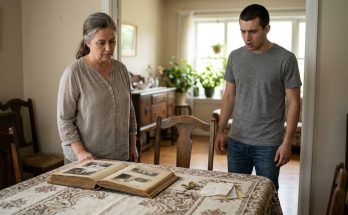
PART 14 — “What Did You Do?”
David left my house carrying the notebook like evidence from a crime scene.
Because that’s exactly what it was.
Not legal evidence.
Worse.
Emotional evidence.
Proof that while he trusted Clara completely,
his mother had been quietly falling apart.
I stood at the window watching his car disappear through the rain.
Then I whispered something I hadn’t admitted aloud yet:
“Please wake up.”
David found Clara in the kitchen reviewing seating charts for another charity event.
Soft jazz played through hidden speakers.
Wine rested beside her laptop.
Candles glowed warmly across marble countertops.
Beautiful life.
Beautiful lies.
“You’re home early,” Clara smiled without looking up.
David didn’t answer immediately.
Good.
The silence unsettled her first.
Tiny shift.
Tiny crack.
Finally she glanced up.
And froze.
Because she saw it instantly:
something inside him had changed.
“David?”
He set the notebook down on the counter carefully.
Clara’s smile faded slightly.
“What’s that?”
“My mother’s.”
Silence.
Not dramatic.
Dangerous.
David loosened his tie slowly.
Then asked the question differently this time.
Not gently.
“What did you do?”
Clara stared at him.
Perfect pause.
Perfect performance.
“I don’t understand.”
“You told me she was confused.”
“She is confused.”
David’s jaw tightened.
“You told me she was emotional.”
“She has been emotional.”
“You told me she refused help.”
“She DOES refuse help!”
There.
The mask slipped slightly.
Just enough.
David noticed.
Readers would FEEL this moment.
Because for the first time,
David wasn’t listening emotionally.
He was observing.
And manipulators become vulnerable once people start observing instead of trusting.
Clara folded her arms carefully.
“What exactly did Margaret tell you now?”
Not:
Is she okay?
Interesting.
David opened the notebook.
Then quietly read aloud:
“Sold wedding ring today.
Needed heater repair and medication.”
The room stopped moving.
Clara’s face changed instantly.
Tiny change.
Still catastrophic.
Because she knew.
David saw it.
“Her ring?” he whispered.
Clara recovered quickly.
“She’s exaggerating.”
Wrong answer.
David stared at her.
“My father’s ring?”
“She’s trying to make you emotional.”
Another wrong answer.
Because suddenly David heard something horrifying:
Clara wasn’t reacting with grief.
She was managing narrative.
The realization shook him visibly.
“She was getting food from church pantries.”
Clara exhaled sharply now.
“David, please.”
She stepped closer.
“You know how dramatic older people become when they feel lonely.”
Older people.
Not your mother.
David looked at her like he had never fully seen her before.
And honestly?
Maybe he hadn’t.
Love makes people blurry sometimes.
“She cut her medication in half.”
Clara rubbed her forehead.
“Oh my God.”
Then softly:
“She wrote all this down?”
Fear.
Real fear this time.
Not sadness.
Not concern.
Fear of documentation.
And David noticed THAT too.
Very important.
“She trusted you,” he said quietly.
Clara’s expression hardened for half a second before softening again.
“She’s manipulating you.”
There it was.
The final strategy.
Not:
The documents are wrong.
Not:
The transfers are fake.
Instead:
attack Margaret’s credibility completely.
David looked exhausted suddenly.
Emotionally exhausted.
Like his entire marriage had become unstable beneath his feet.
“The account exists, Clara.”
Silence.
“He showed you the statements?” she whispered.
Not denial.
Readers would go INSANE here.
Because Clara accidentally confirmed everything without realizing it.
David stepped backward slowly.
And in that moment—
the entire emotional structure collapsed inside him:
- his trust
- his certainty
- his marriage
- his version of reality
All cracking at once.
“You stole from my mother.”
Finally.
Finally he said it aloud.
Clara’s eyes filled instantly with tears.
Weaponized tears.
“I did everything for us!”
Her voice broke beautifully.
“The business was struggling—”
David physically recoiled.
Because now:
truth wasn’t abstract anymore.
Now it sounded selfish.
Human beings can survive lies longer than they can survive hearing the motive behind them.
“You let her sell Dad’s ring.”
Clara cried harder immediately.
“David please—”
“No.”
The word came out quietly.
Destroyed.
He looked toward the notebook again.
Then whispered the line readers had waited for through the entire story:
“What did I do to her?”
PART 15 — “She Still Defended You”
David didn’t sleep that night.
He sat alone in his office downstairs while rain struck the windows and Clara cried somewhere upstairs behind a locked bedroom door.
At least—
he assumed she was crying.
For the first time in years,
he wasn’t sure what was real anymore.
The notebook sat open on the desk beneath the lamp.
His mother’s handwriting stared back at him quietly.
No manipulation.
No performance.
Just dates.
Pain.
Silence.
David read the pages again around 2AM.
Then again at 3.
And each time,
different sentences destroyed him.
“David sounded relieved when I said I was fine.”
Another page:
“I think Clara is teaching my son the wrong version of kindness.”
And another:
“The hardest part is watching him trust her more gently than he listens to me.”
David pressed both hands over his face hard enough to hurt.
Because suddenly every memory had split into two versions:
- what he thought was happening
- what was actually happening
And the distance between those versions made him feel sick.
At 4:17AM,
he found himself opening the kitchen drawer searching for aspirin.
Instead,
he found receipts.
Small grocery receipts.
Not unusual by themselves.
But the dates—
the dates matched the missing transfers.
And every receipt carried Clara’s handwriting:
“Reimburse from Margaret acct.”
David went completely still.
One receipt fluttered from his hand onto the floor.
Another showed:
- luxury skincare
- designer shoes
- spa reservation
Paid from Margaret acct.
His stomach turned violently.
Not survival money.
Not emergency money.
Comfort.
His mother sold her wedding ring while Clara bought luxury moisturizer.
David gripped the counter so hard his knuckles whitened.
Then suddenly—
he remembered something.
Mother’s Day.
The church pantry bag beneath the kitchen counter.
Oh God.
He hadn’t imagined it.
He had seen it.
And he ignored it because Clara smiled first.
The realization hit him so hard he had to sit down.
That’s the worst kind of guilt:
the kind built from moments that now seem obvious.
At sunrise,
he drove to Margaret’s house.
Too fast.
No breakfast.
No sleep.
The roads still glistened wet beneath pale morning light when he pulled into the driveway.
His mother was watering lavender on the porch.
Of course she was.
Ordinary routines surviving extraordinary pain.
When she saw him,
her face softened immediately.
Still.
Even now.
“David?”
He stepped out of the car slowly.
And Margaret noticed it instantly:
- red eyes
- shaking hands
- guilt
The awakening had finally begun.
“Sweetheart…”
David walked toward her like a little boy approaching after breaking something precious.
Then stopped halfway up the porch steps.
For several seconds,
he couldn’t speak.
Because language becomes difficult once shame arrives honestly.
Finally he whispered:
“You sold Dad’s ring.”
Margaret looked down at her bare hand quietly.
Then nodded once.
David’s face collapsed.
Not dramatically.
Silently.
Like a building finally realizing its foundation cracked months ago.
“Why didn’t you call me?”
Margaret almost smiled sadly.
“You were busy protecting Clara.”
The sentence hit harder than yelling ever could have.
David lowered his eyes immediately.
Good.
Readers would ache for him now.
Because finally—
he understood the full horror:
his mother had not lost him suddenly.
She lost him slowly,
one dismissed concern at a time.
“I thought she was helping you.”
Margaret’s expression softened painfully.
“I know.”
No anger.
That made it worse.
David looked at her desperately.
“Why are you still being kind to me?”
The question hung between them in the cold morning air.
Margaret stepped closer slowly.
Then touched his cheek the same way she did when he was a frightened child.
“Because guilt already punishes good people enough.”
And that sentence—
that sentence completely broke him.
PART 16 — “The Dinner Invitation”
Three days later,
Margaret invited them both to dinner.
Clara almost refused immediately.
David noticed.
Tiny thing.
Still important.
“Why?” Clara asked carefully while standing in their kitchen adjusting an earring.
“You and your mother barely speak right now.”
David looked up slowly.
That sentence would have sounded normal to him two weeks ago.
Now it sounded strategic.
“She’s my mother.”
Clara forced a smile.
“Of course.”
A pause.
“I just don’t want another emotional scene.”
Emotional.
Always emotional.
Never truthful.
Never wounded.
David watched her differently now.
And Clara could feel it.
That was the problem with awakening:
once trust cracks,
people begin hearing old conversations with new ears.
“She sounded calm on the phone,” David said.
Margaret had sounded calm.
Too calm.
That frightened him more than anger would have.
Margaret spent the afternoon cooking slowly.
Not because she wanted peace.
Because she wanted clarity.
The dining table held:
- roasted chicken
- mashed potatoes
- green beans
- apple pie cooling near the window
Ordinary family dinner.
That was intentional.
Truth arrives hardest inside familiar spaces.
She moved carefully around the kitchen while the brown leather notebook rested beside a folder near the sink.
Inside the folder:
- bank transfers
- account copies
- reimbursement receipts
- printed timelines
Everything organized.
Quiet women often prepare most dangerously.
At 6:12PM,
David and Clara arrived.
Margaret noticed immediately:
they entered separately.
Interesting.
“Mother,” Clara smiled politely.
Too polite now.
Fear was hiding beneath elegance.
David hugged Margaret longer than usual.
And when he pulled away,
his eyes drifted unconsciously toward her left hand again.
Still bare.
Still hurting him.
Good.
They sat down together beneath soft kitchen light.
For several minutes,
conversation remained painfully normal:
- weather
- traffic
- charity events
- church renovations
The performance of family.
Then Margaret served pie.
And softly asked:
“David… what date did you say you started sending the five thousand?”
The room froze instantly.
Clara’s fork stopped moving.
David looked up carefully.
“March.”
Margaret nodded slowly.
Then turned toward Clara.
“And you said you started bringing cash after my birthday?”
Tiny pause.
“Correct,” Clara answered smoothly.
“April birthday,” Margaret said quietly.
“Yes.”
Margaret folded her napkin carefully onto the table.
Then looked directly at David.
“Your transfers started in March.”
A pause.
“Clara claims she switched to cash in April.”
Another pause.
“So where did March go?”
Silence detonated quietly across the room.
Readers would HOLD THEIR BREATH here.
Because finally:
the contradiction became public.
David turned slowly toward Clara.
And this time—
he did not rush to rescue her.
Good.
Very good.
Clara smiled too quickly.
“There may have been overlap.”
“Overlap?” Margaret asked softly.
“Yes.”
Clara laughed lightly.
“Honestly, financial details blur together sometimes.”
Margaret tilted her head slightly.
“Interesting.”
A pause.
“Because they seemed very clear when you explained my confusion to David.”
David flinched.
Good.
The sentence landed exactly where it needed to.
Clara’s eyes sharpened instantly.
“Margaret, I think this conversation is becoming inappropriate.”
There it was again:
control the emotional frame.
But tonight,
David noticed it too.
“How exactly did you open the supplemental account?” he asked quietly.
Clara turned toward him immediately.
“David—”
“No.”
His voice stayed calm.
“Answer me.”
The room changed.
Completely.
Because for the first time:
David sounded like someone searching for truth instead of comfort.
Clara inhaled slowly.
“I handled paperwork after Frank died.”
“You used her identity.”
“She authorized me!”
Margaret spoke quietly before David could.
“No, I trusted you.”
Silence.
Heavy.
Permanent.
David stared at Clara now like he was watching his own marriage disappear in real time.
And Clara finally understood something terrifying:
the emotional wall between mother and son was collapsing.
So she made one last desperate move.
Tears.
Instant.
Perfect.
Controlled.
“I did everything for this family!”
David closed his eyes briefly.
And instead of comforting her—
he whispered the sentence readers had waited for all story:
“Then why does my mother look like the one who paid for it?”
PART 17 — “The Receipt”
Clara stared at David in complete silence.
For the first time since Margaret met her,
the woman looked cornered.
Not defeated.
Dangerous.
Because manipulative people become most unpredictable once control begins slipping away.
“David,” Clara whispered carefully,
“you’re letting your mother turn this into something ugly.”
There it was again.
Not:
I’m innocent.
Instead:
The problem is emotional discomfort.
David noticed now.
Every shortcut.
Every deflection.
Every carefully redirected conversation.
And suddenly the last eight months rearranged themselves inside his mind like broken glass.
Margaret stayed quiet.
That mattered.
Because the silence forced Clara to keep speaking.
And the more Clara spoke—
the worse she sounded.
“I covered expenses for this family while you traveled constantly,” Clara continued.
“I handled everything alone.”
David looked exhausted.
“Using my mother’s account?”
Clara’s composure flickered.
“Temporarily.”
Margaret opened the folder slowly beside her plate.
Then slid one receipt across the table.
Spa reservation.
$1,280
Paid from Margaret acct.
David stared at it.
Then another receipt.
Designer shoes.
$940
Paid from Margaret acct.
Another.
Luxury skincare subscription.
Paid from Margaret acct.
The room went completely still.
Not survival.
Not emergency spending.
Comfort.
Vanity.
David looked physically ill now.
And readers would feel devastated because:
this was no longer abstract theft.
Now it had texture.
While Margaret:
- skipped medication
- used church pantries
- sold her wedding ring
Clara bought luxury products using her money.
David’s breathing changed.
He looked toward Clara slowly.
“You told me she was confused.”
Clara’s eyes filled instantly again.
Weaponized tears.
“She IS confused!”
Margaret finally spoke.
Quietly.
“No.”
A pause.
“You just never expected me to keep records.”
That sentence landed like a knife.
Because it was true.
Clara underestimated quiet women.
She assumed shame would keep Margaret silent forever.
David stared at the receipts again.
Then suddenly—
his eyes stopped on something specific.
Date.
He grabbed one receipt immediately.
“Wait.”
Margaret watched him carefully.
David looked up toward Clara.
“This spa charge…”
His voice weakened.
“…this was the same week Mom called about the heater.”
Clara said nothing.
David’s face drained completely.
Because now:
the timelines touched each other emotionally.
His mother slept in the cold while Clara relaxed in luxury.
And worst of all—
he defended Clara during that exact week.
“Oh my God.”
The sentence barely escaped him.
Clara stepped toward him quickly.
“David, listen to me—”
“No.”
He backed away instantly.
“Don’t.”
Readers would FEEL the shift here.
Because for the first time:
David no longer wanted comfort from her touch.
That matters emotionally.
Clara’s panic surfaced completely now.
“You think your mother’s innocent?”
She laughed shakily.
“She manipulated you perfectly!”
David stared at her in disbelief.
“She sold Dad’s ring.”
Wrong thing to say.
Wrong moment.
Because suddenly Clara realized:
the ring mattered more than the money emotionally.
David’s eyes filled instantly.
And when he spoke again,
his voice sounded shattered.
“You knew about the ring?”
Silence.
Tiny silence.
Deadly silence.
David closed his eyes briefly.
That was it.
Confirmation.
Margaret watched her son carefully now.
Because this—
this was the real heartbreak:
watching someone realize the person they trusted most was capable of watching suffering without stopping it.
David looked at Clara one final time.
Then quietly asked:
“When Mom needed help…”
A pause.
“…did you ever once feel guilty?”
The room held its breath.
And Clara made the mistake that finally destroyed everything.
She answered honestly.
“I didn’t think it was that serious.”
David physically recoiled.
Because suddenly he understood the full horror:
his mother’s suffering had become background noise to the woman he married.
And he had helped silence it.
PART 18 — “The Boy She Raised”
David left the dinner table without another word.
The front door slammed hard enough to shake the framed family photographs near the hallway.
Then silence.
Heavy silence.
Clara stood frozen beside the dining table while Margaret slowly folded her napkin into perfect quarters.
Ordinary movement.
Extraordinary collapse.
Finally Clara whispered:
“You planned this.”
Margaret looked up calmly.
“No.”
A pause.
“You planned this eight months ago.”
The sentence landed cleanly.
Precise truth always sounds colder than anger.
Clara’s mascara had started smudging beneath her eyes now.
Good.
For the first time,
her appearance reflected reality.
“You think you’ve won?” Clara snapped quietly.
“You just destroyed your son.”
Margaret’s expression changed instantly.
Pain.
Real pain.
Because that part mattered.
“David destroyed himself tonight,” she answered softly.
“He simply finally noticed.”
Clara laughed bitterly.
“You really think he’ll forgive you for humiliating his wife?”
Margaret almost smiled sadly.
“No.”
A pause.
“I think he’s trying to figure out whether he can forgive himself.”
And suddenly Clara looked frightened.
Not of Margaret.
Of what guilt might turn David into.
David drove for nearly two hours without realizing where he was going.
Rain blurred against the windshield while memories attacked him one after another:
- the church pantry bag
- the broken heater
- the empty refrigerator
- the missing ring
- Clara crying while Margaret stayed silent
Worst of all:
his own voice.
“Mom… Clara would never do that.”
His stomach twisted violently.
At a red light,
he suddenly slammed both hands against the steering wheel.
“What did I do?”
The question echoed through the car brokenly.
Because now he understood:
he hadn’t failed in one moment.
He failed repeatedly.
Gently.
Politely.
Lovingly.
That made it worse somehow.
Good people often imagine betrayal only comes through cruelty.
But neglect can wound just as deeply.
David pulled into an empty church parking lot around midnight and finally stopped driving.
Rain hammered the roof while he sat there breathing hard.
Then—
without thinking—
he opened his phone.
Old photographs filled the screen:
- Margaret teaching him to ride a bike
- Margaret sewing his graduation suit
- Margaret sitting beside Frank’s hospital bed exhausted but smiling for David anyway
And suddenly he remembered something so small it nearly destroyed him.
Third grade.
He came home crying because another boy stole his lunch money.
Margaret held him close and said:
“The worst thing isn’t losing money, sweetheart.”
“It’s discovering someone was comfortable letting you suffer.”
David started crying immediately.
Not graceful tears.
Deep,
shaking,
humiliating grief.
Because Clara knew.
The whole time.
And his mother knew too.
Which meant:
every phone call,
every dinner,
every conversation—
Margaret sat there watching her own son defend the person hurting her.
Oh God.
David covered his face with both hands.
For the first time in years,
he felt like a child again.
Lost.
Ashamed.
Wanting his mother.
At 1:43AM,
Margaret heard knocking at the front door.
Not polite knocking.
Desperate knocking.
She opened the door immediately.
David stood there soaked from rain.
Completely wrecked.
His eyes were swollen red.
His breathing uneven.
His shoulders shaking slightly.
And Margaret realized instantly:
the boy she raised had finally returned.
“David—”
He stepped forward suddenly and wrapped both arms around her so tightly she nearly lost balance.
Then he broke.
Completely.
“I’m sorry,” he choked out.
“Oh God, Mom… I’m so sorry.”
Margaret held him automatically.
Like mothers do.
No hesitation.
No punishment.
David buried his face against her shoulder like he used to after nightmares as a child.
“She lied to me.”
His voice cracked apart.
“And I helped her hurt you.”
Margaret closed her eyes briefly.
Because this—
this was the moment she had secretly feared most.
Not anger.
Guilt.
Good sons suffer terribly once they realize they failed the women who loved them first.
“David…”
“I didn’t SEE it.”
He shook violently now.
“You kept trying to tell me and I kept defending her.”
Margaret held the back of his head gently.
“You loved your wife.”
“I abandoned my mother.”
The sentence shattered in the middle.
And honestly?
Readers would cry here.
Because now:
David finally understood the emotional cost of blindness.
Margaret guided him slowly inside while rain poured behind them.
The heater hummed softly through the hallway.
Paid for by the ring he never noticed disappearing.
David saw it immediately now.
Every detail hurt differently.
He looked around the small house like someone seeing a crime scene hidden inside ordinary life.
Then his eyes landed on the framed photograph of Frank.
And quietly—
so quietly it almost disappeared—
David whispered:
“I failed both of you.”
PART 19 — “The Morning After”
The next morning felt strangely quiet.
Not peaceful.
After destruction, silence often feels exhausted instead.
David sat at Margaret’s kitchen table wearing one of Frank’s old sweaters because his clothes were still damp from the rain.
The sweater hung awkwardly on him now.
He looked older somehow.
Not physically.
Emotionally.
Margaret stood at the stove making coffee while pale morning sunlight stretched across the floorboards.
Neither of them spoke for a long time.
Words become careful after emotional collapse.
Finally David whispered:
“I left Clara.”
Margaret’s hands paused slightly against the coffee pot.
Not shock.
Sadness.
Because despite everything,
divorce still sounds like grief to mothers.
“Did she try to stop you?”
David laughed once.
Broken sound.
“She tried to explain it.”
A pause.
“She kept calling it temporary.”
Another.
“She said she was protecting our lifestyle.”
Lifestyle.
Interesting word.
People often rename selfishness once enough money surrounds it.
Margaret carried two coffee mugs to the table slowly.
David noticed immediately:
one mug had been chipped for years.
He remembered breaking it accidentally at sixteen.
Margaret kept using it anyway.
Suddenly that hurt too.
Everything hurt now.
“She said I made her feel unsafe last night,” he murmured.
Margaret sat quietly across from him.
“And how did that make you feel?”
David stared into the coffee.
“Confused.”
A weak breath escaped him.
“She stole from you… and somehow I still felt guilty for upsetting her.”
Margaret nodded softly.
“That’s what emotional manipulation does.”
A pause.
“It teaches good people to feel cruel for noticing cruelty.”
David looked up sharply.
Because suddenly:
his confusion had a name.
That mattered.
For months he believed:
- he was protecting peace
- he was being reasonable
- he was preventing family conflict
Now he understood:
he had been trained to distrust pain if acknowledging it threatened Clara emotionally.
And that realization devastated him.
“I keep replaying every conversation,” he whispered.
“The pantry bag.”
Another breath.
“The heater.”
Another.
“The ring.”
His voice broke completely on the last word.
Margaret reached across the table gently covering his hand with hers.
“It’s over now.”
David shook his head immediately.
“No.”
His eyes filled again.
“You lived through all of that alone.”
Not alone, Margaret almost said.
Women survive quietly beside invisible company:
memory,
routine,
pride,
God.
But she understood what he really meant.
He should have been there.
The guilt was eating him alive.
Good.
Not because suffering was deserved.
Because guilt was proof his humanity survived.
David swallowed hard.
“How did you keep loving me?”
Margaret almost smiled sadly.
“Oh sweetheart.”
A pause.
“You were never the person trying to hurt me.”
The sentence landed harder than blame ever could have.
Because now:
David realized his mother separated blindness from cruelty.
And somehow that mercy hurt even more.
He lowered his eyes toward the notebook resting nearby on the table.
“I don’t know who I was these last few months.”
Margaret looked at him carefully.
“You were a husband who trusted his wife.”
A pause.
“That’s not shameful.”
Then softly:
“Refusing to see the truth after discovering it would’ve been shameful.”
David closed his eyes briefly.
Because she was giving him a path back to himself.
That was another thing good mothers do:
they leave emotional doors unlocked even after being hurt.
Then suddenly,
David frowned slightly.
“What happens now?”
Margaret looked toward the folder of documents near the window.
“Now?”
A pause.
“Clara returns what she stole.”
“And if she doesn’t?”
Margaret’s voice stayed calm.
“Then the law becomes part of the conversation.”
David inhaled slowly.
Law.
Police.
Court.
Public exposure.
Reality was becoming real now.
And for the first time,
he looked frightened of what came next.
Not for himself.
For the life collapsing behind him.
Margaret saw it immediately.
“David.”
He looked up.
“You are allowed to grieve the marriage you thought you had.”
That sentence nearly broke him all over again.
Because yes—
Clara betrayed Margaret.
But Clara also destroyed David’s understanding of his own home,
his own love,
his own judgment.
Manipulation creates multiple victims.
And now everyone was bleeding differently.
PART 20 — “Clara Comes Back”
Clara returned three days later.
Not for David.
For control.
Margaret knew it immediately the moment the black Lexus rolled into the driveway just after noon.
Women like Clara never return emotionally first.
They return strategically.
Margaret was trimming dead lavender stems beside the porch when Clara stepped out of the car wearing dark sunglasses and a cream wool coat.
Beautiful.
Composed.
Dangerous again.
Interesting.
Fear had apparently reorganized itself back into elegance.
“Margaret,” Clara said calmly.
Not Mother anymore.
Good.
Masks were falling permanently now.
Margaret kept trimming lavender quietly.
“What do you want?”
Clara removed the sunglasses slowly.
Her eyes looked tired beneath perfect makeup.
“I need to speak with David.”
“He isn’t here.”
A tiny flicker crossed Clara’s face.
Disappointment.
Not grief.
Not love.
Loss of access.
Margaret noticed everything now.
“I tried calling him,” Clara continued carefully.
“He won’t answer.”
Margaret set the gardening scissors down beside the flower pot.
“That seems wise.”
Clara inhaled slowly.
Then came the performance.
Not crying this time.
Fragility.
“Margaret… this situation has become completely out of control.”
Interesting phrasing.
Not:
I hurt people.
Instead:
consequences became inconvenient.
Margaret looked toward the driveway calmly.
“You stole forty thousand dollars.”
“It wasn’t like that.”
“How was it?”
Clara hesitated.
Tiny hesitation.
Then:
“I intended to pay it back.”
There it was.
The sentence manipulators love most.
Temporary harm.
Future correction.
Delayed morality.
As though planned repayment erases present suffering.
Margaret studied her quietly.
“My wedding ring?”
That landed.
Clara looked away immediately.
Good.
Even now,
that detail still poisoned the entire situation emotionally.
“I didn’t know about the ring,” Clara said softly.
“No.”
Margaret nodded once.
“You just knew I was struggling.”
Silence.
The wind moved gently through the lavender between them.
Finally Clara whispered:
“You think David will ever forgive me?”
Interesting.
Not:
Can you forgive me?
David still remained the emotional center of Clara’s fear.
Margaret answered honestly.
“I don’t know.”
And for the first time since arriving,
Clara looked genuinely shaken.
Because manipulators survive through predictability.
But guilt changes people unpredictably.
Especially good men.
“He won’t even speak to me,” Clara whispered.
Margaret watched her carefully.
Then quietly asked the question that mattered most:
“Do you miss David?”
A pause.
“Or do you miss the life around him?”
Clara’s face hardened instantly.
There.
Truth touched something real.
“You think I never loved him?”
Margaret stayed silent.
Because honestly?
She no longer knew.
And that uncertainty felt tragic in its own way.
Clara laughed bitterly.
“You know what the worst part is?”
Her voice cracked slightly.
“Everyone suddenly acts like I’m some monster.”
Margaret stared at her.
“Aren’t you?”
The question hung coldly between them.
Clara’s eyes filled immediately.
Real tears this time.
Interesting.
Maybe even selfish people bleed once consequences arrive fully.
“I was drowning,” she whispered.
“The business debt… the pressure… David constantly traveling…”
Another breath.
“I just needed time.”
Margaret listened quietly.
Then asked softly:
“So why didn’t you ask us for help?”
Clara opened her mouth.
Stopped.
Because there was no answer that didn’t expose pride.
Or entitlement.
Or greed.
Exactly.
Margaret nodded slowly.
“That’s what I thought.”
Clara looked smaller suddenly.
Still elegant.
Still polished.
But smaller.
Because once manipulation fails,
people must finally stand beside their choices without emotional camouflage.
And many look shockingly fragile there.
Then headlights appeared down the road.
David’s truck.
Clara froze instantly.
Fear.
Real fear now.
David stepped out slowly when he saw Clara standing beside the porch.
The air changed immediately.
Not hatred.
Worse.
Disappointment.
Deep disappointment from someone who once loved you completely.
Readers would ache here.
Because Clara finally understood:
David no longer looked at her with emotional safety.
He looked at her with caution.
“David,” she whispered.
He stopped several feet away.
No hug.
No warmth.
Nothing.
Just distance.
Clara’s voice broke.
“Please talk to me.”
David looked exhausted.
“I listened to you for eight months.”
The sentence hit like a door locking shut.
Clara physically flinched.
Good.
Then David noticed the gardening scissors beside Margaret.
And beside them—
the lavender.
Freshly trimmed.
Carefully maintained.
His mother still nurturing living things after everything.
Meanwhile Clara consumed people while calling it survival.
That contrast hurt him visibly.
“Did you ever once think about her?” he asked quietly.
“The actual human being?”
Clara cried harder immediately.
“I thought I could fix it before anyone knew.”
David shook his head slowly.
“That’s the problem.”
A pause.
“You knew.”
PART 21 — “The Lawyer”
The lawyer’s office smelled like leather, coffee, and expensive silence.
David sat beside Margaret at the long conference table while Attorney Bennett reviewed the documents one page at a time beneath bright office lights.
Across from them,
Clara looked perfectly dressed and completely exhausted.
Interesting combination.
People often polish themselves harder when their inner life starts collapsing.
Attorney Bennett adjusted his glasses slowly.
“So let me understand this clearly.”
He looked toward Clara.
“You opened a supplemental account using Mrs. Hayes’ identity and redirected monthly transfers into your consulting business.”
Clara folded her hands tightly together.
“It was temporary.”
Bennett didn’t react.
Good lawyers don’t emotionally respond to excuses.
They translate them into liability.
“And Mrs. Hayes did not authorize these transactions?”
Clara hesitated.
Too long.
David noticed immediately now.
Every hesitation.
Every dodge.
Every emotional calculation.
“No,” Clara admitted quietly.
There it was.
Official now.
Not confusion.
Not stress.
Not family disagreement.
Fraud.
David looked physically ill hearing the word become real inside a legal room.
Bennett continued reviewing the receipts carefully.
Then stopped on one page.
His expression changed slightly.
“Spa charges?”
Clara’s face tightened.
David shut his eyes immediately.
Because somehow,
those receipts still hurt more than the account itself.
Luxury purchased beside hidden suffering.
That contrast poisoned everything emotionally.
Margaret sat quietly with both hands folded in her lap.
Calm.
That frightened Clara more than anger ever could have.
“You understand,” Bennett continued,
“that these transactions create both civil and criminal exposure.”
Criminal.
The word settled heavily across the room.
For the first time,
Clara looked genuinely afraid.
Not socially embarrassed.
Afraid.
David noticed that too.
And readers would FEEL the tragedy here:
the woman he once trusted most now looked like someone he didn’t fully know.
“I’ll repay everything,” Clara whispered quickly.
Bennett nodded professionally.
“That would certainly help.”
A pause.
“But repayment does not erase fraudulent conduct.”
David finally spoke.
Quietly.
“When were you planning to stop?”
The question cut deeper than legal language.
Because it wasn’t about money anymore.
It was about intention.
Clara looked toward him desperately.
“I didn’t mean for it to become this big.”
David stared at her.
Eight months.
Forty thousand dollars.
A wedding ring sold.
Big didn’t happen suddenly.
It accumulated.
One selfish decision at a time.
Margaret watched her son carefully now.
Because underneath the anger,
she could still see grief tearing through him.
Good men mourn betrayal differently.
Part of them keeps searching for the person they thought existed.
Bennett closed the folder gently.
“My recommendation,” he said calmly,
“is immediate repayment, formal written admission, and negotiated settlement before litigation proceeds.”
Litigation.
Settlement.
The marriage now sounded like paperwork.
That hurt David visibly.
Clara turned toward him suddenly.
“David, please.”
Tears filled her eyes again.
“You know me.”
And there it was.
The final emotional plea.
Not:
I’m innocent.
Instead:
remember the version of me you loved.
David looked at her for a very long time.
Then quietly answered:
“That’s the problem.”
A pause.
“I don’t know if I ever did.”
The sentence shattered the room.
Because honestly?
That was the real tragedy of the entire story.
Not stolen money.
Not legal consequences.
The terrifying realization that you can share your life with someone for years…
…and still not fully know what they’re capable of becoming.
PART 22 — “The Church Basement”
The story spread quietly before it spread publicly.
That’s how small towns work.
Not through newspapers.
Through pauses in conversations.
Through lowered voices in grocery stores.
Through church women pretending not to gossip while already knowing everything.
Margaret felt it the moment she entered St. Mary’s the following Sunday.
People looked at her differently.
Not pity exactly.
Recognition.
Reverend Cole approached gently after service while volunteers folded chairs in the basement.
“You holding up alright?”
Margaret smiled softly.
“As well as anyone can.”
He nodded slowly.
Then:
“David came by yesterday.”
That surprised her.
“He did?”
Reverend Cole leaned against the folding table quietly.
“He asked how long you’d been using the pantry.”
Margaret’s chest tightened immediately.
“Oh.”
The Reverend hesitated.
“I told him the truth.”
Of course he did.
And suddenly Margaret understood:
David was reconstructing reality now piece by piece.
Every hidden humiliation.
Every overlooked detail.
Good.
Painful.
Necessary.
Good.
“He cried,” Reverend Cole admitted softly.
That hurt more than she expected.
Because mothers never fully stop wanting to protect their children from suffering—
even when the suffering is deserved.
“What exactly did you tell him?” she asked quietly.
Reverend Cole looked saddened.
“I told him you always volunteered extra hours before taking food home.”
A pause.
“And that you asked us not to mention it because you didn’t want him worrying.”
Margaret closed her eyes briefly.
Oh David.
The guilt must be unbearable now.
Reverend Cole studied her carefully.
“You still defending him?”
She almost smiled.
“He’s still my son.”
The Reverend nodded slowly like he expected that answer.
Then his expression shifted slightly.
“There’s something else.”
A pause.
“Mrs. Patterson told him about the ring.”
Margaret physically went still.
Of course she did.
David asked.
People tell truths once someone finally looks ready to hear them.
“What did she say?”
“That you sold it the week the heater broke.”
Another pause.
“She said you cried in the pawn shop parking lot afterward.”
Margaret looked away immediately.
Interesting.
She hadn’t realized anyone saw her there.
The Reverend lowered his voice.
“He looked sick hearing it.”
Good sons should.
Not from punishment.
From love arriving too late.
That evening,
David sat alone in Margaret’s living room while she prepared tea in the kitchen.
He had started coming by almost every day now.
Not forcing conversation.
Not trying to repair things too quickly.
Just…
showing up.
That mattered.
The old David would have filled silence with solutions.
This David sat quietly inside consequences.
Growth often looks quieter than people expect.
Margaret carried tea into the room slowly.
David noticed immediately:
the church pantry bread on the counter.
Again.
Except this time—
he didn’t look away.
His eyes stayed on it painfully.
“I talked to Reverend Cole.”
Margaret nodded once.
“I figured.”
David stared down at his hands.
“He said you volunteered before taking food.”
His voice weakened.
“So nobody would feel sorry for you.”
Margaret sat beside him gently.
“Pride survives strange things.”
David swallowed hard.
“And Mrs. Patterson told me about the pawn shop.”
There it was.
The full wound finally opened.
Margaret looked down at her bare hand quietly.
David’s breathing became uneven again.
“I bought Clara a bracelet that same week.”
Oh God.
That was the kind of detail that destroys people emotionally.
Because guilt sharpens through contrast.
While his mother sold her marriage to survive—
he rewarded the thief with jewelry.
“I didn’t know,” he whispered.
Margaret reached over and covered his hand softly.
“I know.”
“No.”
His eyes filled again.
“You don’t understand.”
A pause.
“I thought I was being a good husband.”
And there it was.
The true emotional center of the story.
David’s blindness didn’t come from cruelty.
It came from a sincere desire to love correctly.
That’s why readers hurt for him now instead of hating him.
Margaret squeezed his hand gently.
“You loved someone who lied to you.”
A pause.
“That shame belongs to her first.”
David lowered his head.
Then quietly confessed the thing haunting him most:
“The worst part is…”
His voice cracked.
“…every time you tried telling me the truth, I thought Clara was the one who needed protection.”
Silence settled heavily around them.
The heater hummed softly nearby.
David stared at it for a long moment.
Then whispered:
“That sound is going to haunt me for the rest of my life.”
PART 23 — “The Hearing”
The courtroom felt colder than churches do.
Not physically.
Emotionally.
Everything inside it sounded controlled:
- polished shoes against tile
- quiet paper shuffling
- restrained voices
- consequences arriving professionally
Margaret sat beside Attorney Bennett wearing her navy church dress and the pearl earrings Frank once bought her at a county fair thirty years ago.
Simple earrings.
Real love rarely looks expensive.
Across the aisle,
Clara sat beside her own attorney looking immaculate in gray silk.
Interesting.
Some people dress for court like they’re still trying to win admiration instead of forgiveness.
David sat alone behind them both.
That mattered.
No longer beside Clara.
Not fully beside Margaret either.
Just:
alone inside what he finally understood.
The clerk called the case softly.
Legal language filled the room.
Fraudulent transfers.
Unauthorized account access.
Financial exploitation.
Ugly truths sound even uglier once institutions formalize them.
Clara kept her posture perfect through all of it.
But David noticed something Margaret missed:
her hands trembled whenever the transfer records appeared on screen.
Fear.
Real fear finally entering the body.
Attorney Bennett stood calmly.
“Your Honor, this is not merely a financial disagreement between family members.”
He gestured toward the evidence binder.
“This is a sustained pattern of deception against an elderly widow who trusted the defendant completely.”
Elderly widow.
David physically flinched hearing his mother reduced to vulnerability in public language.
Because suddenly he understood:
the world saw Margaret as someone needing protection.
And he had failed at that protection himself.
Clara’s attorney immediately responded.
“Mrs. Hayes was never denied support.”
A pause.
“My client intended repayment and believed the funds were being used within family discretion.”
Family discretion.
Margaret almost smiled sadly.
Interesting how theft becomes softer once wealthy people rename it carefully.
Then came the moment David dreaded most.
The notebook.
Attorney Bennett approached carefully holding the brown leather journal.
“Mrs. Hayes documented the financial and emotional impact of these events contemporaneously.”
Contemporaneously.
Such a cold word for heartbreak written in kitchens at midnight.
Bennett opened to one page.
Then read aloud:
“Cut blood pressure pills in half today.
Refill must wait until next Thursday.”
The courtroom went silent.
Not dramatic silence.
Human silence.
The kind people make once suffering suddenly becomes real.
David lowered his head immediately.
Good.
Readers would ache for him here because:
this was no longer private guilt.
Now strangers knew he failed to notice too.
Bennett turned another page.
“Sold wedding ring today.”
Clara shut her eyes briefly.
First visible crack.
The judge looked up sharply.
“Mrs. Hayes sold personal property for basic living expenses?”
Margaret answered quietly.
“Yes, Your Honor.”
The judge’s expression hardened instantly.
Good.
Even institutions respond once suffering becomes specific.
Not forty thousand dollars.
A wedding ring.
That detail humanized everything.
Clara’s attorney shifted uncomfortably.
David stared at the notebook like it might physically destroy him.
And honestly?
Maybe it already had.
Then Bennett presented the receipts:
- spa charges
- designer shoes
- luxury skincare
All connected to Margaret’s redirected funds.
The contrast poisoned the room emotionally.
Because everyone understood now:
this wasn’t desperation alone.
It was comfort purchased beside hidden suffering.
Finally,
the judge looked directly at Clara.
“Mrs. Hayes…”
A pause.
“Did you understand your mother-in-law was struggling financially during this period?”
The room held its breath.
Clara hesitated.
Tiny hesitation.
Fatal hesitation.
“Yes.”
David closed his eyes immediately.
Because that was it.
Not accounting confusion.
Not temporary borrowing.
Awareness.
Knowing.
The judge’s voice became colder.
“And you continued redirecting funds anyway?”
Clara’s composure finally cracked.
“I thought I could fix it before it became serious.”
There it was again.
The same sentence selfish people always use:
I thought there was still time before consequences mattered.
But suffering already mattered.
That’s the thing people like Clara never understand early enough.
The hearing continued another hour.
Legal arguments.
Settlement negotiations.
Restitution terms.
But emotionally?
The case ended the moment Clara admitted she knew Margaret was struggling.
Because after that—
every transfer looked cruel instead of careless.
When court adjourned,
people slowly began standing.
Papers folded.
Chairs moved.
Quiet conversations resumed.
David remained seated.
Still staring downward.
Margaret touched his shoulder gently.
“Sweetheart.”
He looked up slowly.
And readers would feel it instantly:
he looked like a man carrying grief instead of anger now.
That’s heavier.
“I used to think evil looked obvious,” he whispered.
A broken breath escaped him.
“But it looked like my own kitchen.”
PART 24 — “The House Felt Different”
After the hearing,
David stopped sleeping at the house.
Not immediately.
At first he told himself it was temporary.
Just until legal matters settled.
Just until emotions cooled down.
But deep down,
he already knew the truth:
the house no longer felt safe emotionally.
Every room carried echoes now.
The kitchen island where Clara cried while manipulating him.
The dining room where Margaret sat silently being doubted.
The hallway where he kissed his wife goodnight after defending her lies.
Memory changes architecture once truth arrives.
That was the terrifying part.
One evening,
David stood alone in the master bedroom while Clara packed clothes into expensive suitcases quietly across the room.
No screaming.
No dramatic fight.
Just distance.
Honestly?
That felt sadder.
“You don’t have to leave,” Clara said finally without looking at him.
David almost laughed at the sentence.
Because emotionally,
she had already left months ago.
Maybe years ago.
“I think you know I do.”
Clara zipped the suitcase sharply.
“So that’s it?”
She looked up finally.
“Twenty years together and suddenly I’m a monster?”
David stared at her silently.
Monster.
Interesting word.
Because the hardest part still wasn’t believing Clara was evil.
It was accepting she became comfortable ignoring suffering.
And maybe that distinction mattered.
“I don’t think you started as a monster,” he answered quietly.
That landed harder than anger would have.
Clara’s eyes filled instantly.
“Then why are you looking at me like that?”
David looked away toward the bedroom window.
Rain moved softly down the glass again.
Always rain during endings.
“Because I don’t recognize the person who watched my mother struggle and kept taking money anyway.”
The room went still.
Clara’s voice cracked slightly.
“You think this is easy for me?”
David closed his eyes briefly.
There it was again.
Her pain still stood at the center of every conversation.
Even now.
“I think everything became easier for you once you stopped seeing other people clearly.”
The sentence hurt her.
Good.
Not revenge.
Truth.
Clara sat slowly on the edge of the bed.
Smaller somehow.
Without performance,
without parties,
without polished smiles—
she suddenly looked like a frightened woman who made terrible decisions and kept making them too long.
And honestly?
That was sad too.
Manipulators are often emotionally starving people who learned control feels safer than vulnerability.
But understanding damage doesn’t erase damage.
“I loved you,” Clara whispered.
David’s face tightened painfully.
“I think you loved what life felt like beside me.”
Silence.
Because both of them feared he might be right.
After a long time,
Clara quietly asked:
“Did you ever love me?”
That question nearly destroyed him.
Because yes.
Completely.
That was the tragedy.
David sat down slowly across from her.
“I loved you enough to stop seeing things clearly.”
Clara cried then.
Real crying.
Not strategic.
Interesting.
Maybe consequences finally stripped performance away.
Or maybe losing emotional safety hurts everyone eventually.
David watched her for a long moment.
Then softly said the sentence readers would remember:
“My mother was starving quietly while I was thanking you for feeding her.”
Clara lowered her head completely after that.
No defense left now.
Only consequences.
Later that night,
after Clara drove away with the last suitcase,
David walked slowly through the empty house alone.
The silence sounded enormous.
No music.
No television.
No perfume drifting through rooms.
Just absence.
He entered the kitchen automatically.
Then froze.
The fruit bowl sat perfectly arranged in the center island exactly the way Clara always kept it.
Beautiful.
Untouched.
Decorative.
And suddenly David realized something devastating:
the house had always looked full.
Even while love inside it slowly emptied.