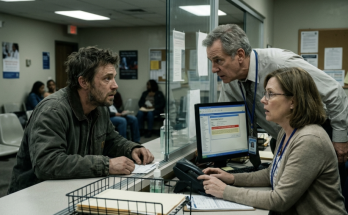
Detective Morris took a deep breath before answering.
“It was your husband.”arrow_forward_iosRead more
Pause
00:00
00:10
01:31
Mute
I didn’t understand the words at first. I heard them, yes, but they didn’t sink in immediately. They bounced around somewhere in my head—absurd, impossible, monstrous. My first instinct was to deny it with my entire body.
“No,” I said, and my voice sounded dry, broken. “No. You’re wrong.”
The detective didn’t look away.
“Hailey identified him clearly. She also described situations, dates, and details about the inside of the house that match what we had already begun to review. We have probable cause to arrest him.”
I felt the hallway tilt. Amanda caught me before my legs failed me. I remember the smell of stale coffee in the station, the hum of a fluorescent light, and the brutal certainty that my life had just split in two: the woman who didn’t know yet, and the one who had just heard that.
“I want to see her,” I whispered.
Lauren, the social worker, appeared at my side.
“She’ll be out in a moment. But I need you to promise that when you see her, you won’t ask for explanations or ask why she didn’t speak up sooner. The most important thing right now is for her to understand that you believe her.”
I nodded, though I wasn’t sure I could do anything right ever again in my life.
A few minutes later, Hailey walked out of the interview room. She was hunched over inside a gray hoodie that was far too big for her. Her face was swollen from crying, but when she saw me, she looked up with a mixture of fear and shame that pierced me like a knife.
I ran toward her.
She stood still for a second, as if she didn’t yet know if the world allowed for such a gesture.
Then I hugged her.
I hugged her carefully, my hands trembling, my heart shattered, saying the only truth that mattered over and over again.
“I believe you. I believe you. I believe you.”
My daughter collapsed in my arms.
“I thought you were going to hate me,” she sobbed. “I thought you were going to say it was my fault.”
I pulled back just enough to hold her face in my hands.
“Never. Do you hear me? Never. You did nothing wrong. Nothing.”
She closed her eyes and kept crying, but for the first time since I had seen her fall ill, her weeping wasn’t just out of terror. It was also out of exhaustion. The exhaustion of someone who had been holding an impossible secret for far too long.
They didn’t let us go back home.
While a patrol car and two detectives went for Mark, Lauren organized everything to move us to a safe house. Amanda drove in silence. I sat in the back with Hailey, holding her hand. She didn’t speak, and I didn’t force her to. We had spent weeks in that house demanding normalcy from her, when all she was doing was surviving.
We arrived at a discreet, clean shelter with beige walls and small windows. They gave us a simple room and comfortable clothes. Hailey sat on the bed as if she didn’t know what to do with so much stillness. I stood in front of her, not yet daring to sit too close.
“Since when?” I finally asked, my voice very low.
I saw the effort it took for her to breathe.
“For almost a year,” she whispered. “It started when you worked late on Wednesdays. He said he just wanted to talk to me. Then he said if I screamed, no one would believe me. And then… after that, I didn’t have the strength to fight anymore.”
I put a hand to my mouth to keep from screaming.
She continued staring at the wall.
“When I started feeling sick, I thought I was going to die. And then I thought maybe that was better.”
“Don’t say that.”
“It’s true,” she murmured. “In that house, I felt like I was already gone.”
I sat down beside her.
I didn’t know what answer could repair a sentence like that. So I did the only thing I should have done much earlier: I listened to her without correcting her, without rushing her, without trying to make the pain more comfortable than it was.
We didn’t sleep that night. Every time I closed my eyes, I saw Mark in small, domestic, unbearably normal scenes: pouring coffee, laughing at the TV, telling me Hailey was exaggerating, that I shouldn’t waste money, that it was a phase, that it was all just teenage drama. And now every memory had a different edge. Every sentence of his seemed like a maneuver. Every gesture, a smokescreen.
At three in the morning, my phone rang. It was Detective Morris.
“We arrested him an hour ago. He denied everything, then asked for a lawyer. We need to make sure he has no further contact with you or the minor.”
I looked at Hailey, finally asleep, exhausted, her arm over her forehead like when she was a little girl.
“He won’t,” I said.
The next morning, the hardest part began: the decisions.
The doctors spoke with a delicacy I will never forget. There were options. There were timelines. We had to prioritize Hailey’s physical and emotional health. No one pressured her. No one spoke for her. And that, in the midst of so much devastation, was a form of dignity.
I sat by her side at every consultation.
Once, while we were waiting for results, she asked me without looking at me:
“Are you going to make me have it?”
I felt myself break again.
“No,” I replied immediately. “I’m not going to make you do anything. What happens with your body will be decided with you, not for you.”
She cried silently.
“He said I didn’t belong to myself anymore.”
I took her hand.
“He lied.”