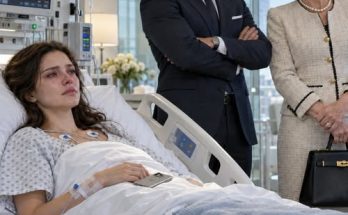
Part 2
Officer Hayes visited before her shift ended. She told me she would be speaking at the Harbor District gala on Friday night about public safety and emergency response.
Then she said something I never forgot.
“Sometimes people need to hear what abandonment sounds like when it has a timestamp.”
She asked if she could read the text exchange publicly.
Three days earlier, I would have protected my father. I would have made excuses. He misunderstood. He was busy. He loved me in his way.
But “in his way” had cost me too much.
So I said yes.
Doctors warned me not to attend the gala. Leah called it medically reckless but strategically historic.
I went anyway.
I wore a black dress, a long coat, and flat shoes. Leah drove me to the Four Seasons. Inside, two hundred people gathered around glowing images of the Harbor District project.
My project.
My father sat at the front with Charlotte on one side and Preston on the other.
Charlotte saw me first. Her smile collapsed. Then Preston looked. Then my father.
He came toward me with his public smile.
“Caroline. What are you doing here?”
“Attending the gala,” I said.
“You should be resting.”
“Should I?”
Charlotte tried to sound concerned for the donors nearby. I told her I had been in a major car accident. Several people turned.
Before my father could control the conversation, the lights dimmed.
The speeches began. Sustainability. Transformation. Partnership. Future.
Then Officer Hayes stepped onto the stage.
She spoke first about commercial vehicle safety and emergency response. Then she described the I-5 collision without naming me. She said there was another hour people rarely discussed: the hour after a patient wakes and asks for family.
My father’s posture changed.
Officer Hayes opened her folder.
She read my message.
Dad, I was in an accident. I’m at Harborview ER. Please come.
The ballroom went silent.
Then she read his reply.
I’m at lunch with Charlotte. Can’t just leave. Call an Uber.
No one moved.
She explained the injuries I had at the time: punctured lung, fractured ribs, suspected internal bleeding, head trauma. She also noted that follow-up calls from emergency staff had been declined, while work emails demanding password access arrived within hours.
My father stood and called it inappropriate.
Officer Hayes looked at him calmly.
“What is inappropriate, Mr. Irwin, is treating emergency care like a scheduling conflict and then treating the injured person like an asset to be accessed.”
Then Leah stepped forward.
She announced that she represented me in matters involving authorship, project attribution, employment misclassification, and protected technical access related to Harbor District.
She had preservation notices ready.
She had documentation ready.
She had everything.
My father turned to me and asked, “What have you done?”
It was the question guilty men ask when they are shocked someone kept records.
I looked at him and said,
“I stopped covering for you.”
The Harbor District deal did not close that weekend. The client demanded authorship verification. Investors demanded audit trails.
The files showed my name again and again.
Original models. Compliance notes. Environmental frameworks. Design revisions. Technical calculations. Crisis memos. Secure folder architecture.
Every invisible hour had left evidence.
My father claimed exaggeration.
The files disagreed.
Preston claimed he supervised me.
His emails disagreed.
Charlotte claimed the family had been under stress.
The text message disagreed.
Within two months, Irwin Holdings lost control of the Harbor District project unless I stayed attached as independent technical authority.
I refused under the original terms.
The board reviewed the company’s finances. Lenders looked closer too. Without Harbor District, my father’s empire began to show what it really was: debt, delayed payments, and a business built on labor he had never credited.
He resigned before the board could remove him.
They called it a transition.
I called it consequence.