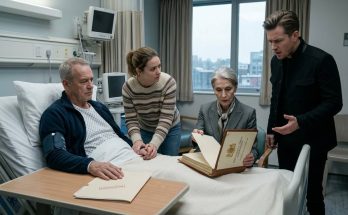
The memory returned in fragments: fever, seizure, hospital lights, Daniel’s lie, Dr. Marsh’s face, the tiny weight of Noah’s hand in hers.
Some days she did not shower. Some days she cleaned until her hands split. Some days she sat on the floor of Noah’s empty room at the old house while her father packed boxes because she could not decide whether to keep a crayon drawing of a rocket ship.
The civil case forced the facts into order.
Security footage showed Claire entering first with Noah in her arms. Daniel came in eighteen seconds later carrying Lily.
The triage audio from the desk recording captured Claire yelling, “My son is seizing,” and Daniel answering, “She did,” when asked which child arrived first.
Lily’s records showed mild respiratory distress, stabilized within minutes.
Noah’s records showed prolonged seizure activity, delayed intervention, oxygen deprivation, and catastrophic neurological injury.
Daniel’s deposition happened in a conference room with gray carpet and terrible coffee.
Claire sat at the far end of the table. Her lawyer had told her she did not have to attend, but Claire needed to hear him say it under oath.
Daniel looked smaller in the chair.
Marissa asked, “Mr. Whitmore, did you know your son was actively convulsing when you approached the emergency intake desk?”
Daniel swallowed. “Yes.”
“Did you tell the nurse that Lily Reed arrived before Noah Whitmore?”
“Yes.”
“Was that true?”
“No.”
“Why did you say it?”
Daniel stared at his hands.
“Because I wanted Lily seen first.”
The room went utterly still.
Marissa continued. “Why?”
Daniel’s attorney shifted beside him. “Objection to form.”
“You can answer,” Marissa said.
Daniel closed his eyes.
“Because Vanessa called me and said if anything happened to Lily, she would never forgive me. I thought Noah would be okay. He had febrile seizures before when he was younger. I thought we had time.”
Claire felt Audrey’s hand tighten around her wrist under the table.
Marissa’s voice sharpened. “Had Noah ever seized for that length of time before?”
“No.”
“Had he ever turned blue before?”
Daniel’s face twisted. “No.”
“Did your wife tell you he needed immediate help?”
“Yes.”
“Did you ignore her?”
A tear slipped down Daniel’s cheek.
“Yes.”
That word became the center of the case.
Yes.
It appeared in articles, though Claire refused every interview. It appeared in legal summaries. It appeared during settlement talks Daniel’s attorney tried hard to keep private.
The hospital first denied liability, arguing emergency departments depend on available information during chaotic intake. But the footage, audio, and staff testimony made that defense difficult. One triage nurse admitted she should have visually assessed Noah at once instead of relying on Daniel’s statement and paperwork.
The case never reached trial.
The hospital settled with Claire and agreed to revise emergency intake procedures involving multiple pediatric patients arriving with the same party. Daniel separately accepted a financial judgment that cost him the house, savings, and most of his retirement accounts.
Claire did not celebrate.
Money did not hold a child.
Money did not say, “Mommy, watch this.”
Money did not leave sticky fingerprints on the refrigerator.
But the legal record mattered.
It said Noah had arrived first.
It said Daniel had lied.
It said the delay mattered.
The divorce was finalized nine months after Noah’s death. Daniel appeared alone in court. He had lost weight. Gray had appeared at his temples. Claire heard through mutual acquaintances that he had moved into a studio apartment near Mesa and had been placed on leave from work after the story spread through his company.
Vanessa Reed left Arizona completely.
For a while, Claire hated how easily Vanessa could disappear.
Then she understood Vanessa was not the person she needed to carry in her mind. Vanessa had been part of the wreckage, but Daniel had been the driver. He had been the husband, the father, the man standing at the desk.
One year after Noah died, Claire returned to St. Augustine Medical Center for the first time.
Not to forgive.
Not to forget.
She came because the hospital had asked her to speak at a mandatory training session for emergency intake staff.
Audrey offered to go with her. Claire said yes.
The room was filled with nurses, residents, administrators, and security staff. Dr. Marsh sat in the front row. Monique, the nurse who had held Claire’s elbow, was there too.
Claire stood at the podium with a folded sheet of paper in her hands.
For ten seconds, she could not speak.
Then she looked at the screen behind her.
It showed a photo of Noah smiling in a red raincoat, holding a puddle-stained toy truck.
Claire began.
“My son’s name was Noah James Whitmore. He was five years old. He liked blueberry waffles, plastic dinosaurs, and asking whether the moon followed our car.”
No one moved.
“He arrived at your emergency room before another child. He was actively seizing. His father lied. A system believed the adult who sounded most certain instead of the mother holding the child whose body was failing.”
Her voice shook, but it did not break.
“I am not here to tell you that everyone in that room was evil. I am here to tell you that seconds matter. Assumptions matter. A child who cannot speak still needs someone to look at him. Not at a form. Not at insurance. Not at the adult making the loudest claim. At him.”
Dr. Marsh wiped her eyes.
Claire looked across the room.
“Noah does not get another chance. But the next child might.”
When she finished, nobody clapped at first. Then Monique stood. Dr. Marsh stood after her. Slowly, the entire room rose.
Claire did not smile.
But for the first time in a year, something inside her loosened. Not healed. Not yet.
Loosened.
Outside, the desert sun was bright enough to sting her eyes. Audrey walked beside her toward the parking lot.
“You were incredible,” Audrey said.
Claire looked down at the small silver necklace resting against her chest. It held Noah’s fingerprint, pressed into metal before the funeral home closed his casket.
“I was his mother,” Claire said. “That’s all.”
That evening, she drove alone to the cemetery.
The grass around Noah’s grave had grown thick and green. Someone had left a small blue toy car beside the headstone. Claire knew it was Daniel. He came sometimes, always when she was not there. The groundskeeper had told her.
At first, Claire had wanted to throw away anything he left.
Then she stopped.
Noah had loved blue cars.
That mattered more than Daniel.
Claire sat on the blanket she kept in her trunk and placed fresh hydrangeas beside the stone.
“Hi, baby,” she said softly. “Mommy talked about you today.”
A breeze moved through the cemetery. Cars passed beyond the fence. Somewhere nearby, a child laughed, and Claire closed her eyes against the sound.
The pain was still there.
It would always be there.
But it no longer felt like the hospital hallway, endless and fluorescent and full of Daniel’s shouting.
It felt like weight.
Heavy, permanent, carried.
Claire touched the engraved letters of Noah’s name.
“I made sure they knew you came first,” she whispered.
Then she sat with him until the sun disappeared behind the low Arizona hills and the sky turned the exact shade of blue he used to choose from every box of crayons.