I was never supposed to know the truth. I was only supposed to be the grieving grandmother, a tragic prop in a macabre play I didn’t even know I was cast in.
The grandfather clock in the cavernous hallway of the Vance Estate struck eleven, its heavy, resonant chimes instantly swallowed by the low, menacing rumble of thunder rolling across the Chicago suburbs. I stood entirely alone in the center of the living room, drowning in an ocean of white lilies. Their sickly-sweet, cloying perfume hung thick in the humid, storm-pressed air, but it failed to mask the faint, sterile scent of chemical preservatives that clung to the small, white casket resting on the mahogany viewing stand.
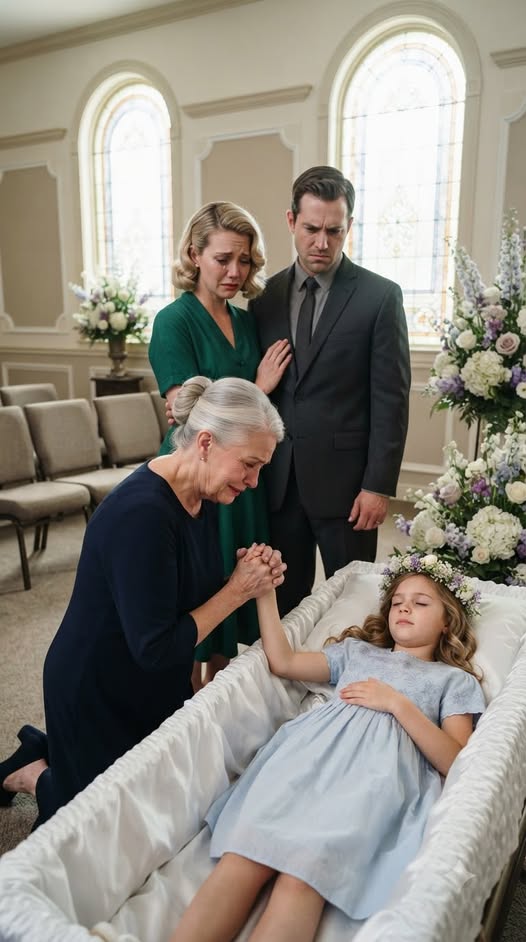
Inside lay my six-year-old granddaughter, Chloe.
According to my son, Julian, and his wife, Victoria, she had succumbed to a sudden, aggressively mutating respiratory contagion. The narrative they had spun for the doctors, for the extended family, and for the world was flawless, delivered with perfectly timed tears and trembling hands. It was a tragedy of unimaginable proportions. And because of this alleged “highly contagious” pathogen, the private funeral director—a gaunt man whose eyes stubbornly refused to meet mine all evening—had informed us that the casket needed to be permanently sealed by midnight. Health department regulations, Julian had claimed, his face a mask of stoic, untouchable sorrow.
They had given me exactly ten minutes alone to say my final goodbye before the funeral director returned with his industrial drill and heavy steel screws.
My hands trembled violently as I reached out to touch the polished, icy wood of the lid. My mind felt thick, wrapped in a strange, suffocating fog that made the edges of the room blur. Twenty minutes earlier, before retreating upstairs, Victoria had pressed a steaming porcelain mug of chamomile tea into my hands.
“Drink this, Eleanor,” she had murmured, her perfectly manicured hand rubbing circles into my shoulder. Her voice was like spun sugar, sweet but entirely devoid of warmth. “You look entirely undone. It will calm your nerves for tomorrow. You need to rest.”
I had taken exactly one sip. It tasted metallic and sharply bitter beneath a heavy layer of organic honey. A lifetime of trusting my maternal instincts—instincts that had been screaming at me for months that something in this house was fundamentally wrong—had prompted me to pour the rest of the murky liquid into the large potted ficus by the bay window the absolute second she turned her back. Even so, that single, solitary sip had been enough to make my eyelids heavy and my limbs feel as though they were filled with wet sand.
I leaned heavily against the casket, fighting the chemical lethargy dragging me down. The silence of the house was absolute, save for the violent lashing of rain against the glass. Julian and Victoria were upstairs, supposedly incapacitated by their grief.
As I laid my forehead against the cool, white enamel of the lid, closing my eyes to pray, I heard it.
A sound so impossibly faint it could have been the wind rattling the old windowpanes. A soft, desperate scrape of fingernails against satin.
I held my breath. The blood roaring in my ears suddenly went dead silent.
“Please… don’t close it. I’m still here.”
My heart stopped beating. The voice was a fractured, dry whisper, paper-thin and rasping, but it unmistakably belonged to Chloe.
A surge of pure, maternal adrenaline, cold and electric, violently burned away the sedative fog clouding my brain. I stepped back, my eyes darting frantically across the lid. The funeral director had already set the first two heavy screws into the back hinges, leaving the front brass latch half-locked in preparation for the final seal. I gripped the ornate handles and pulled upward. It didn’t budge.
Panic, raw and jagged, clawed at my throat. I frantically searched the deep pockets of my heavy wool cardigan, my fingers brushing past used tissues until they closed around my heavy brass house key. I wedged the jagged teeth of the key into the small, reinforced gap where the latch met the wood and pressed down with every ounce of desperate strength I possessed. The metal dug viciously into my palm, drawing a warm bead of blood, but I didn’t care. I leveraged my entire body weight against it. With a sickening crack that echoed like a gunshot in the quiet room, the wood splintered, and the latch violently gave way.
I pushed the heavy lid backward.
Chloe’s small chest was barely rising, her breathing shallow and erratic. Her normally rosy skin was a translucent, ashen gray, pulling tightly against her cheekbones, and her lips were cracked and bleeding. But her eyes—wide, terrified, and feverishly bright—stared up at me from the plush white satin.
“Grandma,” she breathed, her voice a fragile, trembling thread. “Please don’t leave me.”
“I’ve got you, my sweet, brave girl. I’m right here,” I choked out, hot tears instantly blinding me. I reached in, slipping my arms beneath her. She was feather-light, her body burning with an unnatural heat as I lifted her against my chest.
As I pulled her close, a sudden, microscopic mechanical whir and a soft click drew my attention upward. In the far corner of the living room ceiling, hidden cleverly within the grated casing of a carbon monoxide detector, a tiny, glowing red light blinked to life. It pivoted, the lens focusing directly on me. A hidden camera. It was tracking my every movement.
Right above my head, the ceiling floorboards groaned in protest.
A heavy thud echoed from the second-floor master bedroom. Then, the frantic, terrifying sound of heavy footsteps sprinting toward the top of the stairs.
They knew I had opened the box. And they were coming.
There was no time to process the betrayal, no time to think, only an immediate, primal imperative to run. I wrapped Chloe tightly in my heavy woolen shawl, shielding her fragile body, and clutched her fiercely to my chest as I bolted from the living room.
This house, once a familiar sanctuary where I had spent countless holidays bouncing a healthy, laughing Chloe on my knee, now felt like a claustrophobic labyrinth designed by a predator. I rushed down the long, dark hallway toward the back of the estate, my sensible shoes slipping on the polished hardwood. My destination was the laundry room at the end of the corridor. It had a heavy solid-core oak door, iron security grates on the exterior windows, and, crucially, the old landline phone mounted on the wall that Victoria had always complained was an “eyesore.”
“Daddy said it would be easier if I just stayed quiet,” Chloe whimpered into my collarbone, her breath hot and shallow against my skin. “He said the medicine would make the camera people happy.”
The words hit me like a physical blow, nausea twisting my stomach. The camera people.
“Shh, baby. You’re safe now. I promise you,” I lied, my chest heaving as I threw myself into the laundry room. I slammed the heavy oak door shut behind us and instantly threw the deadbolt, the metallic snick offering a fleeting illusion of safety.
I reached blindly for the beige wall phone, snatching the receiver from its cradle with trembling fingers. I pressed the plastic to my ear, desperately praying for the steady, reassuring hum of a dial tone.
Dead air.
I pulled the cord. It came away completely detached, swinging uselessly in my hand. The thick copper wires had been cleanly, deliberately snipped from the wall jack with wire cutters. A cold, paralyzing dread coiled tightly in my gut. They hadn’t just faked her death; they had anticipated every variable. I reached frantically into my cardigan pocket for my cell phone, only to find the fabric empty. Victoria. She had intentionally bumped into me in the kitchen while handing me the poisoned tea. She had picked my pocket.
They had planned this. Every agonizing, monstrous detail.
The doorknob rattled violently, shaking the frame.
“Mom?” Julian’s voice bled through the heavy wood. It wasn’t the voice of a grieving father. It wasn’t even the voice of the confused, stubborn boy I had raised. It was a cold, calculated, and deeply malevolent sound. It was the voice of a cornered animal.
“The police are coming, Julian!” I screamed, backing away from the door, holding Chloe so tightly my arms ached. “I’ve called them!”
Silence hung in the air for a terrible, stretching second. The thunder boomed outside, rattling the floorboards.
Then, Victoria’s voice pierced the quiet, shrill, hysterical, and laced with absolute panic. “Did she find her? Julian, she wasn’t supposed to wake up yet! The dose was supposed to last until morning! Mr. Graves will be here in five minutes with the sealant!”
“Open the door, Mother,” Julian demanded. The polite, grieving facade had entirely vaporized. Something heavy—his shoulder, perhaps, or a boot—slammed violently against the wood. The doorframe shuddered, dust drifting from the hinges. “You are ruining everything. You have no idea what is at stake here. Bring her out. Now.”
“You’re monsters! Both of you!” I sobbed, my eyes darting frantically around the small, brightly lit room.
I had to protect the child. I set Chloe down gently in a large, plastic laundry basket lined with clean towels, hushing her terrified whimpers. I grabbed the heavy, cast-iron ironing board and wedged it under the doorknob at a harsh angle. Then, I turned and braced my back against the massive, front-loading washing machine. Digging the rubber soles of my shoes into the linoleum, I pushed with a desperate, frantic strength I didn’t know I still possessed. The heavy appliance groaned, slowly sliding across the floor until it ground harshly against the door, creating a formidable barricade.
Smash!
Julian kicked the door. The wood splintered near the lock, and the washing machine shrieked against the tiles, shifting an inch backward.
“Mother, you are senile!” Julian yelled, his voice adopting a sickeningly patronizing tone, a tactic designed to gaslight me even now. “You are having a grief-induced episode! Chloe is gone. You are holding a doll. Open the door before you hurt yourself!”
Suddenly, the small, slatted ventilation window set high in the center of the door shattered inward. A shower of sharp, jagged glass rained down on the white tiles. Through the narrow, jagged opening, Victoria’s slender arm thrust inside. Her manicured hand, the skin sliced and smeared with bright crimson blood from the broken glass, blindly and frantically grasped the air, reaching downward toward the inside deadbolt.
Her bloody fingers brushed the brass lock.
Victoria’s hand thrashed wildly, her bloody fingers desperately seeking purchase on the deadbolt. I didn’t hesitate. I grabbed a heavy, industrial-sized plastic bottle of liquid laundry detergent from the shelf above the sink and swung it downward with all my might, striking her forearm.
She let out a piercing, inhuman shriek and violently withdrew her arm, retreating into the hallway. I could hear her cursing viciously, sobbing in pain and rage.
“That’s it. I’m going to break this damn door down, Mother!” Julian roared. The unmistakable, heavy sound of boots retreating down the hall echoed through the house. He was heading for the garage. He was going to get a tool. An axe, a sledgehammer, a crowbar. He was going to breach the room.
I looked at the back window of the laundry room. It was locked from the outside, covered in a heavy iron security grate that Julian had installed years ago to “keep the family safe from intruders.” We were trapped in a reinforced box.
“Grandma, I’m scared. My chest hurts,” Chloe cried, coughing weakly and curling into a tight, trembling ball inside the laundry basket.
“I know, baby, I know. Just look at me. Keep your eyes on me,” I said, my voice shaking as I frantically scanned the room. My eyes landed on Julian’s heavy metal toolbox resting on the top shelf of the utility closet. I dragged a small step stool over, grabbed the largest, heaviest steel wrench I could find, and turned toward the exterior window. The iron security grate was solid, bolted into the brick, but the glass behind it wasn’t.
I swung the wrench, shattering the thick windowpane. The storm instantly howled into the room, bringing with it a freezing, sideways rain that soaked my face and clothes. Through the iron bars, I could see the dark, wet asphalt of the main road about a hundred yards away, separated by a long stretch of manicured lawn.
I reached back into my pocket, my fingers fumbling with my keyring. Alongside my house key was a small, high-powered tactical LED flashlight Julian had mockingly given me for Christmas two years ago. For when your old eyes fail you, he had joked.
My hands shook so violently I could barely press the rubber button at the base.
Click. Click. Click. Three short flashes.
Hold. Hold. Hold. Three long flashes.
Click. Click. Click. Three short flashes.
SOS. The universal plea for salvation.
Click Here to continues Read Full Ending Story👉 PART 2 : At my 6-year-old granddaughter’s funeral, I leaned over her casket to say a final goodbye. Then I heard a faint, desperate scrape from inside. “Daddy said if I woke up, I would ruin everything,” she whispered. I froze. My son and his wife had told everyone she died from a sudden contagion. I pried the lid open. As I lifted my breathing grandchild, heavy footsteps rushed down the stairs.
At my 6-year-old granddaughter’s funeral, I leaned over her casket to say a final goodbye. Then I heard a faint, desperate scrape from inside. “Daddy said if I woke up, I would ruin everything,” she whispered. I froze. My son and his wife had told everyone she died from a sudden contagion. I pried the lid open. As I lifted my breathing grandchild, heavy footsteps rushed down the stairs.
Part 1 of 2