“She didn’t even blink, Mom,” Mara said, her voice dropping to a whisper. “I saw her through the glass before I left. She was smiling and talking to the receptionist. How can someone look that innocent if they did something so terrible?”
“It is a mask, Mara,” Evelyn said, though her own fingers were dry and cold as she rubbed her left ring finger.
“What if Caleb’s forensic route doesn’t work?” Mara asked, looking down at her coffee. “If they sue us for defamation, we lose everything. The shelter, the offices, the house. I’m starting to think we can’t prove any of this.”
A waitress set a plate of cold toast between them, the butter already hardened into yellow patches.
“We have the bank records,” Evelyn said, trying to believe the strength in her own voice.
“But they have millions of dollars to tie us up in court for years,” Mara said. “We don’t have the money to fight a defamation suit, Mom. How are we going to pay for Caleb’s research if they freeze your accounts?”
Evelyn stared at the yellowed linoleum table, where a small crack had been taped over with clear packing tape.
“We will find a way,” Evelyn said, though the words felt hollow in the small, warm space of the booth.
“The board members are already calling me,” Mara said. “They heard Harrison’s company might pull the corporate sponsorship for the winter toy drive. If that happens, the whole program collapses.”
“I will talk to the board,” Evelyn said.
“They won’t listen to us if they think we are dragging the non-profit into a personal family feud,” Mara said, her voice shaking slightly as she looked away.
The afternoon sun was already dipping below the tree line when Evelyn arrived back at her modest colonial home.
The kitchen smelled of stewed tomatoes and old floor wax.
Lily met Evelyn at the back door, her fingers twisting the hem of her oversized grey cardigan. She held a long white envelope with a red certified mail stamp across the front.
“A man in a blue jacket delivered this,” Lily whispered, her eyes wide as she handing the paper to Evelyn. “He said it was urgent.”
Evelyn tore the paper open. The letterhead belonged to the management company of her non-profit’s office building, a subsidiary of Vale International.
The lease for Harper North was terminated, effective immediately, citing a violation of the building’s moral conduct clause. They had twelve hours to vacate the premises.
“What is it, Evelyn?” Lily asked, her voice trembling slightly.
“They are closing the office,” Evelyn said, her voice barely a whisper.
“Where will the children’s records go?” Lily asked.
Evelyn did not answer. She stood in the center of the kitchen, the paper rustling in her hand. On the floor by the pantry, three empty cardboard boxes sat waiting for the recycling truck.
Evelyn looked at the cardboard boxes stacked in her kitchen.
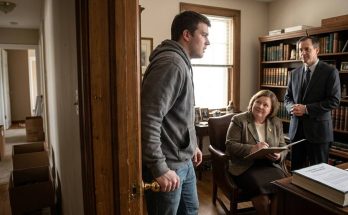
The morning light in Caleb’s office was thin and grey, catching the dust motes that drifted over the stacks of legal folders on his desk.
Jonah sat in the corner, his chair scraped close to a tall, silver-haired man who wore a faded wool jacket.
Jonah pushed his glasses up his nose and cleared his throat, nodding toward the visitor.
“Mother, this is Arthur Vance,” Caleb said, his voice quiet and formal. “He spent twenty-eight years as the chief of digital forensics for the state police.”
Arthur Vance did not stand, but he offered a dry, calloused hand that Evelyn shook.
“Jonah showed me the metadata from the September 2006 server logs,” Arthur said, his voice carrying the gravel of a lifetime spent in basement offices. “The hospital administration claims it was a routine archival merge, but the digital signature on the deletion command didn’t come from the hospital network.”
Evelyn leaned against the edge of the mahogany table, her fingers tightening.
“Where did it come from?” she asked.
“A private terminal registered to Ellery Marsh Holdings,” Arthur said, placing a single sheet of paper on the table. “I usually charge four hundred dollars an hour for this kind of extraction, but Jonah told me what happened to your girls.”
Evelyn looked at the paper, where a long string of numbers and letters ended in a time stamp from seventeen years ago.
“I cannot afford your standard rate, Mr. Vance,” Evelyn said. “My personal savings are nearly gone.”
“I will do the full analysis of the hard drive for a flat fee of fifty dollars,” Arthur said, tapping the paper. “No family should have their medical history rewritten by a real estate firm.”
Caleb sat back, his eyes fixed on the document.
“If Arthur can prove the signature was forged on that terminal, Claire’s defamation threat falls apart,” Caleb said. “But we have to get the physical drive before her lawyers file the injunction.”
“How long do we have?” Evelyn asked.
Arthur pulled a silver pocket watch from his vest and clicked it open.
“Three days, if we are lucky,” Arthur said.
By eleven o’clock, the heat in Evelyn’s attic had risen, carrying the scent of cedar shavings and dry pine boards.
Lily knelt beside a green steamer trunk, her small hands lifting a stack of hand-knit cardigans that had belonged to Mara when she was a toddler.
“Are we sure we want to sell these, Evelyn?” Lily asked, twisting the hem of her grey cardigan around her thumb. “They look so small.”
“We need the space, Lily, and the consignment shop on Elm Street pays cash for vintage wool,” Evelyn said, sorting through a box of old porcelain plates.
Lily reached deeper into the bottom of the trunk, her fingers brushing against a small, velvet pouch that had slipped between the cedar slats.
She pulled out a heavy, silver-plated key with an intricate bow shaped like a sleeping cherub.
“What does this open?” Lily asked, holding it up so the weak sunlight from the gable window caught the tarnished silver. “It feels too heavy for a diary.”
Evelyn stopped sorting, her breath catching in her throat as she stared at the cherub’s wings.
It was the key to the nursery on the third floor of Harrison’s estate, the room she had painted pale yellow before the fourth pregnancy ended in silence.
“It belongs to an old house,” Evelyn said, keeping her voice steady with an effort that made her shoulders ache. “I thought I lost it during the move.”
“It feels important,” Lily whispered, tracing the silver feathers with her index finger. “Like it belongs to something quiet.”
“Put it in your pocket for now,” Evelyn said, turning back to the cardboard boxes. “We have to get these clothes downstairs before the bank meeting.”
At two o’clock, the air inside the private viewing room of the Meridian Trust vault was cold and smelled of ozone and brass polish.
Harrison stood by the mahogany table in the center of the room, adjusting his gold cufflinks before he looked up at Evelyn.
“You look tired, Evelyn,” Harrison said, his booming voice muffled by the thick steel door behind them. “This whole business is wearing you down to nothing.”
“I am fine, Harrison,” Evelyn said, keeping her handbag pressed against her side.
Harrison reached into his breast pocket and drew out a folded cream document, laying it flat on the table between them.
“This is a lease agreement for a new office space on Tremont Street,” Harrison said, his finger resting on the signature line. “Three years, fully paid, with a thirty-thousand-dollar grant for your children’s programs.”
Evelyn rubbed her left ring finger, where her skin was still slightly pale from the band she had discarded years ago.
“And what is the price for this generosity?” she asked.
“A standard non-disclosure agreement regarding the historical records of the Marsh Clinic,” Harrison said, his voice dropping to a low, persuasive rumble. “We both know those old files are full of administrative errors, Evelyn. There is no reason to drag Claire’s name through the mud over a seventeenth-year-old mistake.”
Evelyn looked at the legal text, her eyes catching the phrase permanent waiver of claims.
“Claire paid him, Harrison,” Evelyn said softly. “The terminal signature is hers.”
“Claire is my wife, and she has protected my family’s name while you have spent the last decade running a charity on pocket change,” Harrison said, his tone tightening. “Sign the paper, Evelyn. Take the building and go back to your foster children.”
“And if I refuse?”
Harrison leaned forward, his hands flat on the mahogany.
“My lawyers will file the defamation suit by five o’clock,” Harrison said. “They will freeze your personal accounts as part of the discovery process, and your little non-profit will be locked out of its storage units before the weekend.”
“You would let her do that to Caleb’s career?” Evelyn asked.
“Caleb is acting as your attorney, not my son,” Harrison said. “He made his choice when he took the case.”
Evelyn looked down at her own hands, then back to the man she had lived with for eighteen years.
“I will see you in court, Harrison,” Evelyn said.
At four o’clock, Caleb’s office was nearly dark, the streetlamps outside on Court Street casting long shadows across the floorboards.
Caleb sat behind his desk, his fingers linked together as he listened to Evelyn describe the meeting in the vault.
“If we reject the NDA, Claire’s firm will file the emergency injunction within the hour,” Caleb said, his voice measured and analytical. “They have the resources to keep our assets frozen for six months before we even get a hearing.”
“Can we survive six months without the storage units?” Evelyn asked.
“The foster care supplies are in those units, Mother,” Caleb said. “The winter coats, the school books, the beds. We have no other place to store them.”
Jonah stood by the window, holding a folder containing the digital analysis Arthur Vance had started.
“The hard drive backup is still active on the hospital’s redundant server,” Jonah said. “If we file the counter-suit tonight, we can legally compel them to preserve the data before Claire’s people can touch it.”
Evelyn stood up and walked to the window, looking down at the evening traffic.
She thought of the thirty-thousand-dollar grant, the warm office on Tremont Street, and the quiet life she could have if she simply signed the paper and let the past stay buried.
Then she thought of Lily’s fingers tracing the silver key in the attic, and the seventeen years she had spent believing her own body had failed her.
“I don’t need a building to do my work, Caleb, but I do need the truth,” Evelyn said, turning back to the desk.
Caleb opened his drawer and pulled out the counter-suit declaration, his hand steady as he laid it before her.
“Once I file this, there is no turning back,” Caleb said. “They will go after everything we have left.”
Evelyn took the pen from his hand and signed her name at the bottom of the page, her signature sharp and clear against the white paper.
She picked up the unsigned settlement agreement Harrison had given her, folding it once.
Evelyn slid the settlement document back across the table unsigned.
The heavy oak door of the Vale estate swung inward, revealing the wide marble hallway Evelyn had once swept with her own hands.
Harrison stood just inside the threshold, his fingers adjusting his gold cufflinks with a quick, rhythmic tug.
“I am glad you came, Evelyn,” Harrison said, his deep voice carrying through the high ceiling.
Behind him, Claire walked down the carpeted stairs, her steps silent and measured.
She wore a soft cream knit sweater and no jewelry at all, her face free of its usual sharp composure.
“Thank you for coming, Evelyn,” Claire said, her voice quiet and strangely gentle.
Evelyn kept her purse tucked firmly under her arm, her left hand instinctively finding her bare ring finger.
“I came because Harrison said it was urgent,” Evelyn said.
Claire gestured toward the velvet sofa near the fireplace, where a silver tea service sat on a low cherry wood table.
“It is urgent, but only because we wanted to speak to you without the lawyers present,” Claire said, pouring hot water into a porcelain cup.
Harrison took a seat in the leather armchair opposite them, leaning forward with his elbows on his knees.
“We wanted to apologize,” Harrison said.
Evelyn remained standing by the edge of the Persian rug, her eyes tracking the steam rising from the teacup.
“The lease on your office,” Claire said, offering the cup with a hand that did not shake. “It was an administrative decision made by our property management team, but I should have stopped it.”
She looked directly at Evelyn, her eyes wide and clear.
“We are all getting older, Evelyn, there is no reason for us to remain enemies,” Claire said.
The words hung in the warm air of the room, accompanied only by the soft crackle of the birch logs in the fireplace.
Evelyn looked at Harrison, whose face seemed lined with a fatigue she had never noticed before.
For seventeen years, the silence between them had been a cold wall, but now the room felt thick with a sudden, soft warmth.
“The non-profit has already begun packing the files,” Evelyn said, her voice barely above a whisper.
“Then let us help you unpack them,” Claire said, setting the teacup down with a soft click.
She reached into her small knitted cardigan pocket and pulled out a narrow white envelope.
“This is for your foundation,” Claire said, sliding the envelope across the polished wood of the table.
Evelyn did not reach for it.
“What is this, Claire?” Evelyn asked.
“A private donation of fifty thousand dollars,” Claire said.
The sum was written in elegant black ink on the front of the envelope, the numbers clear and heavy.
“It is a personal gift from my own accounts, not Vale International,” Claire added, her fingers resting lightly on the edge of the table.
Harrison nodded, his large hand resting on his knee.
“We want you to have your security back, Evelyn,” Harrison said. “The lawsuit, the legal bills, none of it helps the work you do for those children.”
Evelyn looked from the envelope to Harrison’s face, searching for the familiar condescension that had defined their marriage.
There was only a quiet, waiting stillness in his eyes.
“The children need the space,” Evelyn said, her hand tightening on her purse strap.
“They do,” Claire said, her voice soft and encouraging. “And with this, you can secure a five-year lease on the building down on Elm Street.”
The thought of the children having a permanent home, free from the threat of eviction, pulled at Evelyn’s chest.
“I would have to consult Caleb,” Evelyn said.
“Caleb is an attorney, he sees everything as a battle,” Claire said with a small, sad smile. “But this is between us, as a family.”
The word family sounded strange in the mouth of the woman who had replaced her.
Yet the warmth of the fire and the quiet regret in Harrison’s eyes felt real, a sudden shelter after weeks of cold legal threats.
“Think about it, Evelyn,” Harrison said, rising from his chair. “Just think about it.”
He checked his watch and gave a short nod toward the hall.
“I have to take a call from the city planning office,” Harrison said. “But please, stay and finish your tea.”
He walked out of the parlor, his heavy footsteps fading down the long hallway toward the study.
Evelyn looked down at the white envelope, the fifty thousand dollars representing safety for her staff and the foster families.
“Is this truly without conditions, Claire?” Evelyn asked.
“No agreements to sign, no lawyers,” Claire said, her voice steady and smooth. “Just a gift to end the pain.”
She stood up, smoothing her skirt with both hands.
“I will leave you to your thoughts,” Claire said. “The front door is unlocked whenever you are ready.”
She walked toward the rear of the house, leaving Evelyn alone with the quiet hum of the grandfather clock.
Evelyn picked up the envelope, the paper heavy and crisp between her fingers.
She slipped it into her purse and walked out into the central hallway, her head light with a fragile sense of relief.
At the turn of the corridor, near the tall grandfather clock, Preston stood with his hands in his pockets.
He looked up as Evelyn approached, his defensive posture melting into a hesitant, downward gaze.
“Preston,” Evelyn said, stopping a few feet away.
The boy ran his hand through his hair, his fingers lingering near his temple before he looked at her.
“I wanted to apologize for what I said at the diner,” Preston said, his voice quiet.
Evelyn watched his face, looking for the arrogance that had mirrored Harrison’s so perfectly.
“You were protecting your family,” Evelyn said.
“That doesn’t make it right,” Preston said, keeping his eyes on the polished floorboards. “My mother told me what you’ve been through with the losses, and I shouldn’t have threatened your charity.”
He looked up then, and Evelyn saw a genuine fear in his eyes, the look of a child trying to fix a mistake he didn’t fully understand.
“Thank you, Preston,” Evelyn said softly.
“I just want things to be quiet again,” Preston said. “For everyone.”
He gave her a small, awkward nod and turned toward the stairs, his steps slow and heavy.
Evelyn walked out of the heavy front doors and down the wide stone steps toward the gravel driveway.
The autumn air was cool, but the sun felt warm on her face for the first time in months.
She reached her small blue sedan and opened the driver’s side door, her mind already planning the call to the Elm Street landlord.
A dark sedan pulled up behind her car, the engine idling quietly.
The passenger door opened, and Jonah stepped out, holding a manila folder close to his chest.
His glasses sat slightly crooked on his nose, and he pushed them up with a quick, nervous motion.
“Evelyn,” Jonah said, his voice hushed as he looked toward the estate windows.
“Jonah, what are you doing here?” Evelyn asked, her hand still on her car door. “I told Caleb I was coming alone.”
Jonah didn’t answer directly; instead, he opened the manila folder and pulled out a single sheet of paper.
“We got into the server backup logs ten minutes ago,” Jonah said, his breath coming in short, quick puffs.
“The audit isn’t until next month, Jonah,” Evelyn said, her heart dropping as she looked at the paper.
“This isn’t from the audit files,” Jonah said. “This is an internal email from Claire’s private account, sent to the clinic’s IT director yesterday morning.”
Evelyn took the paper, her fingers brushing the cold page as she read the printed text.
The date at the top was indeed yesterday, timed at four in the morning.
“Read the second paragraph,” Jonah said.
Evelyn’s eyes focused on the words printed in the middle of the page.
“The backup server in the basement must be decommissioned before the forensic team arrives on the twelfth,” the email read. “Ensure all data from September 2006 is overwritten.”
Evelyn’s hand began to numb, the warmth from the parlor disappearing instantly.
“She’s paying them twenty thousand dollars to destroy the files,” Jonah said. “She used the estate tea as a distraction to keep you from checking the court schedule today.”
Evelyn looked from the printed email to the grand stone facade of the Vale estate.
The fifty thousand dollar check sat inside her purse, a heavy weight against her side.
“She wanted me to feel safe,” Evelyn said, her voice flat and cold.
“She wanted to buy three days,” Jonah said. “By the time Caleb files the next motion, the backup drive will be physical scrap.”
Evelyn reached into her purse and pulled out the white envelope.
The crisp paper of the check felt thin and worthless under the grey sky.
“She said we were getting older,” Evelyn whispered.
She looked down at the muddy ground near her front tire, where the rain from the night before had pooled in the gravel.
Evelyn opened the envelope, took out the check for fifty thousand dollars, and let it slip from her fingers.
It drifted downward, landing flat in the dark, cold mud.
The mud on my shoe had dried by ten the next morning, leaving a light crust over the black leather as I sat in the corner chair of Caleb’s office. The small room smelled of old paper and the burnt-coffee scent coming from the breakroom down the hall.
Jonah pushed his glasses up his nose and leaned toward the blue screen of his laptop, his shoulders hunched over the keyboard. He clicked a file labeled Archive-06, and a series of scanned hospital records from the night of my fourth miscarriage appeared on the monitor.
“The digital signature on the backup server matches the clinic’s internal registry for September 2006,” Jonah said, pointing a finger at a highlighted row of yellow numbers.
Caleb stood by the window, his back to the room, looking down at the street below where a delivery truck was idling near the curb. He didn’t have his leather notebook out, but his fingers were curled tightly into his palms, his knuckles white against his skin.
“Just read the line, Jonah,” Caleb said, his voice carrying the flat, level tone he used when he was trying to keep his anger in check.
Jonah cleared his throat, his eyes scanning the scanned medical page on his screen. He looked at me first, a brief, apologetic glance, before he spoke the words that broke seventeen years of quiet belief.
“The medical file says the infant was transferred out of the clinic alive.”
I reached out and rubbed my left ring finger where my wedding band used to sit, the bare skin still feeling slightly tender as if the gold were still there.
“That is a mistake,” I said, my voice barely louder than the hum of the cheap office printer. “They told me there was no heartbeat. I was there for three days, and they told me she was gone.”
“Dr. Marsh signed the transfer sheet three minutes before the official time of death was logged on your main chart,” Jonah said, his finger tracing the line. He turned the laptop toward me, showing a scanned page with a faint purple stamp at the bottom that read Emergency Extraction.
“Who received the baby?” I asked, my fingers tightening against my knee until my joints ached.
Jonah clicked a separate folder tab on his screen, revealing a digitized nursery log from the same night.
“The name on the transfer receipt is Ruth Bell, registered nurse.”
I stared at the name, trying to place it among the faces of the women who had checked my bandages and changed my IV drips during those dark days.
“I do not remember a Ruth Bell,” I whispered, the room suddenly feeling very small.
“She wasn’t on your primary care team, Mom,” Caleb said, finally turning from the window to face me. “She was assigned to the neonatal ward, the one they told us was closed for renovations.”
Mara let herself into the office at eleven, carrying three paper cups of tea that smelled faintly of cheap cinnamon. She set them on the small conference table and looked at Jonah, then at me, crossing her arms tightly over her chest.
“We found Ruth Bell’s employment file from the state licensing board,” Mara said, her voice quick and passionate. “She left the clinic the week after your discharge, and she never went back to nursing in Boston.”
“Where did she take her?” I asked, my heart hammering against my ribs as I looked at the scanned signature.

One Comment on “PART5: Seventeen Years After Her Fourth Loss a Blue Blanket Explains a Legacy”