Chapter 1 — The X-Ray
The emergency-room lights buzzed overhead as the doctor put the X-ray up on the monitor and moved his pen, slowly, from one fracture to the next.
“Mr.
Sterling,” he said quietly, “I have to be honest with you.
This wasn’t done to frighten her.
Whoever did this meant to hurt her as badly as they possibly could.”
I made myself look at the image, because she was my daughter and I would not look away from anything that had happened to her.
I will not describe what I saw on that screen, or the state my daughter was in behind the curtain a few feet away, because Chloe is a private person and her injuries are hers, and I have no interest in laying them out for anyone.
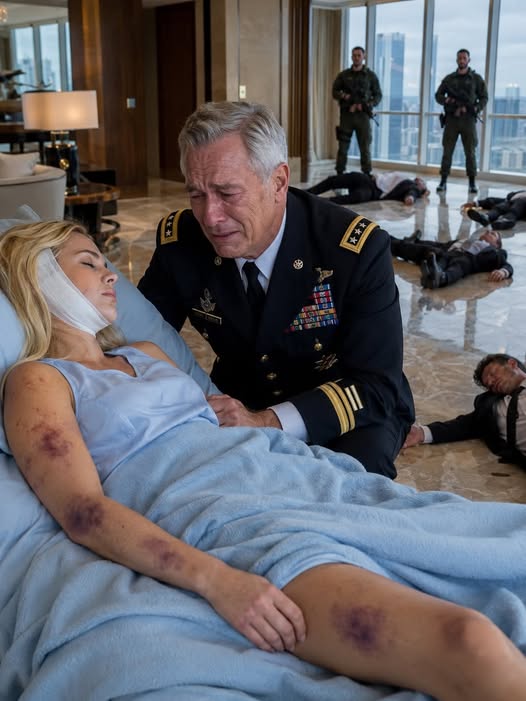
It is enough to say that she had been beaten, seriously, and that she would need surgeons, and time, and that when I sat down beside her and took her hand and told her that her father was there, she squeezed my fingers back — weakly, but enough for me to feel it — and that nearly finished me where I sat.
To everyone who knew us, I was Alexander Sterling.
A widower.
A quiet security consultant.
A father who had some old scars he never explained and a past he never discussed.
My daughter knew I had been a soldier once, a long time ago.
She did not know what kind.
That was the way I had always wanted it.
I had spent nineteen years making very sure that the man I used to be stayed buried, so that Chloe could grow up with an ordinary father in an ordinary house.
Sitting in that emergency room, holding her hand, I felt that buried man stir for the first time in two decades.
And I understood that the hardest thing I was going to have to do, in the days ahead, was not to wake him.
It was to keep him asleep — and to get justice for my daughter as her father, in the light, instead of as the thing I used to be, in the dark.
I want to name that tension at the very start, because it is the true subject of everything that follows, more than the crime or the criminals.
There were, that night, two men available inside me to respond to what had happened to my daughter.
One was Alexander Sterling, the father — grieving, frightened, and, on his own, largely powerless against families with this much money and this much reach.
The other was the man I had buried, who was not powerless at all, who knew precisely how to make three young men and their families cease to be a problem, permanently and untraceably.
And the terrible truth I had to sit with in that emergency room is that the buried man was the one who could actually help.
The father could hold her hand.
The other man could avenge her.
For most of my life I had believed the second was the stronger.
That night, and in the days after, I learned that I had it exactly backward — that reaching for the buried man would have been the weak choice dressed as the strong one, and that the genuinely difficult thing, the thing that required more from me than any mission ever had, was to refuse the power I knew I had, and to win my daughter’s justice slowly, lawfully, in the daylight, as the ordinary father I had chosen to become.
This is the story of how I did that.
It is not a story about a soldier coming back.
It is a story about a soldier refusing to, on the one night it would have been easiest, and finding out that the refusal was the bravest thing he ever did.
Chapter 2 — Who I Had Been
There is no version of my old life that appears in any record you could find.
That was the entire point of it.
Once, before Chloe, before her mother, I had led a small unit that officially did not exist — the kind of unit that gets sent to the places a country insists it never went, to do the things it insists were never done.
No photographs.
No medals.
No paper trail.
My men and I lived in the spaces between the official history, and we were very, very good at what we did, and what we did left marks on all of us that never fully healed.
And then my daughter was born, and I looked at her, and I understood with total clarity that the man I had been could not raise her.
That man knew too much about how the world actually worked, and had done too much in its shadows, and carried too much that a child should never have to sense in her father.
So I did the hardest operation of my career.
I retired the man I had been.
I buried him so deep that even I could almost forget he was down there.
And in his place I built Alexander Sterling, an ordinary widower who consulted on building-security systems and coached nothing more dangerous than his daughter’s grade-school science projects.
For nineteen years, that had been not just enough but everything — the best and truest work I have ever done.
Being Chloe’s father was the only mission I had ever run that felt like it was on the right side of things.
I had no intention of ever trading it back for the other one.
Not for anything.
I want that understood before I tell the rest, because the rest is about the enormous effort it took to keep that promise, on a night when every instinct I had was screaming at me to break it.
Chapter 3 — Every Detail Too Convenient
The hospital had called at 11:47 that night, and by the time I arrived, I already knew — the way I used to know things — that something was very wrong beyond the obvious.
Campus security told me the cameras had malfunctioned.
All of them.
That night.
In that location.
The emergency phones in that quarter of campus had been down.
There were, they assured me, no witnesses to be found.
Every single detail was too clean, too convenient, arranged too neatly into a shape that added up to nothing can be proven. I had spent a career reading exactly this kind of pattern, and I read it now with a cold and rising fury: someone had begun erasing the evidence of what happened to my daughter before she had even been wheeled into the emergency room.
This was not the chaos of an ordinary crime.
This was the tidiness of a cover-up, already in motion, already professional.
Which told me two things.
It told me that whoever hurt Chloe had the kind of power that can make cameras fail and witnesses vanish.
And it told me that they were absolutely certain, down to their bones, that people like them never answer for anything.
They had good reason to be certain.
It is almost always true.
It was not going to be true this time.
Chapter 4 — Three Names
A nurse gave me Chloe’s things in a sealed bag — her torn sweatshirt, and, caught beneath the fabric where it had been missed, a small, stiff, bloodstained scrap of paper.
Three names were written on it, in my daughter’s own hand.
I understood, later, that she had managed to write them in the moments before she lost consciousness, so that whatever happened to her, the truth would not be lost.
That is the kind of person my daughter is.
Even then.
Even broken.
She left a record.
Chad Kensington.
Brantley Holloway.
Wyatt Holbrook.
I knew the names.
Everyone in the city knew the names.
Kensington’s family controlled half the region’s construction industry.
Holloway’s mother sat on a powerful committee in Washington.
Holbrook’s father ran a defense contractor worth billions.
These were not ordinary young men.
These were the heirs of three of the most powerful families in the state, and the moment I read their names, the whole shape of the night came into focus.
They had not hurt my daughter by accident, or in some random encounter.
And the cameras had not failed by chance.
Three families with that much money and that much reach had decided, collectively and quickly, that their sons’ night was going to disappear — and that my daughter, whoever she was, was the price of making it disappear.
They had chosen to act as though their names made them invisible.
As though the rules that bind everyone else did not apply to blood like theirs.
I sat in that hospital with the bloodstained paper in my hand, and I made them a silent promise: that they were about to learn, all of them, how visible they were.
Because the invisibility those three families believed in was never real.
It merely felt real, and it felt real for the oldest and simplest of reasons: it had never once been tested.
Wealth and power of the kind those families held does not actually make you invisible to the law.
What it does is make everyone around you afraid to look — the detective who trembles at your name, the university that malfunctions its own cameras, the officials who take your call.
And when everyone around you looks away, for long enough, across enough years, you begin to mistake their averted eyes for your own genuine invisibility.
You come to believe you cannot be seen, when the truth is that no one has ever dared to look.
It is a fragile thing, that kind of power, far more fragile than the people who wield it understand, because it depends entirely on the continued cooperation of everyone’s fear.
It has no substance of its own.
The moment one person with sufficient resources and sufficient resolve simply refuses to look away — refuses to be bought, refuses to be frightened, and insists on seeing what is actually there — the whole edifice of invisibility evaporates, because it was never anything more than an agreement not to look.
Those three families had spent a generation surrounded by averted eyes, and had concluded that they were gods.
They had simply never, in all that time, encountered someone who would not look away.
My daughter, it turned out, was that someone, in an alley, at nineteen.
And I was that someone, in the days that followed.
And once we had both refused to look away, everyone else remembered that they could look too — the young women who had been made to feel invisible themselves, the honest investigators who had been waved off before.
Visibility, it turns out, is contagious, once someone is brave enough to start.
Chapter 5 — The Detective
The detective who came was named Miller, and he barely glanced toward my daughter’s bed the entire time he spoke to me.
“These cases are complicated, Mr.
Sterling,” he said, not quite meeting my eyes.
“No witnesses.
No footage.
I want to be straight with you — there may not be a great deal we can do here.”
I watched his hands as he said it.
And when he came to the third name — when he said Holbrook — his hands trembled, just slightly, and he set down his notepad to hide it.
It told me everything.
Someone had already reached Detective Miller.
Someone had already made a phone call, applied a pressure, offered or threatened whatever it took, and a man who was supposed to protect my daughter had been quietly converted, before he ever walked through the door, into one more part of the machinery erasing her.
“Then I suppose your investigation is finished,” I said, evenly.
And I watched relief cross his face — actual relief, the loosening of a frightened man who believes the difficult thing has just gone away on its own.
He thought I was surrendering.
He thought I was one more powerless father who would rage for a night and then accept that men like the Kensingtons and the Holbrooks are simply beyond reach.
It was the same mistake I had watched powerful men make, in the places that never existed, right before everything they were certain of came apart.
I did not correct him.
Let him have his relief.
It would make what came next land harder.
But I want to be fair to the wider truth here, beyond the one frightened detective, because it would be easy to tell this story as though the whole justice system had failed my daughter, and that is not quite what happened, and the distinction matters.
The system did not fail her because it is rotten to the core.
It failed her, at first, because it had been reached — because at the precise local point where her case entered it, three families had applied money and pressure and fear, and bought or bent the handful of specific people who happened to stand at that entry point.
That is how power like theirs actually works.
It does not corrupt everything; it cannot afford to, and it does not need to.
It only corrupts the specific, local, load-bearing points where cases begin — the one detective, the one campus office, the one set of cameras — because it understands that if it can strangle a case in its cradle, before it ever reaches the larger system, then the larger system’s integrity never even gets a chance to matter.
The genius and the cowardice of it are the same thing: they never fought the whole machinery of justice, which they could not have beaten.
They only made sure the case never reached it.
And that is exactly why the answer was not to rage at the system, and not to abandon it for the darkness Leo offered, but to route around the bought local choke point and get my daughter’s case into the hands of a part of the system too large and too distant to have been reached — the federal authorities, who had taken no one’s phone call, and owed those three families nothing, and were entirely willing to look.
The system had not failed my daughter.
A few bought men at its doorway had blocked her from reaching it.
My whole task was only to carry her past them, to the part that still worked.
It worked.
Chapter 6 — The Coin
I stepped out into the empty hallway, and I took out my wallet, and from behind the cards I pulled a thing I had not touched in nineteen years.
A challenge coin.
Black, worn smooth at the edges from a life it had lived long before this quiet one.
A silver eagle on one face, above three words: VANGUARD NEVER DIES.
And on the other face, engraved small, a telephone number I had memorized two decades ago and had never once dialed, because dialing it meant waking everything I had put to sleep.
I stood in that hospital hallway and turned the coin over in my fingers and I thought hard about what I was doing.
Because I knew my old men.
I knew that if I made this call, they would come — all of them, from wherever they were, without a question — and I knew what they were capable of, and I knew what they would want to do to the three young men who had done this.
And some furious, grieving part of me wanted exactly that.
I will not pretend otherwise.
For one long moment in that hallway, the buried man was fully awake, and he wanted blood, and it would have been so easy to let him have it.
And then I looked through the glass at my daughter, and I made the decision that the rest of this story turns on.
I would make the call.
I needed my men; I could not do this alone, against families this powerful, as one ordinary father.
But I would not unleash them.
I would bring them back for one purpose only, and it was not vengeance.
It was to do the thing the system had refused to do: to drag the truth into the light, and to make three untouchable families answer for it in a court of law, in front of the whole world.
I dialed the number.
It rang once.