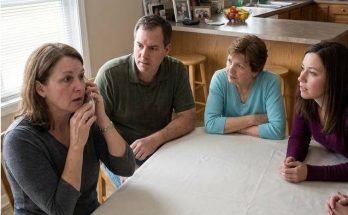
We made breakfast at nearly noon because none of us had eaten properly.
Ethan burned the toast. Clara insisted on scrambling the eggs. I cut fruit, having long ago been informed that my cooking style relied too heavily on precise measurements and insufficient faith.
For almost an hour, nobody said Dominic’s name.
That silence was different from the one Clara had been living inside. It was not denial. It was rest.
Ethan told us about his clinic, housed in a former elementary school the city leased for almost nothing. The heating failed regularly. His staff had adopted a stray cat from behind the building and named it Habeas.
Clara laughed hard enough that she had to wipe her eyes.
I realized I could not remember the last time I had heard her laugh without checking whether anyone approved first.
She went upstairs to sleep after lunch.
Ethan and I cleaned the kitchen.
“How’s Olivia?” I asked.
“Good.”
“And Sophie?”
“Growing at an alarming rate.”
“I should call.”
“You could.”
There was enough history inside those two words to fill another room.
Ethan’s wife, Olivia, was a surgeon and one of the most capable people I knew. Apparently, I had spent years making her feel as though she were appearing before a professional licensing committee whenever she sat at my dinner table.
“I never disliked her,” I said.
“I know.”
“Then why would she think otherwise?”
Ethan looked at me.
And I heard the problem before he answered.
“You assume that because your intention was reasonable, someone else’s reaction must be incorrect.”
I leaned against the counter.
“I asked about her work because I was interested.”
“You evaluated her.”
“That is different.”
“Mom.”
I closed my eyes.
“No,” I said. “Perhaps it isn’t.”
I called Olivia before I could turn the insight into another theory.
She answered cautiously.
“Victoria?”
“I owe you an apology.”
Silence followed.
She did not rescue me by denying it.
I respected her for that.
“I treated you as if you were applying for my approval,” I said. “You never were.”
A small laugh came through the phone.
“For the first three years, I absolutely was.”
“That makes my behavior worse.”
“A little.”
By the time we finished talking, she had invited me to dinner the following Sunday.
It was not a dramatic reconciliation. It was simply a door reopening.
That afternoon, Daniel Reyes called.
My formal recusal was complete.
I was no longer Judge Sterling in the investigation involving Dominic Ward.
I was Clara’s mother.
That role frightened me considerably more.
Clara chose to speak with investigators.
Daniel arrived with Assistant U.S. Attorney Priya Nair. They met with her in my library while Ethan and I remained in the kitchen.
We did not listen.
It was one of the hardest ethical accomplishments of my life.
When Clara emerged more than an hour later, she looked drained but steadier.
She did not tell me what she had said.
I did not ask.
Several days passed.
Clara slept. She walked around the neighborhood with Ethan. She helped me revive neglected houseplants. She spoke with Priya twice more.
Our conversations slowly shifted from what Dominic had done toward what Clara might want next.
She had no answer.
I began to see that not having one was healthy.
On Friday, a courier delivered three boxes.
No sender was listed.
My first reaction was suspicion.
Clara recognized the contents immediately.
“My things.”
Inside were clothes, books, two framed sketches, a ceramic bowl from college, and a leather portfolio she had not seen in two years.
She carried the portfolio to the dining table.
Page after page contained plans for the gallery she had once intended to open.
There were drawings of the old train station downtown, children holding brushes, elderly students seated around worktables, and a storefront bearing Clara’s name.
The floor plan included an exhibition wall and a room labeled COMMUNITY CLASSROOM.
Ethan leaned over her shoulder.
“You planned free classes?”
“Half the schedule. Teenagers, retirees, anybody who wanted to learn and couldn’t pay.”
“When were you going to open it?”
“Last spring.”
“What stopped you?”
Clara stared at the plans.
“I thought the numbers didn’t work.”
“Did they?”
“Dominic said they didn’t.”
In the portfolio’s back pocket was an envelope.
Inside was a brief handwritten message.
Whoever wrote it told Clara that her studio had been financially viable after all and apologized for allowing her to believe otherwise.
It was signed with a single initial.
M.
Ethan frowned.
“Who’s M?”
“I don’t know.”
The answer came too quickly.
Not because Clara was lying.
Because something about the handwriting or the sentiment had touched a memory she could not yet retrieve.
We spread the drawings across the table.
“What happened to the grant?” Ethan asked.
Clara rubbed her forehead.
“I withdrew the application.”
“Why?”
“Dominic said we didn’t need outside financing.”
“Did you send the withdrawal yourself?”
“I emailed it.”
Ethan had spent enough years handling housing fraud, benefits disputes, and forged landlord documents to develop a distrust of simple answers.
“Can you still access the account?”
Clara opened her laptop.
The email archive remained intact.
We found the withdrawal message.
It was written in Clara’s voice.
It even ended with her usual sign-off.
But Ethan noticed the timestamp.
“Were you in Zurich that week?”
Clara looked at him.
“Yes.”
“You said you didn’t take your laptop.”
Her face changed.
She searched the travel dates.
The withdrawal had been sent while Clara was abroad at an event with Dominic. At the time recorded on the message, she had been attending a dinner across the city.
Priya came to the house that evening.
She examined the email without making promises.
“Who knew your password?”
Clara’s answer was quiet.
“Dominic.”
Nobody needed to dramatize what that meant.
A man did not need to lock every door to control a life.
Sometimes he only needed to redirect one application.
Delete one opportunity.
Explain one disappointment.
Repeat often enough that the failure belonged to you.
Priya photographed the correspondence.
“This may have nothing to do with the federal investigation,” she warned.
“I understand.”
“But it matters independently.”
“Yes.”
After Priya left, Clara sat at the dining table surrounded by her old plans.
“I thought I remembered the gallery wrong,” she said.
Ethan pulled out the chair beside her.
“You didn’t.”
“I thought maybe it had always been unrealistic.”
“You are terrible at accounting.”
She glared at him.
“So am I,” he added. “Civilization invented accountants for a reason.”
She laughed.
I watched her fingers move across the blueprint and felt my understanding of rescue change.
For days, I had imagined helping Clara meant extracting her from Dominic’s world.
But perhaps leaving was only the first motion.
Perhaps what mattered was helping her believe her own memory again.
That evening Olivia arrived with baby Sophie.
The moment Clara held her niece, tears appeared.
No one commented.
She asked Olivia questions about pregnancy she had apparently been too embarrassed to ask anyone else. Ethan argued about nursery furniture. Olivia mocked him. For an hour the house sounded like a family that had stopped auditioning for one another.
After they left, Clara stood beside me at the front door.
“I didn’t realize how far away I got.”
“They missed you.”
“I missed them too.”
She looked toward the dining room, where her old future remained spread across the table.
“I don’t feel completely back.”
“You don’t have to.”
“Maybe I’m close enough to begin.”
The following morning, an actual letter arrived.
Cream stationery.
My name written by hand.
The return address belonged to a nursing residence in Charlottesville.
I had not seen the sender in fifteen years.
Margaret Vale.
Clara watched my face as I read.
“Who is she?”
“Someone who knew your father.”
“Dad?”
Robert had been dead eleven years.
Margaret’s letter explained that before his death he had entrusted something to her for Clara. She had delayed for years, uncertain when to deliver it.
Recently, while sorting old charitable records, she had seen Clara’s name.
Connected to the Mercer Community Arts Trust.
Clara sat slowly.
“That’s the organization I applied to.”
I looked toward her gallery plans.
Then back at Margaret’s letter.
Whatever Robert had left behind was tied somehow to the grant Dominic had convinced Clara she never deserved.
And for the first time, our mystery reached beyond Clara’s marriage and into the life of a man we had buried eleven years earlier.
Click Here to continue read next: PART4: A Letter From Robert’s Past Led Us to a Locked Studio, a Lost Grant, and Dominic’s First Wife
The Night My Daughter Came Home Pregnant, I Was Holding a Warrant With Her Husband’s Name Buried Inside
Part 3 of 8