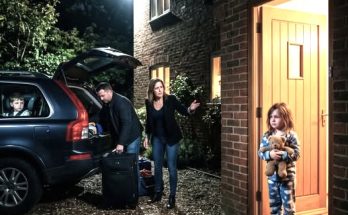
The photograph from my backyard appeared on Kayla’s mantel before either girl saw the printed copy.
We learned that because Kayla sent Lizzie a picture of her apartment several weeks later. The frame stood on a narrow shelf beside a plant and a stack of books. Nothing else surrounded it. No expensive family portraits, no carefully arranged country-club photographs, no evidence that she was trying to make the picture prove anything.
Lizzie enlarged the image on her phone.
“She actually framed it.”
Jennifer glanced over.
“She asked for a photograph. Usually people frame those.”
“You know what I mean.”
I did.
For years, photographs had been part of Kayla’s performance. She had used imaginary visits and invented memories to support a life that looked more connected than it was. The picture from my backyard was different because everyone in it knew exactly what the relationship was.
Imperfect.
Unfinished.
Real.
I expected that to be the last major chapter in the story.
Life rarely respects expectations.
Three months later, Jennifer received an email from a lawyer named Samuel Dorsey.
She initially assumed it was spam.
The subject line contained her father’s full name.
She called me from work.
“Grandma, did Dad know someone named Samuel Dorsey?”
The name pulled at an old memory.
“Maybe.”
“Maybe?”
“Your grandfather used a lawyer named Dorsey years ago. I don’t remember his first name.”
Jennifer forwarded the email.
Samuel explained that his father had handled several legal matters for my son before his death. While closing old storage records, Samuel had discovered a sealed property file connected to him.
The file should have been resolved years earlier.
It had not been.
Jennifer read the next line aloud over the phone.
“It says Kayla’s name is attached.”
My stomach tightened.
“Don’t answer yet.”
“I already checked the firm. It’s real.”
Of course she had.
Jennifer had inherited none of my willingness to let uncertainty sit overnight.
We arranged a meeting.
This time, Kayla knew nothing about it.
Samuel Dorsey’s office occupied the second floor of an old brick building downtown. Jennifer and Lizzie arrived together. I came separately after work.
Samuel was perhaps forty, with his father’s narrow face and careful manner.
He shook my hand.
“You’re Margaret.”
“Yes.”
“My father remembered you.”
“That makes one of us. I barely remember him.”
He smiled.
“He handled your husband’s estate.”
That explained it.
Then he placed a battered folder on the conference table.
My son’s name was handwritten across the tab.
Seeing his handwriting reproduced on old documents after so many years felt like hearing a voice from another room.
Jennifer touched the folder but did not open it.
“What is this?”
Samuel sat.
“Your father owned a small parcel of land jointly with another relative.”
I remembered immediately.
“The cabin property.”
Samuel looked relieved.
“Yes.”
The land had belonged to my husband’s brother first. Later, my husband and our son bought interests in it. It was little more than wooded acreage with an aging cabin near a lake several hours away.
After my son died, I assumed his interest had been settled.
Apparently, I was wrong.
Samuel explained that ownership had become complicated after the other relative died overseas. The parcel remained tied up in probate, tax questions and conflicting records.
Years passed.
Eventually, the county rezoned nearby land.
Developers arrived.
The nearly worthless acreage became valuable.
“How valuable?” Lizzie asked.
Samuel gave us a number.
Nobody spoke.
It was not Graham money.
But it was enough to change a life.
Jennifer stared at him.
“And Dad’s share?”
“Still exists.”
“Who inherited it?”
Samuel folded his hands.
“That’s the problem.”
My son’s old will named Kayla as his primary beneficiary.
That was unsurprising.
They had been married.
But a later handwritten amendment, properly witnessed though never incorporated into a revised formal will, directed that his interest in the cabin property should eventually pass to his children if he had any.
The twins had already been born when he signed it.
I felt my throat close.
“He knew.”
Jennifer turned toward me.
“What?”
“He knew the property might matter someday.”
I remembered a conversation with my son shortly before his death.
He had joked that the cabin was useless unless squirrels started paying rent.
Then he said he wanted the girls to have it someday because his father had taken him there as a boy.
At the time, I had barely listened.
Young parents talk about the future as if they have unlimited amounts of it.
Samuel continued.
Because the property remained unresolved when the estate closed, the amendment was never properly applied.
Then he said the sentence that brought Kayla back into the center of everything.
“Your mother has been receiving correspondence about this property for years.”
Jennifer’s expression changed.
“How many years?”
“Possibly twelve.”
Lizzie leaned forward.
“She knew Dad left something for us?”
Samuel chose his words carefully.
“She knew there was an unresolved asset connected to his estate.”
“That isn’t what I asked.”
“No.”
He met her eyes.
“I cannot prove when she understood the daughters’ provision.”
Jennifer asked, “Do you have letters?”
“Yes.”
“From her?”
“Some.”
He opened the folder.
The earliest letter was more than a decade old.
Kayla had asked whether the cabin property could be sold without reopening my son’s estate.
The answer had been no.
Another letter came several years later.
She asked whether appreciation in the land’s value changed the distribution.
Again, the attorney explained that unresolved beneficiary questions would need review.
Then came a letter written only eighteen months before Kayla returned to my house.
Jennifer read it.
Her face went completely still.
“What?”
I asked.
She slid it toward me.
Kayla had asked whether establishing renewed contact with the twins would affect her ability to negotiate a family settlement over the property.
There it was.
Another motive.
Older than Graham’s foundation scheme.
Closer to my son.
More painful.
Lizzie stood.
She walked to the far end of the conference room.
“She knew.”
Samuel said nothing.
“She knew Dad left us something, and then she came back.”
Jennifer stared at the papers.
“The country club wasn’t the beginning.”
“No,” I said.
Her eyes met mine.
“The money started before that.”
I hated agreeing.
“Yes.”
Samuel raised one hand.
“I need to be precise. The documents do not prove she returned solely because of the property.”
Jennifer gave him a cold smile.
“Lawyers really love that word.”
“What word?”
“Solely.”
He accepted the criticism.
“The distinction matters.”
“I know.”
She looked back at the letters.
“That’s why I hate it.”
Samuel explained that the property could finally be resolved.
A developer had made an offer.
The twins’ combined interest might be substantial.
But because of the old estate records, Kayla would need to sign documents disclaiming any competing interest.
Lizzie laughed from across the room.
“So we have to ask her permission to receive what Dad left us?”
“Not permission.”
“It sounds like permission.”
“It would make the process much cleaner.”
“And if she refuses?”
“Then we litigate.”
Jennifer closed the folder.
“How long?”
“Potentially years.”
We left with copies.
The drive home was silent.
That evening, the documents covered my dining table.
For once, nobody wanted coffee.
Jennifer sat with her father’s handwritten amendment in front of her.
The paper was a copy, but she handled it carefully anyway.
“He wrote our names.”
“Yes.”
Jennifer Marie.
Elizabeth Anne.
The names he and Kayla had chosen together.
Lizzie traced one line with her finger.
“He wanted us to have something.”
“He wanted you to have many things.”
“That isn’t what I mean.”
I understood.
They had almost no direct memories of their father.
Everything they knew came through photographs, stories and objects.
Now they had a decision he made specifically for them.
It mattered beyond money.
Jennifer looked toward the mantel.
The new photograph of all four of us stood beside the old country-club picture.
“Do we tell her?”
“We have to eventually.”
Lizzie’s expression hardened.
“I want to know first.”
“Know what?”
“When she found out.”
Jennifer nodded.
“Me too.”
They called Kayla the following evening.
She answered cheerfully.
The cheerfulness lasted less than a minute.
Jennifer said Samuel Dorsey’s name.
Silence.
Kayla asked, “Why were you talking to him?”
Lizzie closed her eyes.
That question answered more than Kayla intended.
Jennifer said, “You know why.”
Kayla began explaining immediately.
She claimed the property had been confusing.
She said attorneys had contradicted one another.
She insisted she never knew exactly what belonged to whom.
Jennifer let her speak.
Then she asked, “When did you learn Dad wanted his share to go to us?”
Kayla stopped.
“When?”
“I don’t remember.”
“Try.”
“Years ago.”
“How many?”
“I don’t know.”
“Before you came back?”
Silence.
Jennifer’s voice lowered.
“Before you started researching Graham’s estate?”
“Yes.”
Lizzie stood and walked away from the phone.
Jennifer continued.
“Did the property have anything to do with why you looked us up?”
Kayla began crying.
That was not an answer.
Jennifer repeated the question.
Finally Kayla said, “It was one reason.”
One reason.
Not the reason.
Not no reason.
One.
I watched Jennifer absorb it.
She had already suspected.
Hearing confirmation was different.
“What did you plan to do?”
“I thought if we repaired things, we could settle everything together.”
“Meaning?”
“The property.”
“Meaning money.”
“Yes.”
“And Graham?”
“That came later.”
Jennifer closed her eyes.
So there had been layers.
The land brought Kayla back toward the twins.
Jennifer’s career made her useful to the foundation plan.
Graham’s promise made the family photograph valuable.
One motive reinforced another until Kayla could convince herself she was rebuilding a family.
Jennifer asked, “Was any part of it actually about us?”
Kayla’s voice broke.
“Yes.”
“How are we supposed to know?”
“I don’t know.”
That answer, strangely, sounded truthful.
Jennifer looked at Lizzie.
Her sister returned to the table.
Then Lizzie asked the question neither had planned.
“If Dad’s property were worth nothing, would you have contacted us?”
Kayla did not answer quickly enough.
Lizzie nodded to herself.
“Okay.”
“That isn’t fair.”
“Neither was disappearing for twenty years.”
“I did miss you.”
“You missed the idea of us.”
“No.”
“You watched us from a car when we were seven and twelve.”
Kayla started crying harder.
“You could have gotten out.”
“I was scared.”
“But when the land became valuable, suddenly fear became manageable.”
Kayla had no response.
The call ended without shouting.
That almost made it worse.
Two days later, Samuel sent the legal documents Kayla needed to sign.
Jennifer forwarded them.
No message.
Kayla did not respond.
A week passed.
Then two.
The developer’s deadline approached.
Samuel warned that delay could cost everyone the sale.
Lizzie became convinced Kayla was using the documents as leverage.
Jennifer was less certain.
I tried not to speculate.
On the eighteenth day, a courier arrived.
Inside was the signed disclaimer.
Kayla had surrendered every possible claim.
No conditions.
No request for a percentage.
No demand for contact.
Attached was a single handwritten page.
Jennifer read it.
Then passed it to Lizzie.
Eventually, they handed it to me.
Kayla wrote that she had spent years confusing what she wanted with what she deserved.
She acknowledged that the property came from their father.
She admitted she had once imagined negotiating for part of it.
She would not do that now.
At the bottom she wrote:
“What he left for you should reach you without passing through me.”
Jennifer sat silently.
Lizzie folded the letter.
“Does signing this make her good now?”
“No,” I said.
“Does it matter?”
“Yes.”
Both looked at me.
“Those can both be true.”
The sale closed six weeks later.
The money went into separate accounts for Jennifer and Lizzie.
Neither spent much of it.
Jennifer paid off student loans.
Lizzie put most of hers into savings.
Then they made one decision together.
They bought the small remaining section of lakefront acreage that the developer did not want.
It included the old cabin.
The building was barely standing.
The roof leaked.
The porch leaned.
The plumbing belonged in a museum.
I loved it immediately.
We drove there in early autumn.
Jennifer unlocked the door.
Dust floated in the sunlight.
Lizzie found carved initials in an old wooden beam.
Her father’s.
She touched them.
For a long time, nobody spoke.
Then Jennifer found something beneath a loose floorboard near the fireplace.
A rusted metal box.
Inside were fishing hooks, old photographs, a pocketknife and several folded pages protected inside a plastic bag.
One page was addressed in my son’s handwriting.
Not to Kayla.
Not to me.
To his daughters.
Jennifer sat on the dusty floor.
Lizzie lowered herself beside her.
Neither opened it.
Not yet.
They simply stared at the words on the front.
For Jennifer and Elizabeth, when you’re old enough.
Click Here to continue read next: PART10: Inside Their Father’s Hidden Letter, Jennifer and Lizzie Found the One Truth About Kayla That None of Us Had Ever Known
The Afternoon My Daughter-in-Law Walked Away From Two Babies and Quietly Decided Their Future Without Asking Me
Part 9 of 12