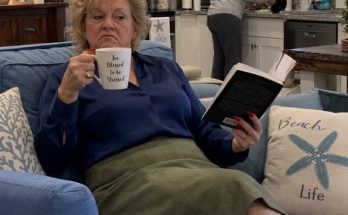
Mom's fingers stopped before touching the mug.
Then she looked at Laura.
Laura seemed uncertain what to do with her hands.
The argument had ended, but nobody quite knew what came next.
Mom pulled her hand back.
“You don't have to worry about the coffee.”
Laura looked at her.
“I should.”
Mom shook her head.
“You've had enough to drink.”
A few people laughed quietly.
Nathan covered his mouth.
Laura looked at him.
He lowered his hand.
“Sorry.”
That made Mom laugh.
The tension cracked just enough for everyone to breathe again.
My aunt began collecting plates.
Mom immediately stood.
“I'll help.”
I caught her wrist.
“No.”
She looked at me.
“I can help.”
“I know.”
I pulled out the chair beside me.
“Sit.”
She hesitated.
Then she sat.
It was such a small thing, but I realized how rarely my mother allowed herself to remain seated while other people worked.
Laura was still standing near the table.
She looked toward the kitchen.
Then toward Mom.
Then down at her own hands.
Finally she walked away.
For a moment I thought she was leaving.
Instead, she returned carrying the coffee pot and the carton of cream.
She stopped beside Mom.
“How do you take your coffee?”
Mom looked up.
“Milk, actually.”
Laura stared at the carton of cream in her hand.
Nathan made a strange sound that might have been a cough.
Mom smiled.
“It's all right.”
Laura looked at the mug.
“I've been giving you the wrong thing all morning.”
“You've been giving me coffee.”
“Not the kind you wanted.”
Mom shrugged.
“I survived.”
Laura laughed.
It was the first genuine laugh I had heard from her that weekend.
Nathan laughed too.
I did.
Even Ronald smiled.
Laura poured some coffee into a clean cup and added milk.
She handed it to Mom.
“Here.”
Mom accepted it.
“Thank you.”
Laura sat across from her.
Nobody spoke for several seconds.
Then Mom asked, “How was your book?”
Laura looked down at the book she'd abandoned earlier.
“Fine.”
“Good?”
Laura smiled.
“Fine.”
Mom nodded.
That was enough.
I sat back and watched them.
I had expected some grand transformation.
I had expected Laura to suddenly become humble, warm, and easygoing.
That didn't happen.
She was still Laura.
She still carried herself like someone accustomed to being listened to.
Mom was still Mom.
She still preferred practical things to arguments and would rather fix a broken cabinet than discuss why someone had broken it.
But something had shifted.
The next afternoon, while everyone was preparing to leave, I found Laura in the kitchen alone.
She was washing cups.
I stopped in the doorway.
She looked over.
“You're not going to tell me to sit down?”
I smiled.
“No.”
“Good.”
She rinsed another cup.
“I owe your mother another apology.”
“You already apologized.”
“I know.”
She looked at the sink.
“I don't think one apology fixes a habit.”
I didn't answer.
She dried the cup.
“When I was younger, I thought education was proof that I'd earned my place.”
I leaned against the doorway.
She continued.
“My father was always talking about achievement. Grades. Universities. Publications. Everything had to mean something.”
She looked at me.
“Your mother doesn't seem to need any of that.”
“She doesn't.”
“I don't understand how.”
I thought about it.
“Maybe because she already knows what she's worth.”
Laura looked down.
For once, she didn't immediately respond.
Then she said, “That was probably the thing I resented.”
“What?”
“That she didn't seem embarrassed.”
I didn't expect that.
Laura continued.
“When I found out she hadn't gone to college, I expected her to be defensive.”
“She wasn't.”
“No.”
She dried another cup.
“She wasn't ashamed. And I think that bothered me.”
I didn't tell her whether I understood.
I did.
But understanding wasn't the same as excusing.
“You should tell her that,” I said.
Laura nodded.
“I will.”
She put the towel down.
Then she walked outside.
Mom was sitting on the porch with a cup of coffee.
Laura approached.
I stayed inside.
I couldn't hear everything they said.
I didn't need to.
I saw Laura sit beside her.
I saw Mom hand her a lemon cookie.
Laura took it.
They talked.
At one point Mom laughed.
Laura smiled.
Nothing dramatic happened.
No tears.
No speeches.
Just two women sitting beside the ocean with coffee between them.
Later, when we packed the cars, Nathan came over.
“You okay?”
I nodded.
“I think so.”
He looked toward his mother and mine.
“I was angry.”
“I know.”
“I still am.”
I looked at him.
“About what?”
“That Mom treated your mother like she was less intelligent because she didn't go to college.”
He rubbed the back of his neck.
“And I hate knowing my grandfather helped her stay enrolled when other students didn't get that chance.”
“You didn't cause that.”
“I know.”
He looked at me.
“But I needed her to hear it.”
“She did.”
He smiled.
“Your mother handled it better than I did.”
“She usually does.”
We loaded the last bags into the trunk.
Then Nathan stopped.
“You know what I noticed?”
“What?”
“During the questions, your mother never tried to beat her.”
I smiled.
“That’s Mom.”
“She didn't care about winning.”
“No.”
“She just wanted everyone to stop acting like not knowing something makes you stupid.”
I looked toward the porch.
“That was the whole point.”
Before we left, Laura walked over.
She held something in her hand.
A small notebook.
She gave it to Mom.
“What is this?” Mom asked.
“I thought you might like it.”
Mom opened it.
The first page contained a handwritten list.
Gardening questions.
Book recommendations.
A few subjects Laura said she wanted to learn more about.
Mom read the page.
“You made a study list.”
Laura smiled.
“Apparently I still have things to learn.”
Mom closed the notebook.
“So do I.”
Laura looked relieved.
Then Mom added, “We could compare notes.”
Laura laughed.
“I'd like that.”
I turned away before they could see me smiling.
The drive home was quiet.
The ocean disappeared behind us.
The weekend hadn't gone the way I'd imagined.
There had been no perfect reconciliation.
No sudden transformation.
But there had been something more useful.
A boundary had finally been drawn.
Not by shouting.
Not by humiliating Laura.
Not by proving that my mother was secretly more knowledgeable than someone with degrees.
Nathan had forced the real question into the open.
What makes a person intelligent?
A diploma?
A title?
The ability to remember facts?
Or the willingness to admit what you don't know and keep learning?
Mom had never stopped learning.
She simply hadn't been given the same starting line.
That difference mattered.
But it didn't make her less.
A few weeks later, we were back at Mom's house.
I found her in the garden, kneeling beside the parsley.
The mint had been trimmed back.
“Looks like you won,” I said.
She glanced at me.
“It's not a competition.”
“You're right.”
She smiled.
“That's what I've been trying to tell you.”
I sat beside her.
“How are things with Laura?”
Mom considered the question.
“She calls.”
“Really?”
“Sometimes.”
“What do you talk about?”
“Plants. Books. Coffee.”
I laughed.
“Coffee?”
Mom nodded.
“She still gets it wrong.”
I stared at her.
“She does?”
“Occasionally.”
“Do you correct her?”
Mom smiled.
“Of course.”
That evening, Nathan called.
He told me Laura had asked him whether Mom might recommend a gardening book.
I told him Mom probably had twelve recommendations ready.
He laughed.
Then he grew quiet.
“I think she finally understood.”
“Maybe.”
“Do you?”
I looked through the kitchen window.
Mom was standing at the counter, reading a library book with a pencil tucked behind her ear.
“I think she understood enough.”
Nathan agreed.
And that was how the lesson stayed with us.
Not as a story about one woman knowing more than another.
Not as a contest between a degree and a life without one.
It became something simpler.
My mother had spent years believing that she needed to make herself smaller whenever people asked about the education she never had.
She stopped doing that.
Laura had spent years believing that academic success gave her permission to judge people who had taken different paths.
She began questioning that belief.
And Nathan learned that defending someone doesn't always mean speaking louder than everyone else.
Sometimes it means asking the one question nobody wants to answer.
Sometimes it means putting the coffee cup back on the table and refusing to let another person be treated as though she exists only to serve.
Months later, at our wedding, Laura gave a short speech.
She didn't mention degrees.
She didn't mention universities.
She talked about family.
She thanked Mom for welcoming her.
Then she paused.
“I've learned something from Rose's mother,” she said.
Mom looked surprised.
Laura smiled.
“Being educated and being wise aren't the same thing.”
The room was quiet.
Then Mom raised her glass.
“To learning.”
Everyone lifted theirs.
Laura lifted hers too.
And when the toast ended, she turned to Mom.
“Milk?”
Mom smiled.
“Please.”
Laura poured it correctly.
This time, nobody laughed.
Nobody needed to.
Click here to continue reading: PART 5: The Apology Changed the Wedding Plans, but Laura’s First Private Conversation With Mom Revealed a Problem Neither Woman Had Expected
My Mother Had Given Up College for Her Family, But One Dinner Revealed Exactly What My Future Mother-in-Law Thought That Meant
Part 4 of 20