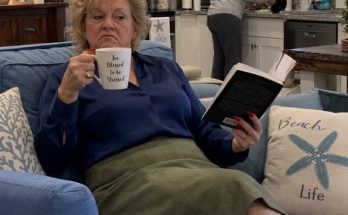
The invitation arrived three months after graduation.
Mom found it tucked between two ordinary letters on a Wednesday afternoon.
At first she assumed it was another request for information about the community class. Then she saw the university letterhead and stopped.
She called me.
“Rose?”
Her voice had that careful quality it always had when she was trying not to sound nervous.
“What happened?”
“Nothing.”
“That means something happened.”
She laughed.
“Come over.”
I did.
When I arrived, Mom was sitting at the dining table with the letter open in front of her. Her reading glasses were low on her nose, and she had the expression of someone who had read the same paragraph several times without understanding why it was addressed to her.
I picked it up.
A university in another state was hosting a national conference on adult education and lifelong learning. The organizers had read Mom's published research and wanted her to speak on a panel.
Mom stared at me.
“They want me to give a talk.”
“I can see that.”
“To academics.”
“Yes.”
“About education.”
“Yes.”
She folded her hands.
“That seems backwards.”
I smiled.
“Why?”
“Because they know more about education than I do.”
I sat across from her.
“Do they know your experience?”
“No.”
“Then maybe that's why they asked.”
She looked back at the invitation.
“I don't know if I belong there.”
The sentence reminded me of the woman she had been before Laura's insult.
For years, Mom had mistaken unfamiliar rooms for rooms she had no right to enter.
But there was a difference now.
She had evidence.
She had a degree.
She had research.
She had taught.
Still, the old feeling had not disappeared completely.
It had simply lost its authority.
Laura came over that evening.
Mom showed her the invitation.
Laura read it carefully.
Then she placed it on the table.
“You should go.”
Mom looked at her.
“That was quick.”
“I've spent years being the person who tells other people they belong in rooms.”
She smiled faintly.
“I should probably practice what I teach.”
Mom shook her head.
“You're going to make me give a speech.”
“No.”
Laura pointed at the letter.
“They already did.”
Preparing for the conference became a family project despite Mom's protests.
Nathan helped her test the presentation slides.
I listened to her practice.
Laura challenged her arguments.
Ronald, surprisingly, stayed out of it until Mom asked him to review one section.
He read it at the kitchen table.
“This is good.”
Mom looked suspicious.
“That's all?”
Ronald smiled.
“What do you want me to say?”
“You're a professor.”
“And you're the researcher.”
That answer pleased her more than a longer compliment would have.
The conference was six weeks away.
Mom decided to speak about adults who had left education because life had demanded something else from them.
She refused to frame them as failures.
She refused to romanticize sacrifice, too.
That mattered.
She did not want to say that giving up school was always noble.
Sometimes it was necessary.
Sometimes it was painful.
Sometimes it was imposed by circumstances.
Sometimes it was a decision someone later regretted.
And sometimes people simply changed their minds.
There was no single moral attached to any of it.
One night, while she was revising the presentation, Mom stopped typing.
“What if someone asks whether I regret leaving school?”
I answered honestly.
“You can tell them the truth.”
“I have several truths.”
“Then choose the one that matters.”
She leaned back.
“I regret that I didn't have more choices.”
I waited.
“But I don't regret taking care of them.”
Her younger sister and brother were rarely mentioned by name now. They were both adults with families of their own. Mom had helped them when they were children, then continued helping long after she was no longer obligated to.
She had spent years believing that if she admitted any regret, she would somehow dishonor them.
Now she understood that two feelings could exist together.
She could wish life had been different.
She could still love the life she had lived.
The conference arrived in late autumn.
Mom wore a dark blue jacket and the simple watch she had received for graduation.
Laura traveled with her.
Nathan and I followed the next day.
The university was larger than Mom's campus.
Its central hall was lined with photographs of scholars, founders, presidents, and donors.
Mom stopped beneath one display.
“So many portraits.”
Laura glanced at her.
“Feeling intimidated?”
“No.”
Mom looked at the wall.
“I'm wondering how many of them ever changed their minds.”
Laura smiled.
“Probably fewer than they should have.”
Mom's panel was scheduled for the afternoon.
Before it began, she stood behind the curtain with her notes in one hand.
Then she folded the pages in half.
“I don't need these.”
Laura looked at her.
“You sure?”
Mom nodded.
“I know what happened.”
The moderator introduced her as a researcher, educator, and adult learner.
Mom walked to the microphone.
For the first few seconds, she said nothing.
Then she looked at the audience.
“I want to begin with something I used to be embarrassed to say.”
The room became still.
“I left school when I was nineteen.”
She explained why.
She talked about losing her parents, taking care of her younger siblings, working long hours, and later building a family of her own.
She did not describe herself as heroic.
She described herself as busy.
The audience laughed gently.
Then she told them about the years when she thought the absence of a degree meant the absence of intellectual life.
“I was wrong,” she said.
“But I was also wrong to believe the opposite—that because I had learned outside school, I didn't need school.”
That sentence made Laura smile.
Mom continued.
“Both ideas are too simple.”
She spoke about practical knowledge, formal knowledge, curiosity, evidence, humility, and the danger of confusing credentials with character.
Then she told them about returning to university.
“I was older than most students in my classes. I had spent decades believing that being late meant being lost.”
She paused.
“It doesn't.”
The applause came slowly.
Then it grew.
During the question period, a professor asked whether Mom believed everyone should return to school if they had left early.
Mom shook her head.
“No.”
The professor looked surprised.
Mom smiled.
“Education is not a punishment for having made a different choice.”
Several people laughed.
Then she became serious.
“If someone wants to study, I hope they can find a way. If they don't, that doesn't make their life empty. The question isn't whether everyone follows the same road. The question is whether people have enough freedom to choose their road honestly.”
Afterward, people surrounded her.
Some wanted to discuss research.
Some wanted to tell their own stories.
One woman waited until nearly everyone else had left.
She looked about Mom's age.
“My daughter thinks I'm too old to start.”
Mom smiled.
“How old are you?”
“Seventy-one.”
Mom nodded.
“Then you have experience being told what you are too old for.”
The woman laughed.
“What should I do?”
Mom did not answer immediately.
She pointed toward the conference program.
“Find one class that interests you.”
“And then?”
“Take it.”
The woman smiled.
“That simple?”
“No.”
Mom's eyes softened.
“That worthwhile.”
That evening, the four of us ate in a quiet restaurant near the university.
Ronald raised his glass.
“To Mom.”
Mom shook her head.
“To learning.”
Laura lifted her glass.
“To changing your mind.”
Nathan added, “To coffee.”
Everyone laughed.
The next morning, before they left, Mom received another message.
This one was from the university hosting the conference.
They wanted to discuss a longer-term collaboration.
Mom read it twice.
She did not immediately smile.
Instead, she looked out the hotel window.
“I thought graduating was the end.”
Laura stood beside her.
“Maybe that's the problem.”
Mom turned.
“What problem?”
“We keep thinking every achievement is a finish line.”
Mom considered that.
Then she folded the letter.
“Maybe it's just another door.”
Click here to continue reading: PART 15: A New Program Needed Someone Who Understood Both Classrooms and Real Life, but Mom Refused to Accept the Role Until Laura Asked Her One Difficult Question
My Mother Had Given Up College for Her Family, But One Dinner Revealed Exactly What My Future Mother-in-Law Thought That Meant
Part 14 of 20