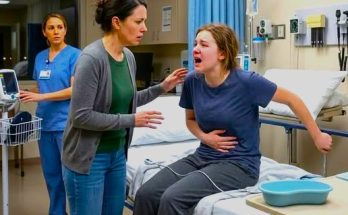
The emergency physician returned just after midnight.
He carried a tablet and wore the tired expression of someone who had spent too many hours delivering information that changed families.
“Her initial bloodwork isn't showing anything immediately dangerous,” he said.
I released a breath I hadn't realized I was holding.
“But,” he continued, “because of the duration and the neurological symptoms you've described, we want additional imaging.”
My daughter nodded.
Her father stood at the foot of the bed.
“What kind of imaging?” he asked.
The doctor explained.
I listened carefully, asking questions whenever something wasn't clear.
My daughter remained unusually quiet.
When the doctor left, I looked at her.
“Tomorrow's appointment is with a neurologist?”
She nodded.
Her father answered for her.
“Yes.”
“How did you arrange that so quickly?”
He looked at me.
“I didn't.”
I frowned.
“What do you mean?”
“The appointment was arranged months ago.”
I stared at him.
“Months?”
He nodded.
Our daughter shifted beneath the blanket.
“I forgot about it.”
“No,” I said. “You didn't forget.”
She looked at me.
“You've known something was wrong for months.”
She didn't deny it.
That silence was answer enough.
I sat down.
“Start at the beginning.”
She closed her eyes.
“It started after the trip.”
“What trip?”
“The one with Dad.”
I turned toward him.
“What trip?”
He didn't answer immediately.
Then he said, “The summer before last.”
I remembered it.
Our daughter had spent several days away with him. At the time, I had thought nothing of it. She had returned tired and quiet, but when I asked if she had enjoyed herself, she said yes.
Now I wondered what I had missed.
“What happened on that trip?”
“Nothing,” her father said.
Our daughter looked at him.
“That's not true.”
He went still.
She swallowed.
“I fell.”
My chair scraped backward.
“You fell?”
“On the stairs.”
“Why didn't you tell me?”
“I wasn't badly hurt.”
Her father interrupted.
“She hit her back.”
“And you took her to a doctor?”
“No.”
I stared at him.
“Why not?”
“She said she was fine.”
Our daughter whispered, “I wasn't fine.”
Her father closed his eyes.
The guilt on his face was unmistakable.
I stood.
“You knew.”
“I knew she fell.”
“You knew she was hurt.”
“Yes.”
“You knew the pain started afterward.”
He didn't respond.
I turned to my daughter.
“Why did you keep this from me?”
She looked ashamed.
“Because Dad said it was better not to.”
I looked at him.
“Why?”
He finally spoke.
“Because I was afraid.”
“Afraid of what?”
He shook his head.
“I didn't understand what I was seeing.”
“What were you seeing?”
He stared at the floor.
“Something that reminded me of someone.”
The words made no sense.
“Who?”
He didn't answer.
Our daughter looked frightened.
“Dad.”
He looked at her.
“You don't have to say it.”
I stepped between them.
“Say what?”
He was silent.
I felt anger rising again.
“Enough.”
He looked at me.
“You don't get to decide what I can handle anymore.”
He took a breath.
“Her grandmother had the same symptoms.”
I froze.
My daughter's grandmother.
His mother.
The woman who had died years earlier.
I remembered very little about the final months of her life because I had not been close to her. She had always been distant with me, polite but guarded.
“What symptoms?”
He began counting them quietly.
“Back pain. Weakness. Numbness. Then problems with balance.”
My daughter stared at him.
“And you think that's what I have?”
“No.”
“Then why didn't you tell me?”
“Because I didn't know.”
I interrupted.
“You said you knew why it hurt.”
He looked at me.
“I said I knew where it might come from.”
“That's not the same thing.”
“No.”
His voice dropped.
“It's not.”
The doctor returned to take our daughter for imaging.
I walked beside the bed until they reached the doors.
She caught my hand.
“Mom.”
“Yes?”
“Don't be angry with Dad yet.”
I looked at her.
“Why?”
“Because he was trying to protect me.”
“From what?”
She shook her head.
“I don't know.”
The doors closed.
Her father and I were left alone.
For several minutes neither of us spoke.
Finally I said, “Tell me about your mother.”
He sat down.
“She became sick when she was about the age our daughter is now.”
“What was wrong with her?”
“They never figured it out.”
I frowned.
“Never?”
“They tried.”
“What happened?”
“She got worse.”
His hands trembled slightly.
“She had pain first. Then weakness. Doctors kept treating individual symptoms.”
“And then?”
“She stopped walking.”
The hallway seemed suddenly colder.
“When did she die?”
“Three years later.”
I looked through the glass toward the imaging area.
“You think our daughter inherited it.”
“I don't know.”
“Then why did you make that appointment?”
“Because I found her old medical records.”
“When?”
“A few months ago.”
“Why?”
He hesitated.
“Because our daughter asked me why her back kept hurting.”
That explained why he had become so secretive.
It didn't excuse it.
“What did the records say?”
“Not much.”
“You found something.”
He looked at me.
“There was one name.”
“Whose?”
He reached into his jacket and pulled out a folded piece of paper.
He handed it to me.
It was old, yellowed around the edges.
At the bottom was a doctor's name.
I recognized it.
Not from medicine.
From somewhere else.
I looked at my ex-husband.
“Why do I know this name?”
His expression changed.
“Because that doctor treated someone else in our family.”
My stomach tightened.
“Who?”
He didn't answer.
The imaging doors opened.
A nurse hurried toward us.
“Are you the patient's parents?”
We both stood.
“Yes.”
“She wants to speak with you.”
I followed the nurse.
My daughter was sitting up, her face pale.
She held a small plastic bag in her hand.
Inside was a folded document.
She looked at me.
“I found this in Dad's car.”
My ex-husband went white.
Click here to continue reading: PART 4: The Paper Hidden in His Car Contained One Familiar Name, and Suddenly My Daughter’s Pain Had a History
The Words My Daughter Whispered From the Hospital Bed Made Me Realize Someone Had Been Hiding the Truth
Part 3 of 12