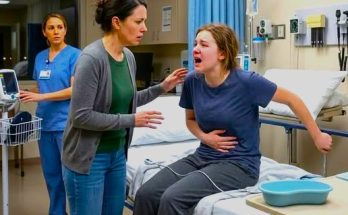
Years later, I still remembered the emergency room.
Not every detail.
Some memories had softened.
The fluorescent lights were no longer painfully bright in my mind.
The hospital corridor had become simply a corridor.
The smell of antiseptic had faded.
But I remembered the moment Emily whispered to me.
He knows why it hurts.
For a long time, I thought that sentence was the beginning of the story.
It wasn't.
It was the moment the story finally became impossible to hide.
Emily finished university with honors.
She studied psychology, just as she had said she might.
She worked with young people during her final year.
She told me she wanted to help children recognize controlling behavior before they convinced themselves it was normal.
I never asked her to choose that work.
She chose it herself.
That distinction mattered.
Her life did not become a memorial to what happened.
She built something new.
She traveled.
She made friends.
She fell in love.
She broke up.
She laughed.
She made mistakes.
She became an adult.
And through all of it, the past remained part of her history without becoming the whole of her identity.
Michael remained out of our daily lives.
The legal restrictions eventually changed as the years passed, but Emily never chose renewed contact.
She did not owe him reconciliation.
She did not owe him a final conversation.
She did not owe anyone a version of forgiveness that made the story easier for other people to accept.
His mother died several years later.
A relative sent Emily a letter.
She read it once.
Then she asked me to keep it.
It contained no dramatic confession.
No hidden explanation.
Just a few memories of the woman she had been.
Emily cried when she read them.
Not because she wanted Michael back.
Because she finally understood how many people in that family had spent their lives afraid.
She said something I have never forgotten.
“I can understand where the silence came from without carrying it forward.”
That was the clearest description of healing I had ever heard.
Not forgetting.
Not excusing.
Not pretending.
Refusing to repeat.
The old phone stayed with me.
Eventually, the battery stopped holding a charge.
The cracked screen darkened completely.
I kept it in the same drawer where I stored old photographs.
Once, Emily asked why.
I told her because it had helped prove the truth.
She shook her head.
“It did more than that.”
“What?”
“It reminded me that I knew what was happening.”
I understood.
The phone had not saved her.
She had saved herself by recording what she knew, by telling the truth, and by continuing to ask for help even after she had been taught that asking was dangerous.
I had simply been fortunate enough to finally listen.
Years after the hospital, Emily and I visited the city where she had attended her summer program.
We passed the university campus.
She pointed toward a café.
“That place had the worst coffee.”
“You drank it every day.”
“I was young.”
“You were seventeen.”
“Exactly.”
I laughed.
We walked for another block.
Then she stopped.
“Mom?”
“Yes?”
“Do you remember the hospital?”
“Yes.”
“I used to hate thinking about it.”
“Do you still?”
She shook her head.
“Not really.”
“Why?”
She looked down the street.
“Because that's where everything changed.”
I waited.
“Not because I got sick.”
She touched my arm.
“Because I finally told you.”
I swallowed.
“You shouldn't have had to be that afraid before I listened.”
“I know.”
The answer was gentle.
She had forgiven me in her own way.
Not by pretending I had been perfect.
By allowing me to become someone different.
We continued walking.
She told me about a young woman she had been helping through an internship.
“She keeps saying she's overreacting.”
“What do you tell her?”
“That pain doesn't become imaginary because someone else tells you it is.”
I looked at her.
“You remember.”
“I'll always remember.”
We stopped at a crosswalk.
Cars passed.
People hurried along the sidewalk.
Nothing about the afternoon looked important.
But I knew better.
Important moments rarely announce themselves.
Sometimes they arrive as a whisper.
Sometimes as a question you almost ignore.
Sometimes as a child standing in a hospital bed, afraid that telling the truth will destroy everyone she loves.
Emily looked at me.
“Mom?”
“Yes?”
“Thank you for believing me.”
My throat tightened.
“I should have done it sooner.”
“But you did.”
I nodded.
“Yes.”
The light changed.
We crossed.
That evening, back at the hotel, Emily called me from her room.
“Mom?”
“Yes?”
“Do you remember what I said that first night?”
I smiled.
“He knows why it hurts.”
She laughed softly.
“I was so dramatic.”
“No.”
“I was terrified.”
“Yes.”
She was quiet for a moment.
“Do you know what I meant now?”
“I think I do.”
She waited.
I said it carefully.
“You meant that he knew the pain wasn't imaginary because he knew what had happened.”
“Yes.”
“And you wanted me to know too.”
“Yes.”
I closed my eyes.
“I wish I had understood immediately.”
“So do I.”
Then she added, “But you understand now.”
I smiled.
“Yes.”
She said goodnight.
I stayed by the window for a while after the call ended.
The city lights reflected against the glass.
I thought about the woman I had been before the emergency room.
I had believed that keeping a family together meant enduring whatever threatened to break it.
I had believed that silence could protect a child.
I had believed that love could compensate for fear.
I was wrong.
Love without safety is not enough.
Protection without truth is not protection.
And silence does not preserve a family.
It preserves whatever is hurting the people inside it.
Emily had taught me that.
Not through a speech.
Not through some grand confrontation.
She had taught me by surviving long enough to tell the truth.
The central mystery had eventually been resolved.
Her pain had not come from the inherited disease Michael feared.
The old family records had revealed a history of silence and untreated suffering, but they had not predicted Emily's future.
Her immediate medical crisis came from an injury that had been ignored until infection made it dangerous.
The evidence on the phone established what had happened.
The hospital treated what her body needed.
The court established consequences.
Therapy helped both of us understand what came afterward.
But none of those things erased the first truth.
Emily had been hurting.
She had said so.
And someone had told her that her pain was not important enough to speak about.
She eventually learned that his judgment did not define reality.
Neither did mine.
The final choice belonged to her.
She chose to speak.
She chose to leave.
She chose to heal.
She chose a profession where she could help others recognize the warning signs she had once struggled to name.
She chose a life that did not revolve around the person who had hurt her.
And when she became afraid again, she learned to say so without shame.
That was the outcome I wanted most.
Not revenge.
Not a dramatic ending.
Not even an apology.
Freedom.
Years after that first night, I found the old phone in my drawer one last time.
I turned it over in my hand.
The crack across the screen was still there.
I thought about throwing it away.
Instead, I put it back.
Some things deserve to be kept.
Not because we want to live in the past.
Because remembering accurately can protect the future.
I closed the drawer.
Then I heard my phone ring.
Emily.
I answered.
“Hey.”
“Hey, Mom.”
“What are you doing?”
“Making pancakes.”
“At midnight?”
“Yes.”
“Why?”
“I felt like it.”
I laughed.
“You've always been strange.”
“You raised me.”
“That is unfortunately true.”
She laughed.
For a moment, I heard the girl from the hospital and the woman she had become at the same time.
Then she said, “Mom?”
“Yes?”
“I love you.”
“I love you too.”
We hung up.
I stood alone in the kitchen.
The house was quiet.
But this time, quiet did not mean fear.
It meant peace.
And when I thought back to that hospital room, I no longer remembered only the pain.
I remembered the moment my daughter chose truth.
I remembered the moment I finally chose to hear it.
And I understood, at last, what she had been trying to tell me.
He knew why it hurt.
But more importantly, she knew.
And once she knew that her pain deserved to be heard, no one could make her silent again.
The End
Read more original stories on Feel Every Story.
The Words My Daughter Whispered From the Hospital Bed Made Me Realize Someone Had Been Hiding the Truth
Part 12 of 12