Nearly a year passed before I stopped checking the locks three times every night.
Emily noticed before I did.
“You only checked twice,” she said one evening.
I looked at the front door.
“I did.”
She smiled.
“Progress.”
I laughed.
The sound surprised me.
There had been a time when laughter in that house always felt cautious.
Now it came without permission.
Emily was sixteen.
She complained about homework.
She argued about her curfew.
She borrowed my sweaters.
She left cereal bowls in the sink.
She had become wonderfully ordinary again.
There were still difficult days.
Healing did not erase what happened.
Sometimes she still went quiet when a man raised his voice.
Sometimes she checked the locks.
Sometimes she carried her phone from room to room even though there was no reason to.
But she was no longer living as though danger were inevitable.
That mattered.
The old phone remained in a small box.
The police had returned it after the evidence process.
The screen was still cracked.
One afternoon, Emily picked it up.
“I thought about throwing this away.”
I looked at her.
“Why didn't you?”
She turned it over.
“Because it proved I wasn't imagining things.”
I sat beside her.
“You never imagined it.”
“I know now.”
She looked at the dark screen.
“But back then, I wasn't sure.”
I understood.
Michael had spent years making uncertainty part of the household.
If Emily was upset, she was dramatic.
If I was angry, I was emotional.
If something broke, someone else had caused it.
If he shouted, there had been a reason.
He had made reality negotiable.
The recordings had stopped that.
Not because a phone was magical.
Because the truth had been preserved before he could rewrite it.
Emily opened the old note again.
IF I FORGET.
She read it silently.
Then she smiled sadly.
“I sounded so scared.”
“You were scared.”
“I was trying to make sure future me would remember.”
I touched her shoulder.
“You did.”
She looked at me.
“So did you.”
I knew what she meant.
I had finally remembered what I had spent years trying not to know.
Michael had not suddenly become abusive in the emergency room.
The hospital had simply become the place where hiding stopped working.
The warning signs had been there.
The broken objects.
The threats.
The bruises.
The fear.
The way Emily watched his face before answering a simple question.
The way I watched it too.
I had mistaken survival for normal family life.
That was the hardest truth I carried.
Not that I had been fooled.
That I had helped teach my daughter to doubt what she knew.
I could not change that.
I could only refuse to repeat it.
A month later, Emily had another medical appointment.
Just routine follow-up.
The doctor told us her recovery was progressing well.
On the way out, we passed the emergency department.
Emily slowed.
I stopped beside her.
She stared through the glass doors.
“That was where I told you.”
I nodded.
“Yes.”
She shook her head.
“No.”
I looked at her.
“That was where you finally listened.”
I swallowed.
She wasn't accusing me.
That almost made it harder.
She was simply telling me the truth.
I put my arm around her.
“I listen now.”
“I know.”
We walked toward the parking lot.
The sunlight felt strangely bright.
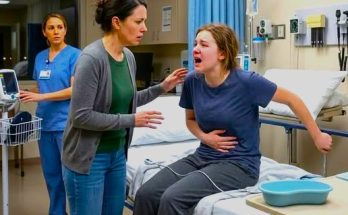
I thought about the first night.
The hospital bracelet.
The IV.
The fear in her eyes.
The phone in my hand.
The sentence that had changed everything.
He knows why it hurts.
At the time, I thought the words were about a medical mystery.
I thought her father possessed some hidden knowledge about a disease.
I thought the old records would explain the pain.
In the end, the truth was both simpler and harder.
He knew because he had caused part of it.
He knew because he had watched her suffer.
He knew because he had told her to hide it.
And he knew because he believed he could control what happened afterward.
He was wrong.
The doctors treated her injury.
The police preserved the evidence.
The court imposed consequences.
But the first real change happened when Emily finally said what had happened and I believed her.
That moment could not undo the past.
It could not erase the fear.
It could not give her back the nights she spent wondering whether anyone would believe her.
But it changed what came next.
Emily started therapy.
So did I.
We learned different things.
She learned that fear did not have to decide every choice.
I learned that peace purchased by silence was not peace.
We learned how to speak without measuring every sentence against someone else's temper.
We learned that apologies were not substitutes for changed behavior.
And we learned that forgiveness was not a requirement for healing.
Michael remained under court restrictions.
He attempted contact through relatives twice.
Both attempts were documented.
We did not respond.
His mother eventually stopped calling.
The house grew quieter.
At first, quiet frightened us.
Then we learned to enjoy it.
I could cook dinner without listening for footsteps.
Emily could close her bedroom door without asking whether she was allowed.
She could have friends over.
She could laugh loudly.
She could disagree.
She could say no.
One Saturday morning, she stood in the kitchen wearing one of my old sweaters.
“Mom?”
“Yes?”
“Can we get pancakes?”
I looked at the clock.
“It's almost noon.”
“So?”
“So pancakes are still legal.”
She grinned.
“Good.”
I watched her pull a bowl from the cabinet.
The same kitchen.
Different life.
That distinction mattered.
The place where she had been hurt no longer belonged to that memory alone.
It belonged to us again.
A few weeks later, she asked whether I regretted leaving.
I told her no.
She thought for a moment.
“Do you regret not leaving sooner?”
I did not lie.
“Yes.”
She nodded.
“So do I.”
I reached across the table.
“But we can't live there.”
“I know.”
She squeezed my hand.
“I just don't want another girl to think she has to prove she's hurting before somebody helps her.”
“Neither do I.”
She looked toward the old phone sitting on the shelf.
“Maybe that's why I kept it.”
“Maybe.”
She smiled.
Then she picked it up.
The cracked screen reflected her face.
“Dad always said nobody would believe me.”
She paused.
“He was wrong.”
I waited.
She looked directly at me.
“I believed me.”
I smiled.
“Yes.”
She placed the phone back on the shelf.
Then she went outside to meet her friends.
I watched her through the window until she disappeared down the driveway.
For years, I had thought protecting a family meant keeping its problems hidden.
Now I knew better.
Sometimes protecting your child means naming what happened.
Sometimes it means opening the door you were afraid to open.
Sometimes it means letting evidence speak when someone has spent years making truth sound unreasonable.
And sometimes the sentence that terrifies you most is the sentence that finally gives you the courage to listen.
He knows why it hurts.
My daughter had been trying to tell me.
This time, I heard her.
Click here to continue reading: PART 9: The Life We Built After the Hospital Was Quiet, Until One Unexpected Message Forced My Daughter to Revisit Everything
The Words My Daughter Whispered From the Hospital Bed Made Me Realize Someone Had Been Hiding the Truth
Part 8 of 12