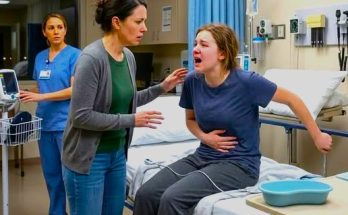
Emily slept through most of the first day after surgery.
I barely left her room.
Every time she moved, I woke.
Every time the monitor changed its rhythm, I looked up.
The hospital became its own strange world of plastic cups, rolling carts, dimmed lights, and nurses who spoke softly even when they were moving quickly.
On the second day, Emily woke hungry.
It was the first ordinary thing she had asked for.
“Can I have toast?”
I nearly cried.
“You can have whatever the doctor allows.”
She smiled faintly.
“That means yes?”
“That means I'll find out.”
She closed her eyes again.
For a few minutes, everything felt almost normal.
Then she asked, “Did Dad call?”
“No.”
“Did Grandma?”
I hesitated.
“Not yet.”
Emily looked toward the window.
“I don't want to talk to anyone.”
“You don't have to.”
She nodded.
Later that afternoon, Michael's mother called my phone.
I almost ignored it.
Instead, I answered.
Her voice was already crying.
“Please don't do this to him.”
I stared at Emily sleeping.
“Do what?”
“You know what I mean.”
“He assaulted our daughter.”
“He lost his temper.”
“He hit her.”
“He didn't mean for her to end up in surgery.”
I closed my eyes.
The sentence was so absurd that I could not answer immediately.
Finally I said, “She was in severe pain and he told her not to tell me.”
“He was frightened.”
“So was she.”
“He is still her father.”
I looked at Emily.
“No. Right now, he is the man who hurt her.”
Silence.
Then she said, “You're destroying the family.”
I felt something inside me settle.
“No.”
My voice was quiet.
“He did that.”
I ended the call.
Emily opened her eyes.
“Who was it?”
“Your grandmother.”
“What did she want?”
“For me to protect your father.”
Emily stared at me.
“Why?”
“I don't know.”
She turned toward the window.
“People always protect him.”
I took her hand.
“Not anymore.”
She looked at me.
I meant it.
The legal process began almost immediately.
A protective order was filed.
Michael was prohibited from contacting Emily directly.
The phone records were examined.
The recordings were copied.
Messages were recovered.
One of them made me stop breathing.
It was a message Michael had sent to someone before we reached the hospital.
Emily better keep her mouth shut about Saturday.
Another was sent to a friend.
Sarah is stupid enough to believe she's sick from school stress.
I read it twice.
Then I put the phone down.
He had not been confused.
He had not misunderstood.
He knew she was hurting.
He had simply wanted me to believe another explanation.
I told the investigator.
He photographed the messages.
The evidence continued accumulating.
There were recordings from six weeks earlier.
One from three months earlier.
A photograph Emily had taken of bruising on her wrist.
A text to a friend saying she was afraid to go home.
I had never seen any of them.
She had kept them hidden.
Not because she wanted revenge.
Because she had learned that memory could be challenged.
Evidence could not.
That realization followed me home when Emily was finally discharged.
She was still weak.
The house looked exactly as it had before.
That was the strangest part.
The same dishes.
The same couch.
The same framed photographs.
The same kitchen cabinet where she had fallen.
Nothing in the room announced that our family had changed.
But it had.
Emily refused to sleep in her room the first night.
She asked if she could sleep near me.
“Of course.”
She stood in the hallway holding a pillow.
Then she asked, “Can we lock the door?”
“Yes.”
“Twice?”
“Yes.”
I locked it.
Then checked it again.
She watched.
“Thank you.”
I almost told her she didn't need to thank me.
Instead I said, “You never need permission to feel safe here.”
She nodded.
A few nights later, I found her sitting on the kitchen floor at two in the morning.
The room was dark except for the light above the stove.
She was staring at the cabinet.
I sat beside her.
For a while, neither of us spoke.
Then she asked, “Are you mad that I recorded him?”
“No.”
“He said recording family was betrayal.”
I shook my head.
“Protecting yourself isn't betrayal.”
She looked at me.
“Why didn't you leave before?”
The question was quiet.
It was also the hardest one she had ever asked me.
I could have explained money.
Fear.
Years of manipulation.
The difficulty of starting over.
The fact that I had believed things would improve.
All of those were true.
None was the answer she needed.
“I was scared,” I said.
“Of him?”
“Yes.”
“Then why did you keep telling me everything was okay?”
I looked at the floor.
“Because I thought if I kept him calm, things wouldn't get worse.”
She nodded slowly.
“But they did.”
“Yes.”
I did not defend myself.
I did not ask her to understand.
“I was wrong,” I said. “And you paid for it.”
She started crying.
I pulled her against me.
“I should have protected you sooner.”
She cried into my shoulder.
After a while she whispered, “You're doing it now.”
I held her tighter.
“Yes.”
Months passed.
The court process moved slowly.
Michael denied intentionally injuring her.
His attorney argued that the recordings were incomplete.
They questioned the context.
They questioned the timeline.
But they could not make the hospital records disappear.
They could not erase the photographs.
They could not erase the messages.
They could not make Emily's statement vanish.
And they could not explain why Michael had told her not to seek help.
At the preliminary hearing, I saw him for the first time since the hospital.
He looked toward me.
For a second, I remembered the man I had married.
Then I remembered the kitchen.
Emily's voice.
The recordings.
The hospital bed.
I looked away.
He had spent years depending on my engagement with him.
My anger.
My fear.
My explanations.
Now I gave him none.
Emily did not attend that hearing.
She was in school.
That mattered to me.
She had a history test that week.
She complained about studying.
She argued with me about breakfast.
She left her backpack in the hallway.
Those ordinary problems felt precious.
Her life was becoming ordinary again.
Not perfect.
Not untouched.
But hers.
The legal case continued.
Michael eventually accepted a plea agreement involving the charges connected to the assault and his attempt to prevent her from receiving medical help.
There were restrictions on contact.
Counseling requirements.
Court supervision.
It was not a clean ending.
Nothing about what happened could be clean.
But there were consequences.
For the first time, the rules were not his.
The conditions were not his.
The story was not his.
Emily's recovery was slow.
Some nights she woke from nightmares.
Some days a raised male voice in a grocery store made her freeze.
She returned to volleyball eventually.
The first practice exhausted her.
She came home limping slightly and dropped onto the couch.
“How was it?”
“Terrible.”
I smiled.
“That's good.”
She frowned.
“Why?”
“Because terrible is normal.”
She laughed.
It was a small laugh.
But it was hers.
Click here to continue reading: PART 8: The Old Phone Became the Proof My Daughter Needed, While I Learned That Believing Her Was Only the Beginning
The Words My Daughter Whispered From the Hospital Bed Made Me Realize Someone Had Been Hiding the Truth
Part 7 of 12